Search across our learning center -- articles, newsletters, and more. Start typing or click a topic above.
Stay in the Loop
Get exclusive publishing strategies, industry insights, and early access to new features. No spam -- just signal.
Join 2,000+ publishers. Unsubscribe anytime.
Newsletter Digests
How Facebook Content Monetization Invites Are Being Earned Right Now
Publisher In a Box12 min read
Table of Contents
This article expands on our Publisher Insider newsletter, published by Publisher in a Box, with verified industry data.
The Facebook Content Monetization Invite Is Still the Gate
Facebook Content Monetization (CM) is the single revenue path for page publishers on Facebook in 2026. Meta consolidated its previous suite of earning programs, In-Stream Ads, Ads on Reels, and the Performance Bonus, into one unified program, and access remains invite-only. Creators who have not received an invitation can submit an interest form, but Meta has stated clearly that the form is not an application and does not guarantee an invite. That makes the question of how pages earn the invite one of the most consequential in the publisher market right now.
The good news is that the path has become more documented and repeatable than at any point since CM launched. The bad news is that the playbook requires operational discipline, upfront ad spend, and a willingness to think in portfolios rather than single pages. Here is what the market is converging on.
Publishers building Reels-first pages are reaching CM eligibility faster than legacy page operators, often within weeks of hitting platform thresholds.
New Pages Are Clearing CM Faster Than Legacy Ones
The most striking pattern in current CM approvals is who is getting in. Most pages clearing CM right now launched in 2026. They are not legacy accounts with years of history. They are purpose-built pages, started from zero, that grew quickly using Reels and a small ad budget.
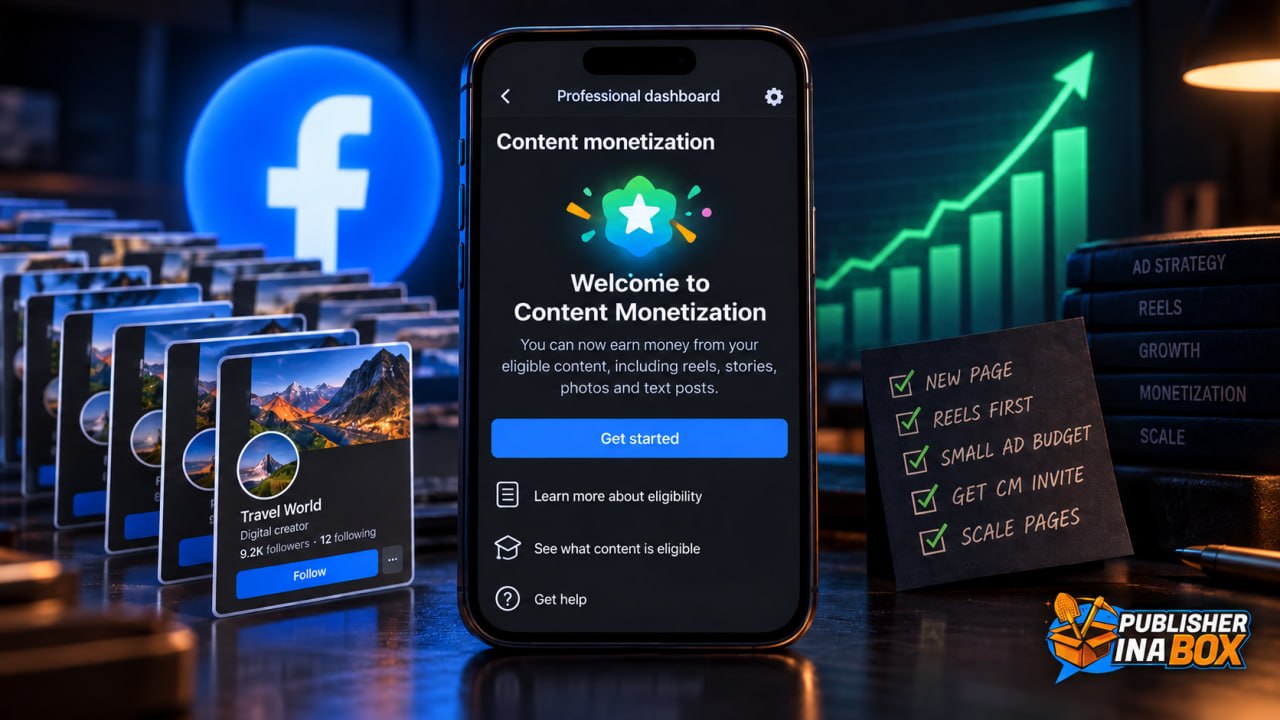
The dominant entry playbook works like this: a publisher spends roughly $300 in Facebook ads to acquire around 9,000 to 10,000 followers on a brand-new page. That seed audience creates the social proof and content-views activity that Facebook's system weighs when deciding whether to extend a CM invite. Pages started as recently as early 2026 have reported receiving invites within weeks of hitting the relevant thresholds, according to Publisher in a Box reporting.
This is a meaningful shift from the legacy assumption that a page needed years of posting history to be considered. Meta publishes no follower minimum for Facebook Content Monetization, and the program's eligibility criteria center on content performance and policy compliance rather than account age. The implication is that a well-built new page can outcompete an older page that was built around static images and never developed meaningful Reels reach.
Consistency compounds the advantage. Creators who post Reels four to six times per week experience a 41% higher follower growth rate compared to those posting fewer than twice weekly. The three-Reels-per-day cadence that operators report using sits at the high end of this range, which is likely intentional: maximum posting frequency during the page's growth window accelerates the view accumulation that triggers CM consideration.
Format length also matters within Reels. Shorter Reels around six seconds generate high view counts through looping behavior, while the 15-to-30-second range tends to produce stronger completion rates. Reels in the 15-to-30-second range show 45% higher completion rates than longer videos, and completion is one of the algorithm's primary ranking signals. Publishers running for view count thresholds may favor shorter loops; publishers optimizing for long-term distribution health typically target the 15-to-30-second window.
Key Reels performance advantages driving the Reels-first CM playbook in 2026.
The Operational Mechanics of a New Page Build
The steps operators follow when launching a new page have become standardized enough to function as a repeatable checklist. Based on Publisher in a Box reporting from active operators, the sequence looks like this:
Set up the page completely before posting. Add a profile photo, cover image, and a populated About section. Let the page sit for 24 hours. Spend a few minutes scrolling and interacting with the feed after creation to establish normal account behavior, then leave it untouched until the posting schedule begins.
Post three Reels per day with text descriptions and three topic tags. After one to three weeks of consistent posting at this cadence, pages begin getting picked up by Facebook's suggested-pages recommendation system. Operators report pages growing organically to 30,000 or more followers once this distribution kicks in, per Publisher in a Box reporting.
Keep the scheduling window short on new pages. Scheduling content 30 or more days ahead on a brand-new page reportedly triggers quality flags. Operators limit scheduling to two to three days ahead initially, expanding to longer windows only after the page has several weeks of history.
Operators running at scale also report that AI-generated content does not appear to be a barrier to CM eligibility. Facebook's system detects and labels AI-produced content, but publishers using it report no negative impact on invite timing or monetization status, according to Publisher in a Box reporting. The critical variable is originality and consistency of voice, not production method. The platform appears indifferent to how content is made as long as it is distinctive, policy-compliant, and meeting engagement thresholds.
Portfolio Scale Is the Real Strategic Edge
What separates the operators generating meaningful income from CM versus those earning low is not the performance of any single page. It is the number of pages running simultaneously. The publishers seeing the most consistent returns are running 30 or more pages at once, all in the same niche, all targeting the same high-value geographic mix, according to Publisher in a Box reporting.
The portfolio logic is straightforward: any individual page may earn low, may grow slowly, or may hit an unexpected policy issue. Spreading across many pages means that the aggregate of pages with CM enabled produces income even when individual pages underperform. Volume compensates for variance.
This approach also addresses the question many operators face about legacy pages. If an older page has CM enabled but earns low because it was built on static image posts that never developed Reels reach, the calculus may favor starting fresh with the Reels-first method rather than continuing to invest in a page with poor distribution infrastructure. Mid-sized Facebook pages currently show the strongest sustained audience growth, which means a new page built to that size range via the seed-audience method sits in the most algorithm-favorable position.
The risk for high-volume operators is asymmetric. Since January 2026, Meta's User True Interest Survey (UTIS) model adds a survey-based interest signal to Reels ranking, asking users in-feed how well a video matches their interests on a rated scale. Repeated poor ratings from users can suppress an entire page's distribution over time, not the individual post that was flagged. For publishers running three Reels a day across 30 or more pages, even a small percentage of low-quality posts generating negative survey responses can create compounding distribution penalties across the portfolio. Monitoring content mix and engagement quality is not optional at this scale.
Google's AI Contribution Pilot: A Parallel Revenue Signal for Publishers
The picture that emerges from current market behavior is that Facebook Content Monetization is more accessible than ever for operators willing to build pages the right way from the start. The barrier is no longer obscure or arbitrary. It is a repeatable process: seed audience via ad spend, Reels at consistent volume, geo-targeted to high-CPM markets, with scheduling discipline during the early growth window. Pages are clearing CM in weeks rather than years.
The strategic question is whether to continue investing in older pages built on formats that never generated Reels reach, or to allocate resources toward new builds. The data favors new builds for operators who can manage a portfolio. For publishers who want hands-on guidance structuring that portfolio or managing page operations at scale, our consulting team and management programs are built around exactly this kind of operation.
Frequently asked questions
What is Facebook Content Monetization and how is it different from older programs? Facebook Content Monetization is Meta's unified ad revenue program that replaced In-Stream Ads, Ads on Reels, and the Performance Bonus in August 2025. Instead of joining separate programs for each content type, eligible creators now earn across Reels, long-form video, photos, and text posts through a single program approved once from the Professional Dashboard.
How long does it take to get a Facebook Content Monetization invite? There is no universal timeline. Meta does not publish a fixed follower count or view threshold that guarantees an invite. Based on Publisher in a Box reporting, publishers using a Reels-first build with a seed audience acquired through ad spend are receiving invites within weeks of hitting activity thresholds, though individual results vary based on niche, content quality, and policy standing.
Does AI-generated content hurt your chances of getting a CM invite? Based on current operator reporting compiled by Publisher in a Box, AI-generated content does not appear to negatively affect CM eligibility or invite timing. Facebook's system detects and labels AI content but does not penalize it, provided the content is original in voice, policy-compliant, and meeting engagement thresholds. The platform focuses on output quality and distribution performance rather than production method.
Why do operators geo-target pages to the US, UK, Australia, and Canada? These markets have the highest advertiser demand on Facebook, which translates to higher CPMs and higher earnings rates within CM. Facebook Content Monetization is available in these countries as part of the full program rollout. Traffic from lower-CPM markets still counts toward view thresholds but contributes less to earnings, so operators optimize their ad spend to acquire followers from the highest-value geographies.
What are Facebook's post-level quality surveys and why do they matter? Meta surfaces in-feed surveys asking users whether a post was worth their time or how well it matched their interests. These responses feed into Facebook's ranking models and influence distribution at the page level over time, not for the individual post surveyed. For high-volume publishers posting frequently across many pages, a pattern of low-quality content generating poor survey responses can suppress distribution across the entire portfolio.
See more from Publisher in a Box in your Google results
The team behind 300M+ managed followers. We help publishers scale traffic, revenue, and audience across Facebook, Google Discover, and syndication networks.