Search across our learning center -- articles, newsletters, and more. Start typing or click a topic above.
Stay in the Loop
Get exclusive publishing strategies, industry insights, and early access to new features. No spam -- just signal.
Join 2,000+ publishers. Unsubscribe anytime.
Market Analysis & News
Facebook Content Monetization Signals Every Page Owner Should Read
Publisher In a Box11 min read
Table of Contents
This article is part of our daily digest series, in-depth summaries drawn from our X account, @publisherinabox, expanded with industry data.
A $3.72 Facebook Reel RPM Is Worth Unpacking
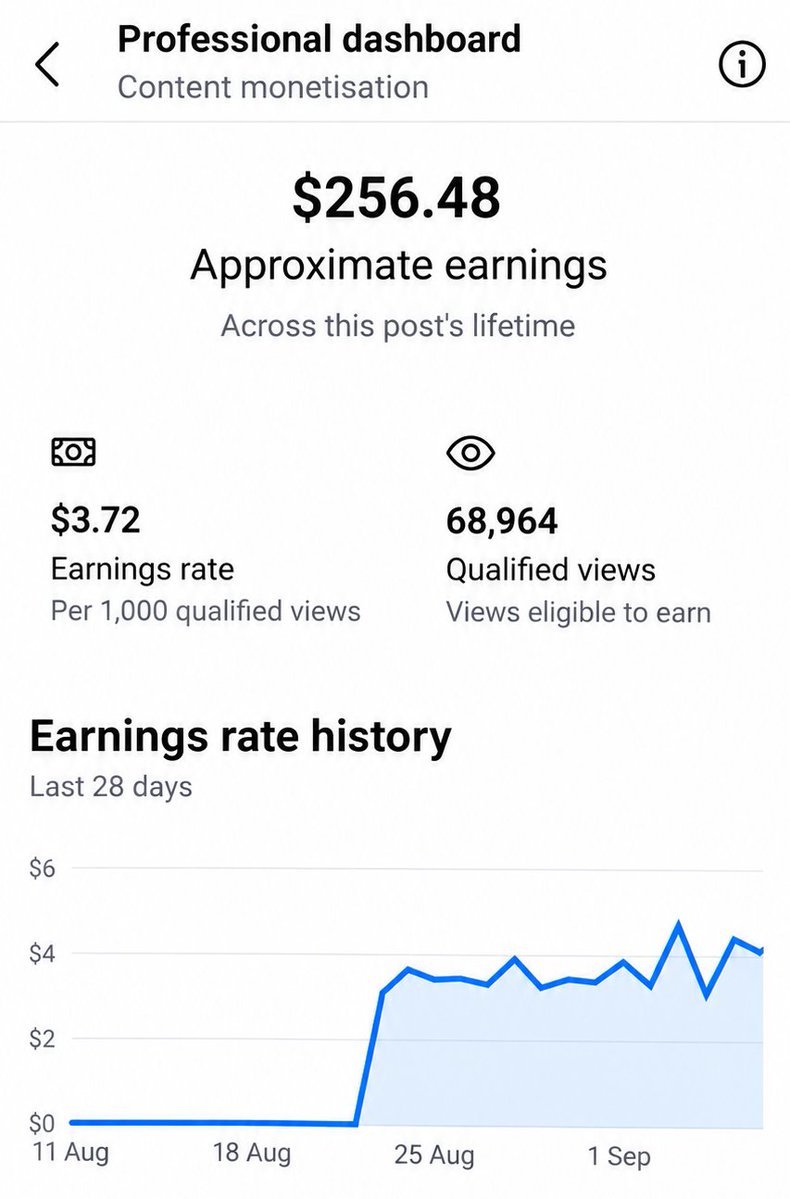
A history-niche publisher shared a screenshot inside a Facebook community that stopped a lot of page owners mid-scroll. One long-form Facebook Reel had generated 68,964 qualified views and paid out $256.48 across its lifetime, landing at a $3.72 RPM. That figure sits well above what most publishers expect from short-form video on the platform.
Real publisher data: $3.72 RPM on a single history-niche Facebook Reel, posted inside a Facebook community.
Context matters here. Under Meta's unified Content Monetization Program (CMP), which replaced Reels Play Bonus, standalone In-Stream Ads, and Performance Bonuses in late 2025, RPM outcomes now vary far more than they did under the old fragmented system. The earnings gap between a well-structured long-form Reel and a generic sub-30-second clip is not marginal. Creator earnings data compiled in 2026 shows that the spread between the lowest and highest RPM outcomes on Facebook video is a factor of 10 to 50 times per view in many cases, and the core driver is mid-roll ad placement, which requires a minimum video length to trigger.
The history niche is also doing real work in this example. Niche audiences with strong advertiser demand and a predominantly English-speaking, high-income geography command materially higher CPMs from advertisers, which flows directly into creator RPMs. Creator reports from 2026 describe the contrast sharply: a US finance creator with a five-minute video can earn $15 or more per 1,000 views, while a general entertainment creator whose audience is concentrated in lower-CPM markets may earn $0.05 per 1,000 views.
RPM ranges under Meta's unified Content Monetization Program vary dramatically by format, length, niche, and audience geography.
For page owners working with a Facebook consulting partner, this Reel is a useful benchmark to stress-test against their own content mix. If your average Reel RPM sits below $0.50, the issue is almost a combination of video length, niche, and audience geography rather than reach alone.
Facebook Insights Is Telling You What to Post. Most Owners Never Look.
The second signal from our posts today is operational and free: two underused panels inside Facebook Insights that most page owners scroll past without reading.
Facebook Insights: the Trending Topics panel and the Popular with Your Followers panel are two of the most actionable, and most ignored, tools on the platform.
The first is the "Trending topics" panel, which surfaces what is gaining traction on the platform right now, not last week. The second is the "Popular with your followers" panel, which shows the content categories and topics your specific audience is already engaging with across Facebook, independent of your own page's output. Together they form a real-time editorial brief that costs nothing to access.
This matters more now than it did two years ago. Facebook's algorithm has fully pivoted from the social graph to the interest graph, meaning content is now recommended based on behavior and engagement patterns rather than existing follower relationships. That shift gives smaller pages a genuine distribution opportunity if their content intersects with a rising topic at the right moment. A page that identifies a trending topic early and produces a 90-to-120-second Reel around it has a distribution window that a page posting evergreen content on a fixed schedule does not.
Facebook Reels between 90 and 120 seconds generate the most engagement on the platform, which is notably longer than the typical sweet spot on TikTok or Instagram. That finding reinforces the RPM data above: the optimal Facebook Reel is longer, more substantive, and better matched to its audience than the content that performs on competing short-form platforms.
For teams managing multiple pages, Facebook turnkey management workflows that build the Insights review into a daily content planning cycle tend to see more consistent reach than those that rely on intuition or fixed content calendars alone. The trending panel is real-time data; treating it as a weekly check-in gives up most of its value.
AI Search Is Redistributing Your Readers. Facebook Content Monetization Fills Part of the Gap.
The third signal from today's posts connects to a larger structural shift that every publisher with a web presence needs to track. AI-powered search tools, primarily Google's AI Overviews, are absorbing the informational queries that once sent readers to publisher websites. The consequence for referral traffic is already measurable and, by most forecasts, will worsen before it stabilizes.
According to eMarketer, publisher referral traffic decreased as much as 25% due to AI Overviews, and paid link click-through rates drop from 13% to 6% when AI Overviews are present in a search result. A separate Reuters Institute and Chartbeat analysis, cited by QuickSEO, puts the global Google search traffic decline for publishers at 33% in the year to November 2025, with US publishers hit harder at minus 38%.
This is why Facebook content monetization has moved from a supplemental revenue line to a primary one for many publishers. When a platform's own algorithm distributes your content to non-followers based on topic relevance, it partially replaces the discovery function that Google search once performed. Facebook is now the top network for product discovery, with nearly 40% of social users using it specifically to find new products, according to the Sprout Social 2026 Content Strategy Report. For publishers in informational niches, that discovery behavior extends to articles, videos, and topic-based content, not only commerce.
The advertiser side of this equation also supports the thesis. Meta posted Q2 2026 revenue of $60.8 billion, up 28% year over year, with advertising revenue up 27% and ad impressions up 14%. The average price per ad rose 12% year over year. Rising ad prices translate directly into higher CPMs for content eligible under the Content Monetization Program, which is the mechanism behind RPMs like the $3.72 figure that opened this digest. When advertiser demand on the platform increases, publisher RPMs tend to follow, though with a lag and with niche-level variation.
First, if your Reel library skews short, your RPM ceiling is structurally limited. The $3.72 case study is a history-niche long-form Reel. The format, niche, and audience geography all worked in the publisher's favor. Building even a portion of your weekly Reel output around longer, topic-specific videos in your highest-CPM content categories is worth testing against your current average RPM.
Second, the Trending Topics and Popular with Your Followers panels in Facebook Insights are editorial intelligence that most pages leave unused. Checking both panels before drafting your content calendar for the day takes fewer than five minutes and aligns your output with what the algorithm is already amplifying. That alignment is increasingly the difference between a Reel that gets distributed beyond your followers and one that does not.
Third, the AI search traffic decline is real and accelerating. Publishers who have already built Facebook content monetization into their revenue model are better positioned than those who still treat Google referral traffic as a stable baseline. The two strategies are not mutually exclusive, but the risk weighting has shifted. Social-first content distribution is no longer a hedge. For many publishers, it is the primary channel.
Frequently Asked Questions
What RPM can a Facebook Reel realistically earn in 2026? RPM varies significantly by content format, video length, niche, and audience geography. Short Reels under 60 seconds typically earn between $0.02 and $0.20 per 1,000 qualified views. Long-form Reels in high-CPM niches with primarily English-speaking audiences can reach $3 to $8 or more. Finance and premium-niche content with US audiences can exceed $15 per 1,000 views. The $3.72 RPM in today's digest reflects a history-niche long-form Reel with a favorable audience profile.
How does the Facebook Insights Trending Topics panel help with Facebook content monetization? The Trending Topics panel shows what subjects are gaining traction on Facebook in real time. Pairing it with the Popular with Your Followers panel gives page owners a two-signal editorial brief: what is trending broadly and what their specific audience is already engaging with. Producing a timely Reel or post at the intersection of those two signals increases the probability of algorithmic distribution to non-followers, which expands qualified views and, in turn, RPM earnings.
Why is AI search affecting Facebook page monetization strategy? Google AI Overviews are reducing click-through rates on search results and cutting publisher referral traffic. The Reuters Institute and Chartbeat estimate a 33% global decline in Google search referrals to publishers in the year to November 2025. As search-driven traffic shrinks, publishers are shifting toward platform-native content distribution, including Facebook, where the algorithm distributes content to non-followers based on topic relevance. That makes Facebook content monetization a more central part of the revenue mix.
What is a qualified view on Facebook and why does it matter for RPM? A qualified view is a view that generates advertising revenue. Not all views on a Facebook Reel are monetized. Bot traffic, short-duration views, and viewers in countries not supported by the Content Monetization Program do not count as qualified views. In practice, only 40 to 70 percent of total views typically qualify. A publisher comparing raw view counts across posts without looking at qualified views may be misreading which content is earning.
How do I access Facebook consulting or management help for my page? Publisher in a Box offers both a Facebook consulting service for page owners who want strategic guidance and a Facebook turnkey management service for those who want an expert team to handle content, monetization, and growth operations. Both are described on the respective service pages.
See more from Publisher in a Box in your Google results
The team behind 300M+ managed followers. We help publishers scale traffic, revenue, and audience across Facebook, Google Discover, and syndication networks.