This is Part 1 of a two-part guide to Facebook content monetization for creators in 2026. Part 1 maps the opportunity: the payout data, the creators already earning, and why Facebook is the most underpriced platform in the creator economy.
Part 2 is the execution system. Publisher In a Box manages more than 300 million followers and builds Facebook content monetization for creators and digital publishers, and this guide lays out what the platform pays and how the earnings work.
There is a check sitting on the table right now. It has your name on it. And most creators in 2026 are walking straight past it because they decided years ago that Facebook was their parents' platform and never looked back.
That decision is costing them. A lot.
Anwar Jibawi is a creator you probably know. Comedy sketches, 20 million followers, built his whole career on Vine before moving to YouTube and TikTok. For years, he treated his Facebook page the way most creators do, as a leftover, a backup, something that existed because it existed. Then the checks started getting bigger. Not a little bigger. Noticeably, undeniably bigger. He paid attention. He hired a new team member specifically to keep up with the posting pace and started publishing comedy sketches ten times a day.
“It's not unusual for it to hit six figures a month,” he told The Hollywood Reporter.
Six figures per month, from a platform most of the creator economy has quietly written off.
He is not an outlier. He is an early mover. And the gap between what the early movers are collecting and what the average creator leaves on the table is not small, it is the difference between a secondary income stream and the biggest paycheck of your career.
1. Facebook Content Monetization Is Paying Out Billions
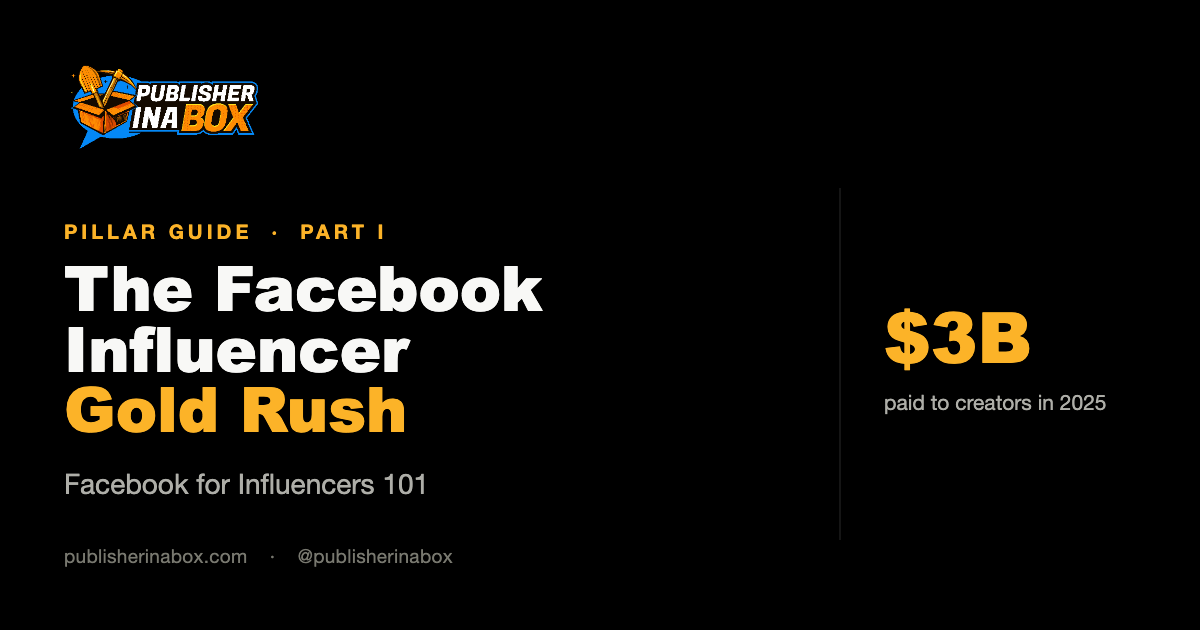
Facebook paid content creators nearly $3 billion in 2025. That is a 35% increase from the year before, and it is the highest annual creator payout the platform has ever produced. The number of creators earning more than $10,000 a year on Facebook grew by more than 30% year over year.
At the same time, most conversations about the creator economy in 2025 and 2026 have centered on TikTok's regulatory instability, YouTube's evolving Shorts program, and Instagram's ongoing competition with both. Facebook barely comes up. When it does, it gets dismissed with the same reflex: “That's where older people are. My audience isn't there.”
That reflex is expensive.
As of Q1 2026, Facebook has 3.07 billion monthly active users. It is the largest social platform on earth by a margin no other network has come close to closing. Pew Research data from late 2025 shows 38% of American adults regularly get their news and content from Facebook, not occasionally, not passively, but regularly. And influencers who are active on the platform post an average of 4.19 times per week, more than on any other network.
The audience is there. It is enormous. It has disposable income. And it is dramatically underserved by the creator class that has spent years building audiences everywhere except the biggest room in the building.
Mark Zuckerberg said it directly on The Colin and Samir Show podcast: “I just don't think that a lot of creators today think about Facebook as the primary place they can go. But that itself actually creates this huge arbitrage opportunity.”
The CEO of the platform is telling you the competition is thin and the money is there. That is about as clear a signal as the creator economy has ever produced.
2. The creators already winning here and what they're pulling
Anwar Jibawi: six figures a month from comedy sketches
The Jibawi example is the most documented because he spoke about it publicly, but the pattern he describes is not unique to comedy or to people with 20 million followers. After ignoring Facebook for years, he started noticing the checks compounding. He leaned in. He hired for it. He treats it as a primary platform now, not an afterthought. The result: a comedy sketch page earning more from Facebook alone than most creators earn across all platforms combined.
What changed was not the content. He was making the same comedy videos he had always made. What changed was where he was publishing them and how seriously he was treating the distribution.
Maggie McGaugh: $20,000 to $30,000 a month from DIY content
Maggie McGaugh runs DIY content and scam-reveal videos under the name wishbonekitchen. She has 1.9 million Facebook followers. She reliably earns $20,000 to $30,000 per month from Facebook's monetization program. “Unless I get a huge brand deal, it's my biggest source of income,” she said in an interview with The Hollywood Reporter.
Here is the detail worth paying attention to: she has had a single photo post generate thousands of dollars. Not a Reel. Not a long-form video. A photo. That points at something specific about how Facebook's monetization works that almost no other platform offers, every format earns. Reels earn. Long-form video earns. Photos earn. Text posts earn. Instagram does not pay you for a photo caption. TikTok does not pay you for a text post. YouTube does not pay you for anything outside of video. Facebook is the only platform that has opened up every content format as a revenue source, and most creators are still not running a single post there.
Erika Kullberg: the finance lawyer who proved the platform gap in both directions
Erika Kullberg is a former corporate attorney turned personal finance creator with 21 million followers across TikTok, Instagram, YouTube, and Facebook. She published her exact earnings from every platform, which is rare and the numbers are instructive in a way that cuts deeper than a simple success story.
On Facebook, she has 4.5 million followers and earned just over $20,000 across roughly two years of posting. Her own verdict, YouTube pays her far more. But here is what makes her example worth including. She posted inconsistently on Facebook, treated it as a secondary channel, and collected around $964 a month on average. The range in any given month swung from $23 to $2,696, almost entirely dependent on how much she posted and how much engagement she generated. She basically ran the experiment at half capacity and documented the result publicly.
What she proved without intending to is the platform's floor and ceiling problem in the same data set. The floor is what passive, inconsistent publishing gets you. The ceiling, which she touched on her best months, reflects what the algorithm does when the content is actually running. Her 4.5 million followers generating close to $2,700 in a single strong month is not a weak result. It is what happens when someone with the right audience and the right niche runs even a fraction of the content system the platform rewards.
For a personal finance creator treating Facebook as a primary channel, posting consistently and building the format stack properly, those numbers look completely different. Kullberg's data is the most transparent public benchmark available on what the platform pays a finance creator at scale and it shows both why most creators underestimate Facebook and exactly where the upside sits.
Amy Jackson: $27,000 a month with no famous name and no production team
Amy Jackson is not a household name anywhere outside the Facebook creator community. She does not have a viral moment, a major press profile, or a background in content creation. What she has is a niche, a consistent posting system, and a Facebook-first strategy that she built while most creators were looking the other way.
She has publicly shared that she earns around $27,000 per month from Facebook alone, and her story spread widely enough that it became one of the more referenced examples of what the platform pays creators who are not already famous. She has since walked her audience through her exact process in public, covering setup, content format, and the specific decisions she made to get approved and stay in the monetization program.
The reason her example belongs here is not the dollar figure on its own. It is what the figure proves about who Facebook pays. Jibawi has 20 million followers and a career built over years. McGaugh had an established DIY audience. Jackson built hers largely on Facebook, with everyday content and a system, without a prior platform to leverage. The platform does not require a pre-existing audience elsewhere, a recognizable face, or expensive production. It requires the right niche, the right format mix, and consistency. Jackson is the clearest proof of that specific point, and it is the point most skeptical creators need to hear before they will take the opportunity seriously.
The famous people case: what passive publishing looks like at scale
Then there is the famous-people data, which tells a different and equally important story.
Cristiano Ronaldo has 171 million followers on Facebook. He is the most-followed individual on the entire platform. His content is training clips, family moments, and brand partnerships, none of it is complex production. Mr. Bean's page, operated by Banijay Rights, sits at 140 million followers and posts primarily memes and repurposed clips from a decades-old television show. Not an influencer strategy. Not a content team running at full capacity. Just a beloved character, consistent posting, and an audience that keeps showing up.
140 million followers. More than Taylor Swift on the same platform. More than Harry Potter, more than McDonald's. Shakira has 122 million followers. Leo Messi has 116 million.
None of these are aggressive content operations like Jibawi's page. They show up, they post, and the Facebook audience is there for them every time. The lesson is not that passive publishing is the strategy. The lesson is that the audience is already on the platform, enormous, engaged, and waiting, and the creators who treat Facebook seriously are collecting revenue that most of their peers do not even know is available.
3. Why Facebook Page Monetization Is the Biggest Arbitrage in the Creator Economy
Most creators are optimizing for discovery. They chase the platforms with the youngest demographics, the fastest-growing user bases, and the most algorithm-driven virality. TikTok, Instagram Reels, YouTube Shorts. These are legitimate platforms with real audiences. Nobody is saying to leave them.
But while everyone is fighting for attention in the same crowded rooms, Facebook is sitting there with 3 billion users, a mature advertiser market, premium US-based ad rates, and a content monetization program paying out billions, and the creator competition on the platform is nowhere near what it is on TikTok or Instagram.
That gap is the arbitrage. Less creator competition on Facebook means better algorithmic distribution for active pages. It means higher visibility per post. It means faster follower growth for creators who commit to the platform at a time when most of their peers are still writing it off. The window for that advantage is open right now. It will not stay open indefinitely, the arbitrage closes when the creator class catches up.
Zuckerberg's comment was not a marketing line. It was an honest operational observation. Most creators have not yet considered Facebook a primary income channel. That gap between what the platform pays and what most creators are collecting from it is the opportunity. It is as large as the gap between what the platform is worth and how seriously the creator class is taking it.
4. The $5 vs $1,000 problem: the TikTok income gap nobody talks about
If you are building your income primarily on TikTok, there is a number worth sitting with.
Anwar Jibawi estimates he gets $5 from TikTok for every $1,000 he makes on Facebook (source). That is not a rounding error or an exaggeration for effect. It reflects a structural difference in how each platform compensates creators for the same piece of content.
TikTok's creator programs have improved since the original Creator Fund, but the RPM on TikTok content, revenue per thousand views, remains a fraction of what Facebook's Content Monetization program pays. Part of this is structural maturity: TikTok's ad market is younger, its advertiser base less developed, and the monetization infrastructure has been built over a compressed window. Facebook has been running ads against content for well over a decade. The ad rates in the US on Facebook content reflect a fully developed, premium advertiser market with decades of data behind the targeting.
Beyond the revenue gap, there is the question of stability. TikTok has navigated multiple near-bans in the United States. The regulatory environment around the platform has created genuine uncertainty for creators whose entire income depends on it. That uncertainty has not resolved, it has become a background condition every TikTok-first creator is operating under, whether they acknowledge it or not.
Building your livelihood on a single platform you do not control is always a risk. Building it on a platform that has been the subject of federal legislation aimed at forcing a sale or shutdown is a specific kind of risk that Facebook does not carry. The audience on Facebook is not going anywhere. The advertiser market on Facebook is not at regulatory risk. The payout infrastructure has been running consistently for years.
For TikTok creators, the move is not to leave TikTok. It is to stop leaving Facebook money uncollected while TikTok uncertainty runs in the background.
5. Why YouTube creators are also missing it
The argument for YouTube creators is different in shape but identical in conclusion.
YouTube remains the strongest platform for long-form video, and the ad revenue model there is well established. Nobody is arguing against YouTube. But YouTube's Shorts program has created a real tension for creators building income from short-form content. The RPM on Shorts is structurally lower than standard YouTube video. The ad revenue split on Shorts has drawn consistent criticism. And the format is competing in an increasingly crowded space where discovery advantage is shrinking.
Facebook Reels, by contrast, are the highest-priority format on the platform right now. They received 60% of Facebook's total creator payout in 2025. The algorithm surfaces Reels far beyond existing follower counts, a page with 100,000 followers can generate 500,000 to 1 million views on a strong Reel when the content connects. The RPMs on Facebook Reels are actively climbing. Pages that build strong Reels libraries now are positioned ahead of where the platform is heading, while creators who wait are playing catch-up.
For YouTube creators, there is also a format advantage that most overlook. Facebook pays across every content format. A YouTube creator who repurposes their short clip content as Facebook Reels, their video images as Facebook image posts with long captions, and their commentary as text posts is running three content formats on Facebook from a single YouTube production cycle. Each format earns separately. The production investment is already sunk.
The how-to and educational content categories are among Facebook's strongest performers in Content Monetization data. If your YouTube channel lives in cooking, finance, fitness, DIY, or any instructional niche, Facebook already has an enormous audience looking for exactly what you make. That audience is older than your YouTube audience, has more purchasing power, and has shown consistently higher direct purchase intent on the platform than equivalent audiences elsewhere.
6. Why Instagram creators are one toggle away from a second paycheck
This is the most straightforward case of all, and it is the one where the missed opportunity is most direct.
Instagram Reels and Facebook Reels share infrastructure. Instagram Reels can be simultaneously published to Facebook with a single toggle in the settings. For any Instagram creator who has not turned that toggle on, every Reel they have ever posted has been earning from one platform when it could have been earning from two. The production cost is zero. The workflow change is one setting. The revenue is sitting there uncollected.
But the more significant gap is in formats. Instagram does not pay you for photo posts. It does not pay you for captions. Facebook pays for both. Every image post an Instagram creator publishes that does not also go to Facebook is a post that earns nothing on Instagram's content program and could be earning real money on Facebook's.
The audience demographic difference matters here too. Facebook's core audience skews 25 to 55. That is older than Instagram's heaviest user concentration. That demographic has more disposable income, a longer purchase history with consumer brands, and meaningfully higher direct purchase intent on social platforms. For any creator who sells anything, a product, a program, a membership, a course, the Facebook audience converts better than the Instagram audience at equivalent engagement levels.
Pew Research data shows US adults are more likely to make a purchase directly on Facebook than on any other social media platform. That is not brand perception data. That is actual purchase behavior. For any creator with a product attached to their brand, that single fact changes the platform calculus.
7. The Creator Fast Track program: a guaranteed entry ramp with a limited window
In March 2026, Meta launched a program called Creator Fast Track. It is the clearest signal the company has sent about how seriously it is competing for the creator economy, and it is also a window that will not stay open at these terms indefinitely.
What it offers
- Creators with at least 100,000 followers on Instagram, TikTok, or YouTube earn a guaranteed $1,000 per month
- Creators with more than 1 million followers on any one of those platforms earn a guaranteed $3,000 per month
- The requirement: 15 Reels per month spread across at least 10 different days
- The content does not need to be exclusive to Facebook, repurposed content from other platforms qualifies
- Immediate access to Facebook's Content Monetization program, bypassing the standard eligibility review
- Algorithmic boost, a “Fast Track” tag that surfaces content to lookalike audiences, accelerating follower growth beyond a cold organic start
Why this matters more than it looks
The guaranteed payment is not the main value here. Three thousand dollars a month is meaningful but not transformative for a creator already earning at scale elsewhere. The main value is what comes after the program, permanent Content Monetization access and permanent algorithmic positioning built from a boosted starting point.
A creator who enters through Creator Fast Track arrives on Facebook with their Content Monetization already active, an audience growing faster than an organic cold start would produce, and a 3-month window of guaranteed income while they build. After those three months, the Content Monetization keeps running. The audience they built during the accelerated period continues to engage. The page is established with a head start that an organic build would take 6 to 12 months to replicate.
Yair Livne, Facebook's VP of Creator Product, described the intent directly: “What we're trying to do is make that a little less well-kept secret and get the word out. Because we do believe the opportunity here for creators is very, very large.”
This is not a temporary promotion. It is a deliberate effort to close the gap between what Facebook pays and how seriously the creator class takes it. The creators who use it as an entry ramp collect the guaranteed income, the algorithmic boost, and the early positioning advantage simultaneously. The ones who wait will enter a more competitive environment on standard terms.
8. The audience demographic is not a bug, it is the whole business case
The instinct to dismiss Facebook because it skews older than TikTok gets the business logic exactly backwards.
Facebook's core audience runs 25 to 55. That demographic has more disposable income than TikTok's Gen Z core. It is more likely to have a credit card, a consistent purchase history with consumer brands, and the financial capacity to act on a direct-to-consumer recommendation. Pew data shows US adults in that range are among the most active Facebook users by time spent and content engagement, they are not passive scrollers. They are readers, sharers, and buyers.
For a creator selling anything, a fitness program, a coffee brand, a supplement line, a clothing label, a course, a community membership, the Facebook audience converts better than younger audiences at the same engagement level. Most creators spend their time optimizing for the audience that watches and shares. Facebook's audience watches, shares, and buys.
This is part of why creators like Maggie McGaugh see returns that look disproportionate to what a 1.9 million follower count “should” produce. The audience composition matters as much as the size. A highly engaged 35 to 45 year old audience on Facebook is a completely different commercial proposition than a highly engaged 18 to 24 year old audience on TikTok, even at identical follower counts.
US adults are more likely to make a purchase directly on Facebook than on any other social media platform. That data point is not about brand perception or general intent. It is actual purchase behavior, tracked and measured. For any creator with a product or a shop attached to their content brand, that single fact changes everything about how Facebook should rank in their platform strategy.
The question is not whether Facebook is worth it. The question is how long you are willing to leave the money sitting there while the early movers get the compounding advantage of an established page, a trained algorithm, and an audience that already knows them.
Frequently asked questions
How much do creators earn from Facebook content monetization in 2026?
Facebook paid creators nearly $3 billion in 2025, a 35% increase year over year, and the number of creators earning more than $10,000 a year grew over 30%. Documented examples include a comedy creator at six figures a month, a DIY creator at $20,000 to $30,000 a month, and a niche creator at around $27,000 a month. Earnings depend on niche, format mix, and posting consistency.
Does Facebook pay creators for photos and text posts, or only video?
Every format earns. Reels, video, image posts, and text posts are all eligible for Facebook content monetization, the structural difference from Instagram, TikTok, and YouTube. One creator has had a single photo post earn thousands of dollars.
What is the Facebook Creator Fast Track program?
Creator Fast Track launched in March 2026. Creators with at least 100,000 followers on Instagram, TikTok, or YouTube earn a guaranteed $1,000 a month, and creators above 1 million earn $3,000 a month, for posting 15 Reels a month across at least 10 days. It grants immediate Facebook content monetization access and an algorithmic boost.
Is Facebook better than TikTok for creator earnings?
On a revenue-per-view basis Facebook pays far more. One creator reports roughly $5 from TikTok for every $1,000 earned on Facebook. Facebook Reels also received 60% of the platform’s 2025 creator payouts, and Facebook carries none of the regulatory uncertainty TikTok faces.
How does a creator start with Facebook content monetization?
It comes down to the right niche, a daily Reels cadence, and a native-format mix instead of link posts. Publisher In a Box helps creators and digital publishers set up and scale Facebook content monetization across the formats the platform rewards.
Keep going
Part 2 turns this opportunity into an execution system: page setup, the content formats that earn most, and the creator income stack. To have Publisher In a Box run Facebook content monetization on your pages, see Facebook Turnkey Management, or scale it yourself with Facebook Elite Consulting.
Facebook Influencer Strategy Guide
The execution playbook. Page setup, the content formats that earn most, the platform-by-platform playbook by where you are coming from, the Facebook content monetization income stack, revenue progression by follower stage, and the mistakes that kill pages early. Read it as a sequence, not a menu.