Search across our learning center -- articles, newsletters, and more. Start typing or click a topic above.
Stay in the Loop
Get exclusive publishing strategies, industry insights, and early access to new features. No spam -- just signal.
Join 2,000+ publishers. Unsubscribe anytime.
Facebook Monetization
Facebook Link Limits and Meta One: What Publishers Should Do Now
Publisher In a Box24 min read
Table of Contents
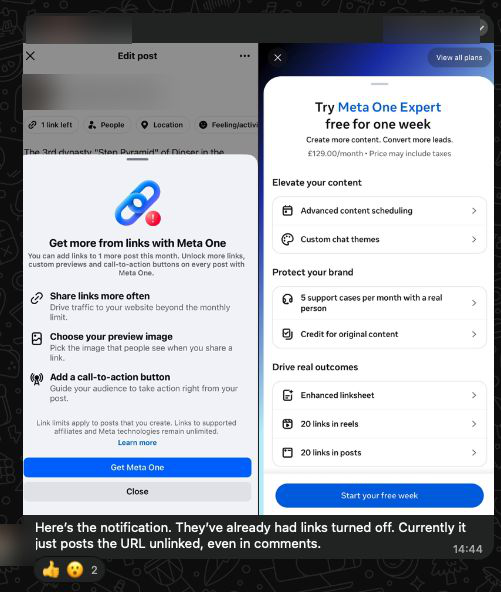
An operator in our community went to add a link to a post, the same thing she does every working day, and hit a message nobody had seen before. The composer showed one link left. The URLs she was posting, including the one in her first comment, were going out as plain text with nothing to tap. That was the first sighting of a change that is now moving across Facebook in waves, and it rewrites how referral traffic works on the platform.
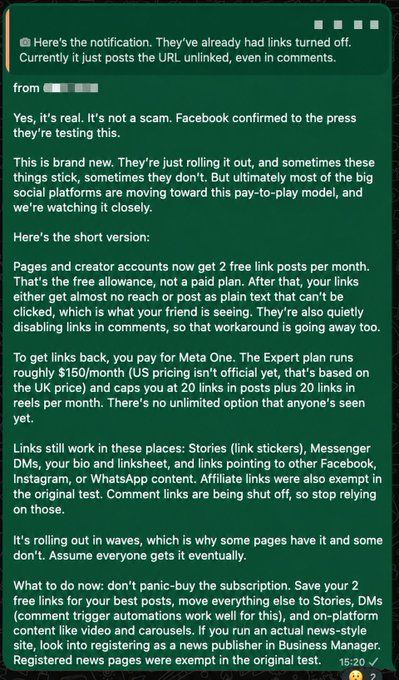
Here is what actually happened, and it is worth stating plainly before the panic sets in. Facebook has put a meter on links. Pages and professional-mode profiles in the rollout get two free link posts per calendar month. Past that allowance the post still publishes, but the URL renders as plain text with no preview card and nothing to tap, so the post reaches people and earns you nothing. The paid route is Meta One, a four-tier subscription that buys back your ability to post working links. This piece sets out what changed, what each tier costs and returns, how to work out whether a subscription pays for itself on your numbers, and why the operators reading this rollout as the end of Facebook publishing have it upside down.
Facebook composer showing a link-limit notification with one link left, next to a Meta One Expert plan screen
The moment it broke, caught inside the community before it reached the trade press. The composer already showed the cap, and the paid plan sat one tap away.
What Facebook actually changed
Three things moved at once, and each one matters to a different part of a publishing operation.
The free allowance is two link posts per month for Pages and professional-mode profiles included in the rollout. Once you spend them, the composer still lets you publish. What it will not do is make the URL work. A link past the cap goes out as plain text, which means your best story can reach a large audience and produce no clicks at all.
Comment links close in the same rollout. Dropping the URL into the first comment has been the standard workaround since Facebook started throttling outbound links, and it has propped up a lot of traffic strategies that were never written down anywhere. Those strategies stop working the moment this reaches your pages, so audit whatever you have running through the first comment before it quietly stops sending traffic.
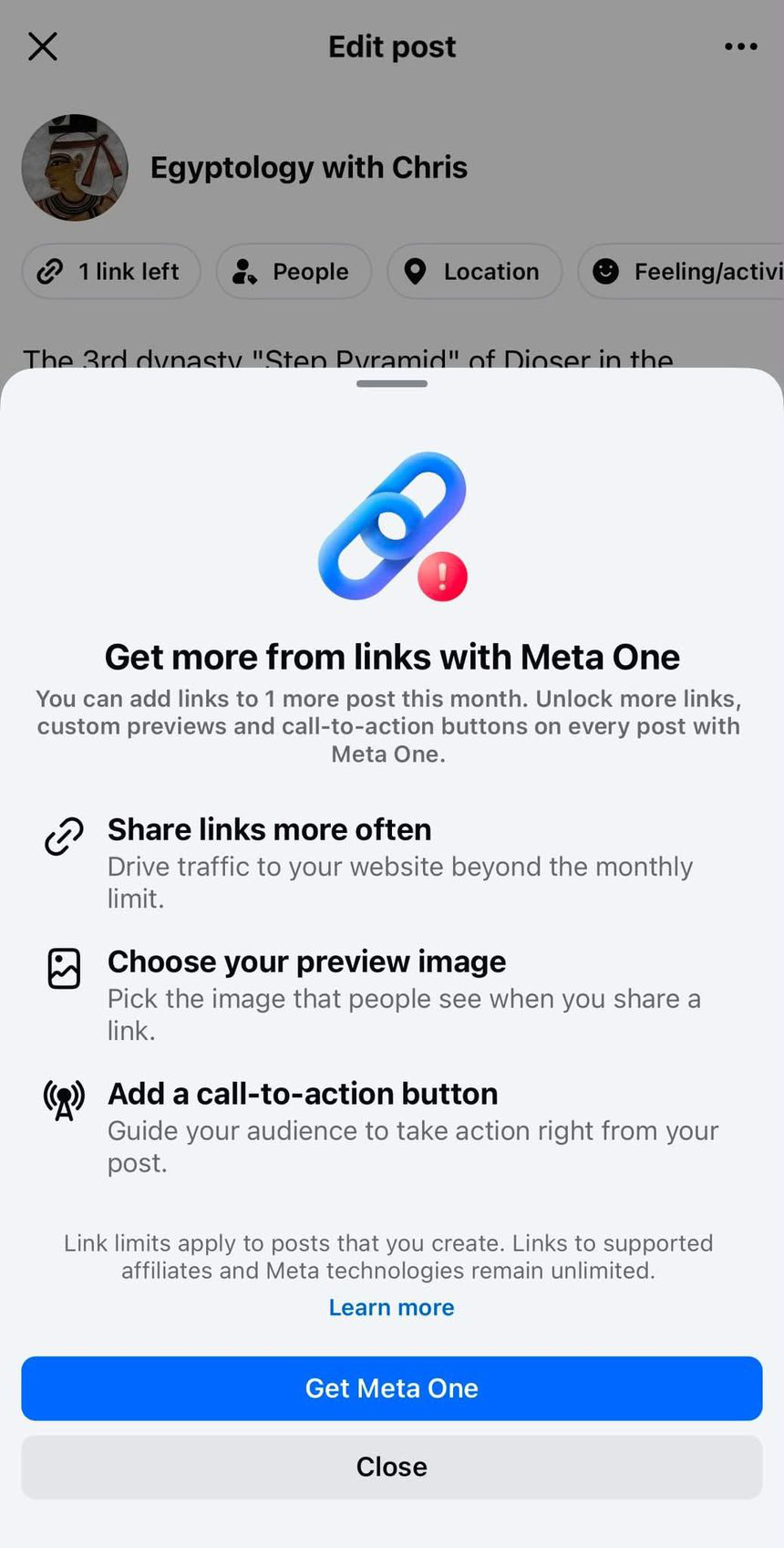
Two exemptions are written into the notification itself. Links to supported affiliates and links to Meta technologies stay unlimited. Neither is a loophole for a publisher trying to move readers to their own site, but both are worth knowing before you plan around the cap. There is a detail most people missed in the same prompt: Meta One also gives you a custom preview image, so you choose the image people see when you share a link rather than accepting whatever the scraper picks, plus a call-to-action button on the post. Both are click-through levers that have sat on publisher wish lists for years, and they belong in the value calculation alongside the raw link count.
The full link-limit notification, showing the one-link-left chip and the small print exempting supported affiliates and Meta technologies
The notification in full. Note the chip reading one link left, and the small print at the bottom, links to supported affiliates and Meta technologies remain unlimited.
How to check whether your pages are affected
Some pages have this today and some do not. There is no announcement and no email, so you check each page yourself. Two checks tell you where every page stands, and both take seconds.
The composer check comes first. Open the post composer and look at the top row of the editor, alongside People and Location. A chip showing a number next to a link icon means that page is in the rollout, and the number is what you have left this month.
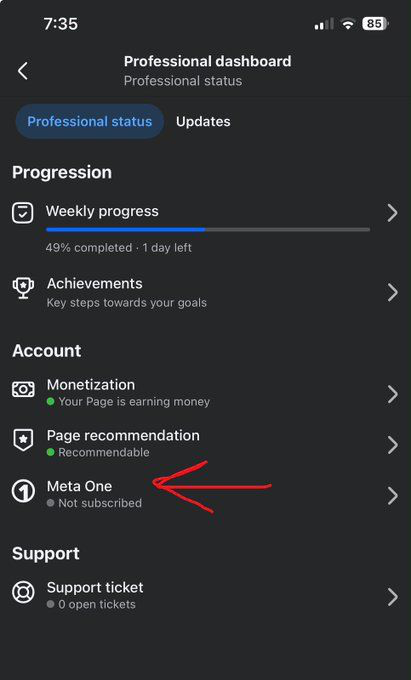
The dashboard check is the more reliable of the two. Open Professional dashboard and look under the Account section. A Meta One row sits there alongside Monetization and Page recommendation, showing your subscription status. It appears whether or not you have opened the composer, which is why it is the one to trust across a portfolio.
Facebook Professional dashboard Account section with a Meta One row between Monetization and Page recommendation
Professional dashboard, Account section. The Meta One row shows subscription status directly, which makes it the reliable check across a whole portfolio.
Run both checks across every page and profile you operate before you decide anything, because the answer changes what you do on each one. A page already in the rollout needs its two free links allocated this week. A page still outside it has a window to build the workflows that will carry it when the wave lands. No chip and no Meta One row means the page sits in a later wave, which is time you should spend rather than waste.
Every Meta One tier, priced and documented
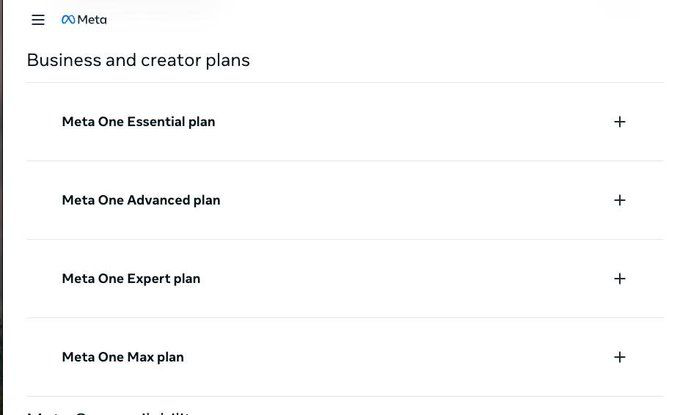
Meta's help centre lists four subscription plans: Essential, Advanced, Expert, and Max. Each has its own published plan document, and each carries separate Facebook and Instagram allowances. There is no published rate card, so the prices below come from live subscription screens rather than a Meta announcement.
Meta help centre page listing four subscription plans, Essential, Advanced, Expert and Max
Meta's own help centre. Four subscription plans, each with a published benefits document behind it.
Meta has published no rate card, and the prices below come from live subscription screens on real accounts. Read them as two separate regional price sets rather than one set converted, because they are not the same number in different currencies. On UK accounts the four tiers show as Essential at £12.49 a month, Advanced at £41.99, Expert at £129.00, and Max at £419.00. On US accounts, Advanced has been seen at $34.99 and Max at $499.00. Advanced at £41.99 is roughly $53, so it is plainly not the $34.99 US screen converted, and Max at £419.00 is roughly $535 while the US screen reads $499.00. Meta is pricing by region, not by exchange rate. Before budgeting off any of this, open your own subscription screen and read what your account is actually being offered.
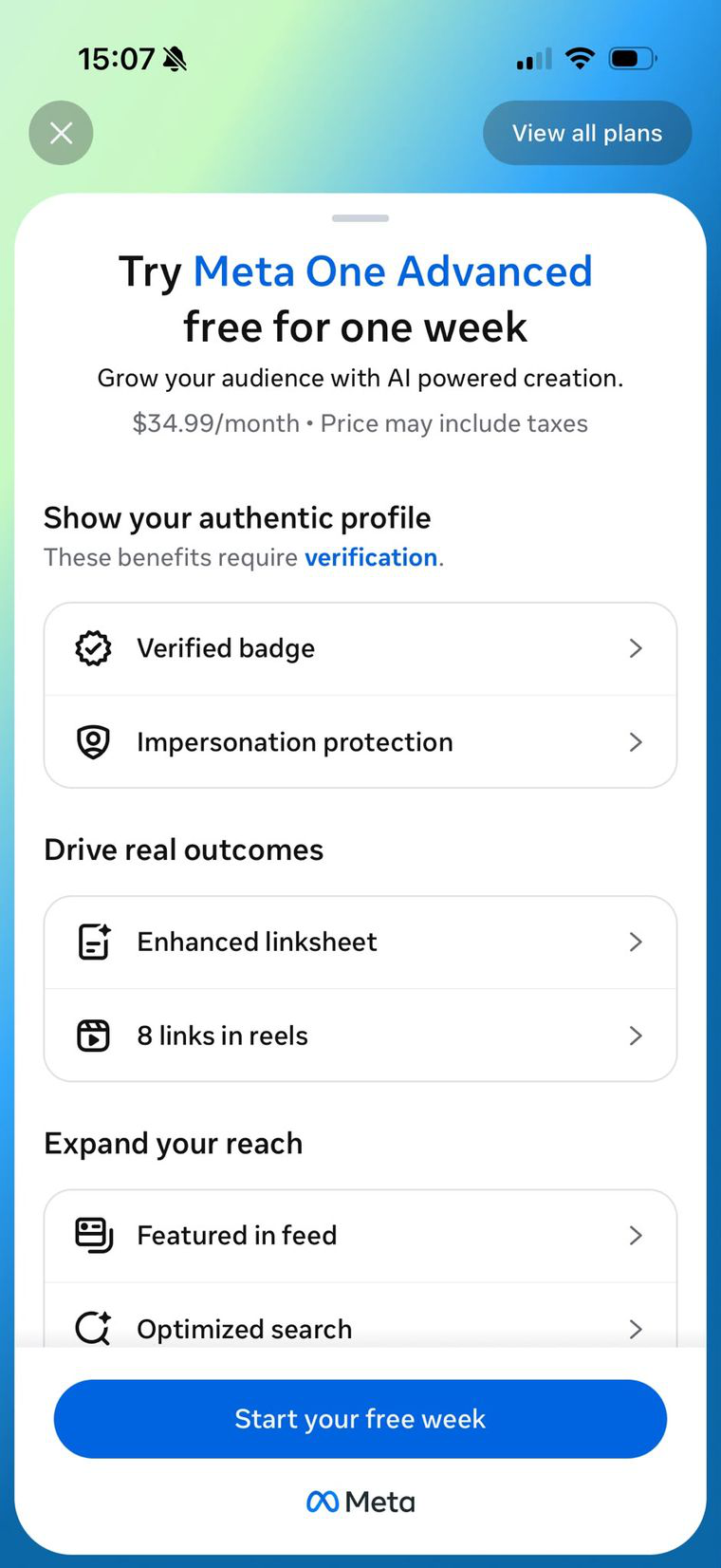
Meta One Advanced subscription screen at $34.99 a month
Advanced at $34.99 on a US account. UK accounts show £41.99. Read the feature list carefully, it advertises links in reels and the enhanced linksheet but says nothing about links in posts. That gap matters, and we come back to it.
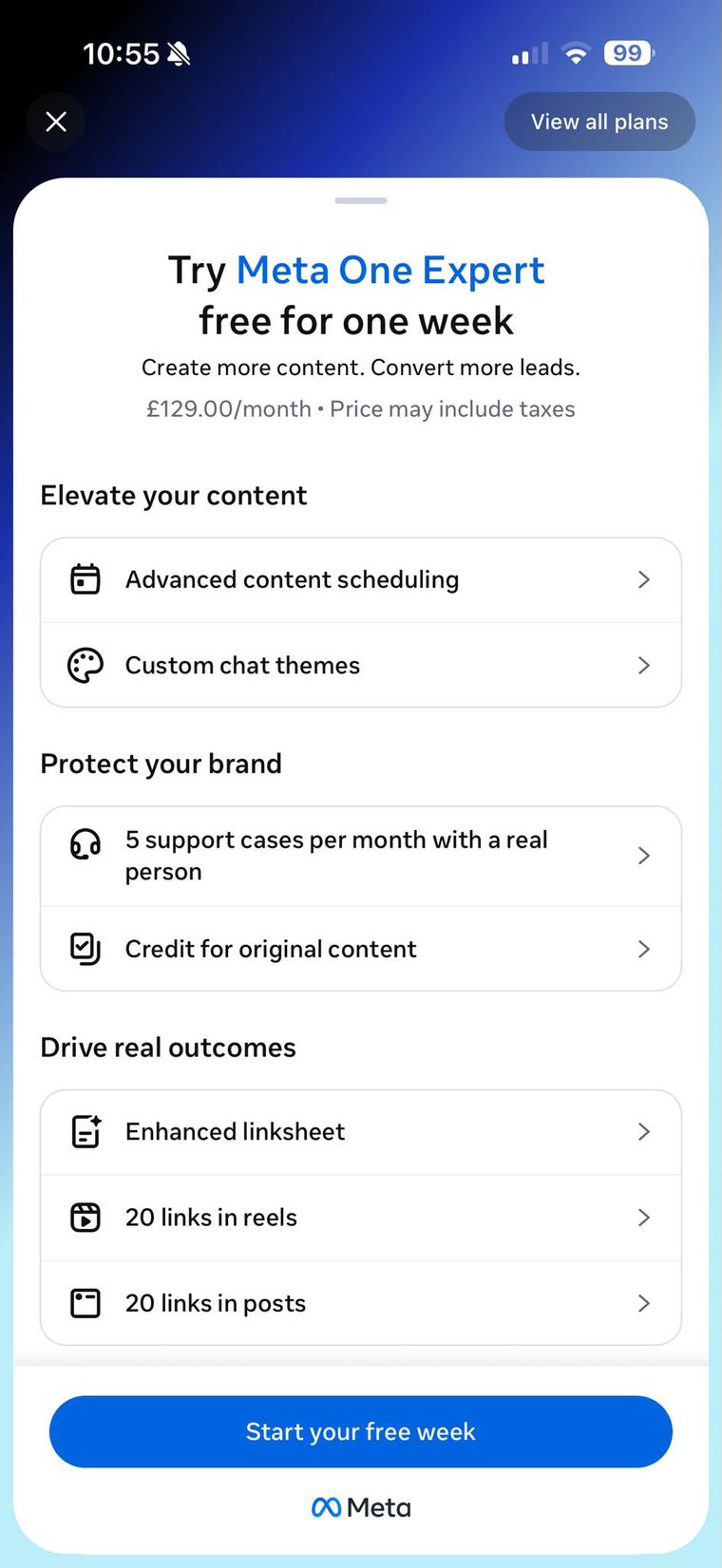
Meta One Expert subscription screen at £129.00 a month
Expert at £129.00 a month. Twenty Facebook link posts and twenty Facebook reels, plus support from a real person five times a month.
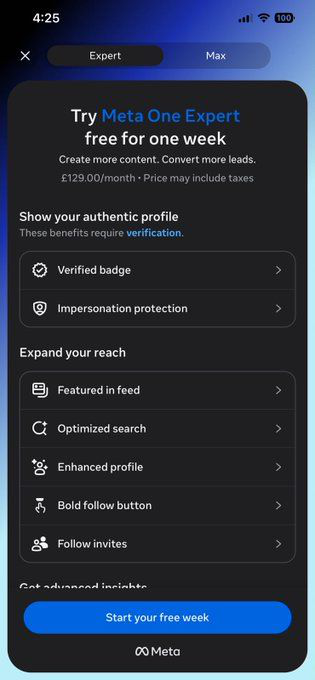
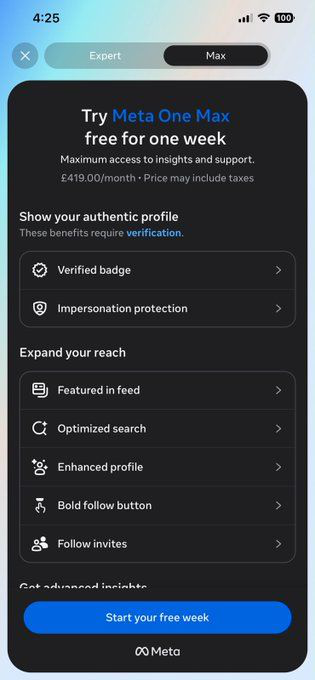
The clearest evidence on the top tier comes from a single dashboard with an Expert and Max toggle, where switching tabs moves the price from £129.00 to £419.00 a month. That pair is the strongest pricing proof available on Max, and it puts the top tier at £419.00 rather than the £499 figure reported in an earlier sighting.
Meta One Expert tab showing £129.00 a monthMeta One Max tab showing £419.00 a month
The same sheet, two tabs. Run them together, because together they are the proof that Max is £419.00 a month.
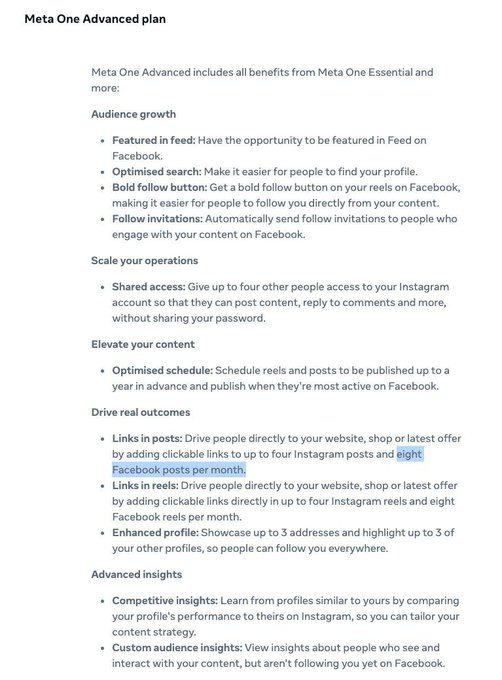
Two things reported earlier need correcting, and one of them is a correction we made ourselves. Max at £419.00 and Max at $499.00 are both real. Earlier coverage treated a 499 sighting as a superseded pound price, and the likeliest reading now is that it was the US dollar price all along, read as pounds. A UK account pays £419.00 and a US account pays $499.00, and neither figure replaces the other. The second correction stands as reported: Advanced does include links in posts, where it was first read as reels-only. Meta's Advanced plan document lists clickable links in up to four Instagram posts and eight Facebook posts a month, even though the Advanced subscription screen never mentions links in posts.
Here is the full picture in one place.
Tier
Price seen
FB link posts
FB reel links
Instagram
Shared access
Support and content
Essential
£12.49
Not listed
Not listed
Not listed
Not listed
Verified badge, impersonation protection, enhanced linksheet. Marked Recommended on the screen, and it does not list links in posts
Advanced
£41.99 UK, $34.99 US
8 (plan document)
8
4 posts, 4 reels
4 people
1 support case a month with a real person, verified badge, impersonation protection, featured in feed, optimised search, bold follow button, follow invitations, optimised scheduling up to a year ahead, enhanced profile, competitive and custom audience insights
Expert
£129.00 UK
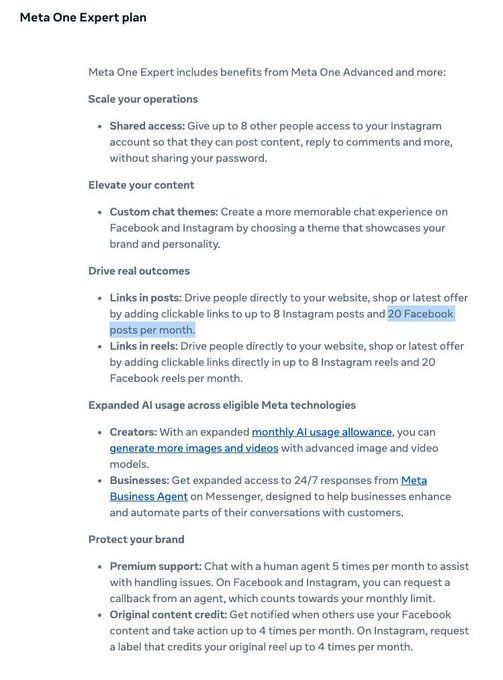
20
20
8 posts, 8 reels
8 people
Human agent 5 times a month, callbacks count toward that limit. Original content credit up to 4 times a month. Custom chat themes, expanded AI usage
Max
£419.00 UK, $499.00 US
Unlimited
Unlimited
12 posts, 12 reels
30 people
Human agent as often as needed, plus callbacks. Original content credit up to 6 times a month. Adviser strategy call every 6 months. Maximum AI usage allowance
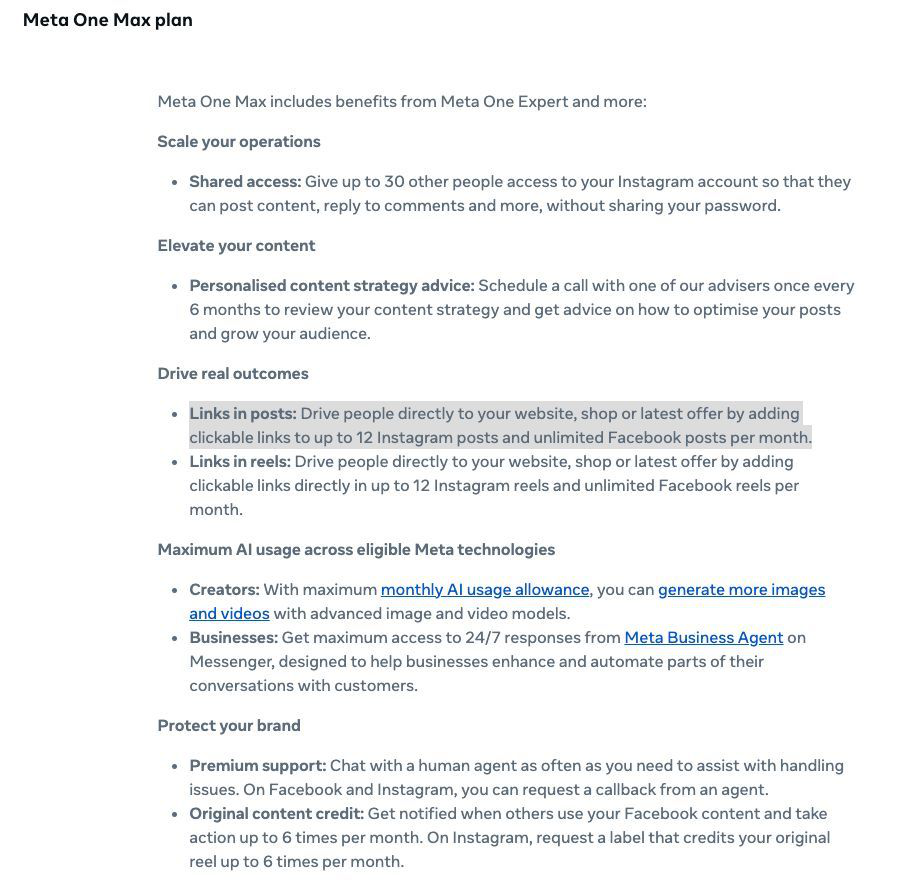
A free one-week trial is offered on Advanced, Expert, and Max, which is the cheapest way to measure what a real allowance does for your numbers before you commit. Read the shared-access lines with care, because in all three plan documents the shared access described covers Instagram accounts. If your reason for considering Max is getting a thirty-person team off shared passwords on Facebook, confirm that before you buy.
$34.99
Advanced tier, listed at eight Facebook link posts a month in Meta's plan document, four times the free allowance for roughly a fifth of the Expert price.
Source: Meta One Advanced plan document
The finding worth acting on
Advanced at $34.99 may be the cheapest route back to link posting, and it is the single detail most likely to save operators real money. Meta's Advanced plan document lists eight Facebook link posts a month, four times the free allowance, for roughly a fifth of the Expert price. The Advanced subscription screen advertises links in reels and the enhanced linksheet but says nothing about links in posts, so the two sources disagree. Use the free week to test it on one page before you commit a portfolio to it. If the plan document holds on your account, a large number of operators are about to overbuy Expert when Advanced would have carried them.
Meta One Advanced plan document listing four Instagram posts and eight Facebook posts a month with clickable links
The Advanced plan document, where the Facebook link-post allowance actually appears. This is the source that disagrees with the subscription screen, and it is the one worth testing.
Meta One Expert plan document listing eight Instagram posts and twenty Facebook posts a month
The Expert plan document. Each tier inherits everything below it, so Expert includes all of Advanced and Max includes all of Expert.
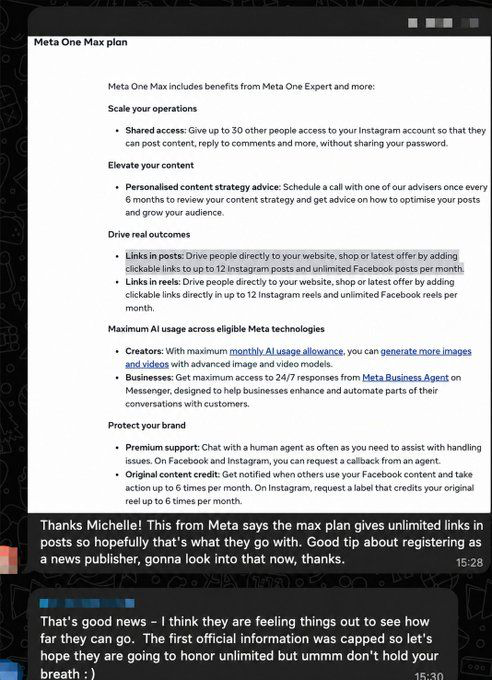
Meta One Max plan document listing unlimited Facebook posts and twelve Instagram posts a month, plus shared access for thirty people
The Max plan document. The line that matters for publishers is unlimited Facebook link posts, with the shared-access figure describing Instagram accounts.
Why this is an opportunity, not a funeral
The reaction in the first 48 hours was close to panic. The free ride is over, Facebook is finished, publishing on the platform is done. That read is upside down, and the case for why becomes clear once you follow the incentives.
Put a price on something and you find out who was serious. For years the feed has carried links from operators spraying fifteen or twenty a day with no consideration of whether anyone actually wanted the click. That volume is exactly what trained people to stop tapping. A meter clears it out, because operators running on razor-thin margins and pure volume cannot absorb a monthly subscription, and what remains is a feed with a fraction of the link traffic in it.
Facebook now has a revenue interest in your link working, which has never been true before.
For a decade the platform throttled link posts, and the logic was obvious, because links take people off Facebook. That incentive has just inverted. A platform charging a subscription for link posting has every reason to deliver those posts properly, because a subscriber whose links reach nobody cancels. Expect real distribution behind links that go out on a paid plan, and expect the audience to be slowly retrained to click again, because what they see will no longer be junk. In your numbers that should show up as higher RPMs, higher click-through rates, and the strongest engagement on link posts you have had in years.
There is a format shift buried in the tier list that most people have not registered yet. Reels carry clickable links on every paid plan, eight on Advanced, twenty on Expert, unlimited on Max. Video has been a reach and monetization format on Facebook, useful for earnings and close to useless for referral traffic. That changes the moment reel links go live at scale, and the publishers who have a working video pipeline in ninety days will be taking traffic from the ones who start building in ninety days.
The first community briefing on the change, written before any unlimited tier had been seenThe Max plan document landing, confirming unlimited Facebook links in writing
How this was tracked in real time, day by day, as operators compared dashboards. That is why the pricing was corrected twice as better evidence arrived, and why the newest numbers are the ones to trust.
The honest counterweight belongs in the same breath, because it is real. This is good for professional publishers and hard on small operators with thin margins. A £129 line item is a rounding error against five figures a month and a serious decision against three. That cost deserves to be said plainly rather than argued away. It is also worth being sober about how settled any of this is. The current tier structure is what Meta is testing, not what Meta has committed to, and the company's own documentation states that Meta One is not available everywhere and the link limits are not settled global policy. There is one more thing to treat with care, because it has not been announced. A cleaner link environment could make the pinned comment feature Meta has been testing far more useful, which would turn every high-reach image post and reel into a direct traffic driver. That is a reasonable expectation based on the direction of travel, and it should be read as an expectation, not as reporting.
The math: what a Facebook click is worth to you
Before you buy anything, calculate one number. Take your monthly site revenue attributable to Facebook referral traffic and divide it by the number of link posts that produced it. That is your revenue per link post, and it decides the whole question.
If you cannot produce that number today, that is the real problem this rollout exposed, and it deserves more of your attention this week than the subscription decision does. A publishing operation that does not know what a click is worth cannot price a subscription, a traffic partnership, or anything else that turns on the value of its traffic. This is the through line in everything we run, because almost nothing about a Facebook page is a fixed number you accept. It is a number you read and then move. The operators who come out of this ahead will be the ones who can answer what did that link make us without opening three tools and guessing.
Once you have the number, the tiers become arithmetic. The table below runs each tier at its Facebook post allowance across five revenue levels, Facebook posts only.
Revenue per link post
Advanced, 8 posts, $34.99 US
Expert, 20 posts, about $165
Max, unlimited, $499.00 US
$5
+$5
−$65
100 posts to break even
$10
+$45
+$35
50 posts to break even
$25
+$165
+$335
20 posts to break even
$50
+$365
+$835
10 posts to break even
$100
+$765
+$1,835
5 posts to break even
Three things fall out of that table. At $5 a link post, fix the link post before you buy anything above Advanced, because the subscription is not your problem. Expert only clears its own cost from about $9 a link post upward. And Max makes sense above roughly twenty-five to thirty link posts a month at a healthy revenue per post, which is a volume most single-page operators are not running and most multi-page portfolios comfortably are. Two adjustments before you treat the table as final. It counts Facebook posts only, so if you publish to Instagram as well, the Instagram allowances improve every tier. And it ignores reels entirely, which on Advanced alone doubles your linked placements from eight to sixteen.
Run this per page, not per portfolio. Revenue per link post varies enormously between verticals and between pages in the same vertical. A portfolio average will talk you into a subscription on a page that does not deserve one and out of a subscription on a page that would pay for it three times over. The free week exists precisely so you can measure this at a real allowance before committing.
**Want the automation and the strategy together?** The [Facebook Monetization Suite](https://publisherinabox.com/facebook-monetization-suite) pairs the Automation Machine with the full PIB playbook, for operators who want the whole system rather than one piece of it.
What to do this week
The action plan is short, and it is ordered so the cheap decisions come before the expensive ones.
Check every page twice, composer chip and Professional dashboard, and write down which pages are in a wave and which are not. Everything below depends on that list. Calculate revenue per link post page by page, because that number makes the subscription decision for you and stays useful long after this change settles. Test Advanced before you buy Expert, using the free week on one page, and count what actually posts as a live link. Do not panic-buy the top tier, because Max has already been seen at two prices in two weeks and waiting costs you only the two free links you were going to spend anyway.
Spend your free links on proven converters only. Pull the last ninety days of link posts, rank them by revenue rather than reach, and post from the top of that list whatever the publish date. Move everything else to the doors still open, which are story link stickers, Messenger with comment-trigger automations, and your page bio and linksheet. Stop building anything new that depends on comment links, and audit what you already have running on them. Start the reels-with-links workflow now, because building a video pipeline takes longer than buying a subscription, so you want it underway while the cap is still the thing everyone else is arguing about. If you run a genuine news operation, register as a news publisher in Business Manager, because registered news pages were exempt from the December 2025 test, that exemption has not been confirmed for the current rollout, and the registration costs an afternoon against a downside of nothing.
The last step is the one that outlasts the rollout. Keep building beyond the page. A website, an email list, Google Discover, and visibility in AI search are the income streams that do not fail together when a single platform meters one of them. This is the diversification-for-stability doctrine we operate from, and it is why a page that leans on one channel is fragile in a way a publisher operating system across several channels is not. Presence and consistency across many surfaces, what we call Cross-Platform Signal Density, is exactly what survives a change like this one, because the operators with several working channels treat a link cap as a line item rather than an emergency.
Making every metered link earn its slot
Scarcity changes the job. When links were free and unlimited, volume covered for weak posts. With two free slots a month, or eight or twenty on a paid tier, every link post has to earn its place, and two disciplines decide whether it does.
The first is choosing what gets a link. Rank ninety days of link posts by revenue produced rather than clicks received, because high-click, low-revenue posts are usually pulling traffic that bounces, and they were affordable only when links were free. Evergreen beats fresh on a metered slot, because a story that stays relevant for three months earns from one slot for three months while breaking news earns for six hours. Weight your allowance toward content with a long tail, and route anything time-sensitive through the uncapped placements instead.
The second is raising click-through on the posts that do get a link, and this is where the platform change quietly rewards good practice. Use the custom preview image you are now paying for, serve a proper Open Graph image at 1200 by 630 with a single focal point, and if the story turns on a number or a name, burn it into the image. Add the call-to-action button and label it for what the reader gets rather than where they go. Above all, the headline does the work, and what performs on a metered link is specificity. Name the person, the number, the place, or the outcome inside the first four or five words. That is not only a click-through tactic. It is the same entity clarity that makes a page legible to AI answer engines and to Google Discover's natural-language matching, because naming the entity plainly at the front is what both a scrolling reader and a retrieval system are looking for. The discipline that wins a scarce Facebook slot is the discipline that earns an AI citation and Discover surface at the same time.
What this rollout does not touch
One clarification prevents a lot of misplaced panic. Nothing announced here affects Facebook Content Monetization, the program that pays pages directly for reels, video, and post engagement. The link cap governs outbound traffic. Content Monetization governs what your page earns from Facebook itself, and it runs on a separate set of rules this change leaves alone. If most of your revenue comes from on-platform earnings rather than referral traffic to your own site, the practical impact of this rollout on your business is smaller than the volume of discussion suggests, and it may be a chance to pick up the referral traffic that leaves the feed as other operators exit. If most of your revenue comes from referral traffic to a site you own, the dual monetization model that runs on-platform earnings and off-platform traffic together is the position you want to be in before the next wave lands. Either way, this is one more platform-side change that rewards operators who read their own data and act on it, which is the same lesson as Meta handing itself control of ad placements earlier this year.
Where PIB fits
Facebook rewrites the rules every quarter, and this rollout reached our community before it reached the trade press because Facebook publishing is what we do all day. If you want a read on your own pages, our consulting puts that same read on your operation, what changed, what it is costing you, and what to do before the next wave, and you keep 100 percent of the upside because we teach your team to run it. If you would rather we run the operation for you, Facebook Turnkey Management does exactly that on a revenue share with no upfront cost, and you keep the asset. And if you are building the reels-with-links pipeline and the measurement loop yourself, the Facebook Automation Machine is the $397 n8n build that wires the repetitive parts together so your team spends its time on the judgment the machine cannot make. Whichever rung fits, the work underneath it is the same, continuous analysis and optimization of your own data rather than a one-time setup.
Where to go from here
If you want this read against your own pages rather than in the abstract, Facebook consulting covers what changed, what it is costing you, and what to do before the next wave lands. We teach your team to run it, so you keep 100 percent of the upside.
Frequently asked questions
How many free link posts does a Facebook Page get?
Two per calendar month for Pages and professional-mode profiles included in the rollout. The remaining allowance shows as a chip in the top row of the post composer, reading for example one link left.
What happens if I post a link after the free allowance is used?
The post publishes normally, but the URL renders as plain text with no preview card and nothing to tap, so it produces no clicks even if it reaches a large audience. The same applies to URLs placed in comments.
What is the cheapest Meta One plan that gives me links in Facebook posts?
On Meta's own plan documentation, Advanced at $34.99 a month includes clickable links in up to eight Facebook posts and eight Facebook reels. The Advanced subscription screen does not mention links in posts, so the two sources disagree and this needs confirming on your account. Use the free week to test it before committing.
How much do Expert and Max cost?
On UK accounts Expert shows at £129.00 a month and Max at £419.00. On US accounts Max shows at $499.00. These are regional prices, not conversions of one another, and a US Expert price has not been seen. An earlier 499 sighting was reported as a superseded pound figure, but the likeliest reading is that it was the US dollar price. Both £419.00 and $499.00 are real on the accounts that were shown them. Meta has published no rate card, so open your own screen.
Are comment links still working?
No. Links in comments are disabled in the same rollout and post as unlinked plain text. The first-comment workaround that has carried a large share of publisher traffic for years is closing alongside the feed cap. Stop building new strategies on it and audit whatever you already have running through it.
Does this affect my Content Monetization earnings?
No. Facebook Content Monetization, which pays pages for reels, video, and post engagement, is untouched by this rollout. The link cap governs outbound traffic only.
Are news publishers exempt, and is this global?
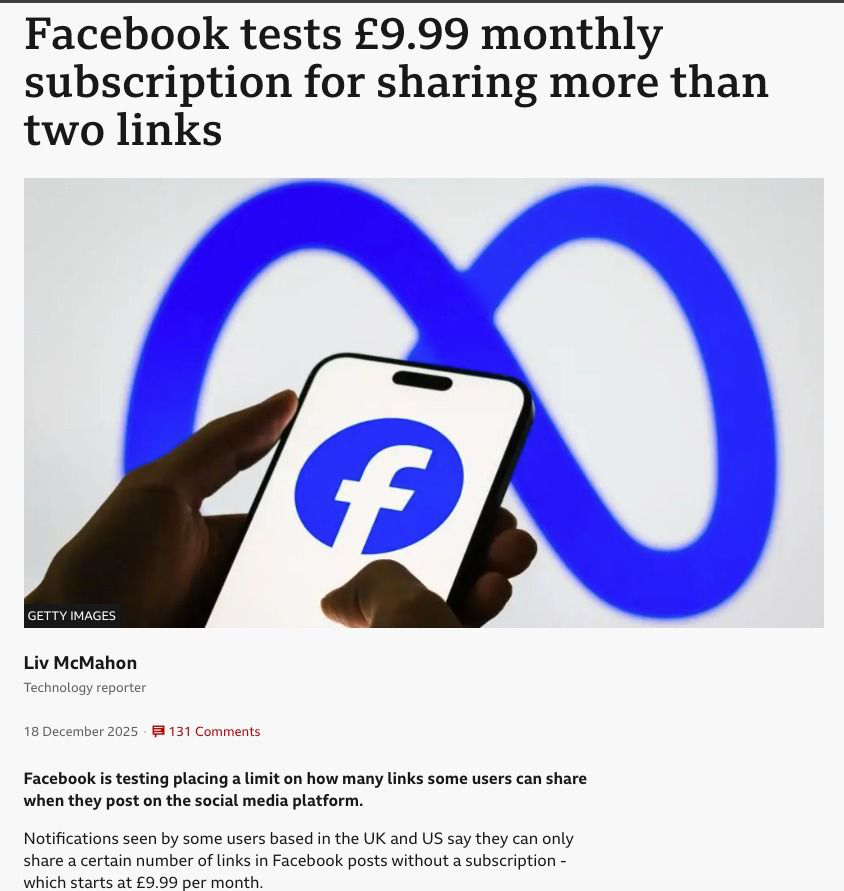
Registered news publishers were exempt from the December 2025 test, per BBC reporting of 18 December 2025 on a £9.99 monthly link-sharing trial. That exemption has not been confirmed for the current rollout, so treat it as unconfirmed. Meta's own documentation states Meta One is not available everywhere and the limits are not settled global policy, so this remains a limited test rolling out in waves.
Key takeaways
Facebook Pages and professional-mode profiles in the rollout get two free link posts a month, after which links post as plain text with no preview and no tap, and comment links close in the same change.
Meta One buys links back across four tiers, priced by region rather than by exchange rate. UK accounts show Essential £12.49, Advanced £41.99, Expert £129.00, and Max £419.00. US accounts show Advanced $34.99 and Max $499.00. A free one-week trial runs on Advanced, Expert, and Max.
Advanced is the finding worth acting on, because its plan document lists eight Facebook link posts a month even though the subscription screen does not, which means many operators may be about to overbuy Expert.
The one number that decides everything is revenue per link post, monthly Facebook-referred site revenue divided by the link posts that produced it. Calculate it per page, not per portfolio.
Read this as an opportunity, not a funeral. A metered feed clears out spray-and-pray volume, and a platform charging for links now has a revenue interest in delivering them, which should lift RPMs and click-through on the posts you keep.
The durable move is Cross-Platform Signal Density across a website, email, Google Discover, and AI search, so no single platform metering one channel can threaten the whole business.
BBC News reporting from 18 December 2025 on Facebook testing a paid subscription for sharing more than two links, with registered news publishers exempt
Where the trail starts. The December 2025 test priced link sharing at £9.99 a month and exempted registered news publishers. That exemption is the one still unconfirmed for the current rollout.
Sources
Facebook in-product limit notifications, post composer chip, Professional dashboard, live Meta One subscription screens, and Meta's published Advanced, Expert, and Max plan documents, captured across operator dashboards in the Publisher in a Box network, August 2026.
Meta help centre listing of the four Meta One subscription plans (Essential, Advanced, Expert, Max) with their published benefits documents.
BBC News, 18 December 2025, reporting Facebook testing a £9.99 monthly subscription for sharing more than two links, with registered news publishers exempt from that trial.
Meta documentation stating that Meta One is not available everywhere and that the link limits are not settled global policy.
See more from Publisher in a Box in your Google results
The team behind 300M+ managed followers. We help publishers scale traffic, revenue, and audience across Facebook, Google Discover, and syndication networks.