Search across our learning center -- articles, newsletters, and more. Start typing or click a topic above.
Stay in the Loop
Get exclusive publishing strategies, industry insights, and early access to new features. No spam -- just signal.
Join 2,000+ publishers. Unsubscribe anytime.
Market Analysis & News
Facebook Page Monetization in Focus: Real Earnings, Engagement Flags, and What Reversals Mean for Publishers
Publisher In a Box10 min read
Table of Contents
This article is part of our daily digest series, in-depth summaries drawn from our X account, @publisherinabox, expanded with industry data.
The scale of Facebook page monetization right now
Facebook page monetization has become a meaningful revenue category for publishers who treat it with operational seriousness. The numbers from Meta confirm the trajectory. In 2025, Facebook paid content creators nearly $3 billion from its creator monetization programs, a 35% increase from the previous year and its highest annual total ever. That figure, reported by Meta, is not a forecast. It is an audited payout number, and it tells you that the money is flowing at scale.
The composition of those payouts matters for understanding where to focus. The company paid nearly $3 billion to creators in 2025, up 35% from the previous year, with about 60% of that total going to Reels content and the rest split across other formats. That split, confirmed by CNBC, means that photo posts, text posts, and Stories still represent a meaningful slice of total earnings. Publishers who post across formats are not leaving money on the table.
The creator population earning meaningfully is also growing. The number of creators earning over $10,000 annually on Facebook has grown over 30% year-over-year, per Meta's announcement. That statistic, cited by MediaPost, signals that the program is maturing beyond early adopters into a repeatable income layer for professional publishers.
Meta confirmed Facebook creator payouts reached nearly $3 billion in 2025, a 35% year-over-year increase and the platform's highest annual total on record.
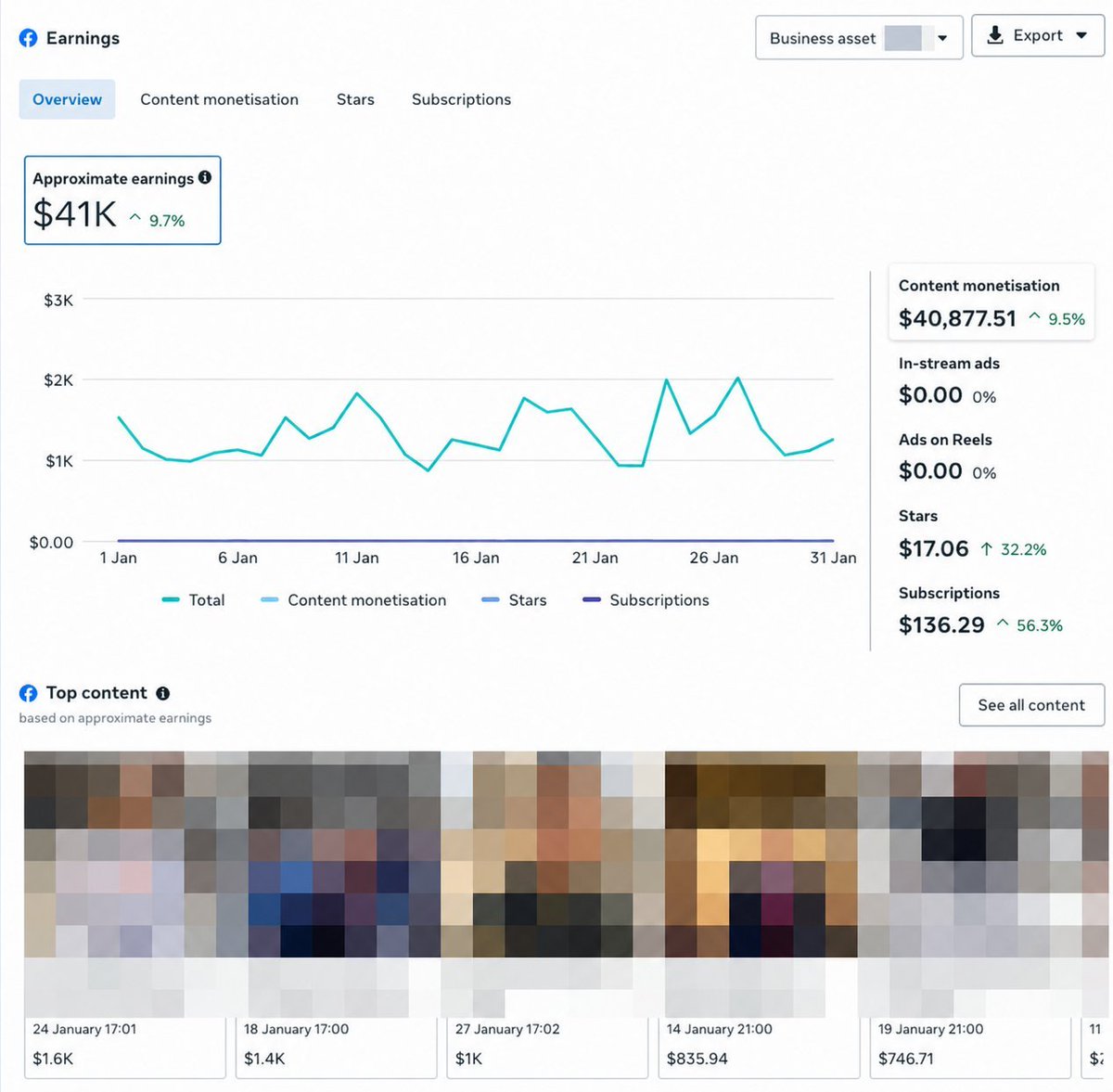
What $41,000 in a single month on one page looks like
One of the pages our team operates directly generated $41,000 in a single month. The screenshot shared today on our X account puts a real number behind what top-performing Facebook page monetization looks like in practice. We manage 300 million followers across the Facebook pages our team runs daily, and some of those pages are among the largest on the platform.
Publisher in a Box team page earnings: $41,000 in a single calendar month from Facebook content monetization on one page.
That figure is not a fluke of a viral moment. It reflects what the program looks like when it is running at a professional operational level over time. For context, from the nearly 700 Pages active on the Facebook monetization program, hundreds of publishers have earned over $51 million with an average earning of $75,000. That average, cited by Echobox, confirms that while top pages pull in far more, the program produces real mid-five-figure income across a wide range of publishers, not outliers.
The unified Content Monetization Program that replaced several older tools is the mechanism behind these payouts. The Facebook Content Monetization program pays creators for every eligible format: short- and long-form videos (Reels), Stories, and photo and text posts. That breadth means a well-run page earns from nearly every content type it publishes, not long-form video. Publishers who work with our Facebook turnkey management service or seek independent Facebook consulting guidance have access to the full range of these monetization surfaces.
The underlying mechanics reward engagement depth, not raw view count. The performance bonus is paid by Meta directly based on content performance metrics, and while the exact formula is not publicly disclosed, page reach, engagement rate, and video completion rate are understood to be key factors. Publishers who optimize for completion and share rates, rather than chasing impressions, are structurally better positioned under the current system.
The inauthentic engagement flag: what it does and what a reversal means
A publisher in our community was flagged for inauthentic engagement two days ago. Their earnings were paused and their page recommendations were killed. Today, Facebook reviewed the page and reversed all of it. That outcome is important to document clearly because it is not the norm.
A community publisher's inauthentic engagement flag was fully reversed after Facebook review, restoring both earnings and page recommendations.
The inauthentic engagement flag is one of the most disruptive enforcement actions a monetizing Facebook page can receive. Inauthentic Engagement is a Meta flag that switches off a page's monetization over suspected artificial activity, fires automatically with no human review, and the notice never names a specific post. The page keeps publishing but stops earning, and in 84% of cases recommendations are pulled alongside monetization, so reach sinks as well.
Meta's enforcement environment has been constructed in escalating stages. The first stage began in July 2025, when Meta announced comprehensive measures targeting accounts that repeatedly share unoriginal content without meaningful enhancement, building on enforcement actions that had already been taken against 500,000 accounts in the first half of the year. That figure, reported by Interesting Engineering, frames how broad the sweep has been.
The broader pattern has drawn formal scrutiny. Since mid-2025, creators across Facebook have reported sudden, unexplained monetization restrictions, and this was formally documented on June 4, 2026, when Meta's independent Oversight Board published findings that described Meta's account governance as lacking "transparency and consistency," producing removals that are not unexplained but, in many cases, unexplainable. Meta itself acknowledged imperfections in its automated systems. The rate of mistakes remained consistent during Q4 2025 with the exception of the number of false positives, which increased over 100% during a brief period of the quarter due to a bug. That disclosure, made in Meta's own H1 2026 Integrity Report, is notable because it came from the company itself.
What makes today's case significant is the confirmed reversal. Meta has confirmed that appeals are reviewed and enforcement decisions can be reversed. The company has explicitly acknowledged that automated systems are not perfect and that creators who believe a decision was incorrect have recourse. That acknowledgment, documented by ALM Corp, is meaningfully different from the reality many publishers report. Reversals do happen. They are not common, but they are possible, and documenting them in real time helps publishers understand what to expect when they pursue an appeal.
Publishers working at scale through a dedicated team, such as those engaged in turnkey Facebook page management, have a structural advantage in enforcement situations: established track records of original content, consistent account hygiene, and direct experience navigating the appeal process. Those factors do not guarantee a reversal, but they change the starting position.
The policy context behind the enforcement wave
Understanding why flags are being issued at this volume requires understanding how Meta's inauthentic behavior policy has evolved. On 12 December 2025, Meta updated Facebook and Instagram's policy on inauthentic behaviour. Rather than using explicit language to prohibit specific cases, particularly those related to politics and elections, the policy now adopts a more content-agnostic framing. That shift, documented by the Platform Governance Archive, means the policy applies more broadly than ever before.
At the same time, Meta has been investing in original content. Both views and time spent watching original Reels on Facebook approximately doubled in the second half of 2025, compared with the same period in 2024. That figure, from Meta's own Rewarding Original Creators announcement, is the other side of the enforcement story: the crackdown on inauthentic engagement is directly tied to a push to make original content more valuable. Pages that produce genuinely original content and build real audience engagement are the ones the system is designed to reward.
The impersonation problem, which sometimes drags legitimate publishers into enforcement sweeps, is also being addressed. In 2025, Meta removed more than 20 million accounts impersonating large content creators, and impersonation reports related to large content creators dropped by 33%. For publishers whose pages have been targeted by impersonators, that enforcement activity is a direct benefit.
What publishers should take from today's events
Three data points define the current moment in Facebook page monetization. First, total payouts are at an all-time high and growing fast. Second, enforcement of inauthentic engagement policies is automated, broad, and capable of producing false positives. Third, reversals are possible when publishers pursue appeals with clean account histories.
The practical implication is that publishers need to treat their Facebook pages as regulated business assets, not organic social accounts. That means maintaining content originality records, monitoring monetization status daily, and having an appeal process documented before any flag arrives. Publishers exploring what professional page management looks like at scale can find that framework through our Facebook consulting and turnkey management resources.
The $41,000 monthly figure from one of our pages and the reversal of today's inauthentic engagement flag are two sides of the same coin: Facebook page monetization produces real income at scale, and the operational discipline required to protect that income is non-trivial. Both facts are worth sitting with.
Frequently asked questions
What does an inauthentic engagement flag do to a Facebook page's monetization? When Meta's systems issue an inauthentic engagement flag, monetization is paused immediately and automatically, without a prior human review. In the majority of cases, page recommendations are also suspended at the same time, which reduces content reach even as the page continues to publish normally.
Can a Facebook inauthentic engagement flag be reversed? Yes, reversals do happen. Meta has confirmed that enforcement decisions can be appealed through the Professional Dashboard and that incorrect actions can be reversed. The process is not guaranteed and reversals are not common, but publishers with clean content histories and documented original output have the strongest basis for appeal.
How much does Facebook pay creators in total through its monetization programs? Meta reported that Facebook paid content creators nearly $3 billion in 2025, a 35% increase from 2024 and the highest annual payout total in the platform's history. Approximately 60% of that figure came from Reels, with the remainder split across Stories, photos, and text posts.
What is the Facebook Content Monetization Program and how does it work? The Facebook Content Monetization Program is Meta's unified payout system that replaced several older programs including In-Stream Ads, Reels Play, and the Performance Bonus. Eligible creators earn ad revenue share across all eligible content formats through a single enrollment. Payouts are processed monthly, typically around the 21st of the month for the prior month's earnings.
How do publishers protect their Facebook page monetization from enforcement actions? The clearest protective factors are consistent original content production, avoidance of any engagement-amplification services, and regular monitoring of monetization and recommendation status in the Professional Dashboard. Publishers operating at scale benefit from having documented content workflows and appeal processes in place before any flag arrives, rather than assembling them reactively.
See more from Publisher in a Box in your Google results
The team behind 300M+ managed followers. We help publishers scale traffic, revenue, and audience across Facebook, Google Discover, and syndication networks.