Search across our learning center -- articles, newsletters, and more. Start typing or click a topic above.
Stay in the Loop
Get exclusive publishing strategies, industry insights, and early access to new features. No spam -- just signal.
Join 2,000+ publishers. Unsubscribe anytime.
Industry News
Facebook Page Monetization, Fake Engagement Rules, and the GEO Shift: What Publishers Need to Know
Publisher In a Box11 min read
Table of Contents
This article is part of our daily digest series, in-depth summaries drawn from our X account, @publisherinabox, expanded with industry data. (weekend recap)
The revenue numbers that defined this weekend
Two case studies circulated across our feed this weekend, and taken together they tell a story about what Facebook page monetization looks like when it is the primary channel rather than a side experiment.
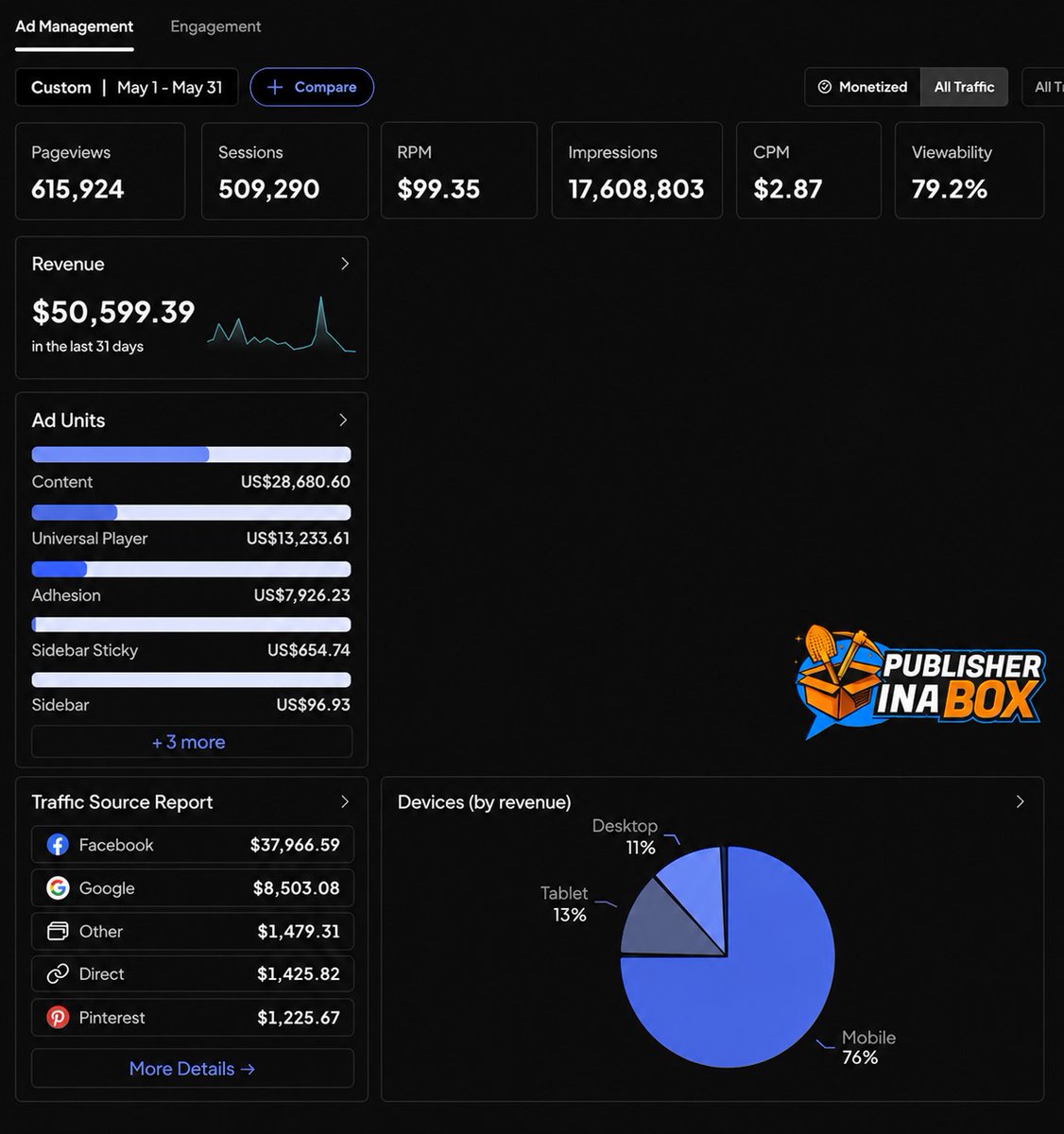
The first: a publisher who earned $10,786.73 in April scaled to $50,599.39 in May on the same site. The mechanism was not a content overhaul or a new niche. Facebook went from a supplementary traffic channel to the main driver, and the earnings followed accordingly.
Same site, same niche: April vs. May after Facebook became the primary traffic driver
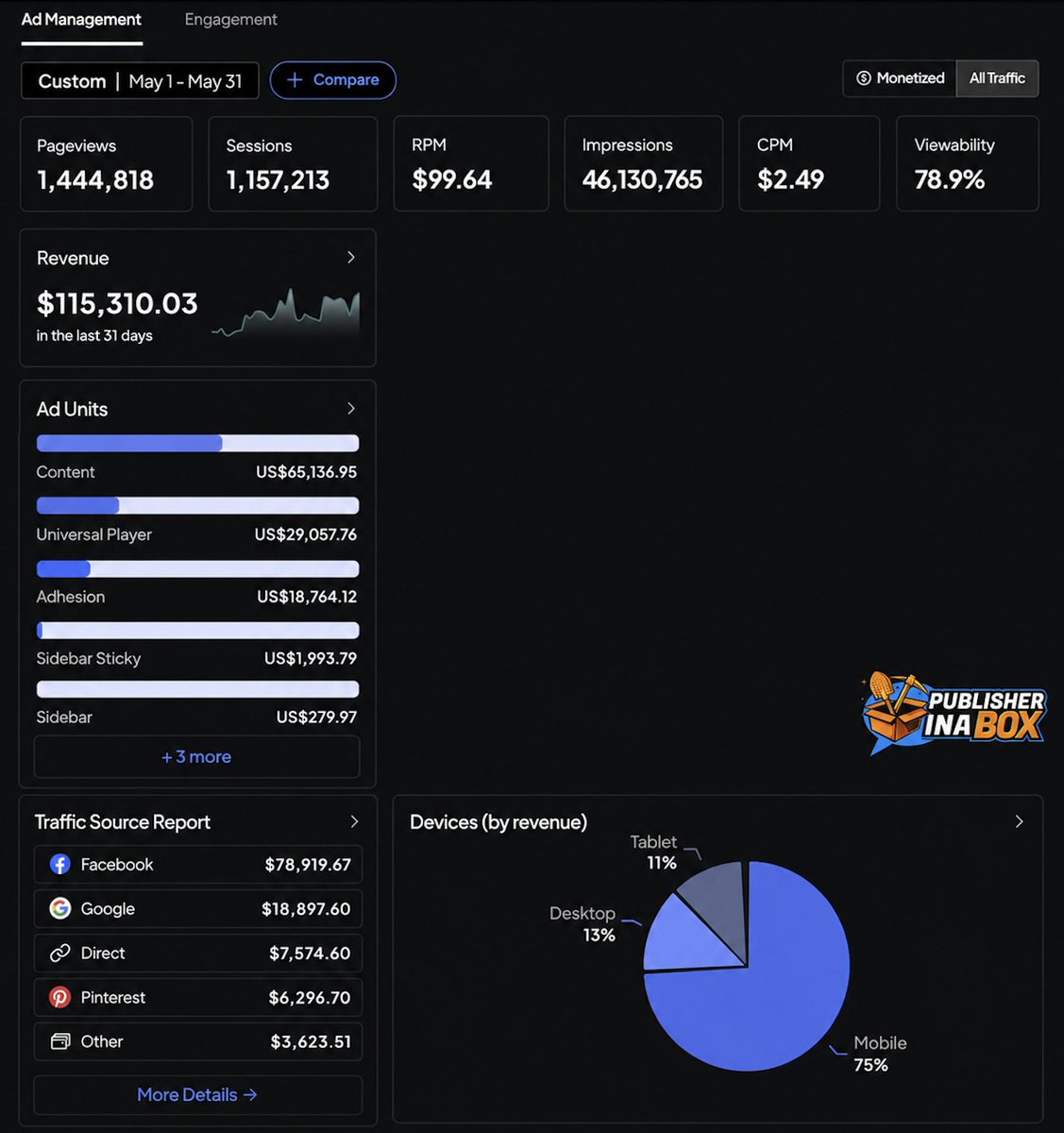
The second: a separate publisher posting $115,310.03 in a single month, with Facebook alone accounting for $78,919.67 of that figure. That is not a diversified portfolio where Facebook contributes a proportional slice. That is Facebook as the engine, by a wide margin.
$115,310.03 in one month. Facebook drove $78,919.67 of it.
These numbers exist inside a broader platform context that is worth understanding. Facebook paid content creators nearly $3 billion in 2025, a 35% increase from the previous year and its highest annual total ever. That figure, published directly by Meta, signals that the platform is actively investing in creator economics, not winding them down. The publishers seeing results in our case studies are operating inside a system that is, by Meta's own numbers, distributing more money than it ever has.
Meta paid creators $3B in 2025, up 35% year over year
At the same time, Meta's total Q1 2026 revenue reached $56.3 billion, up 33% year-over-year, with ad impressions growing 19% and average price per ad rising 12%. According to CNBC, that marked the platform's fastest quarter of growth since 2021. A growing ad market is what funds creator payouts, and that market is accelerating.
For publishers who want a deeper look at how payouts flow, our Facebook consulting overview covers the mechanics of Facebook content monetization in detail.
A brand-new page, nearly one million views, and zero dollars earned, on purpose
Another data point that drew attention this weekend: a page with 993,031 views, 92,353 engagements, and 6,502 net followers in its first week, running on full automation. Earnings were $0.00.
That zero is not a failure. It is the monetization ramp at work. Facebook does not flip a switch the moment a page meets the eligibility threshold. There is a review period, and early pages sit inside it regardless of their traffic volume. The takeaway for anyone building a new Facebook presence is that volume and earnings are on separate timelines, and confusing the two leads to incorrect conclusions about whether a page is working.
Since Meta launched the unified Content Monetization Program in August 2025, the earning structure on Facebook has shifted, consolidating what used to be a confusing patchwork of bonus programs into something more predictable. That consolidation matters for new pages specifically: there is now a single enrollment path rather than multiple parallel programs to navigate. Until January 2025, Facebook's content monetization program was splintered across platforms and growing marginally, with about 2.7 million total users enrolled. Facebook creator monetization has since grown to 12 million accounts, according to Rest of World. That is nearly a 5x expansion in the enrolled base.
What Facebook's fake engagement rules say, and why they matter for monetization
Two posts this weekend covered Facebook's published enforcement criteria for fake engagement, and we want to give this topic the space it deserves because the consequences touch distribution and monetization simultaneously.
Facebook defines inauthentic activity as coordinated, artificial inflation of likes, comments, shares, or follows. The platform flags this behavior at the account level, not the post level, which means a history of purchased or bot-driven engagement can follow a page into its monetization review. The enforcement is not theoretical. Meta confirmed in the first half of 2025 that it had already taken action against more than 500,000 accounts engaged in spammy behavior or fake engagement, with measures ranging from reduced comment visibility to full demonetization. That figure comes from reporting by ALM Corp citing Meta's own disclosures.
The enforcement track matters because it runs parallel to the earnings track. A page can meet the follower and view thresholds for monetization and still be denied or demonetized if its engagement history raises flags. Pages that built their early numbers through gray-area tactics are not grandfathered in once the monetization review begins.
Accounts that have been building reach through fake engagement or keyword-stuffed captions face the same enforcement track: demonetization and reduced distribution. Distribution and monetization are linked. Reducing one reduces the other, which is why the policy documents Facebook publishes on this topic deserve more attention than most publishers give them.
If you are managing a page at scale and want to understand what compliant growth looks like operationally, our Facebook turnkey management overview walks through the operational framework we apply.
Getting paid on Facebook is not the same as earning on Facebook
One of this weekend's most useful posts made a distinction that many publishers miss: earning and getting paid are not the same thing on Facebook. Earnings accumulate inside Meta's systems. Getting paid requires meeting payout thresholds, having a verified payment method, and staying in good standing with the platform's content and integrity policies throughout the payment cycle.
If you are earning through Groups, subscriptions, and Stars, those payments may come through different channels than your Content Monetization Program revenue, so tracking all income sources matters for accurate accounting. The fragmentation of payment channels is one of the most common sources of confusion among publishers who are technically earning but not seeing expected deposits.
The Content Monetization Program does consolidate much of this, but early creator reports suggest some are earning less under the unified program than they did under the old separate programs. Meta has indicated they will continue tuning the rates. That means the relationship between your content performance metrics and your actual deposit is still in motion, and publishers should treat current payout rates as a floor that may shift rather than a fixed contract.
GEO is the search rebuild publishers burned by HCU cannot afford to ignore
A client testimonial shared this weekend captured something we hear repeatedly from publishers who lived through the Helpful Content Update: the experience of building a content business around Google search, watching it collapse in 2023, and then sitting on the sidelines while the rules changed again. The specific quote referenced a writer who had dismissed SEO entirely and had not given Generative Engine Optimization any thought at all.
That posture is understandable but costly. GEO is not a rebranded version of the same game that burned publishers before. If SEO was about earning a spot in the top ten blue links, GEO is about earning a spot in the two to seven sources an LLM typically cites in a single answer. The aperture is narrower, the signals are different, and the measurement system is new. But for publishers who produce specific, authoritative content, the opportunity is real.
Our post this weekend cited Search Engine Journal's coverage of a growing pattern: writers who chose narrow, deeply specific topics are seeing their content cited directly by LLMs like Claude, not summarized or paraphrased, but cited by name. That specificity signal is the single biggest shift in GEO strategy for publishers right now. 35% of US consumers now use AI at the product discovery stage, versus 13.6% who use traditional search, according to the Similarweb 2026 Generative AI Brand Visibility Index. The audience has already moved. Content that is not structured for AI citation is invisible to more than a third of potential readers before they ever reach a search results page.
The structural implication is direct. Pages with FAQ schema and inline citations are weighted approximately 40% higher in ChatGPT source selection than pages without these elements. That finding, from the 2026 State of AI Search, means the technical structure of a page is now part of its discoverability in ways that did not exist two years ago.
For publishers who felt burned by search-dependent revenue and pivoted entirely to Facebook, the GEO conversation is worth revisiting. Facebook and GEO-optimized content are not in competition. Publishers who build citation authority in AI search create a second distribution channel that does not depend on algorithmic feed placement or ad revenue rates on any single platform.
Frequently asked questions
What is the difference between earning money on Facebook and getting paid by Facebook? Earning refers to revenue that accumulates in Meta's systems based on your content performance across eligible formats. Getting paid requires meeting your payout threshold, having a verified payment account on file, and maintaining good standing with Facebook's content integrity policies throughout the payment cycle. Publishers often see a gap between what their dashboard shows and what arrives in their bank account because those two steps are managed separately by Meta.
Why would a Facebook page have nearly one million views but zero dollars in earnings? New pages that meet the enrollment criteria for the Content Monetization Program still go through a review period before earnings are activated. During that window, views and engagement accumulate normally, but the payout mechanism has not been turned on yet. This is standard and expected for pages in their first few weeks. It is not an indicator that the page is failing to perform.
What does Facebook count as fake engagement, and what happens if a page is flagged? Facebook defines fake engagement as coordinated or artificial inflation of likes, comments, shares, or followers, whether through purchased services, bot activity, or organized inauthentic behavior. Pages flagged for this activity face reduced distribution, reduced comment visibility, or full demonetization. The enforcement applies to the account's history, not recent posts, so past fake engagement can affect a current monetization review.
What is GEO and why does it matter for publishers who were hurt by Google algorithm updates? Generative Engine Optimization is the practice of structuring content so that AI search engines like ChatGPT, Perplexity, Gemini, and Claude cite it directly when generating answers. Unlike traditional SEO, which competed for positions in a list of links, GEO competes for one of a small number of cited sources inside an AI-generated response. For publishers whose traffic collapsed after the 2023 Helpful Content Update, GEO represents a structurally different opportunity where specificity and authority matter more than keyword volume.
Does building for GEO conflict with building a Facebook content strategy? No. The two channels operate independently and serve different discovery patterns. Facebook distributes content through feed placement and social sharing. GEO distributes through AI-generated answers to search queries. Publishers who invest in both create two separate traffic sources, which reduces their exposure to any single platform's algorithm changes. The content formats overlap in some areas, particularly long-form, specific, and authoritative writing, which tends to perform in both contexts.
See more from Publisher in a Box in your Google results
The team behind 300M+ managed followers. We help publishers scale traffic, revenue, and audience across Facebook, Google Discover, and syndication networks.