Facebook Page Monetization Signals: Captions, RPM Floors, AI Visibility, and Payout Protection
Publisher In a Box10 min read
Table of Contents
This article is part of our daily digest series, in-depth summaries drawn from our X account, @publisherinabox, expanded with industry data.
The caption is a revenue lever, not an afterthought
Most page operators write one line under a photo and move on. The evidence suggests that is leaving money on the table. Longer, more deliberate captions on the same image posts are correlating with higher earnings per post across accounts we track, and the copy does not need to be literary to perform. It needs to hold attention long enough for the platform to register a qualified view and serve an ad impression.
The format-level data backs this up. Echobox found that image-link posts generated the highest average earnings per share at $1.93, outperforming standard video posts at $1.72. That delta is not enormous in isolation, but applied across hundreds of posts a month on a monetized page, it compounds quickly.
Meta's own Content Monetization program now pays on photos, text posts, Reels, and Stories under a single unified payout system, which means the caption on a photo post is no longer decoration. It is part of the time-on-content equation the algorithm uses to determine whether to serve an ad. Operators who treat caption writing as a distribution tactic rather than a formatting chore are reporting the difference in their dashboards.
The practical implication for anyone doing Facebook consulting work: audit caption length before touching posting frequency. It is the lowest-effort lever available, and it does not require any new creative assets.
A real month of revenue: $23,967.34 in June with RPM holding at $99.35
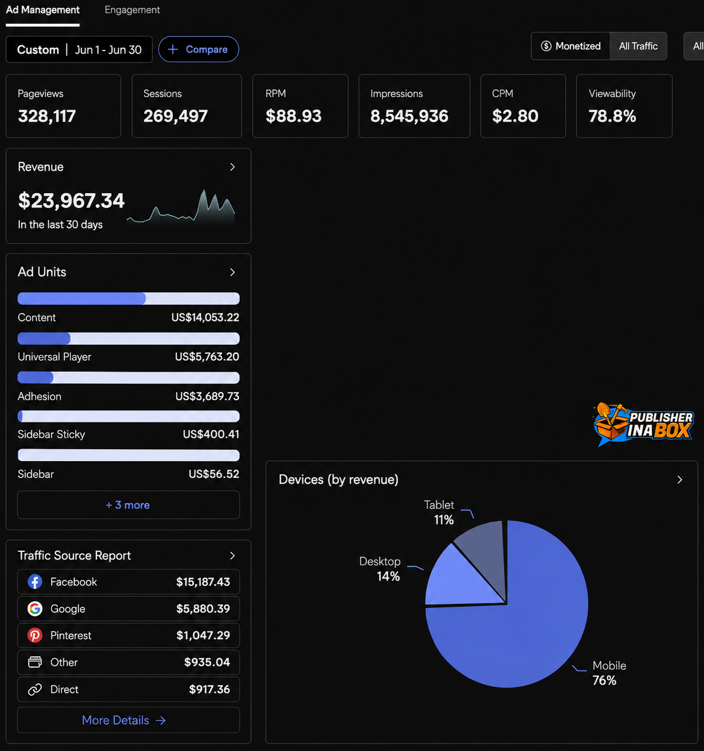
We posted the Chapter Three numbers publicly this week, and we posted them as they arrived. June came in at $23,967.34, down from May. Traffic dropped from 615,924 pageviews to 328,117 as the season turned. The honest read is that the revenue decline was almost entirely a traffic story, not an RPM story. RPM held at $99.35, which means the monetization engine was working. The audience volume was not there in the same concentration.
Chapter Three: $23,967.34 in June earnings, with RPM holding at $99.35 as pageviews declined seasonally from 615,924 to 328,117.
That RPM figure sits well above the range most Facebook-only operators see. Creator-reported data compiled by FB Earning Calculator puts most Content Monetization Program participants between $1 and $10 RPM per 1,000 views, with finance and technology content reaching US or UK audiences capable of $8 to $20-plus. The $99.35 figure in the case study reflects a blended rate across display advertising revenue from a content site, not Facebook CMP alone, which is an important distinction. It demonstrates what diversified, high-quality traffic with strong advertiser demand can produce when the page and the site work in tandem.
Publishing the down months matters as much as publishing the up months. The traffic curve explains most variance in publisher revenue, and operators who understand that separation between RPM health and volume health make better decisions about where to focus their energy.
Seasonal traffic decline accounts for the June revenue dip. RPM remained stable, isolating the cause.
From $300 to $50,000 a month: the execution system behind the climb
Part II of the $300-to-$50,000 series went live this week. Part I covered the market context. Part II is the operating manual: the systems, the sequencing, and the specific decisions that moved a dormant page to $10,000 in month one, $20,000 in month two, and $35,000 by month six.
The trajectory matters because it is not a viral story. There was no single post that changed everything. The page was at $300 monthly before active management began. It crossed $10K in the first month of structured operation, not because the content changed dramatically, but because the distribution, posting cadence, and monetization configuration were aligned deliberately for the first time. Month six at $35,000 and an eventual $50,000 ceiling reflect compounding: each week of clean data made the next week's decisions easier.
Operators considering Facebook turnkey management arrangements often ask how quickly results materialize. The honest answer from this case is that meaningful revenue appears in the first 30 days, but the architecture that makes it defensible takes closer to six months to stabilize. The early months are high-signal. The middle months are where the system is stress-tested.
Interesting Engineering reported that in 2025, Facebook paid content creators nearly $3 billion through its monetization programs, a 35 percent increase from the prior year and the highest annual total in the platform's history. The number of creators earning above $10,000 annually grew by more than 30 percent year-on-year. The opportunity is real and expanding. The gap is in execution.
AI visibility: the median brand appears in only 16% of relevant answers
The AI discovery numbers from Webflow's research are worth sitting with. Webflow analyzed more than 2,000 U.S. company websites, measuring how effectively brands appear across ChatGPT, Gemini, Perplexity, and Claude. The median company showed up in 16% of relevant AI-generated answers and earned a citation with a link only 6% of the time. When brands were mentioned, AI described them inaccurately roughly one-third of the time.
The root causes are not exotic. Webflow found that 62% of sites have broken internal links, 60% are missing basic SEO metadata, and 54% have not refreshed even a tenth of their content in the last six months. These are not algorithmic mysteries. They are maintenance failures.
For publishers who depend on traffic from Facebook and organic search, AI answer visibility is becoming a parallel distribution channel that operates on different rules. Webflow's AEO Maturity Model shows that moving from Level 1 to Level 3 AEO maturity produces a 2.3x higher mention rate and a 3.7x higher citation rate. The average company across the 2,000-site study scored 2 out of 5 on the maturity scale, meaning most publishers have room to capture gains that require no new content budget, only better content architecture.
Digiday noted that AI agent traffic grew 45% in Q2 2026, with 17.7 billion AI agent requests recorded across a network of over 400 companies in that quarter alone. Meta's own RAG crawler grew 163% from Q1 to Q2, meaning Meta is actively reading the web to inform its AI products. Publishers whose content is clean, cited, and structured will benefit from that crawl. Publishers with stale metadata and broken links will not.
Payout restoration: what a human review looks like
A publisher shared a data point this week that cuts through a lot of the speculation about Meta's enforcement and restoration process. His Instagram recommendation and monetization had been suspended. He reached a real human reviewer without paying for Meta Verified. That reviewer identified which Reels to delete. After the deletions, Instagram status returned to green immediately. The green Instagram status then triggered a corresponding human review on his Facebook page.
Monetization and recommendation status restored across both Instagram and Facebook following a successful human review and targeted Reel deletions.
The sequence matters. Platforms are linked. A resolved enforcement flag on Instagram can propagate a positive review signal to Facebook, and the reverse is true as well. Publishers who treat each platform's status in isolation are missing the cross-platform dependency that Meta has built into its enforcement architecture.
Factually.co's analysis of Meta's human review process confirms that when a human reviewer is reached, creators and advertisers who access Meta Business Support report escalations and restorations within 24 to 72 hours. The challenge is reaching that human review in the first place. Most publishers who fail at appeals are failing at the escalation step, not the resolution step.
ALM Corp's review of Meta's 2026 content policies notes that Meta has confirmed creators can appeal originality decisions through the Professional Dashboard, and the company says it is continuously working to improve enforcement accuracy. The appeals process is accessible, but it requires a specific sequence: identify the flagged content, remove it proactively, document the removal, and then request the human review rather than waiting for an automated re-check.
The practical lesson from this week's case is that reaching a human reviewer without paying for an elevated support tier is possible. It requires patience, documentation, and understanding that the platform is looking for evidence of corrective action, not an appeal letter.
What these signals mean together
Four signals converged this week, and they point in the same direction. Caption depth is a monetization variable, not a cosmetic one. RPM stability during a traffic dip is evidence that the monetization infrastructure is sound. AI citation gaps are a fixable technical problem, not a strategic mystery. And human review pathways exist for publishers willing to navigate the escalation process correctly.
None of these require new platforms or new audiences. They require closer attention to the systems already in place. That is the operating principle behind every case study we publish: the gap between current revenue and potential revenue is almost always an execution gap, not a market gap.
Frequently asked questions
Does caption length on a Facebook photo post affect monetization earnings? Yes. Caption depth keeps viewers engaged longer with the post, which signals time-on-content to Meta's algorithm and increases the probability of an ad impression being served. Data from Echobox shows image-link posts already outperform video on average earnings per share, and longer captions compound that advantage by extending the session.
What is a realistic RPM for a Facebook content monetization page in 2026? Creator-reported data places most Content Monetization Program participants between $1 and $10 RPM per 1,000 views. Finance, business, and technology content reaching US or UK audiences can reach $8 to $20-plus RPM. Entertainment content in lower-CPM regions often falls between $0.30 and $2. Geography and niche are the two dominant variables.
How do I get a human review of a suspended Facebook or Instagram monetization account? The fastest documented path is to proactively identify and remove the flagged content before requesting a review, then escalate through Meta Business Support rather than relying on the standard appeal form. Resolving an Instagram enforcement flag can trigger a parallel positive review on Facebook, so treating both platforms as linked is important.
Why does the median brand appear in so few AI-generated answers? Webflow's AEO Maturity Index, which analyzed 2,000 U.S. company websites, found the primary causes are broken internal links (62% of sites), missing SEO metadata (60%), and content that has not been refreshed in more than six months (54%). These are maintenance problems, not strategic ones, and they are fixable without new content budgets.
Can a dormant Facebook page reach significant monthly revenue quickly under active management? Case study data shows a page at $300 monthly can reach $10,000 in the first month of active management when distribution, posting cadence, and monetization configuration are aligned. Six-month figures in the same case reached $35,000. The ramp is real, but the architecture that makes it stable takes multiple months to build.
See more from Publisher in a Box in your Google results
The team behind 300M+ managed followers. We help publishers scale traffic, revenue, and audience across Facebook, Google Discover, and syndication networks.