Search across our learning center -- articles, newsletters, and more. Start typing or click a topic above.
Stay in the Loop
Get exclusive publishing strategies, industry insights, and early access to new features. No spam -- just signal.
Join 2,000+ publishers. Unsubscribe anytime.
Industry News
How Facebook Page Monetization Turns Content Sites Into Six-Figure Publishing Businesses
Publisher In a Box13 min read
Table of Contents
This article expands on our Publisher Insider newsletter, published by Publisher in a Box, with verified industry data.
The Model That Most Publishers Miss
Most content publishers treat their Facebook pages as a destination. The audience shows up, reads a post, and leaves. The page gets likes. Nothing in the bank changes. A different model treats the Facebook page not as a destination but as an engine, one that drives readers off-platform and onto a monetized website, where display advertising revenue belongs to the publisher, not to Meta.
The numbers behind this distinction are not theoretical. Publisher in a Box reporting tracked one operator running two content sites in the same niche, both monetized with display ads, both generating combined revenue of $60,397 per month. Nearly all of that came from Google Search and Pinterest. The sites were stable. They were not growing.
The operator changed one thing: instead of posting content to Facebook as a standalone experience, he began using link posts to send Facebook readers to the websites, where the ad revenue was his to keep. The results arrived inside 30 days.
Real dashboards, real revenue. These two content sites recorded a 694% Facebook revenue jump in 30 days after flipping from page-as-destination to page-as-engine.
The Numbers Behind a 694% Facebook Revenue Jump
According to Publisher in a Box reporting, Facebook revenue across the two sites moved from $14,727 to $116,886 in a single month, a 694% increase. Combined revenue across both sites went from $60,397 to $165,909, a 175% gain. On the smaller of the two sites alone, Facebook revenue grew from $1,587 to $37,966, nearly a 24x increase.
The following month held. Combined revenue came in at $166,664. The larger site posted $142,696.79 on its own, with Facebook accounting for 80% of that figure at $113,985 in a single month. Across the two months following the model change, the pair of sites produced a combined $332,573.
Quality metrics held alongside the volume. The larger site ran 1,766,092 pageviews and 54,286,005 ad impressions in one month while its RPM sat at $99.09. Mobile carried 76% of revenue, consistent with how Facebook readers consume content. A single article generated $13,384.78 on its own. These are not numbers from a traffic spike that collapses; they are from a structural change in how the business acquires readers.
This case sits inside a broader platform trend. Meta paid nearly $3 billion to creators in 2025, up 35% from the previous year, according to CNBC. The number of creators earning more than $10,000 per year through Facebook grew more than 30 percent from 2024 to 2025, according to Inc. The platform paying publishers is not an anomaly. It is a deliberate strategic posture.
Why Facebook Is Still the Fastest Traffic Engine for New Publishers
The instinct to dismiss Facebook as a traffic source for content publishers is common. It is also increasingly expensive to act on. 74% of Facebook users visit the platform daily, including 37% who visit several times a day, according to Shopify. That is not an audience in decline, it is a captive, habituated readership that most publishers are not reaching because they have written the platform off.
Meta's Family daily active people reached 3.58 billion in December 2025, a 7% year-over-year increase. Ad impressions delivered across the Family of Apps increased 12% year-over-year in 2025, while the average price per ad increased 9% year-over-year, according to Meta's 2025 Annual Report. Advertisers are spending more to reach this audience, which means the display inventory on the websites that serve this traffic is worth more.
The display advertising market that sits behind this model is also growing. Social media ad revenues in 2025 reached $117.7 billion, showing 32.6% year-over-year growth, driven by the scaling of the creator economy, deeper commerce integration, and continued performance improvements in targeting, measurement, and attribution, according to the IAB/PwC Internet Advertising Revenue Report for 2025.
Over 94% of all Facebook ad impressions are served on mobile devices, and mobile ads generate 65% more engagement than desktop ads. The 76% mobile revenue share recorded in the Publisher in a Box case study is not a quirk, it maps directly to how Facebook users read and click. Publishers who optimize their sites for mobile load speed and mobile ad density capture disproportionate RPM from this traffic.
A separate publisher reports $41,000 in a single month from one Facebook page. Content monetization accounted for nearly the entire figure, with photo posts driving the majority of earnings.
What a 90-Day Monetization Freeze Means
Every publisher who builds a meaningful Facebook revenue stream eventually confronts the question of enforcement. Meta's monetization policies are enforced at scale, largely by automated systems, and legitimate operators do get caught in review cycles. Understanding what happens during a suspension, and why your response to it depends entirely on how you built your business, is not optional knowledge.
According to Meta's own support documentation, an "Inauthentic Engagement" violation triggers a suspension of approximately 90 days. Earnings are not deleted during this period, they go on hold. An operator can appeal by selecting "Disagree with decision" or "Request Review," which routes the account and the specific violation to a human review team. Most reviews close within 72 hours, though complex cases take longer. If the appeal succeeds, eligibility is restored and held payouts release on the next scheduled payment date. If the suspension runs its full course without resolution, restoration is typically automatic after 90 days, provided the operator followed Meta's Partner Monetization Policies throughout. A confirmed, unresolved violation after the window may result in permanent withholding of unpaid earnings.
The process is not always as clean as those timelines suggest. In Q1 2026, Meta reported $56.31 billion in revenue, up 33% year over year, driven almost entirely by advertising, according to Shopify. A platform at that scale enforces policies through AI review systems, and those systems generate false positives. This is a structural reality, not a reason to avoid the platform.
The practical consequence is straightforward: an operator whose only revenue source is a Facebook page has one answer while a payout sits on hold. Revenue stops until a review team processes the case. An operator running a publishing business, a Facebook page feeding a website that also draws from Google Search, Pinterest, email, and other pages, has a different answer. The business continues. The biggest engine is in review, and the other channels keep producing. Traffic erosion, a volatile open-web programmatic advertising market, and AI-driven shifts in content discovery mean growth now has to be earned differently, according to Digiday. For publishers, that means Facebook is the engine, and everything built around it is what keeps the engine from being the only thing.
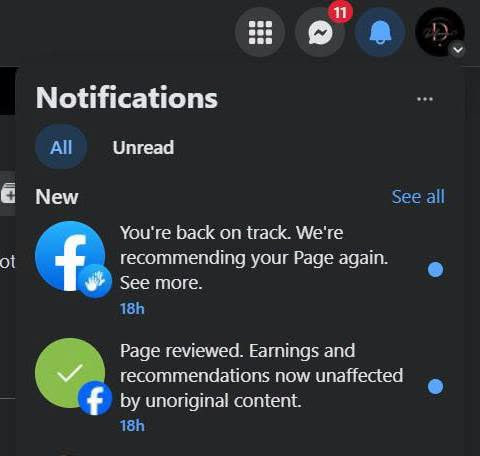
When Facebook freezes payouts, the generic error messages rarely reveal the actual trigger. A structured diagnostic process is the first step toward resolution.
Platform Signals Publishers Need to Watch
Three developments outside the Facebook feed itself carry direct implications for how publishers build and protect revenue.
Google Search Console's social tracking update. Google has introduced a new property type in Search Console called platform properties, which lets you monitor how social media and video posts perform in Google Search and Discover. This feature supports platforms including Instagram, TikTok, X, and YouTube, according to Search Engine Journal. The data this provides is useful. The framing around it requires scrutiny. Ahrefs measured in February 2026 a 58% CTR reduction on the top-ranking page for keywords with AI Overviews. Tracking social impressions in Search Console does not replace the clicks that AI Overviews are suppressing. Publishers should use these new metrics as one signal among several, not as a substitute for owned-audience metrics like newsletter subscribers, direct site visits, and display revenue. Connecting social accounts to Search Console also hands Google a verified identity map linking your website, social profiles, and content to one entity. That data feeds Google's AI authority signals. Understand what you are trading before you connect.
Meta testing AI feature paywalls. Meta is testing new subscription tiers for Facebook, Instagram, and WhatsApp users with exclusive feature access. If that model proves out on Instagram, the incentive to migrate it across the Meta ecosystem is straightforward. For Facebook publishers, the practical implication is not panic, it is preparation. Publishers who already treat their pages as real businesses, who understand what their content does organically and what it does with platform assistance, are positioned to adapt. Publishers who depend on any single Meta feature staying free and accessible are not. Build your operation so that any individual tool change is an inconvenience, not a collapse.
Google A/B testing and documentation conflicts. Google's John Mueller stated publicly that running A/B tests for six to twelve months should not trigger a penalty. Google's own A/B testing documentation explicitly warns that running an experiment for an "unnecessarily long time" could be interpreted as an attempt to deceive search engines. For publishers testing new article layouts, ad placements, or content structures, the operational answer is clear: run tests until you have statistically significant data, commit to the winning variant, use rel=canonical on all test variants and 302 redirects when splitting traffic across URLs, and close the test. Do not let an experiment become a permanent configuration by default.
Publishers who appeal Facebook monetization restrictions do recover eligibility. The operators who weather review periods without revenue collapse are those who built more than one income stream.
Building the Publishing Business, Not the Page
The model documented in the Publisher in a Box case study is a cycle. A Facebook page with enough reach sends readers to a website. The website monetizes those readers through display advertising. The display revenue funds content production, list building, and the expansion of additional pages. Each additional page creates another traffic source and another earning asset.
Facebook is the fastest entry point into this cycle because organic reach on the platform does not require the domain authority buildup that Google Search demands. A new page with good content can reach meaningful traffic within weeks, not the months or years that SEO timelines typically require. eMarketer projects Meta will generate $243.46 billion in ad revenue in 2026, overtaking Google's projected $239.54 billion, according to eMarketer via Quantumrun. That advertising investment reflects where audiences are. Publishers who access those audiences through organic page reach and then monetize the resulting website traffic are working with, not against, that current.
If you are looking to build this kind of operation or optimize the one you have, our team works directly with publishers on Facebook consulting engagements and turnkey Facebook page management. The model in this article is not proprietary theory, it is operational practice.
The publishers who outperform in this environment are not the ones who found a single platform and extracted from it until it stopped working. They are the ones who built a system where each channel reinforces the others: Facebook drives website traffic, the website builds an email list, the email list creates an audience independent of any algorithm, and that audience funds the next round of content. A 90-day review does not threaten that business. It tests it, and the business passes.
Frequently asked questions
How does Facebook page monetization generate website revenue? A Facebook page drives traffic to a publisher's website through link posts. Readers click through and land on the site, where display advertising served programmatically generates revenue per pageview and per ad impression. The Facebook page earns organic reach at no cost; the display revenue on the receiving website belongs to the publisher. The margin on this model is high because the traffic acquisition cost is zero beyond content production time.
What RPM can a publisher realistically expect from Facebook-driven traffic? RPM depends heavily on content niche, ad network, page speed, and the geographic mix of the audience. The Publisher in a Box case study recorded an RPM of $99.09 on over 54 million impressions in a single month. That figure is at the high end of what premium content sites achieve. Publishers in finance, health, and home niches with well-configured ad stacks tend to see the strongest RPMs. New publishers should expect lower RPMs until their ad stack is optimized and their audience mix stabilizes.
What happens to earnings if a Facebook monetization account is suspended? According to Meta's support documentation, a monetization suspension places earnings on hold rather than deleting them. Publishers can appeal through the Creator Studio or Meta Business Suite by selecting "Disagree with decision" or "Request Review." Most cases reach a decision within 72 hours. If the appeal succeeds, held earnings release on the next scheduled payout date. If the suspension runs 90 days without resolution and no violation is confirmed, restoration is typically automatic. A confirmed and unresolved violation after that window may result in permanent forfeiture of held earnings.
How many revenue streams does a publisher need to protect against a Facebook freeze? There is no fixed number, but the operating principle is that no single login should control more than 50-60% of total monthly revenue. The Publisher in a Box case study shows what this looks like in practice: even when Facebook drove 80% of revenue on the larger site, the smaller site, Google Search traffic, and Pinterest continued producing income during any hypothetical review period. A newsletter that delivers content directly to subscribers is the most durable layer because it is entirely platform-independent.
Does Google's new Search Console social tracking feature affect a publisher's Facebook strategy? Indirectly. Google's new platform property feature in Search Console tracks how social posts perform in Google Search and Discover. This can surface useful data on which content types earn search visibility. For publishers whose primary traffic driver is Facebook, the more significant consideration is that connecting social accounts to Search Console gives Google a verified map of your digital identity, which it uses to assess authority signals. Use the data if it is useful. Do not treat social impressions in Search as a substitute for the clicks and display revenue that AI Overviews may be suppressing on your organic search traffic.
See more from Publisher in a Box in your Google results
The team behind 300M+ managed followers. We help publishers scale traffic, revenue, and audience across Facebook, Google Discover, and syndication networks.