Facebook Page Monetization in a Volatile Q4: What Every Publisher Needs to Know
Publisher In a Box14 min read
Table of Contents
This article expands on our Publisher Insider newsletter, published by Publisher in a Box, with verified industry data.
Why This Q4 Is Different From Every One Before It
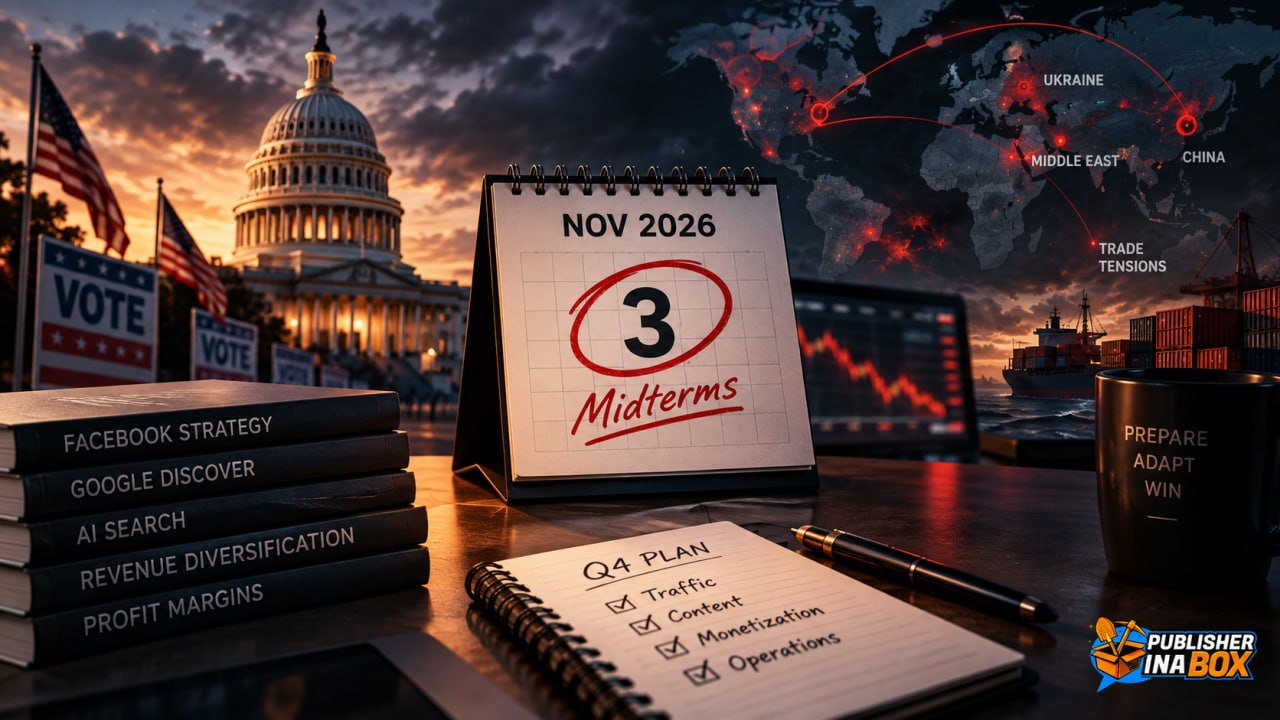
Every fourth quarter brings a predictable surge in ad demand, higher CPMs, and a window for publishers to bank meaningful revenue before the calendar resets. This year that seasonal pattern is colliding with forces that have no historical precedent operating simultaneously: a midterm election cycle that is on track to be the most expensive in U.S. history, a structural shift in how AI systems crawl and compensate publisher content, a live negotiation between Canada and Meta that could reopen an entire national market, and a set of Google reporting bugs that are actively suppressing publisher clicks right now. Any one of those stories would be worth tracking in isolation. Together they define the operating environment every ad-dependent publisher is navigating through November.
The publishers who come through this quarter profitably will not be the ones who got lucky with a viral post in October. They will be the ones who understood the macro forces in September and adjusted their Facebook content strategy, their traffic diversification, and their cost structure before the pressure arrived.
US political ad spend has grown sharply every election cycle. The 2026 midterms are projected to set an all-time record, surpassing even the 2024 presidential cycle.
The $11.6 Billion Midterm Ad Surge and What It Means for Your Revenue
For Facebook page publishers, this creates a two-sided dynamic. Political ad dollars pouring into the platform compress available inventory for non-political advertisers, which pushes CPMs up in competitive states and markets. That benefits publishers running in-stream ads or Instant Articles during the surge. At the same time, advertisers with strong presence in battleground states should expect elevated CPMs throughout Q3 and Q4, which means tighter inventory and higher costs for anyone buying traffic or promotion. Publishers who rely on consistent paid distribution to seed organic reach will feel that squeeze directly.
Assuming the historical pattern holds, there is ample reason to expect a significant ramp in advertising spending during Q3 2026 and the first part of Q4 2026. October is the pressure point. If your Facebook strategy is inconsistent heading into that month, you will give ground to pages that have their posting cadence, content format mix, and engagement structure already optimized. Preparation done in September is preparation that pays in October and November.
A less-discussed downstream effect of election-cycle volatility is consumer behavior unpredictability. Audiences shift what they engage with during high-stakes political moments. Emotional and human-interest content typically outperforms during election windows, which aligns with what we see in the engagement data from high-performing posts tracked across our network. Publishers who understand which content formats hold attention during politically charged news cycles are positioned to maintain interaction rates even when their audience's attention is pulled in multiple directions. For a deeper look at how we approach page strategy during volatile periods, see our Facebook consulting services.
Publisher Insider: Q4 volatility analysis covering midterm ad spend, AI crawler policy changes, and Facebook page strategy for digital publishers.
Meta's Trust Problem and Why It Matters to Facebook Page Publishers
Political volatility is not the only macro force shaping Q4. Meta is operating with a documented trust deficit that has direct consequences for publishers building on its platforms. Forrester's February 2025 Consumer Pulse Survey showed that a third of online adults in the U.S. and U.K. trusted Meta the same or more than they did in 2024. That erosion of platform-level trust does not necessarily reduce engagement volume, but it does affect how users interact with pages and whether they feel comfortable sharing content they encounter through Facebook feeds.
For publishers, the implication is that content which builds its own audience trust, independent of the platform's reputation, performs more durably than content that relies purely on algorithmic distribution. Pages with strong identity, clear editorial voice, and recognizable format signals accumulate the kind of follower loyalty that survives algorithm changes and platform trust cycles. That is a structural advantage that compounds over time and protects revenue when platform conditions shift.
At the same time, Meta is making meaningful changes to its moderation and content governance infrastructure. In January 2025, Meta officially ended its long-criticized third-party fact-checking program, replacing it with the Community Notes system. Publishers are witnessing the gradual removal of legacy violations, from outdated strikes to spam and nudity misclassifications. These changes create a more favorable operating environment for publishers who were penalized by automated moderation errors in prior years, and they represent a real shift in the risk profile of operating Facebook pages at scale.
Cloudflare's September 15 Default Change: A Structural Moment for Publisher Content Rights
While election noise dominates the conversation, a quieter but structurally significant deadline is arriving this month. Cloudflare is giving AI companies until September 15 to separate web crawlers used for search from those used for AI training and agents. Starting that date, Cloudflare's default settings will block mixed-use crawlers from any pages that host ads.
Cloudflare sits in front of roughly 20% of the web, which means this default change moves the baseline for a significant share of the open web, not for individual sites that opt in. The changes apply to new Cloudflare customers, new sites set up by existing customers, and all existing free customers.
The practical significance for publishers extends beyond blocking unwanted crawlers. Cloudflare's Pay Per Crawl experiment is evolving into a Pay Per Use model, where publishers get paid when their content shows up in AI answers, not merely when a bot fetches it. This represents a material shift in how publisher content can generate revenue beyond traditional display advertising. Cloudflare CEO Matthew Prince stated: "Now that the majority of traffic on the internet is non-human, we must go further and act faster so that a sustainable ecosystem can emerge."
Publishers using Cloudflare need to review their crawler settings before the September 15 deadline. The choice is not binary between blocking everything and allowing everything. The three-tier system Cloudflare has introduced lets publishers distinguish between search indexing, AI agent retrieval, and model training, and set different rules for each. That granularity is worth understanding before the default flips automatically.
Canada, Meta, and the News Deal That Could Reopen a National Market
A negotiation that has been building since 2023 is now entering a potentially decisive phase. Meta removed news from Facebook and Instagram in Canada in response to the 2023 Online News Act, which requires the platforms to compensate news publishers for the use of their content. The standoff has kept Canadian news publishers off Meta's platforms for more than two years.
Government officials are in talks with Meta about restoring news to Facebook, as the Online News Act is now on the table as part of trade negotiations with the United States. The U.S. has identified the legislation as a trade irritant, which has added external pressure to a negotiation that had stalled domestically. If a deal is reached, it would represent one of the more significant platform policy reversals in recent years and would open meaningful traffic and monetization opportunities for Canadian publishers and for any publisher whose content reaches Canadian audiences.
The precedent also matters beyond Canada's borders. When Meta returned to the negotiating table in Australia, it reached a compromise deal, and the Australian government claims to have facilitated more than 30 commercial agreements between Google and Meta and Australian news businesses, diverting over AU$200 million to local media providers. A Canadian resolution could accelerate similar conversations in other markets where publishers are seeking formal compensation frameworks.
Google Discover and News Reporting Bugs: A Real Traffic Problem Right Now
While macro forces build toward November, there is a live technical problem affecting publisher revenue today. Multiple site owners are reporting anomalies in Google News and Discover that are costing them clicks. The indexed-pages report for news sitemaps has been stuck around late August and is not showing newer articles, even though those articles are indexed and appear in Google News. Source pages in Google News have been updating extremely slowly, with new articles taking a long time to appear there.
The Discover channel specifically is worth monitoring carefully as a traffic source heading into Q4. It remains one of the few surfaces where content reaches users based on interest signals without an AI-generated summary intercepting the click. According to Similarweb data, Google AI Overviews now appear in 43% of searches, and publisher referral traffic is falling as a result. That makes Discover increasingly valuable as a direct-click traffic source precisely because it has not yet been absorbed into AI answer interfaces.
The drop in Discover traffic among generalist publishers reflects a pattern that has been building for several core update cycles. Google is systematically devaluing breadth-first publishing strategies. Publishers with tight topical focus and clean content structures are gaining ground on those publishing across wide keyword territories. If your site publishes across many unrelated categories primarily to capture search volume, that approach is now working against you in Discover.
If you want a professional review of how your publishing operation is set up ahead of Q4, our team offers full-service Facebook page management for publishers who want consistent output without the operational overhead.
X Retires Creator Revenue Sharing: What the Platform Shift Signals
X officially retired its Creator Revenue Sharing program and replaced it with Original Content Rewards, a program that pays only for original content based on qualified impressions from Premium subscribers. Creators must reapply and meet new thresholds, and aggregators, reposts, and lightly edited copies no longer qualify. The change reinforces a direction all major platforms are moving in: originality is now a technical requirement for monetization eligibility, not an editorial aspiration.
For Facebook page publishers, the X policy shift is a useful signal even if they have no direct stake in it. Platforms are aligning monetization access with original content production, and that alignment is tightening across the industry. Publishers who have built their pages on aggregated content or repurposed material from other sources face growing exposure as these policies propagate. The publishers who are building durable Q4 revenue streams are the ones producing original formats, original angles, and content that cannot be substituted by a repost from somewhere else.
What to Prioritize Before October Closes the Window
The preparation window is September. By the time October arrives, ad inventory is tightening, algorithm changes are already in effect, and any structural weaknesses in your publishing operation are visible in your numbers. There are four areas that merit attention now.
Facebook posting structure and consistency. Facebook remains the largest organic traffic driver for most publishers. Going into Q4 with an inconsistent posting schedule or undefined format mix means competing against pages that have already optimized. The algorithm rewards consistency and engagement velocity, and both of those take time to build. Establishing them in September means they are compounding by October.
Traffic source diversification. Google Discover, AI search visibility, and direct audience relationships through email or push notifications all reduce exposure to any single platform's policy changes. Publishers who are entirely dependent on Facebook or entirely dependent on Google Search are carrying concentration risk that is higher than usual heading into a period when both platforms are changing simultaneously.
Profit margin and operational efficiency. When CPMs soften during election news cycles, or when a platform issue temporarily suppresses traffic, the publishers who stay profitable are the ones with low monthly burn. Workflows that have been consolidated and automated carry a structural advantage over operations that still depend on manual labor for tasks that AI agents can handle at a fraction of the cost and time.
Crawler and content rights settings. The Cloudflare September 15 deadline is a concrete action item. Review your crawler settings, understand what the three-tier system means for your site, and decide whether the Pay Per Use model is an additional revenue channel worth participating in. This is a decision point, not a passive one.
Frequently asked questions
How does midterm election ad spending affect Facebook page monetization? When political advertisers pour billions of dollars into digital channels, CPMs across the platform rise in competitive markets. Publishers running in-stream ads or eligible monetization formats benefit from higher rates during the election window. The risk is that consumer behavior becomes less predictable and non-political content can experience fluctuating reach as audiences focus on election coverage. Maintaining consistent posting and format quality protects your engagement baseline during that period.
What is the Cloudflare September 15 AI crawler change and how does it affect publishers? Starting September 15, 2026, Cloudflare's default settings will block mixed-use AI crawlers from ad-supported pages for new customers, new sites, and all existing free-tier users. Mixed-use crawlers blend traditional search indexing with AI training and agent retrieval. Publishers can choose to block, allow, or monetize AI crawl access through Cloudflare's Pay Per Use program, which compensates publishers when their content surfaces in AI answers rather than when a bot fetches it.
Why is Google Discover still a valuable traffic source for publishers despite AI Overviews growth? Google Discover delivers content directly into user feeds based on interest signals, and it currently routes users to the original article through a direct click rather than intercepting traffic with an AI-generated summary. As AI Overviews now appear in over 40% of searches and reduce referral click-through on traditional search results, Discover has become comparatively more valuable as a source of intact, high-intent traffic for publishers.
What does the potential Canada-Meta deal mean for publishers outside Canada? If Canada and Meta reach an agreement that restores news content to Facebook and Instagram for Canadian users, it sets a precedent for government-platform negotiations globally. Publishers in other markets where similar legislation is under discussion would have a working model to point to. For publishers with Canadian audiences, it reopens a significant distribution and monetization channel that has been closed since 2023.
How should publishers structure their Q4 Facebook strategy to handle volatility? The core principles are consistency, format discipline, and margin management. Posting consistently signals to the algorithm that your page is reliable, which protects organic reach. Using formats proven to drive engagement in your niche, whether Reels, image posts, or video, means your content is competing on equal footing with the highest-performing pages. Keeping operational costs low means traffic dips during volatile weeks do not threaten profitability. All three of those elements are most effective when they are in place before volatility peaks, not after.
See more from Publisher in a Box in your Google results
The team behind 300M+ managed followers. We help publishers scale traffic, revenue, and audience across Facebook, Google Discover, and syndication networks.