Is AI Search Replacing Google? Your Readers Use Both
Publisher In a Box17 min read
Table of Contents
You typed the question into a search bar, or maybe you asked an AI the same thing, which is the whole point of this article. Is AI search replacing Google, and is that why your traffic feels thinner than it did a year ago? The short answer is no, AI has not replaced Google, and the data on that is clearer than almost anything else in this shift. The longer answer is the one that actually helps you, because your readers did something more interesting than switch. They kept Google and added AI on top of it, and that single fact changes where you need to show up and what being absent now costs you.
The reason this matters is that most publishers are planning around the wrong story. They picture readers leaving Google in a line and walking over to ChatGPT, so they either panic that search is dead or reassure themselves that AI is a fad. Neither is true, and both lead to bad decisions. The real picture is that your audience now moves between two surfaces in the same afternoon, and if you only live on one of them, you are meeting half of them and missing the other half at the exact moment they are forming an opinion about your topic.
The data says your readers did not leave Google
Start with the number that settles the replacement question. Similarweb's 2026 Generative AI Landscape report tracked audience overlap between ChatGPT and Google from March through May 2026, and found that 461 million of ChatGPT's 494 million users, which is 95 percent, also use Google in the same window. That figure sat at 95 percent in September 2025, and eight months and hundreds of millions of new visits later it was still 95 percent. If AI were substituting for search, that overlap would be falling as people switched over. It has not moved, which means almost nobody left. They added.
The scale tells the same story from a different angle. Search still pulls roughly 3.3 billion average monthly unique visitors worldwide, while AI chatbots as a whole category, even after strong growth, sit near 655 million. That is search running about five times the size of every AI chatbot combined. AI is growing fast, up around 70 percent year over year across generative platforms, and the audience is broadening rather than staying young, because about half of AI users are now 35 and older. Both things are true at once. Google remains the larger surface, and AI is the one adding new reach quickly.
95%
The share of ChatGPT users who also use Google, unchanged from September 2025 to May 2026, which is what tells you AI is additive rather than a replacement
Source: Similarweb, 2026 Generative AI Landscape report
So the fear that AI killed Google is not supported by the behavior. What the behavior supports is a second question, and it is the one worth spending your energy on. If your readers still use Google and now also use AI, why does the traffic reaching your actual pages feel lighter?
So why does your traffic still feel thinner?
Because usage and clicks are two different things, and they are moving in opposite directions. This is the part where you have to hold both readings at the same time rather than picking the comfortable one. Your readers did not abandon search, and the clicks that used to flow from search are still thinning, and neither statement cancels the other.
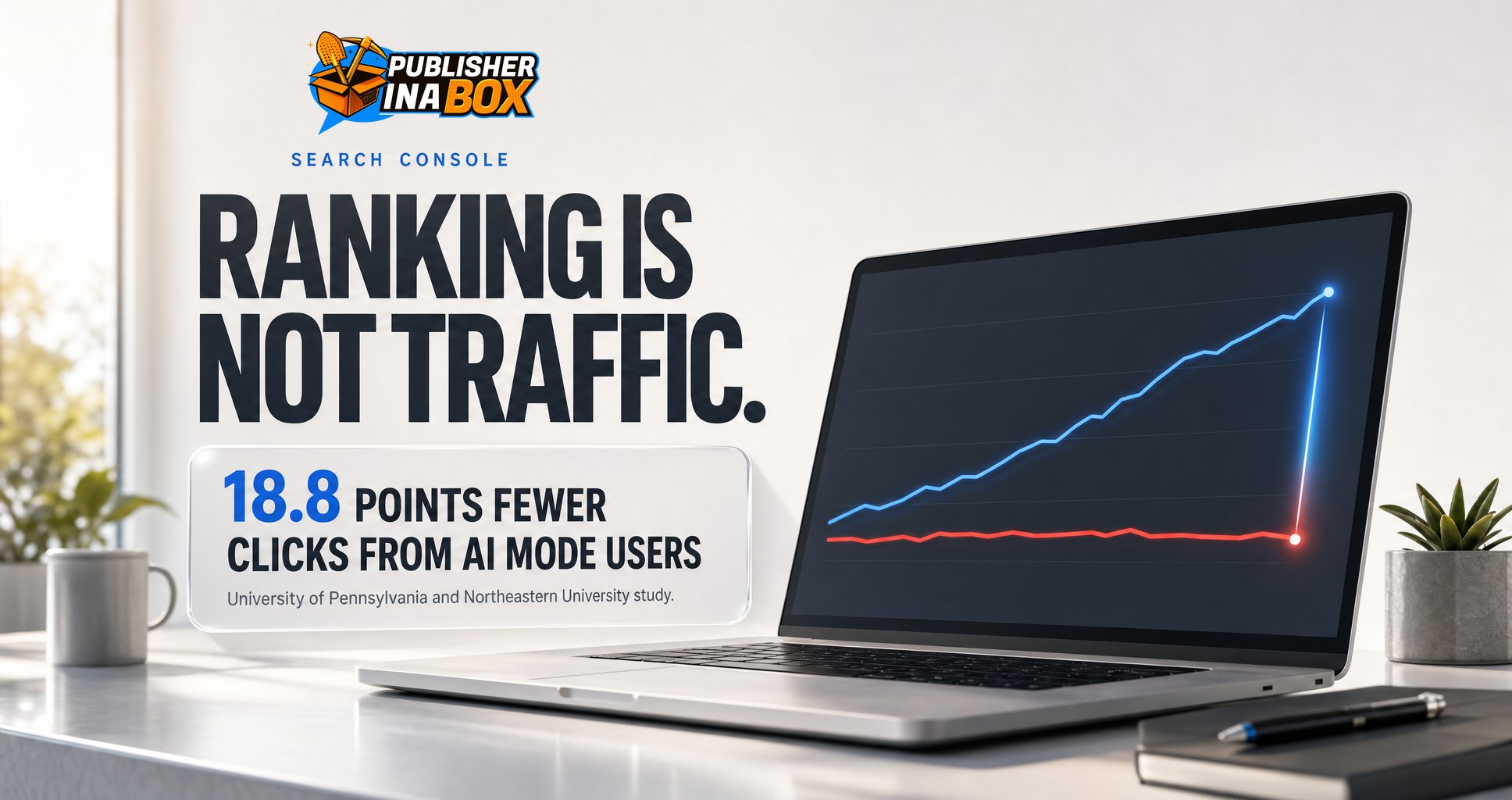
Look at what happens inside a search now. About 68 percent of US Google searches end without a click to any website, up from roughly 60 percent in 2024, because the answer often sits right there on the results page. A Bocconi University study using Comscore clickstream data found that households with access to ChatGPT Search ran 9.4 percent fewer traditional search queries, and that decline accelerated to 17 percent after twenty weeks, with news sites among the hardest hit at a 13.4 percent drop. A separate field experiment on 1,100 Chrome users who were moved to Google's AI Mode for a week saw external clicks fall by 18.8 percentage points, and news clicks specifically drop by 12.5 points. The audience is present. The click that used to carry that audience to your page is getting rarer on both surfaces.
Search versus AI chatbots by monthly unique visitors
monthly unique visitors (billions)
Source: Similarweb, 2026 Generative AI Landscape report. Rounded figures for scale, not audited totals.
Put the two findings together and the situation is not replacement, it is compression. The same reader who once searched, clicked, and landed on your article now often searches, reads the answer in place, and moves on, and sometimes asks an AI the same thing and reads that answer in place too. Your name may have informed both answers. Your page saw neither visit. That is why the traffic report looks like a slow leak even though your audience never went anywhere.
The real risk is invisibility on the second surface
Here is where the additive fact turns into a plan. If readers kept Google and added AI, then the growth is happening on the surface many publishers still ignore, and being absent there does not cost you old readers, it costs you the new ones forming their first impression inside an AI answer. That is a quieter loss than a traffic crash, because nothing shows up as a drop. The visit simply never happens, and you have no line item for a reader who met a machine's version of your topic and never learned your name existed.
The absence gets more expensive when you see how stingy these answers are with links. Only about 6.8 percent of ChatGPT answers in the US included an external link as of May 2026, which is up fivefold from around 1 percent a year earlier, and still means roughly 93 percent of answers send a reader nowhere at all. When the link is that rare, being the source the answer is built from matters more than hoping for the click, because the mention itself is doing the work that a link used to do. If the engine never draws on you, you are not in the reader's consideration set on the surface that is growing fastest, and no amount of Google ranking fixes that, since it is a different retrieval system entirely.
Being absent from AI answers does not cost you old readers. It costs you the new ones forming their first impression of your topic inside a machine, where nothing ever shows up as a drop.
This is the practice called Generative Engine Optimization, or GEO, which is earning a place in the small set of sources an engine trusts when it answers a question in your topic. Its measurable outcome is AI Citation Presence, the rate at which engines name or draw on you when they answer. It does not replace your search work, and it is not a rebrand of it. It is a second front you open on the surface your readers just added, so you are present in both answers instead of one.
How to show up in the answer
Winning a slot in an AI answer is less mysterious than it sounds, because an engine building a reply does not scan a page of ten results and pick one. It pulls a short set of sources it judges reliable, reasons over them, and produces a single answer, so the field collapses from a page to a handful. Getting into that handful rests on three things, and none of them is a trick.
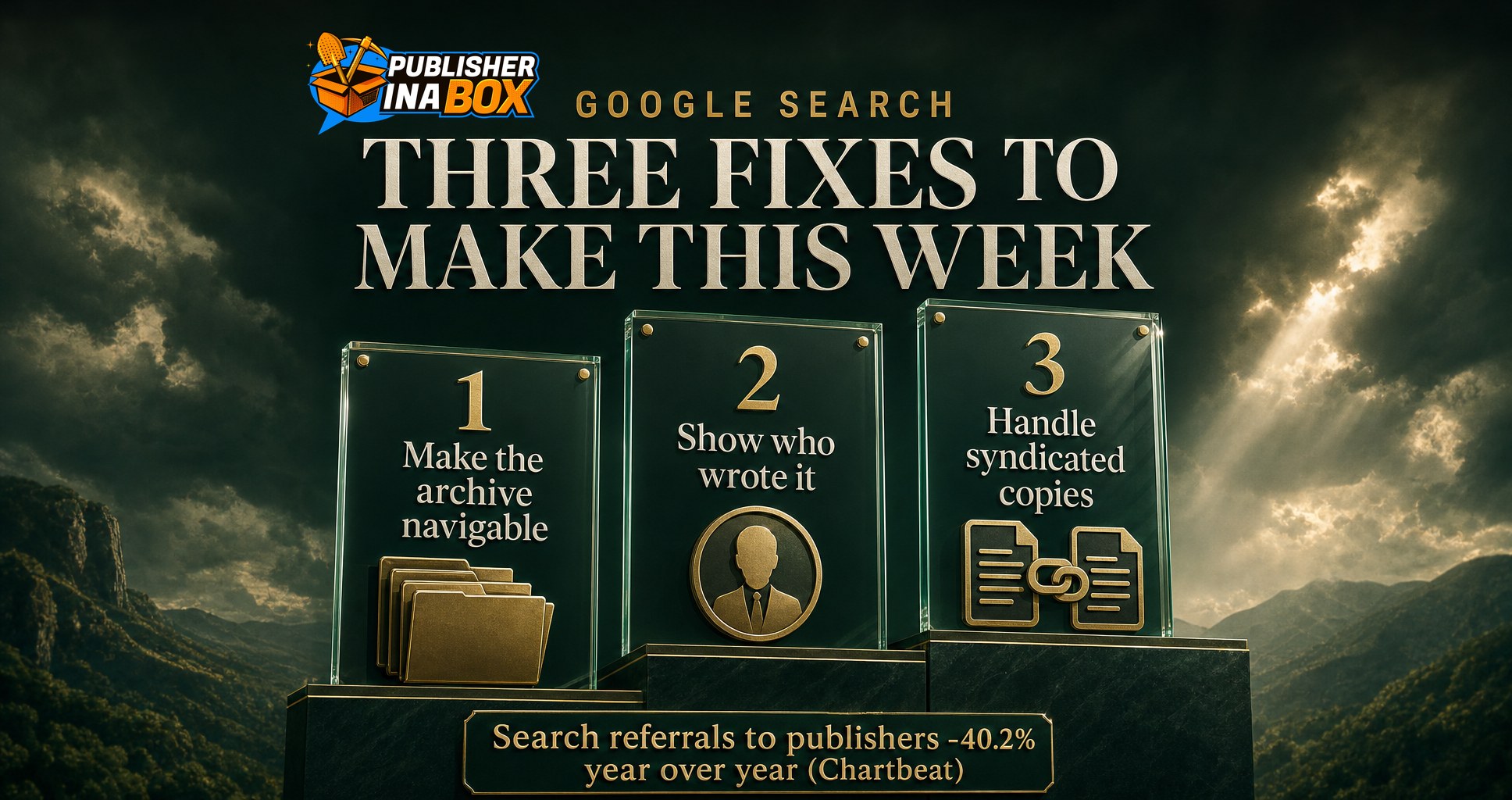
The first is Technical Retrievability, the GEO term for how cleanly a machine can fetch and read your content. When an AI tool retrieves your page it receives raw HTML and has to find your facts inside a document full of menus, cookie banners, scripts, and footers. Content that only appears after JavaScript runs can be invisible to a fetch that does not execute your code, so the most useful single fix is making sure your core article text, your headings, and your key facts are present in the initial HTML. This is plumbing, not strategy, and it is where a lot of sites lose the citation before the reasoning even begins.
The second is verifiable structure. Schema.org markup that labels your author, your publish date, your headline, and your organization turns a fact the model would otherwise infer into a fact it can confirm, and an engine that can confirm a fact uses it with more confidence than one it has to guess at. Article, FAQPage, and Organization schema are the plain version of that work, and they double as the foundation for the question-and-answer format engines love to lift.
The third is entity clarity, which the GEO vocabulary calls Entity Positioning and Topical Authority. An engine deciding whether to rely on you wants one consistent answer to who you are and what you cover, so your author bios, your About page, and your organization details should say the same thing in every place rather than three slightly different things. Consistency reads to a machine as reliability, and reliability is what earns the mention. You do not have to guess whether any of this is landing, because Google now shows AI performance data inside every Search Console account, so you can watch your footprint in AI answers grow or slip instead of reading it off a raw traffic chart.
Turn additive reach into something you own
Getting cited is the first move. Capturing value from it is the second, and skipping it is how publishers do the hard part and still come up empty. A mention without a click is real, because your name sitting inside a trusted answer builds recognition that returns later as direct visits and branded searches, and those are the visits no engine can intercept. But recognition only compounds if the reader who does reach you has somewhere to land that turns a single visit into a relationship you keep.
There is a specific quirk in the data that makes this urgent. When an AI answer does send a click, about 58.8 percent of those referral clicks land on a homepage rather than the exact page that was cited. So the reader who follows a mention often arrives at your front door, not the article, which means your homepage and your brand have to do the introducing that a deep article page used to do. Treat that arrival as the start of an owned relationship. Offer something clearly useful in exchange for an email, run a newsletter a reader actually wants, point them to a community they choose to join. An owned audience is the one channel no answer engine can reprice overnight, and building it is how borrowed reach becomes an asset you control.
This is where the PIB method parts ways with generic advice, because the real answer is not a one-time setup, it is continuous analysis and optimization. AI Share of Voice, the share of answers in your category that cite you against your competitors, moves week to week as engines re-crawl and re-rank, so you read your own data, find the topics where an engine already leans on you, and publish more depth there. That compounds your Authority Saturation in the pockets you are already winning, and it feeds the two pillars every publisher can pull, Curation, which is what you publish and how you shape it to your audience, and Virality, which is the reach that turns one strong piece into a monetized event.
The automation layer, and the honest caveat
Running that loop by hand across citations, schema, entity signals, and content depth is more than one person can sustain, so automation becomes the force multiplier, as long as it does not ship slop. This matters more now, not less, because an engine that catches you publishing hallucinated or generic content trusts you less, and trust is the entire currency of getting cited. The technical fork is worth naming so you know what building this actually looks like. You can wire a monitoring and republishing loop in n8n against the platform APIs, run scheduled jobs that hit the endpoints directly, or use a purpose-built system like the Facebook Automation Machine, PIB's n8n flow at $397, which produces branded, human-reviewed content in the formats a platform rewards rather than raw output that nobody checks. The tool is not the point. The point is a repeatable engine with a human judgment layer, because authenticity is the one asset a machine cannot fake, and in a feed drowning in generic answers it is exactly what earns both the citation and the reader.
Do not bet the business on any one surface
Every move here earns you standing in AI search, and none of them should become the whole plan, because the same lesson keeps arriving in a new costume. A publisher who bet the business on Google referral traffic learned it when AI Overviews absorbed the click. A publisher who bet everything on one Facebook feed learned it when reach changed overnight. AI search is the newest surface to add, and it is not a place to bet the business either, since its rules and its link policy can change the moment its economics change. The durable position is diversification for stability. Publisher in a Box is a publisher monetization company, the operating system for online publishers, and it manages and monetizes publishing assets across Facebook, Google Discover, content syndication, AI search, and asset sales. The point of showing up in AI answers is not to depend on AI answers. It is to hold one more owned position while the ground under every surface keeps moving, and to meet your reader on whichever one they open next.
Where to go from here
If you want to know exactly how the engines see you today and what to fix first, the GEO Authority System is the direct path. It runs an LLM Visibility Evaluation across ChatGPT, Claude, Perplexity, and Gemini, so you can see your AI Citation Presence engine by engine instead of guessing from a traffic dip. It comes with a GEO Authority Playbook built as a 30, 60, and 90 day roadmap, a PubScore report on your overall publishing health, and a custom Claude Context File your team can execute against. It is $499, and it turns the moves in this article into a sequenced plan against your real numbers. You can start at the GEO Authority System, and if you have questions first, the team answers at grow@publisherinabox.com.
Frequently asked questions
Is AI search actually replacing Google?
No. Similarweb tracked ChatGPT and Google audiences from March to May 2026 and found that 95 percent of ChatGPT users also use Google, a figure that held steady across eight months of rapid AI growth. Search still draws about 3.3 billion monthly unique visitors worldwide, roughly five times the entire AI chatbot category combined. Readers are adding AI to a Google habit that has not budged, not switching from one to the other.
If nobody left Google, why is my traffic still down?
Because usage and clicks are moving in opposite directions. About 68 percent of US searches now end without a click, a Bocconi study found traditional search queries fell 9.4 percent and up to 17 percent over time for households using ChatGPT Search, and a field experiment saw external clicks drop 18.8 percentage points under Google's AI Mode. Your audience is still there, but more of them read the answer in place and never click through to your page.
What does it cost me to be absent from AI answers?
It costs you new readers rather than existing ones. Because AI usage is additive, the growth is happening on a surface many publishers ignore, so being absent there means readers form their first impression of your topic inside a machine that never mentions you. That loss never appears as a traffic drop, which is exactly why it is easy to miss.
What is the single most important technical fix to get cited?
Make sure your core content sits in the raw HTML rather than being assembled by JavaScript after the page loads, because AI tools fetching your page often will not run your scripts, so client-side content can be invisible to them. After that, add valid Article, FAQPage, and Organization schema so the engine can confirm your facts instead of guessing at them.
How do I measure whether my AI search work is helping?
Use the AI performance data Google now shows inside every Search Console account, which reports your presence in AI Overviews and AI Mode. Track that footprint over time alongside your AI Share of Voice, the share of answers in your category that cite you against competitors, so you can see whether your presence is growing rather than reading it off total traffic.
Should I move my budget from Google to AI search?
No. The data shows readers use both, so the answer is to be present on both rather than trade one for the other. Earn your standing in AI search, convert the reach you get into an owned audience such as email, and spread your monetization across Facebook, Google Discover, syndication, AI search, and asset sales so no single surface can reprice your business overnight.
Key takeaways
AI has not replaced Google. Similarweb found 95 percent of ChatGPT users also use Google, unchanged from September 2025 to May 2026, so readers added AI rather than switching to it.
Search remains about five times the size of the entire AI chatbot category by monthly visitors, while AI is the surface growing fastest at around 70 percent year over year.
Traffic feels thinner because clicks are compressing on both surfaces at once, with 68 percent of US searches ending click-free and studies showing queries and external clicks falling under AI answers.
Being absent from AI answers costs you new readers, not old ones, and that loss never shows up as a drop, which is what makes it dangerous.
Getting cited rests on Technical Retrievability, valid schema, and consistent Entity Positioning, and you can now watch the result in Google Search Console's AI performance data.
A citation is not a payment, so convert the reach you get into an owned audience, and diversify across Facebook, Google Discover, syndication, AI search, and asset sales so no one surface controls your business.
Search Engine Journal, "Study: Users are adding AI search on top of Google, not replacing it," September 4, 2026. https://www.searchenginejournal.com/google-chatgpt-audience-search-queries-clicks/588200/
Similarweb, "2026 Generative AI Landscape: The Evolution of AI Search," 2026. https://www.similarweb.com/blog/marketing/geo/is-ai-replacing-search/
Semrush, "ChatGPT Is Not Replacing Google, It's Expanding Search," 2026. https://www.semrush.com/blog/google-usage-after-chatgpt-adoption/
Bocconi University via Comscore clickstream data, study on ChatGPT Search and traditional query volume, 2025 to 2026.
Wang et al., field experiment on Google AI Mode and click behavior among 1,100 Chrome users, August 2026.
Search Engine Land, "Google zero-click searches climb to 68% in 2026 study" (SparkToro and Similarweb data), June 2026. https://searchengineland.com/google-zero-click-searches-2026-study-479717
Google Search Central, Search Generative AI performance reports in Search Console, 2026.
schema.org, Article, Organization, and FAQPage structured data types. https://schema.org
See more from Publisher in a Box in your Google results
The team behind 300M+ managed followers. We help publishers scale traffic, revenue, and audience across Facebook, Google Discover, and syndication networks.