Search across our learning center -- articles, newsletters, and more. Start typing or click a topic above.
Stay in the Loop
Get exclusive publishing strategies, industry insights, and early access to new features. No spam -- just signal.
Join 2,000+ publishers. Unsubscribe anytime.
Industry News
AI Search, Facebook Page Monetization, and the Publisher Diversification Imperative
Publisher In a Box12 min read
Table of Contents
This article is part of our daily digest series, in-depth summaries drawn from our X account, @publisherinabox, expanded with industry data. (weekend recap)
The AI Search Traffic Drain Is No Longer a Forecast
The numbers coming out of independent measurement firms have reached a point where no publisher can call this a temporary dip. Brainlabs tracked a 10.5% decline in organic search traffic across 54 advertisers using 14 months of Google Analytics data spanning 19 sectors. That figure is not modeled or projected. It is drawn from real client data, and it sits inside a much larger body of evidence pointing in the same direction.
Chartbeat, which monitors more than 2,500 publisher websites, found that Press Gazette / Reuters Institute reported Google search referrals fell 33% worldwide in the year to November 2025, with the decline reaching 38% for US publishers specifically. Google Discover traffic fell an additional 21% over the same period. The Reuters Institute published those figures in its Journalism and Technology Trends and Predictions 2026 report.
The mechanism driving this is well understood. Digiday reported that across DCN member sites over eight weeks in May and June 2025, the median year-over-year decline in Google Search referral traffic was 10% overall, with non-news brands falling 14%. An automotive content publisher in the same dataset saw a 25% drop in traffic to articles ranking first in organic search, even as its search visibility rose 7%. More visibility, fewer clicks: that is the AI Overviews effect in plain numbers.
Seer Interactive's September 2025 study, which analyzed more than 25 million organic impressions across 42 organizations, found that organic click-through rates dropped 61% on queries where AI Overviews appeared, falling from 1.76% in June 2024 to 0.61% by September 2025, according to Digiday. Publishers who have built their entire audience acquisition strategy around evergreen search content are facing a structural revenue problem, not a rankings problem.
Global publisher Google referral traffic decline over time, per Chartbeat data published by the Reuters Institute.
Google AI Mode Now Features News Carousels: What Publishers Must Do to Get Cited
Google did not take traffic away and walk off. On May 27, 2026, Google expanded its Preferred Sources feature into AI Overviews and AI Mode, a move confirmed by Google Search Product Manager Duncan Osborn on the company's official blog. According to Search Engine Land, users have now selected over 345,000 unique sources, and people are twice as likely to click through to a source they have marked as preferred.
That click-rate advantage matters enormously for any publisher working on audience and platform consulting. A "Highly Cited" label also rolled out alongside the carousels, surfacing articles that other publications have widely referenced. According to SEOteric, the Top Stories carousel within AI Overviews went fully live for US mobile users on July 17, 2026, with search analyst Barry Schwartz noting the feature "can help send clicks from Google's AI search features."
The practical implication is a two-tier citation economy inside AI search. Publishers who earn the "Highly Cited" badge through original reporting and cross-publication references will accumulate a compounding citation advantage. Those publishing derivative, summary content will find the AI engine has already done that work for the reader. The carousels reward freshness, primary sourcing, and coverage of developing stories in a niche. They do not reward republished wire copy or aggregated roundups.
AI engines now select a short list of trusted sources per query. If your page is not among them, readers get their answer without ever visiting your site.
AI Search Platforms Are Now Selling Their Own Ads: What That Means for Publisher Revenue
The search traffic problem has a second dimension that publishers need to track separately from the traffic figures: AI platforms are monetizing the attention they captured. ChatGPT launched its advertising product in February 2026 at a $60 CPM rate and a $200,000 minimum advertiser commitment, according to eMarketer. That CPM positioned the platform as a premium channel at launch.
According to Trending Topics, the $60 CPM is roughly three times what Meta currently charges and is on par with the CPM Netflix commanded when it launched its ad-supported tier in late 2022. Early launch partners included global agency groups WPP, Omnicom, and Dentsu. Industry experts from WPP estimated OpenAI would generate between $500 million and $800 million in advertising revenue in its launch year.
The self-serve OpenAI Ads Manager opened to all US businesses in May 2026, eliminating the $200,000 minimum and shifting the platform to CPC and CPM bidding. eMarketer reported that Criteo subsequently reduced campaign spending minimums from $50,000 to $10,000 and added simplified product-feed integrations. Ads appear at the end of AI responses in a clearly labeled sponsored slot matched by topic relevance, not demographic targeting.
For publishers, the signal is structural: the platforms that displaced your search referral traffic are now selling the advertising inventory that used to sit on your pages. This is not theoretical revenue at risk. It is a direct competitive overlap between AI ad inventory and publisher display inventory, occurring precisely as search CPMs and click volumes fall.
Facebook Page Monetization: Recommendations Restored, Q4 CPMs, and Meta One in the UK
On the Facebook side of the ledger, three separate developments crossed our feed this week that every page operator running managed Facebook page operations should understand.
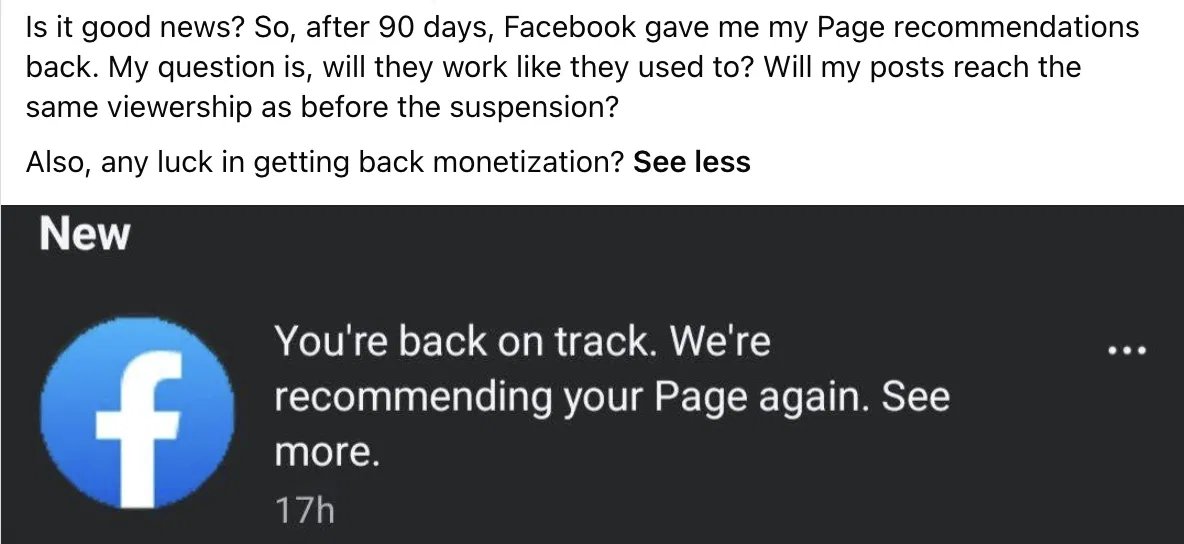
First, a page we track received confirmation from Facebook that its recommendations had been restored after a 90-day period with restrictions. The page operator asked the question that always follows: will reach come back, and does monetization follow? The answer to both is yes. Once a page receives the "we're recommending your Page again" notification, distribution begins rebuilding. Meta's own guidance, reflected in the official Meta newsroom post from March 2026 on rewarding original creators, is explicit that pages in good standing with original content get greater reach and monetization priority. Pages with active policy violations are typically ineligible for content monetization until those violations are resolved.
The "we're recommending your Page again" screen marks the start of a distribution rebuild, not the end of a recovery process.
Second, a science page we manage cleared $22,800 in a single month, up 63.4% from the prior period. The timing was December, and that timing is the mechanism. Q4 ad budgets get spent before year-end, CPMs climb across every monetized platform, and pages with mature, established reach capture disproportionate gains. A page that carries restrictions or policy flags going into Q4 misses the single highest-earning window of the calendar year. That is the operational reason why compliance and recovery timelines matter far beyond the month they occur in.
A mature, monetized science page cleared $22,800 in December, up 63.4%, as Q4 CPM rates peaked across the platform.
Third, a UK publisher received the Meta One prompt this week, and the pricing on that screen is now confirmed in pounds. Meta One Essential runs £12.49 per month, marked "Recommended," and covers the verified badge, impersonation protection, and an enhanced linksheet. Meta One Advanced runs £41.99 per month and adds Featured in Feed placement. Hush Digital has documented the Essential tier as broadly equivalent to where the previous Meta Verified proposition sat, covering badge, impersonation monitoring, and an enhanced linksheet. Meta has confirmed the prior Meta Verified product is not being retired, positioning Essential as its natural successor rather than a replacement.
A UK publisher's Meta One prompt showing Essential at £12.49/month and Advanced at £41.99/month, priced in pounds.
Why Publisher Diversification Is Not Optional
Taken together, this week's signals describe a publishing environment where no single platform can be treated as a stable, durable source of audience or revenue. Google's AI search is reducing click-through rates and building its own ad product. Facebook's algorithm rewards original content and punishes policy violations with reach penalties that compound heading into high-CPM periods. AI engines are directing readers to a short list of cited sources per query, with everyone outside that list effectively invisible.
The Reuters Institute's Journalism and Technology Trends 2026 report found that social referrals were "flat or slightly up" globally, with Facebook up 9% year over year in November. That is a meaningful contrast to the 33% decline in Google search referrals over the same period. Facebook's recommendation engine, as of early 2026, shows AI-recommended content in roughly 30% of Feed posts, per PostEverywhere's algorithm analysis. For pages publishing original, topically relevant content, that recommendation surface is a growth channel at a moment when Google search is contracting.
Diversification across owned audience channels, multiple content formats, and multiple platforms is the structural response. A page that has cleared a recommendations restriction, built consistent original content cadence, and positioned for Q4 CPM peaks is doing what the current environment requires. A page dependent on a single traffic source, whether that is Google search or Facebook organic reach alone, carries concentrated risk that is difficult to hedge once a restriction or algorithm shift arrives.
Frequently asked questions
What does "Facebook recommendations restored" mean for a page's reach and monetization? When Facebook restores recommendations to a page, it means the platform will begin distributing that page's content to users who do not already follow it, through the recommendation engine. Reach rebuilds progressively rather than returning overnight. Monetization eligibility follows the same compliance rules: a page must be in good standing with no active violations. Once recommendations are restored, both reach and monetization income typically recover over the following weeks as the distribution algorithm reintegrates the page into its recommendation pool.
Why do Q4 CPMs matter so much for Facebook page monetization? Advertisers operate on annual budget cycles, and year-end spending pressure pushes CPMs higher across every major ad platform in November and December. Pages with mature, established reach capture more of this premium inventory. A page earning a consistent monthly sum during Q2 or Q3 can see earnings climb 40% to 70% or more in December under the same content conditions. Pages that carry restrictions or low-reach penalties heading into Q4 miss the single highest-value earning window of the calendar year.
What is Generative Engine Optimization (GEO) and why does it matter for publishers now? GEO refers to the set of content and authority-building practices that increase the probability of an AI search engine citing your site when it constructs an answer in your niche. AI engines like Google AI Mode, ChatGPT, and Perplexity select a short list of sources per query. Publishers who are not among those sources receive no referral traffic from that query, regardless of their traditional search ranking. GEO signals include original reporting, cross-publication citations, "Highly Cited" status in Google's system, freshness, and topical authority concentration.
What is Meta One and how is it different from Meta Verified? Meta One is Meta's updated subscription product that consolidates and extends the earlier Meta Verified offering. The Essential tier covers the verified badge, impersonation protection, and an enhanced linksheet. Higher tiers add distribution benefits such as Featured in Feed placement. Meta has confirmed that Meta Verified is not being retired, and that Essential should be understood as its natural successor. UK publishers are now seeing the Meta One prompt with pricing in pounds, confirming the product is in active rollout across international markets.
How should publishers respond to AI search platforms selling their own advertising? AI platforms monetizing attention they captured from publisher traffic creates a direct competitive overlap with publisher display inventory. The practical response is audience ownership: building email lists, push notification subscribers, and direct return-visit habits that do not depend on a search or social referral. It also means concentrating on the content signals that earn AI citation, so that even when an AI engine answers a query, your brand appears as a credited source. Revenue diversification across platform ad programs, direct sponsorships, and owned-audience channels reduces the exposure any single advertising market creates.
See more from Publisher in a Box in your Google results
The team behind 300M+ managed followers. We help publishers scale traffic, revenue, and audience across Facebook, Google Discover, and syndication networks.