
Part 2 lays out the operational playbook. This is the system Publisher In a Box has tested across dozens of conservative media Facebook pages, spanning fresh launches with zero starting followers all the way to dormant multi-million-follower pages being re-activated after periods of neglect. The principles are consistent across both starting conditions. The pacing and intervention sequence adapts to where the page begins.
Part 1 established the market case and the revenue math. Part 2 is the operating manual. Read it as a sequence rather than a menu. Each section builds on the one before it. Skipping sections breaks the system.
Section 1: Page Foundation
- Every page in the network reads like a news outlet, not a personal opinion wall
- Category set to Media/News Company or News & Media Website on every page
- Profile picture is a clean logo, dark or neutral colors, consistent across the network
- Cover photo is headline-focused, no clutter, brand-aligned per property
- Avoid faces, flags, party symbols in branding on any page in the portfolio
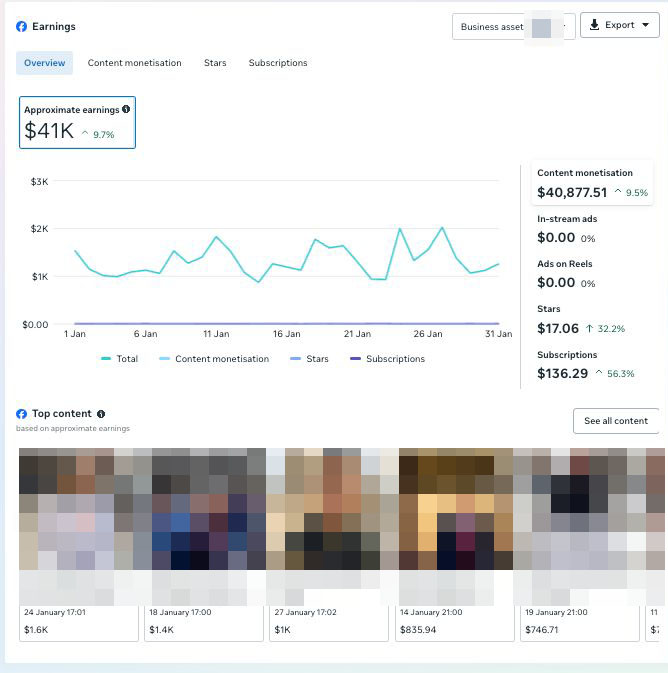
Whether the operation is one new page being launched today or a portfolio of 20 properties already sitting on tens of millions of followers, the foundation rules are the same. New pages lose the game in the first 30 days when the setup looks unreliable. Established networks lose 2 to 10x of available revenue when the audit shows half the pages in the portfolio are misclassified, off-brand, or sending mixed signals to the algorithm. Facebook treats political pages like publishers. The page setup has to match on every page in the network, every time. The operators who win in this niche treat the foundation pass as the single most important audit cycle on the portfolio, because every algorithmic decision Facebook makes downstream is influenced by the signals each page sends.
Page name and identity
A conservative media page that wants long-term distribution and trust needs to be named like a news outlet, not a personal opinion wall. This applies to a fresh page being named today and to a 5,000,000-follower page being re-audited inside an existing brand. Strong brand names already in market still need to be checked against the rules below.
Rules to follow when naming or re-auditing a page:
- Keep the name simple and credible
- Avoid emotional, aggressive, or partisan language in the name itself
- Think like a publisher, not an activist
- Apply the same naming standard to every property in a multi-page network
Page name examples that perform well in the conservative media category:
- Daily Political Buzz
- Capitol News Desk
- Public Affairs Report
A neutral identity helps in three measurable ways. Higher audience trust, more organic shares from people who would otherwise filter out aggressive branding, and faster approval for monetization features later in the lifecycle. Inside a multi-page network, the cumulative effect compounds. Five clean names outperform five aggressive names by a wide margin in long-term distribution, regardless of follower count.
Category selection
On every page in the portfolio, select one of the following Facebook page categories:
- Media/News Company
- News & Media Website
This signals to Facebook's classification system that the page is a legitimate news operation. It aligns the page with how political content is evaluated, distributed, and monetized on the platform. A single misclassified page inside a 20-page network drags the whole property line down. Audit every page in the network and standardize the category before doing anything else.
Profile picture and cover photo
The visual presentation needs to match the news outlet positioning on every property in the network. Mix and match identity across pages confuses both the algorithm and the audience.
Profile picture guidelines:
- Use a clean logo or bold text-based logo
- Dark or neutral colors perform best
- Avoid faces, national flags, or party symbols in the profile image
- Keep visual treatment consistent across every page in the network
The profile image should look like it belongs on a news website header, not a personal profile.
Cover photo strategy: keep it simple and headline-focused. The goal is clarity, not creativity. Effective cover text examples: “Breaking Political News and Analysis” or “Verified Political Updates, Daily Coverage.” Avoid clutter, memes, and slogans. Professional branding sets the tone for everything that follows, and a brand-aligned treatment across a multi-page network reinforces the audience trust that drives both Content Monetization eligibility and referral conversion downstream.
Section 2: Content Strategy from Day One
Politics pages lose when they chase opinions instead of attention. The audience does not show up to be argued at. The audience shows up to be informed, to react, and to share. From day one, content needs to be clear, timely, and professional. Every shortcut on this front costs distribution. Every shortcut.
What to post early
Focus on content that is factual, immediate, and easy to digest. Early content examples include:
- Breaking news summaries
- Short political updates, 3 to 5 lines
- Quotes from officials
- Bills, elections, and policy moves
Post formats that work
Different formats serve different audiences. Use a mix, and stay professional in every format.
- Text posts: simple, clear, to the point, preferably on a black background
- Image posts: real images with overlay text, captions of 3 to 5 short paragraphs work best
- Viral post designs: borrow proven trends, adapt them with creative tweaks specific to the page
- Reels: highest potential to surface in front of fresh audiences, post them consistently
Post style requirements: maintain a neutral tone in the post itself. Avoid emojis, rage bait, or loaded language at the start of a caption.
Posting frequency
A conservative media news network can easily work up to roughly 48 posts per day, posting 24 hours around the clock. Facebook's algorithm figures out the proper distribution to each segment of the audience on its own. The operator's job is to keep the stream alive and to save the strongest content for the windows when the main audience is awake.
- Starting range on a fresh page: 6 to 10 posts per day in the first 30 days while the algorithm calibrates
- Scaling range on a developing page: 12 to 24 posts per day, spread across morning, afternoon, evening, and overnight as views and engagement grow
- Mature range on a large page or a network at full operational capacity: up to 48 posts per day, posted around the clock
- Save the strongest, highest-share-potential posts for the daytime hours when the primary U.S. audience is online. Overnight posts catch international and insomniac segments and feed the algorithm continuous activity signal.
- Higher volume gives Facebook more data to learn what the audience responds to and which segments react to which formats at which hours
The posts published in the first few weeks of a new page, or the first few weeks of a re-audit on an established page, shape how Facebook ranks the property. They shape how the audience perceives credibility. They shape how fast the page builds distribution. Every early decision compounds. Get the opening cycle right and the next twelve months get easier. Get it wrong and the page spends six months digging out of a hole the algorithm dug on its behalf.
Section 3: Sourcing and Curating News the Smart Way
How content is sourced and curated will make the page or break it. There is no middle ground. The audience in this niche expects timely, accurate, relevant news. Done right, curation positions the page as a trusted source the audience returns to every day. Done wrong, the page racks up copyright strikes, loses distribution, and becomes invisible.
Never copy-paste full articles
Copying content verbatim is a fast track to trouble. Facebook monitors this closely. Always rewrite, summarize, or add context. The page is producing original commentary on news events, not republishing someone else's reporting word-for-word.
Best sources for political news
Focus on reliable and authoritative sources:
- Government websites and press releases
- Major news outlets across the political spectrum
- Public statements from officials
- Verified social media accounts of policymakers, agencies, and reporters
Tools to get news early
Timing is everything in this niche. Everything. Early posts perform better, pull wider audiences in, and catch the viral wave first. Late posts pick up scraps. The internal content curation tooling at the operator level needs to do three things:
- Push notifications for trending political stories the moment they begin gaining traction
- Surface verified context quickly so the page can post as the story rises rather than after it peaks
- Track which stories the page itself has already covered, to avoid stale repeats
The brands running the strongest curation pipelines treat this layer as core infrastructure rather than an afterthought. The setup matters less than the discipline. A team owning sourcing across a fixed set of feeds, with documented coverage rules and a real-time pulse on the niche, beats a more elegant tool run sporadically.
How to repost safely
To protect the page from copyright issues or strikes:
- Rewrite in original language
- Link to the original source where attribution is required
- Add a short, neutral summary positioning the page's coverage
Doing this consistently positions the page as a professional news outlet and keeps the operation running smoothly across the full audience cycle.
Section 4: Page Like Ads for Initial Traction
When a new Facebook page launches, the algorithm does not trust it. The page is an unknown signal in the system. Post at full volume from day one and Facebook does not know what to do with the content. It serves it to almost no one. Page goes dark before it had a chance. The fix is page like ads. Small budget. Tight setup. Massive long-term return. Done right, this is the highest-ROI ad spend in the entire system.
The setup that works
| Setting | Specification |
|---|---|
| Daily budget per ad set | $3 to $5, not $10, not $30 |
| Targeting | USA only, broadest possible audience |
| Demographic filters | Age and gender only, no interest layers |
| Campaign structure | One ad set per creative, never bundle |
| Creative testing | 3 creatives at once, kill the weakest 2 after 72 hours |
| Target cost per like | $0.01 to $0.02 |
Going higher than $3 to $5 per ad set does not produce better results. It produces worse ones. The algorithm needs a low, steady signal to optimize. Larger budgets cause the algorithm to expand too quickly, which raises cost per result and breaks the optimization loop.
Why interest targeting fails
The most common mistake is adding interest layers. Operators add political affiliation filters, news interest filters, age range narrowing. None of it works. The algorithm is better at finding the audience than the operator is. The only acceptable demographic filter is age and gender. Nothing else.
Reading the ad results at the 3-day mark
- $0.01 to $0.02 per like: working. Keep running and launch similar creatives modeled on the winner.
- $0.03 to $0.05 per like: the concept is sound, the creative needs work. Pause and rebuild the creative, not the targeting.
- $0.06 and above: kill it. Replace it entirely. Do not try to optimize.
The 90-day economics
$3 a day for 90 days is $270 in total ad spend. $270. At $0.01 to $0.02 per like, with strong content generating organic shares on top of paid acquisition, a page can realistically build to 50,000 to 100,000 followers for under $1,000 in total ad spend. That is the entire bill. Politics specifically produces a stronger organic multiplier than almost any other niche on the platform, because the sharing behavior amplifies every paid follower into multiple unpaid ones. This is the cheapest audience acquisition channel available on Facebook today for this category. Operators who skip it pay a much bigger price later in content production trying to break through without it.
Creative direction for political ads
Content that touches themes of freedom, patriotism, and liberty without making direct partisan statements tends to perform best in ads. The classic format “If you love your country, click the thumbs up below” still works at scale. Direct partisan attack content performs in the feed but does not perform as well in the ad system, which is more sensitive to controversy signals than the organic feed is.
The organic multiplier on every paid follower
For every 1 paid follower acquired through a Page Like ad, a properly run campaign on a strong creative should pull in another 2 to 3 organic followers on top. The paid follower is a seed. Their friends and network see the follow activity, the engagement on the page picks up, and Facebook starts surfacing the page organically to adjacent audiences. The published cost per paid like understates the real cost per follower by a factor of roughly 3x. At $0.02 per paid like with a 1:2.4 organic multiplier, the effective cost per follower added to the page is closer to $0.006.
Reels are now more efficient than Page Like ads on follower growth in 2026
On a developed page in 2026, a strong Reels output is typically more efficient at follower growth than a Page Like ad campaign on a per-dollar basis. Reels generate views far past the existing follower base, pull in organic follows from audiences who would never have been touched by an ad set, and compound into distribution gains across every other format on the page. The two channels are not substitutes. They are stackable. The strongest playbook in this niche runs both in parallel.
- For fresh pages and small or stagnant pages: run Page Like ads from day one to seed the algorithm with a baseline follower signal. Layer Reels on top as soon as the page can produce them consistently.
- For developed pages and large pages: lean on Reels as the primary growth engine and reserve Page Like ads for stuck-page reactivation and for opening up smaller pages inside a multi-page network.
- For multi-page networks: run Page Like ads on the small and stuck pages while Reels carry the growth on the large pages. The same operator runs both lanes in parallel because the audience composition and the algorithmic position of each page calls for a different mix.
Section 5: The Content Formats That Drive the Niche
Image posts with captions are the highest-performing content type across conservative media pages. Followed by Reels. Followed by text posts. The data on this is clearer than most operators realize, and the gap between the formats that win and the formats most operators default to is enormous.
NewsWhip's analysis of political Facebook pages found photo posts produce the most interactions per post. Even though link posts are far more common. Translation: most pages are defaulting to the format that performs worst. Year after year. Cycle after cycle. Leaving distribution on the table the entire time.
For a conservative media page running images and leading with them, the operator is already inside the highest-engagement format inside the highest-engagement political category on the platform. Two structural advantages, stacked. Most operators in this niche never connect those two facts. The ones who do are the pages that dominate the niche.
Image posts with long captions
The primary revenue-driving format. A strong political image, sourced cleanly, with a caption that runs 3 to 5 short paragraphs of real context. The caption needs to earn the “See More” click in the first two lines. If it does not, dwell time stays low and distribution gets cut.
Long captions that hold attention
Facebook measures how long someone spends on a post as a quality signal. A long, substantive caption about a political story, with real context, real background, and real implications, keeps people reading. That dwell time translates directly into better distribution and better monetization performance. Operators who shorten captions because they think no one reads them are training the algorithm to distribute their posts less.
Black background text posts
For politics specifically, the black background text post format outperforms every other background color. The visual contrast and the directness of the format align with how political audiences consume content on the platform. White background text posts underperform black background text posts in the conservative media niche.
Breaking news text posts
The fastest-deployable format in the entire toolkit. No image required, which removes the biggest production bottleneck. Native Facebook text post on black background, publishes in minutes from any device. The word “BREAKING” in the headline triggers higher click and share behavior from political audiences. This format captures the early engagement window on a story, with richer image or Reel content following as it becomes available.
Reels
Covered in depth in the next section.
Evergreen content reflecting values
Freedom, constitutional principles, community, national identity. These themes perform consistently because they map to identity signals that drive sharing behavior. The audience shares content that reflects who they are, not only what happened today. A library of evergreen value-themed content keeps the page performing during slow news cycles.
The sharing test
Every piece of content should pass a simple test before publishing. Would someone share this to signal something about themselves to their own network? If yes, it is a strong post. If not, either the emotional hook is missing or the topic is not resonant enough with audience identity. Send it back for revision before publishing.
The reason this test works is structural. Research has shown that political audiences are not passively reading content. They are actively using it to reinforce and express their identity. When someone shares from a conservative media page, they are not sharing information. They are making a statement about who they are. Content that supports that behavior compounds. Content that does not goes quiet no matter how factually relevant it is.
Section 6: Reels Are the Growth Engine
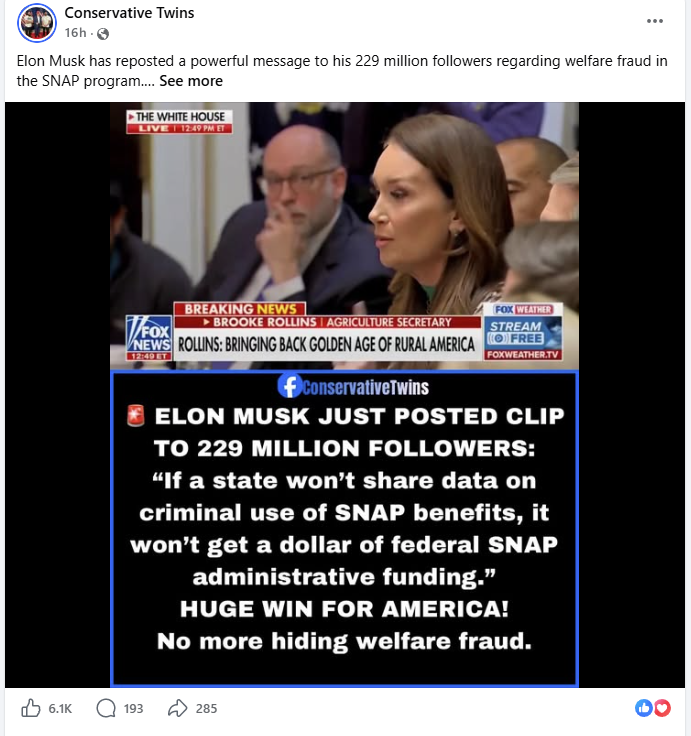
Reels are the highest-view-count format on Facebook by a significant margin. They generate views far beyond the existing follower base. A page with 100,000 followers can generate 500,000 to 1 million views on a single Reel when the content connects. A page with 1.6 million followers can put a single Reel in front of 8 to 16 million viewers. The follower count is not the ceiling on a Reel's view count. The hook is.
Reels are the single largest lever for breaking through the $25,000 a month revenue ceiling on dormant conservative media pages. Image posts, text posts, breaking news, and caption strategy together produce strong baseline performance, but the thing that consistently moves a page past $30,000 a month as a permanent floor, with strong months above $40,000 to $50,000, is the introduction of a super-viral Reels strategy.
Reels income does not replace image post income; it compounds it. Reels generate engagement signals that improve distribution for every other post on the page, so image posts, text posts, and breaking news updates all start performing better because the page has demonstrated to Facebook that it holds attention at scale. One winning Reel a week pulls the entire page upward.
Reels formats that work in conservative media
- Breaking news recaps with fast, punchy delivery
- “Here is what you need to know about ____” format
- Reaction and commentary Reels taking a direct point of view
- Quote and statement visuals set to audio
- Super-viral political content optimized for share rate
Cadence
- Minimum during early growth phase: one Reel per day
- During aggressive growth phases: two or more Reels per day
- Hook the viewer in the first 3 seconds. Everything in Reels depends on not losing them at the start.
The length progression
Most operators stop at the 30 to 60 second Reel format. The revenue gains from extending to longer formats are real and have been documented across multiple pages.
| Phase | Length | Status |
|---|---|---|
| Phase 1 | 30 to 90 seconds | Proven baseline, currently running on most pages |
| Phase 2 | 90 seconds to 3 minutes | Tested, strong revenue lift |
| Phase 3 | 3 to 5 minutes | Active testing, expected next ceiling break |
| Phase 4 | ROI analysis comparing production cost against revenue lift for each length tier | Internal benchmarking phase |
Longer Reels generate more dwell time per view. Dwell time is one of Facebook's primary content quality signals. A 5-minute Reel that holds attention pays significantly more per view than a 30-second clip. The RPM on long-form video is materially higher. The production cost is also higher, which is why testing the ROI at each length tier matters before committing to full-scale production at the longer end of the range.
Reels economics inside Facebook Content Monetization
Approximate Facebook Content Monetization payout on Reels: $100 to $200 per 1,000,000 views, or $1,000 to $2,000 per 10,000,000 views. This number is climbing. Pages that build strong Reels libraries now are positioned ahead of where the RPMs are heading on the platform, while operators who wait six to twelve months are catching up or falling behind.
Section 7: Breaking News Velocity Is the Single Largest Lever
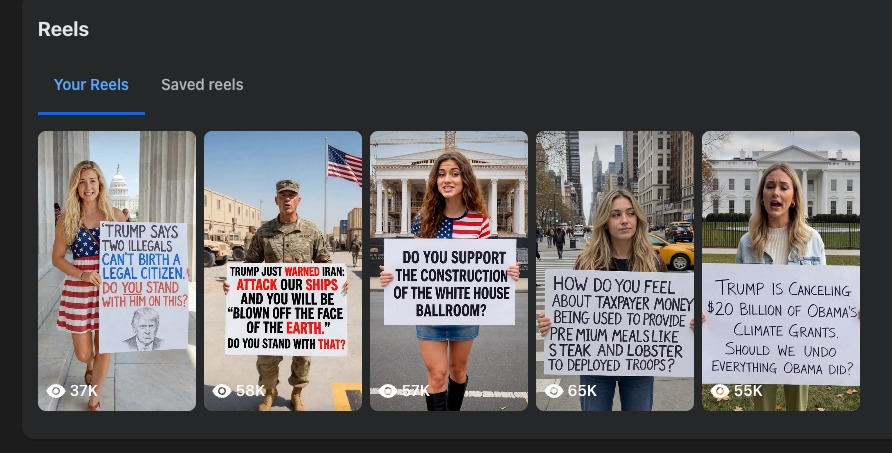
Across the entire system, the largest single lever for the conservative media niche is breaking news velocity. Being 10 to 15 minutes ahead of competing pages on a trending political story produces ten times the views and shares of the same post published an hour later. Not 10% more, ten times.
The reason is mechanical. Political news moves fast, and the audience moves with it. The first page to post a developing story captures the full engagement spike that occurs as the story breaks. Pages that post the same story an hour later pick up residual views. Breaking news posts generate high early engagement velocity, which is the signal Facebook uses to decide whether to expand distribution. The race is won in the first 30 minutes. After that, it is over.
For the conservative media niche specifically, breaking news velocity matters more than in any other category, because the audience is conditioned to follow news as it develops in real time. A page that consistently breaks stories first becomes the default destination for the audience, while a page that arrives second or third on every story becomes a follow-along.
The operational requirements for sustained breaking news velocity
- Real-time news alerts set up across major political sources, with notifications routed to the page operations team within minutes of a story breaking
- Caption templates pre-built for common story types, so the writing phase compresses from minutes to seconds
- Breaking news text post format ready to deploy as the primary speed format, with image and Reel coverage following within 30 to 60 minutes of the initial post
- Direct publish capability from mobile devices, so the team posts breaking news from anywhere without dependency on a desktop scheduling tool
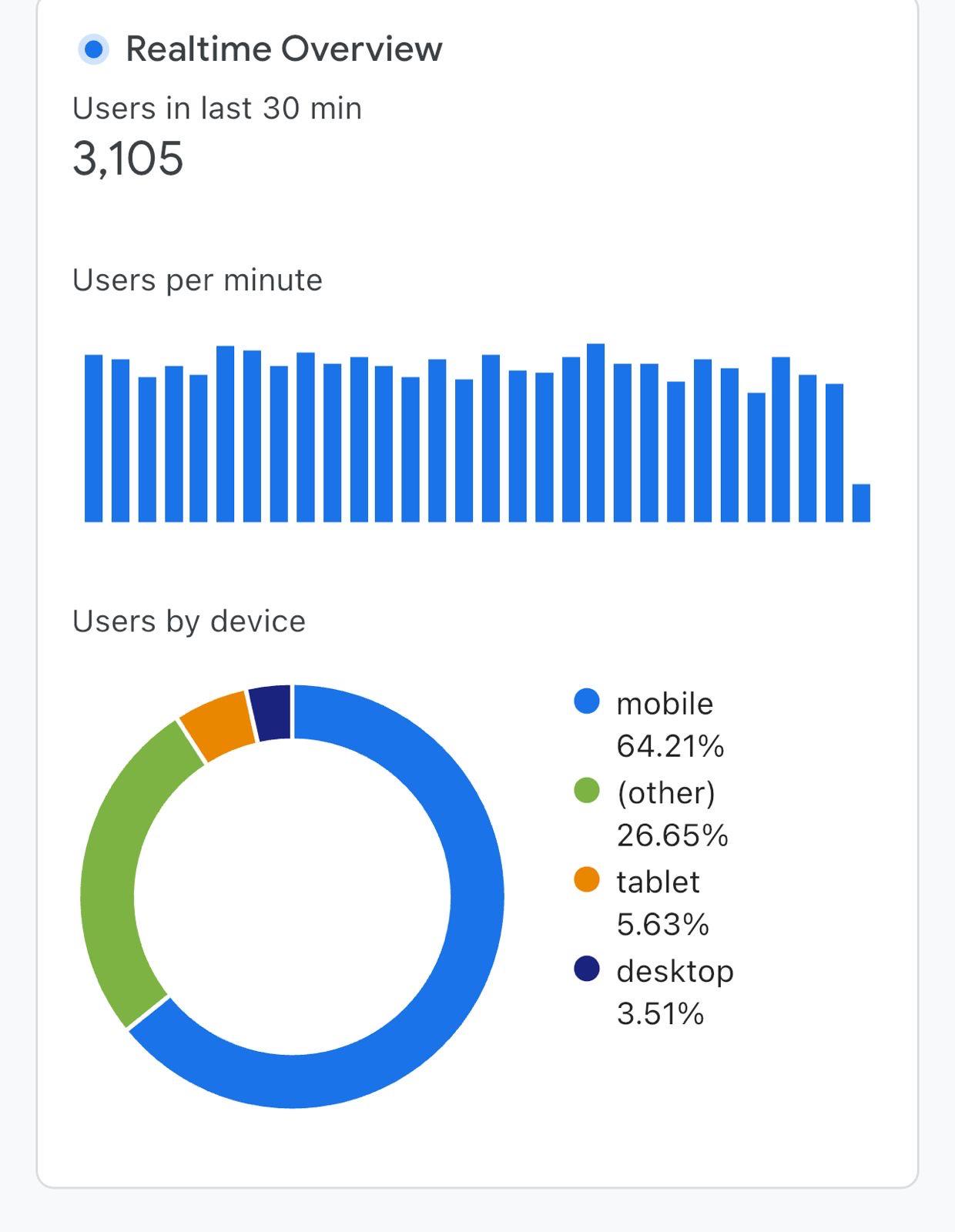
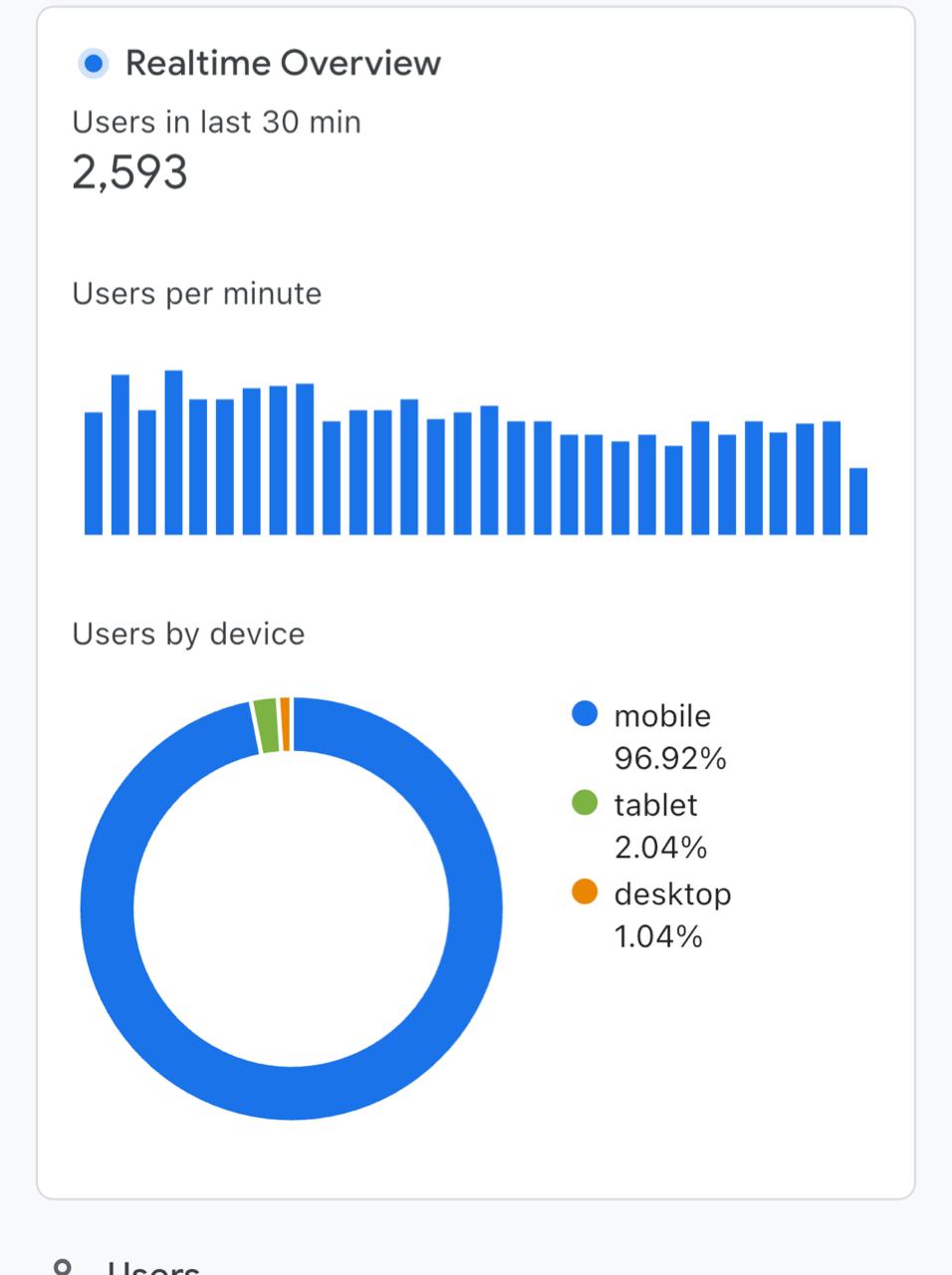
This is operational. It does not require talent; it requires systems. The pages that consistently win the breaking news race are not the ones with better writers, they are the ones with tighter operational loops.
Section 8: The Repost System Most Publishers Ignore
Most operators treat a strong post as a one-time event: it hits, it ages out, the team moves on to the next story. This is operational waste, and it is happening on every major page in this niche right now. In politics, the strongest posts are not one-time events; they are reusable assets. Refreshing the angle, rewriting the hook, and republishing during the same time window often produces a second run that outperforms the first.
Political emotions recycle. Frustration with institutions, pride in national identity, concern about overreach, support for community. These themes resurface constantly because they connect to values, not single news cycles. A post about government accountability that performed during one trend cycle performs again, often better, if the angle is refreshed and the hook is rewritten.
The repost loop
- After a post goes live and performs well, log it as a proven winner in a tracked library
- Identify another news story that connects to the same underlying theme
- Create a new post using the same emotional structure as the winner
- Rewrite the caption opening and the hook while keeping the core content intact
- Publish during a comparable time window to the original
The second run on a strong political post often outperforms the first by 20 to 40%. The reason is that the audience has already validated the underlying emotional appeal through the first post's performance. The algorithm has classified the type of content as high-engagement on the page. The repost is starting from a higher distribution baseline than a brand new post would.
Operators who run this loop systematically build a content library of proven structures rather than constantly generating from scratch. Production speed lifts, hit rate climbs, and the page produces more high-performing content per unit of team effort. Same team, same hours, multiples on output. This is one of the highest-impact operational moves in the entire system, and almost nobody runs it.
Section 9: Sharing Psychology and the Net Follows Metric
The conservative media niche shares more than almost any other vertical on Facebook, and understanding why and engineering for it deliberately is what separates pages that grow steadily from pages that grow exponentially.
Research has shown that conservative Facebook users, in months when they visit Facebook more frequently, consume news that is roughly 30% more conservative than their broader online news diet. The platform intensifies the signal they came in with. What that means for publishers is that the audience is actively using page content to reinforce and express their identity.
When a follower shares a post from a conservative media page, they are not sharing information; they are making a statement about who they are. This is why emotional resonance matters more in this niche than in almost any other. The content is not competing to inform, it is competing to represent, and the posts that win are the ones the audience feels proud to put on their own profile.
Facebook's engagement-based algorithm rewards this behavior. The amplification of emotionally charged content is measurably stronger for political audiences than for general news consumers. The platform's distribution mechanics and the audience's sharing psychology point in the same direction, which compounds the effect.
The sensationalism question
Every conservative media operator has to make this decision consciously, rather than by default. The decision is how far to lean into sensational, divisive content framing.
The honest pattern across the niche is this. The more exaggerated and emotionally charged the framing, the faster view counts climb. Research backs this up. Facebook's engagement-based algorithm rewards emotionally charged content, and the effect is stronger for conservative audiences, who share and interact with inflammatory content at higher rates.
But there is a metric that has to be tracked closely, and most publishers do not track it carefully enough.
Net follows
Net follows is the difference between new followers gained and existing followers lost in any given day or week.
- If sensational content is pushed and new follows outnumber unfollows, the strategy is working and the page is growing.
- If unfollows start matching or exceeding new follows, the content is alienating more people than it is attracting, and growth has a leak in it.
Some audiences in the conservative media niche are highly pro-divisive content. They share it, react to it, bring their networks to it. Other audiences inside the same niche are more moderate. Pushing too hard into inflammatory territory pushes the moderate segment away.
An operator needs to know which audience they have built before deciding how far to lean into sensationalism.
The publisher decision framework
| Primary Objective | Strategy |
|---|---|
| Maximum short-term revenue | Lean harder into viral, emotionally charged content. Accept higher churn. Optimize for views per post. |
| Long-term audience compounding | Accept a slower revenue climb in exchange for stickier followers who do not churn when the content heats up. |
| Both | Watch net follows weekly. Set a floor below which net follows will not drop. Use that floor as the guardrail for content tone decisions. |
There is no universal correct answer. What there is, is a decision that needs to be made consciously rather than by drift.
Section 10: Monetization Preparation
Long before Facebook formally approves a page for Facebook Content Monetization, the operation needs to look and behave like a monetized page. The pages that plan ahead grow faster, get approved faster, and face fewer roadblocks at the approval stage. The pages that wing it get stuck in review queues for months. Same threshold metrics. Different operational hygiene. Completely different timelines to revenue.
What Facebook looks for
- Original captions: every post has unique text, not copied from other sources
- Consistent posting: regular activity signals a reliable publisher
- Policy-safe content: stick to neutral, verified, professional content
- Professional branding: logos, cover images, and overall presentation aligned with a news outlet
When these elements are in place, monetization approval becomes a formality rather than a hurdle. The platform rewards pages that operate like legitimate news outlets from day one. Pages that hit the threshold requirements with messy operational histories get stuck in review. Pages with clean histories get approved fast.
Content originality scoring
Facebook surfaces a content originality score to page operators. The score sits on a band from low to high quality. Pages that score “Very good” with 90% or more of content passing originality checks have a structural advantage in monetization approval and ongoing distribution. The way to score high is operationally simple. Every caption written original to the page. Every image either licensed, original, or transformed enough to pass originality checks. Every Reel structured around original commentary rather than reupload of someone else's content.
Misinformation is the primary monetization risk in this niche
For politics pages specifically, the compliance points that matter more than in other niches are misleading headlines, unverified claims, and exaggerated statistics. These are the equivalent of false health claims in wellness niches. They are the fastest path to losing monetization.
Facebook's own data has shown that posts rated false by fact-checkers historically saw future views drop by over 80% on average. Even with the third-party fact-checking program retired, the underlying detection systems remain active. A single viral misinformation post costs more in lost distribution and monetization eligibility than any short-term engagement spike is worth.
Verify before publishing. Factual accuracy is not an ethical preference in conservative media. It is a strategy to protect monetization revenue.
Section 11: Team Structure
This is the model that separates pages capping at $2,000 a month from pages above $20,000 and beyond, and it is the same model that scales to a network of 40 pages running under a single Project Manager. One person managing a single page scales only so far. Beyond that point, the operation needs a team with clear roles or it stalls. The networks that break through are not the ones with better operators. They are the ones with proper teams stacked under proper management.
The structure is built around two layers. A 3-person operational team that drives the daily work across up to 40 pages of any follower count, and a Project Manager above the team who owns quality assurance, quality control, brand standards, and final content review. As the network scales past 40 pages, the operator stacks additional 3-person teams under the same Project Manager rather than expanding any one team beyond the 3-person boundary.
Role 1: Curator
Sources real-time political content across the niche. Monitors breaking news, identifies stories about to trend before they peak, and pushes them to the rest of the team within minutes of identification. Speed and pattern recognition are the competitive advantages in this role. The Curator feeds the entire production pipeline.
Role 2: Creator
Writes captions. Builds graphics and overlay images. Cuts Reels. Formats every post, regardless of format. Speed is the competitive advantage here. A 15-minute lead on a major story produces 10x the views and shares of the same post published an hour later, and the Creator's pace determines whether the team consistently wins those windows across every page in its portfolio.
Role 3: Distributor
Publishes content across every page in the team's portfolio. Owns the multi-page schedule, handles real-time breaking publishes on stories that cannot wait for the queue, tracks policy compliance flags before any post goes live, and feeds performance signal back to the Curator to inform the next cycle of sourcing. The Distributor is the operational pulse of the team.
Role 4: Project Manager (QA + QC)
The Project Manager sits above the 3-person team or teams and owns the quality assurance and quality control pass on the entire operation. Brand standards. Final image and caption review. Compliance posture across the portfolio. Performance review against the revenue benchmarks in Section 15. As the network scales past 40 pages and a single Project Manager stacks more teams underneath, the role shifts from line-by-line review to systems and exception management, but the QA and QC mandate never leaves the seat.
A single 3-person team can manage up to 40 pages of any follower size. The team does not need to be in place on day one of a single page launch, but the structure must be operational before the network crosses any meaningful scale. Operators who try to manage 10, 20, or 40 pages without a proper team consistently leave 5 to 10x of revenue on the table because the operational capacity is not there to run the full system on every property in the portfolio.
For larger networks of 80, 120, or more pages, the model scales horizontally rather than vertically. Two, three, or more 3-person teams operate in parallel under a single Project Manager, each team owning its own slice of the portfolio. The Project Manager governs across the teams. The teams do not blur together. Each 3-person unit is a self-contained operational cell with clear ownership of its pages.
This structure is the default shape for an independent operator or a small-to-mid network. It is not the only shape. The structure can integrate with whatever editorial and production teams a brand already has in place, and it will look meaningfully different inside a major news organization that mass-produces content with full newsroom infrastructure already running. The principle that does not change at any scale: clear ownership of curation, creation, distribution, and quality control, with a single person accountable for the QA pass across every page in the operation.
Section 12: Breaking Through the Revenue Ceilings
- Starting point ($300/mo): Neglected page, no real management
- Month 1 ($10K/mo): Breaking news + long captions + cadence
- Month 2 ($20K/mo): Increase post volume across the day
- Month 3-4 ($23K/mo): Breaking news text posts as primary speed format
- Month 5-6 ($35K/mo): Super-viral Reels strategy
- Current ($50K/mo): Longer-form Reels (90s to 5min) testing
Every page hits ceilings. The system has them at predictable points, and knowing where the ceilings sit and what breaks them is the difference between a page that runs at $5K a month forever and a page that pushes through to $30K, $40K, $50K and beyond. The driver is sequence, not luck, timing, or audience size. The chart above is the actual sequence, applied to actual dormant pages, with the actual revenue outcomes observed at each step.
The progression above is drawn from observed performance across dormant conservative media pages re-activated through Publisher In a Box Turnkey Management. The starting condition: a page with significant historical follower count generating $100 to $500 a month at takeover. The end condition after the full intervention sequence: $30,000 a month new baseline with peaks of $40,000 to $50,000 during major news cycles, climbing toward $50,000 as the new floor as longer-form Reels enter the mix.
Each intervention has a ceiling. Each ceiling requires a different kind of breakthrough. The pattern is consistent across pages taken from dormant to scaled. The interventions in the chart above are not theoretical. They are the actual sequence applied, in the actual order, with the actual revenue outcomes observed at each step.
For a fresh page starting from zero, the progression compresses. Page like ads carry the early follower acquisition. Breaking news and caption discipline drive the initial monetization. Reels expand views and distribution faster than they would on an established page. The path from launch to $20,000 a month runs months rather than years.
For an established page that is dormant or underperforming, the progression is faster than starting from zero because the audience is already there. The interventions wake the existing audience rather than building a new one. Multi-million-follower dormant conservative media pages have moved from $100 a month to $10,000 a month in the first month of active management under Publisher In a Box Turnkey. That kind of jump is structurally impossible on a fresh page in month one. It is possible on a large dormant page because the audience already exists. Activation is faster than acquisition.
Section 13: When a Page Gets Completely Stuck
Some pages reach a respectable revenue floor and then stop dead. The content system is working, the cadence is fine, and there are no obvious policy issues. The page is doing everything by the book, and it still will not move past its current ceiling no matter what gets published.
This is one of the most common stuck patterns in the niche, and one of the most frustrating because nothing is obviously wrong. The page is performing well enough that it does not signal a problem to the algorithm, but it is also not generating the early engagement velocity Facebook needs to expand distribution meaningfully. The page is stuck in algorithmic purgatory, profitable but going nowhere.
What breaks the ceiling: a page like ad campaign on a stuck page
The exact setup used across stuck-page interventions in the Publisher In a Box network:
- Daily budget: $3 per ad set
- Targeting: USA only, broad audience, no interest layers added
- Creative: emotionally resonant political content with a clear call to action
- Structure: one campaign per creative, three creatives tested simultaneously, weakest two killed after 72 hours
- Duration: ran consistently for several weeks alongside the existing content system
The combination of incoming followers from page like ads and strong organic content gives Facebook enough signal to start pushing distribution harder on the page overall. The paid followers themselves are not the point. The momentum signal they create is.
Once the page is moving, it stays moving. The organic content engine takes over and the ad spend becomes unnecessary.
The lesson is structural. Sometimes a page does not have a content problem. It has a momentum problem. The content is strong enough to grow from but not quite enough to break the inertia the algorithm has the page locked into. A small, consistent paid campaign is the external push that breaks the holding pattern. Once the page is moving again, organic carries it forward.
For operators with multiple pages stuck at predictable revenue floors, this is one of the highest-ROI interventions available. The ad spend is small. The signal effect on the algorithm is large. The unlocked revenue per page typically dwarfs the total spend within the first month of running the campaign.
Section 14: Mistakes That Kill Politics Pages
Most pages that fail in this niche do not fail because the niche is hard; the niche is the easiest high-engagement category on the platform. Pages fail because of avoidable operational errors, not creative ones. The list below is every common cause of death on a conservative media Facebook page, and every one is preventable.
Avoid the following:
- Posting random updates with no real focus on breaking news or viral content strategy
- Publishing posts with no captions or with only a few words of caption text
- Ignoring formatting best practices, including image overlays and clear headlines
- Not using Reels, which are critical for visibility and engagement
- Lacking a system or team to post in real time across formats
- Mixing political stances inconsistently across posts, which confuses the audience and erodes trust
- Letting policy compliance slip on any single viral post in pursuit of short-term engagement
In short, pages that do not optimize for timely, multi-format, professional content leave growth on the table and risk becoming invisible inside Facebook's algorithm. Pages that survive long-term focus on content quality, systems, and consistency. Everything else is noise.
Section 15: Revenue Progression Benchmarks at Each Stage
For an operator running the system above, the realistic revenue picture at each growth stage looks like the table below. These are not projections or estimates pulled out of thin air; they are drawn from observed performance across dozens of conservative media pages running the full Publisher In a Box system.
| Follower Stage | Realistic Monthly Revenue Range | Notes |
|---|---|---|
| 0 to 10,000 | Pre-monetization | Ad spend going out. No revenue yet. Path to Facebook Content Monetization invite. |
| 10,000 to 50,000 | $300 to $500 typical | Early Content Monetization revenue. Modest. Expected. |
| 50,000 to 100,000 | $3,000 to $8,000 | Depends on views, engagement quality, content mix, Reels consistency. |
| 100,000 to 150,000 | $5,000 to $15,000 | Strong execution at this size. |
| 150,000 to 300,000 with elite execution | Up to $35,000 | Not average. What happens when every piece of the system is running tight. |
| 1,000,000 | $30,000 to $60,000 from Content Monetization, plus $15,000 to $60,000 from referral | The benchmark range covered in Part 1 of this series. |
| 1,000,000+ on a dormant page reactivated | $30,000 to $50,000 monthly after the system is applied | Dormant multi-million-follower pages have gone from $100 a month to $30,000 a month baseline within months under Publisher In a Box Turnkey Management. |
The growth phase economics work like this. $3 a day in page like ads over 90 days is $270 in spend. At $0.01 to $0.02 per like, with strong viral content multiplying paid followers organically, a page of 50,000 to 100,000 followers builds for under $1,000 in total ad spend. That page, approved for Facebook Content Monetization and posting Reels consistently, generates $5,000 a month or more. Breakeven on the ad spend runs 3 to 6 months. After that, the page compounds.
Upside variability. Pages with strong referral and website traffic strategies regularly clear 1.5x to 2x the table numbers for an equivalent follower count, sometimes substantially more. Owned- site display ad stacks with high-RPM ad networks, deep affiliate revenue programs, and meaningful licensing and syndication relationships layer on top of the Facebook-attributable revenue here. The table above isolates Content Monetization plus referral on a healthy page. The full picture for a mature operator runs higher.
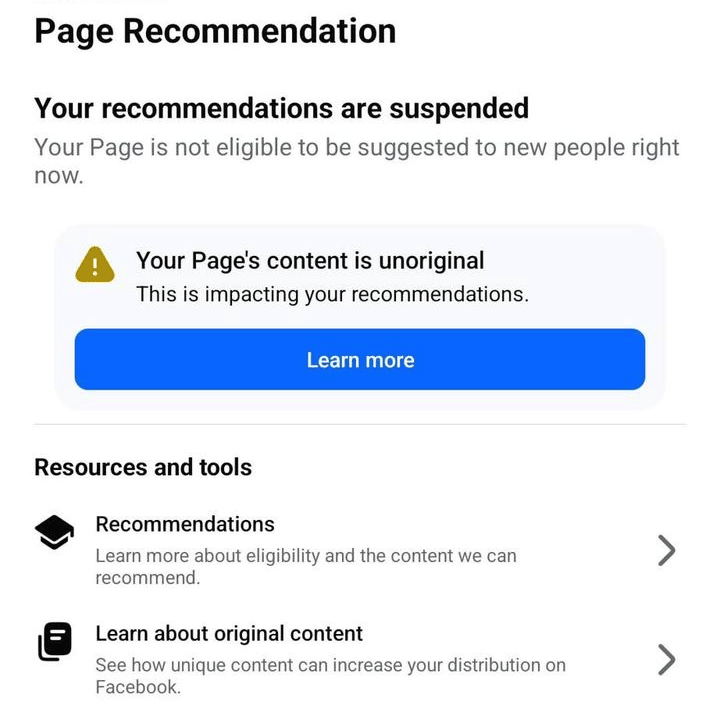
Downside variability. Pages with active policy issues, recommendations suspended, originality flags raised, Content Monetization paused, low-RPM audience composition, or repeated copyright strikes earn well below the table numbers. The first job on any underperforming page is a compliance and health audit, not more posts. The benchmarks above assume a clean, healthy page with no active platform restrictions. Resolve the health issues first, then the math in the table starts to apply.
Section 16: How Follower Growth and Revenue Compound
Most operators think about the relationship between followers and revenue in one direction. More followers leads to more revenue. That is true, and it is incomplete. The full loop is much bigger than that, and it is where the biggest pages in this niche separate from everyone else.
The full loop looks like this:
- More revenue means more views are being served by the platform
- More views means more engagement signals
- More engagement means higher follower growth
- Higher follower count means all other posts on the page start performing better
- Better performing posts mean more engagement
- More engagement means more followers
- And so on
It does not add. It compounds. The loop spins faster every revolution.
The follower trajectories on Publisher In a Box managed conservative media pages reflect exactly that mechanism. Pages have moved from 1.6 million followers at takeover to over 3 million followers within a year, with target trajectories of 5 million followers by the end of year two. That growth runs entirely organic, entirely unpaid, driven by the content system alone. No page like ad campaigns are required after the system is operational. The compounding loop is sufficient.
For an operator with multiple large pages, the compounding effect runs across the network rather than on a single page. Pages that win breaking news cycles drive followers into adjacent pages within the same network. Strong Reels on one page set up distribution for image posts on another. The network operates as a single distribution system rather than a collection of independent properties.
This is why the network-level math in Part 1 of this series is more than the simple sum of the per-page math. A coordinated 20 million follower network outperforms the same 20 million followers spread across uncoordinated pages by a meaningful margin. The system upgrades the whole rather than the parts.
Section 17: The One Thing That Kills Pages Before They Reach Scale
Most operators quit right before the momentum kicks in.
The first 30 days feel slow even when the content is correct, the ad spend is right, and the cadence is on. The early ad spend feels like money going out for nothing, the engagement at 3,500 followers feels small even when in context it is strong, and the first $300 monetization check feels insignificant against the work that produced it. Everyone wants to quit at this stage, and most do.
Operators who make it past day 60 with consistent execution are the ones who see the compounding effect kick in. The page starts pulling organic followers on top of paid, the Reels start hitting wider recommendation audiences, and the engagement rate signals to the algorithm that the page is worth distributing further. The whole system clicks into place, and then it does not stop.
For established conservative media brands, the risk is different in shape but identical in effect. The risk is not abandoning the page; it is leaving the current playbook in place because it is generating real revenue, and that revenue is enough to feel comfortable. Comfort is the biggest threat to a big page in 2026, because the upgrade is where the 2x to 10x lives, and operators who stay comfortable lose the next cycle to the ones who do not.
Conclusion
The conservative media niche on Facebook in 2026 is the strongest combination of audience scale, audience engagement, platform tailwinds, and revenue infrastructure the category has ever produced. The audience is the largest it has been since the suppression policy was reversed in January 2025, Facebook Content Monetization is wide open with fast invite cycles, the format mix that wins is documented and reproducible, and the team structure that runs the system at scale is simple to build. All of it is sitting in front of every operator already inside this category, waiting to be claimed.
The constraint is not opportunity; it is execution.
A single conservative media page run with the full system produces $20,000 to $50,000 a month at scale, and a multi-page network at 20 million followers run with the full system produces $3 million to $6 million a month. The biggest gap in the niche right now is between operators who have the audience and operators who have the system. The first group is generating real revenue on outdated execution; the second group is positioned to capture the 2x to 10x lift over the next 12 months.
The golden age of conservative media on Facebook is back, and the publishers who move first take the biggest share of it. The audience is bigger than it has been in five years, the platform is leaning in harder than it has in five years, and the monetization is paying better than it has in five years. The biggest brands in the niche are running 2018 playbooks in a 2026 environment and leaving 2 to 10x on the table because of it. The only question is who closes that gap first.
If you operate a large conservative media brand on Facebook and want to model what your specific network is generating today against what it should be generating under full execution, start with a baseline analysis of your current revenue across Facebook Content Monetization and referral traffic, mapped against the per-million benchmarks in Part 1 of this series. Most operators run that analysis and find their actual revenue is closer to 25% of the benchmark range than the midpoint. The gap from 25% to 100% is the operating target, and the next 12 months in this niche belong to the publishers willing to take it.
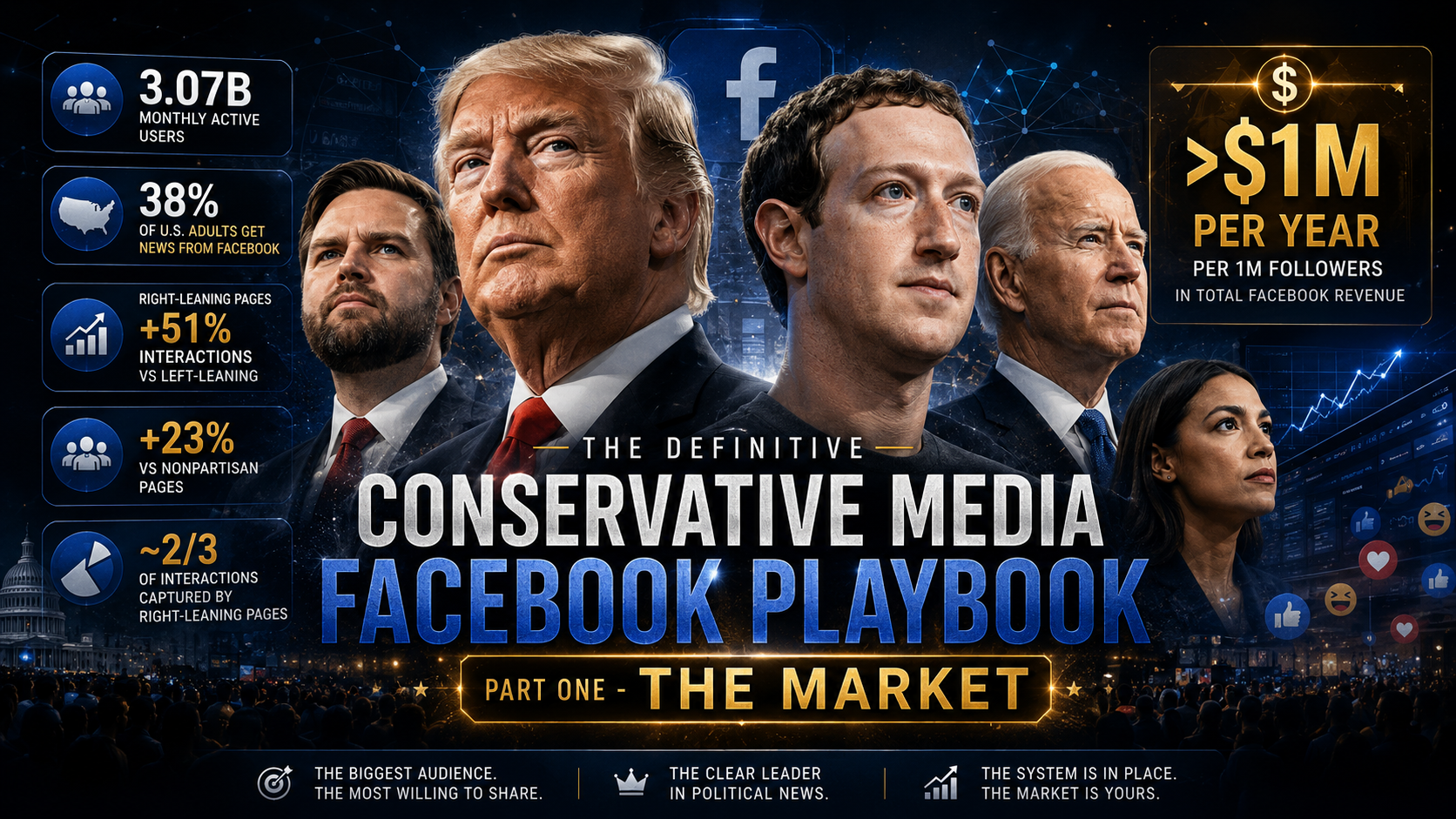
The Market
The market context behind the execution. State of Facebook for conservative media in 2026, the January 2025 policy reversal, per-page and network-level earnings math, where the biggest players are leaving 2 to 10x on the table, and the two revenue streams that compound. Re-read when the operational details start to feel abstract.
Frequently Asked Questions
How much can a conservative media Facebook page earn per month in 2026?
A properly managed conservative media Facebook page generates $20,000 to $100,000 a month per first million followers, with a typical well-run page landing near $45,000. The total splits across Facebook Content Monetization ($12,000 to $60,000) and referral traffic from display ads and affiliates ($8,000 to $40,000). Earnings per follower degrade beyond the first million, but a 10 million follower page still generates substantially more than a one million follower page. The high end is not immediate. It can take up to 12 months of full execution to reach, and the revenue is seasonal, concentrated in Q4 and Q1. Best-in-class execution on a single page exceeds $50,000 a month from Facebook Content Monetization alone.
Is political content allowed on Facebook in 2026?
Yes. On January 7, 2025, Meta reversed four years of political content suppression. The third-party fact-checking program ended, replaced by a Community Notes system. Political content distribution opened back up across the platform. Conservative news content in particular operates with stronger tailwinds in 2026 than at any point since 2020. Political content remains subject to standard Facebook community guidelines, particularly around misinformation, but is no longer subject to the suppression policies in place from 2021 through 2024.
How long does it take to get into the Facebook Content Monetization program in 2026?
For a fresh conservative media Facebook page built with deliberate execution, invites to the Facebook Content Monetization program are arriving in as little as 3 weeks. For an older dormant page being re-energized, the invite window is often shorter because the page already meets follower history requirements. Eligibility requires 10,000+ followers, 150,000+ unique views in the last 28 days, at least 3 Reels posted in the last 90 days, a page at least 30 days old, and a clean policy record.
What is the best Facebook page monetization strategy for a one million follower conservative media page?
The highest-leverage strategy for a one million follower conservative media page is a hybrid post mix: 70 to 80% native engagement content (image posts with long captions, breaking news text posts, daily Reels) to maximize Facebook Content Monetization revenue, and 20 to 30% strategic outbound links to capture affiliate and display-ad referral revenue from the destination site. Critical execution elements include breaking news velocity (15 minute lead on stories), 1 to 2 Reels per day minimum, a three-person operational team (curator, producer, scheduler), and clean content originality scoring to protect monetization eligibility.
Why are large conservative media Facebook publishers underperforming on monetization in 2026?
Most large conservative media Facebook publishers are running playbooks built between 2017 and 2020. The strategy is heavy on outbound link posts, light on Reels, and treats Facebook as a distribution channel for an owned website rather than a profit center in its own right. This worked when Facebook Content Monetization either did not exist or paid poorly. In 2026, Facebook Content Monetization rates are $1,000 to $2,000 per 10 million views and climbing, while the algorithm rewards native engagement over outbound clicks. The post mix shift from link-heavy to native-engagement-heavy, combined with daily Reels and breaking news velocity, typically produces a 3 to 10x revenue lift within 12 months without any change in audience size.
About Publisher In a Box
Publisher In a Box (PIB) is the infrastructure layer behind the conservative media Facebook pages running this system. From asset inception to asset sale, PIB is the operating system that powers online publishers. Over 300 million combined Facebook followers managed across client pages. Self-funded. Market-driven. Operator-built.
Programs available to conservative media publishers
Conservative Media Facebook Monetization Program. The dedicated program for conservative media operators on Facebook, shipped in two performance-based tracks. Track 1, Turnkey Management, hands the entire Facebook layer to PIB: full operation across content, breaking news, Reels, team coordination, and Content Monetization optimization. 50/50 revenue share. 12-month contract. Requires 100,000+ followers on your Facebook Pages. Track 2, Revenue Supplementation, keeps your newsroom in charge while PIB ships pre-approved viral content (image posts, breaking-news text, Reels concepts) aligned with your editorial line. Your editor approves every piece before it publishes. Your in-house content stays 100% yours. 50/50 split on PIB-supplied content only. 3-month contract, renewed quarterly. Zero upfront on either track. Apply for the program →
Google Discover Turnkey Management. PIB produces and optimizes content for Google Discover surfaces to drive supplemental referral revenue alongside Facebook. End-to-end management, 50/50 revenue share, zero upfront. Bundleable with the Conservative Media Facebook Monetization Program. Apply for Google Discover Turnkey →
Syndication Turnkey. Distribution across MSN, Yahoo, AOL, Newsbreak, SmartNews, and other premium syndication networks. Available to major publishers and news organizations. 50/50 revenue share. Bundleable with any other program.
Asset Marketplace. For operators considering entity transfer of dormant pages within their network, PIB Asset Marketplace matches pages with qualified buyers under a transparent 10% structure. Full vetting, structured transactions, and a dedicated buyer pool for monetized properties. Asset Marketplace and Turnkey Management are separate programs and not bundled. Browse the Asset Marketplace →
Learn more at publisherinabox.com. Join 2,000+ publishers on the Publisher Insider newsletter for twice-weekly strategies, case studies, and algorithm updates from the team managing 300M+ followers.