Search across our learning center -- articles, newsletters, and more. Start typing or click a topic above.
Stay in the Loop
Get exclusive publishing strategies, industry insights, and early access to new features. No spam -- just signal.
Join 2,000+ publishers. Unsubscribe anytime.
Industry News
Facebook Content Monetization, AI Search Visibility, and the Unoriginal Content Review Cycle: What Publishers Need to Know
Publisher In a Box12 min read
Table of Contents
This article is part of our daily digest series, in-depth summaries drawn from our X account, @publisherinabox, expanded with industry data. (weekend recap)
Facebook content monetization is producing real, documented payouts across formats
The numbers coming out of our community this week make a clear case that Facebook content monetization is no longer a side channel for publishers. One page inside our private community recorded $13,746.89 across twelve days, with $13,676.63 of that total flowing through Content Monetization alone, up 41.4% on a per-day basis. That is roughly $1,145 landing in a single publisher's account every day, from organic content performance and without a single dollar of ad spend behind it.
The figure is consistent with what the broader data shows. Meta's official announcement in March 2026 confirmed that Facebook paid content creators nearly $3 billion in 2025, a 35% increase from the prior year and the platform's highest annual total on record. Meta also reported that the number of creators earning more than $10,000 annually on Facebook grew by over 30% year-over-year. The program consolidates In-Stream Ads, Ads on Reels, and the Performance Bonus into a single enrollment, meaning publishers now collect earnings from Reels, longer videos, photo posts, Stories, and text posts through one payout system.
Cumulative Content Monetization earnings for one publisher over 12 days, nearly all from Facebook's unified payout program.
A separate case in the same window showed a publisher scaling from $300 a month to $50,000 a month on the same page without migrating to a new asset. The first month of active management produced $10,000. Month two hit $20,000. By month six the page was clearing $35,000. The trajectory maps closely to what INMA and Echobox reported in their analysis of thousands of posts across around 700 Facebook Pages: publishers using the Content Monetization program generated a total of $51 million for an average of $75,000 per page. The ceiling is higher than most operators currently assume.
Publishers looking to understand the mechanics behind these kinds of results can start with our overview of Facebook consulting and the operational frameworks we apply inside Facebook turnkey management.
One photo post, 2.4 million views, $371.89: the image format is not a consolation prize
A single image post from a publisher inside our community pulled 2.4 million views and generated $371.89 in direct earnings from Facebook. No Reel. No video. No carousel. One photo with a caption. That number reflects Facebook paying the publisher directly through Content Monetization, not a brand deal or affiliate arrangement.
One image post, 2.4M views, $371.89 in direct Facebook earnings, shared by a publisher inside the @publisherinabox community.
The data behind this outcome is not anecdotal. INMA's analysis of publisher data found that image-link posts generated the highest average earnings per share at $1.93, outperforming video posts at $1.72. That surprises operators who expect video to dominate in a program that Meta has publicly associated with Reels. Buffer's 2026 analysis confirmed that in 2025 about 60% of total payouts went to Reels, while the remaining 40% was split across Stories, photos, and text posts. The implication is that image content is generating a disproportionate share of earnings relative to the attention most publishers give it.
Caption length is part of the equation. Posts inside our community that carried longer, more substantive captions on the same images have been pulling measurably higher earnings per post. The caption is not decoration placed under the image before moving to the next piece of content. It is a signal Facebook's algorithm reads when deciding how widely to distribute and how richly to reward a post.
The unoriginal content review cycle is real, and it resolves
Two separate cases this week illustrated a pattern that keeps repeating inside our community: a page gets flagged for unoriginal content, the publisher waits, and the restriction clears through review.
A page restricted on July 22 received two back-to-back notifications three days later: recommendations restored and earnings no longer affected by the unoriginal content finding.
In the first case, a page was restricted on July 22 for unoriginal content. Three days later, two notifications arrived: the page was being recommended again, and earnings and recommendations were no longer affected by the unoriginal content finding. In the second case, a publisher reached a real human reviewer without paying for Meta Verified. The reviewer identified specific Reels to delete. Once those were removed, Instagram went back to green, which then triggered a human review on the Facebook side as well, restoring both recommendation and monetization status.
Reaching a human reviewer, deleting the flagged Reels, and having Instagram cleared first triggered a corresponding Facebook review that restored full monetization status.
These outcomes align with Meta's official policy statement from March 2026, which confirmed that creators always have the option to appeal originality decisions and that Meta is continuously working to improve enforcement accuracy. The same announcement noted that views and time spent watching original Reels on Facebook approximately doubled in the second half of 2025 compared to the same period in 2024, which explains why enforcement has intensified: Meta is protecting the distribution pool for original content.
Interesting Engineering's investigation into Meta's enforcement architecture found that the system was built in stages, with automated detection designed to identify existing copies across the platform, not only new uploads in real time. That means archived content can surface in enforcement actions long after it was originally posted. The practical takeaway is that a restriction does not necessarily mean the page is broken. The review mechanism exists, it responds to the right inputs, and the cases we are tracking confirm that outcome is achievable.
A niche breakdown and a site earning $23,967 in June show the range of the opportunity
Two additional data points from the week give useful calibration for publishers thinking about scale and vertical selection. Our financial news niche breakdown made the case that financial content carries different monetization rules on Facebook: CPM rates in financial verticals run materially above the platform average, which means the same view count produces larger payouts than an equivalent page in a lower-value niche.
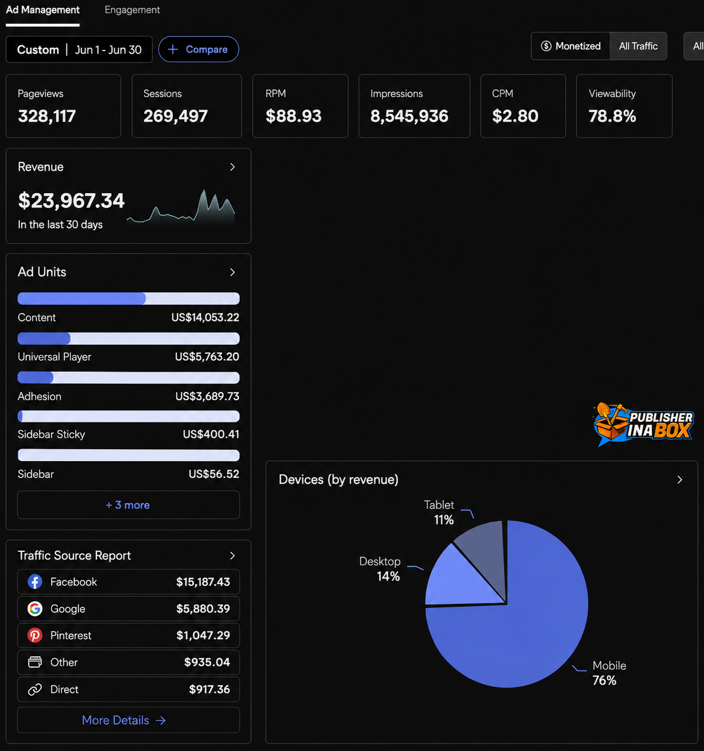
Separately, a site in our series posted $23,967.34 in June. That was down from May, and we published the numbers as they came in without adjustment. The traffic explanation was straightforward: pageviews fell from 615,924 to 328,117 as seasonal patterns shifted, while RPM held at $99.35. The RPM held. The traffic dropped. The revenue followed traffic, not rate compression. That distinction matters for operators trying to diagnose a revenue dip: a stable RPM alongside falling traffic is a distribution problem, not a monetization problem.
June site earnings of $23,967.34 with RPM holding at $99.35 while pageviews dropped from 615,924 to 328,117, a traffic story, not a rate story.
AI search is reshaping how audiences discover publishers, and the citation gap is already wide
The second major thread running through this week's posts is one that most Facebook publishers have not yet internalized: AI search engines are changing who gets found before a user ever reaches a platform. Ahrefs analyzed 300,000 keywords and found that the presence of an AI Overview now correlates with a 58% lower average click-through rate for the top-ranking organic page. That figure comes from December 2025 data and represents a significant worsening of a trend that was already measurable a year earlier.
The authority gap inside AI engines is as stark as the click-through compression. The median company appears in only 16% of relevant AI answers and earns a citation with a link only 6% of the time. Research aggregated from multiple studies found that early AEO adopters capture 3.4 times more AI visibility than late adopters, and that there is a strong linear correlation between domain authority and AI citation frequency. BrightEdge's September 2025 analysis, cited by HubSpot, found that 83.3% of AI Overview citations came from pages beyond the traditional top-ten results, meaning that ranking in the top ten of Google is no longer a reliable proxy for AI visibility.
The citation patterns also vary by engine in ways that create operational risk for publishers who measure visibility on only one platform. Semrush's 126-million-prompt study found that only 36 brands maintained top-100 visibility across all four major AI platforms: ChatGPT, Gemini, Google AI Mode, and AI Overviews. ChatGPT cites an average of 15 sources per response while Gemini cites 3. A brand visible on one engine can be invisible on another. Publishers who are not tracking their citation footprint across ChatGPT, Claude, Perplexity, and Gemini are operating without a meaningful piece of their audience acquisition data.
The underlying signal structure for AI citation is also different from what drove traditional SEO. Ahrefs' analysis of 75,000 brands found that YouTube mentions (correlation of 0.737), branded web mentions (0.664), and branded anchor text (0.527) are the three strongest predictors of AI visibility, all off-site brand signals that outperform backlinks (0.218) by two to three times. Brand presence across the web matters roughly three times more than link counts for AI citation selection. That is a structural shift in what publishers need to build.
Understanding and managing that citation presence across AI engines is now a core operational task for any publisher who relies on search-adjacent traffic channels. The publishers building that foundation today are the ones the engines will keep citing as the default sources tomorrow. Our teams address this alongside content strategy inside both Facebook consulting and turnkey page management engagements.
Frequently asked questions
How does Facebook Content Monetization pay publishers for photo posts? Facebook Content Monetization pays for eligible photo posts based on engagement, qualified views, and overall content performance. The program consolidates what were previously separate bonus and ad programs into a single payout, and data from publisher analytics firm Echobox showed that image-link posts generated the highest average earnings per share at $1.93, outperforming standard video posts. The payout is made directly by Meta into the publisher's account, typically processed around the 21st of the following month.
What happens when a Facebook page is restricted for unoriginal content? A restriction for unoriginal content limits the page's recommendations and can affect earnings through the Content Monetization program. Meta's official policy allows publishers to appeal the decision through the Professional Dashboard, and the company acknowledges that its automated systems are not infallible. The cases we track consistently show that pages restricted for unoriginal content can have their recommendation and monetization status fully restored, often within days of a review resolving in the publisher's favor. Deleting the specific content flagged by a reviewer, when a human review is reached, is the most reliable path to restoration.
Why do AI search engines matter for Facebook publishers? AI search engines like ChatGPT, Perplexity, Claude, and Google's AI Mode are increasingly influencing which sources users trust and follow across every platform, including social. When an AI engine recommends a publisher or cites their content, it drives brand recognition that feeds audience growth on Facebook and other surfaces. Publishers who are absent from AI-generated answers are absent from the discovery process for a growing share of potential readers before those readers ever reach Facebook. Ahrefs found that the presence of an AI Overview reduces click-through rate to the top organic result by 58%, making AI citation a direct revenue-adjacent concern for publishers who also rely on web traffic.
Does caption length on Facebook photo posts affect earnings? The data from publishers inside our community indicates yes. Posts carrying longer, more substantive captions on the same images have produced measurably higher earnings per post compared to posts with minimal caption text. Caption length is one of the signals Facebook's algorithm reads when determining distribution and payout weighting. Treating the caption as a core part of the content rather than an afterthought appears to improve both reach and monetization outcomes for image posts.
What is the difference between a traffic problem and a monetization problem on a publisher site? A traffic problem means your RPM (revenue per thousand pageviews) is stable but the volume of visitors is lower, so total revenue falls proportionally. A monetization problem means RPM is compressing regardless of traffic volume, indicating an issue with advertiser demand, niche positioning, ad setup, or content quality signals. When one of the sites in our weekly series saw June revenue decline from May, the RPM held at $99.35 while pageviews fell from 615,924 to 328,117. That is a traffic problem caused by seasonal patterns, not a monetization problem, and the operating response is different in each case.
See more from Publisher in a Box in your Google results
The team behind 300M+ managed followers. We help publishers scale traffic, revenue, and audience across Facebook, Google Discover, and syndication networks.