Search across our learning center -- articles, newsletters, and more. Start typing or click a topic above.
Stay in the Loop
Get exclusive publishing strategies, industry insights, and early access to new features. No spam -- just signal.
Join 2,000+ publishers. Unsubscribe anytime.
Industry News
Facebook Content Monetization Wave, Cross-Post Violations, and the Google Discover Flip: Weekend Recap June 21, 2026
Publisher In a Box12 min read
Table of Contents
This article is part of our daily digest series, in-depth summaries drawn from our X account, @publisherinabox, expanded with industry data. (weekend recap)
Facebook Content Monetization Is Opening Wider Than Anyone Expected
The dominant signal from our community this weekend was volume. Members across multiple publisher groups are reporting Content Monetization (CM) program invites at follower counts that break the assumptions most operators built their timelines around. Pages with 1,600 followers. Pages with 2,100 followers. The floodgates are open, and a significant portion of the publisher community is still waiting for a threshold signal that has already moved.
The broader financial context supports the urgency. Meta's official announcement confirmed that Facebook paid content creators nearly $3 billion in 2025, a 35% increase from the previous year and its highest annual total on record. CNBC reported that roughly 60% of that payout went to Reels content, with the remainder split across Stories, photos, and text posts. The number of creators earning more than $10,000 annually on Facebook grew by over 30% year-on-year, according to The Next Web.
The program itself consolidates what used to be three separate earning tracks. Facebook for Creators describes the Content Monetization program as a single enrollment that covers Reels, longer videos, photos, and text posts, replacing the older In-Stream Ads, Ads on Reels, and Performance Bonus programs. Earnings remain performance-based, tied to qualified views and engagement. The program is still invite-only, but Meta has stated it is sending invitations to millions of creators and plans to move toward open enrollment.
For operators running pages across news, politics, health, and lifestyle verticals, the combination of lower invite thresholds and rising payout totals makes a strong case for treating CM access as the first measurable milestone rather than a distant target. The data from our community this weekend suggests the milestone is now reachable at a much earlier stage than the platform's official documentation implies.
Facebook paid content creators nearly $3 billion in 2025, up 35% year-over-year, with 60% of payouts going to Reels. Source: Meta.
The Cross-Post Bonus Glitch Is a Real Violation Vector Right Now
The second major thread from this weekend's feed is a warning, and it deserves direct treatment. The Facebook cross-post bonus feature is auto-publishing duplicate content for some users, and those duplicates are triggering policy flags and demonetization events across pages that had clean monetization histories.
We are tracking reports of this issue across multiple communities. The pages being flagged are not spam operations. They are legitimate publishers who turned on a platform feature and were penalized for the output that feature produced.
Community reports confirm the cross-post bonus is auto-publishing duplicate content and contributing to violation flags across multiple pages.
The mechanism behind the risk is not new. Meta's March 2026 enforcement update made clear that accounts posting primarily unoriginal or duplicate content face reduced distribution and demonetization. The cross-post glitch creates a situation where the platform's own tooling generates exactly the kind of output its enforcement systems are designed to penalize. The algorithm does not distinguish between intentional duplication and glitch-produced duplication.
The scale of Meta's enforcement activity contextualizes the risk. Meta confirmed it removed more than 20 million accounts impersonating large content creators in 2025 alone, and impersonation reports dropped by 33% as a result. In the first half of 2025, the company took action against more than 500,000 accounts for spammy behavior. These numbers tell you that the enforcement infrastructure is active and operating at scale. Getting caught in its detection systems, even accidentally, carries real consequences.
The practical step for any operator currently running the cross-post bonus feature is to audit recent publishing activity, check the violations tab in Meta Business Suite, and pause the feature until the underlying glitch is confirmed resolved. Page Quality is not a vanity metric. A single unresolved violation pattern can cost monetization access that took months to build.
The Monetization Restriction Wave: AI Enforcement, False Flags, and How to Escalate
Alongside the cross-post issue, our feed this weekend carried a parallel and separate problem: an active wave of monetization restrictions hitting verified pages. The common thread across the reports is not content quality. The pages being restricted have clean records. The issue is AI-based enforcement flagging legitimate creators, cycling them into automated support loops with no clear path to a human reviewer.
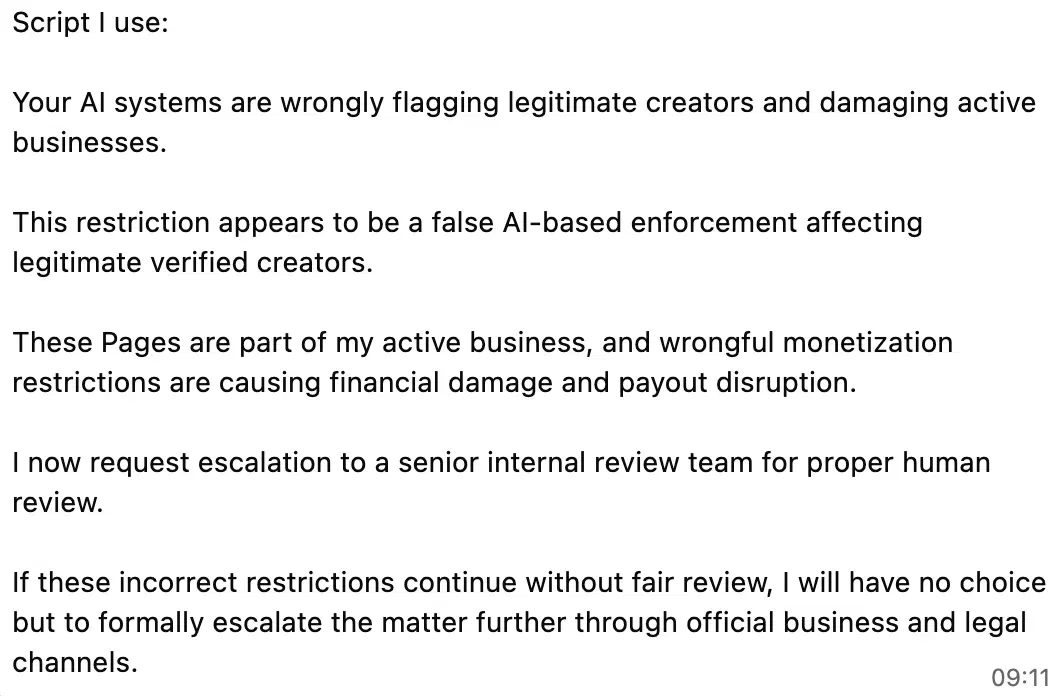
A support script our community is using to escalate past AI support bots and reach human reviewers at Meta.
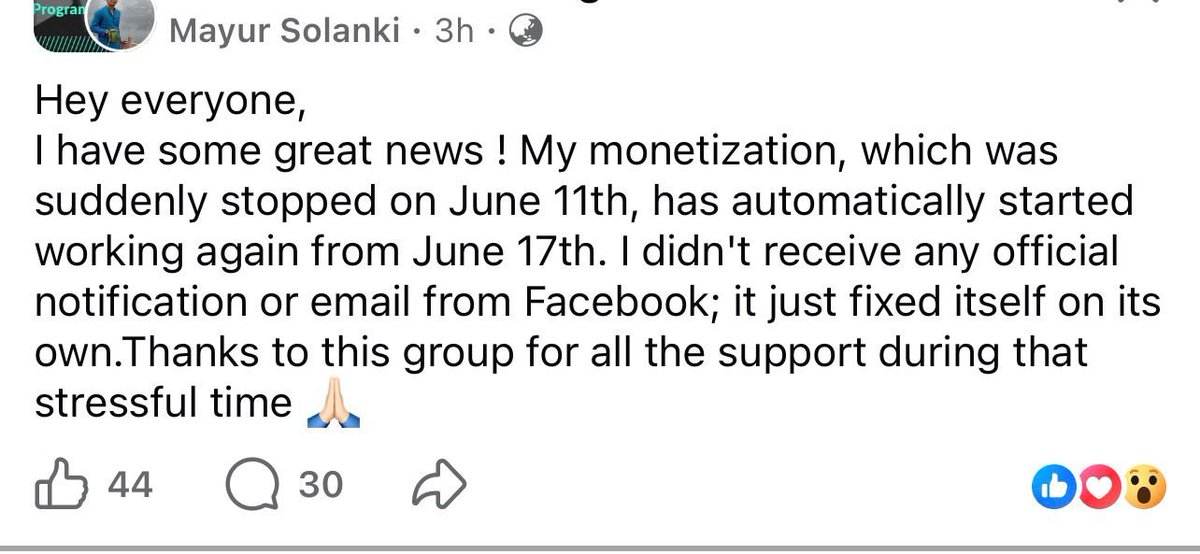
The good news from our community is that restrictions are reversing. We documented multiple pages having recommendations and monetization access restored during this window, in at least one case after a six-day outage with no email, no warning, and no explanation. The access came back on June 17th for a page that went dark on June 11th.
One more page back on. Stopped June 11th, working again the 17th. No email. No warning. switched back on.
Meta's official guidance acknowledges that automated enforcement is not infallible and confirms that creators always have the option to appeal decisions. The appeals process runs through the Professional Dashboard. The problem is that the standard support flow routes most tickets to AI bots before a human ever sees the case. Our community is reporting success using structured escalation scripts that frame the restriction as a false AI-based enforcement event affecting an active business, which appears to increase the probability of reaching a human reviewer.
For pages inside an active restriction cycle, the priority order is: document the restriction type and date, check violations for any specific policy cited, submit the appeal through the Professional Dashboard rather than the general Help Center, and use precise, business-focused language that frames the situation as an enforcement error rather than a policy question. Operators managing multiple pages across a portfolio structure should isolate any flagged pages from shared infrastructure until the restriction is resolved to avoid cross-contamination of monetization eligibility.
Google Discover Now Sends More Traffic Than Search. That Sentence Changes Strategy.
The third major story from this week is structural rather than operational, but it reorders a decade of publisher assumptions about where traffic comes from.
A 2025 analysis of more than 400 news publishers worldwide by NewzDash found that Google Discover now accounts for 67.51% of Google mobile traffic to news organizations. Traditional web search has fallen from 51.10% in 2023 to 27.42%. Press Gazette, citing Chartbeat data across nearly 2,000 global news and media sites, put the Discover share at 68% of all Google traffic, with search accounting for the remaining 32%. For many publishers, Discover is now the single largest source of visitors.
Google Discover's share of news publisher traffic nearly doubled from 37% in 2023 to 67.5% in Q4 2025. Traditional search fell from 51% to 27% over the same period. Source: NewzDash / Chartbeat via Press Gazette.
The acceleration maps to a specific event. Press Gazette noted that the shift accelerated after Google expanded its rollout of AI Overviews. As AI Overviews increasingly answer queries inside Google's interface without sending users to external sites, the traditional search referral collapses. Discover, which operates on interest signals and behavioral data rather than explicit queries, fills the gap.
The operational implication is that a news or media publisher ignoring Discover is ignoring what Chartbeat's data across nearly 2,000 sites identifies as the dominant traffic surface in Google's ecosystem. Discover does not reward keyword optimization. It rewards content that matches reader interest signals at the moment those signals are active, which means the editorial and audience-reading work that feeds a Discover strategy is fundamentally different from the SEO work that fed a search strategy.
Our playbook for reading your real Discover audience starts with two free data sources: Google Search Console's Discover performance report and your site's top-performing content by sessions rather than pageviews. Most operators write for a reader they invented. The traffic data corrects that almost every time. The audience that responds to your content in Discover is often narrower, more interest-specific, and more predictable than the hypothetical reader your editorial instincts describe.
The Publisher Portfolio Playbook: Building Facebook Assets from Zero
The most-read thread on our account this weekend was a step-by-step breakdown of the system we would use to build Facebook publishing assets from scratch, framed around what a displaced worker should do instead of applying for jobs. The thread drew over 1,200 impressions on the opening post alone and generated meaningful follow-through across all 14 steps.
The framework starts with three pages rather than one, targeting niches where the audience has demonstrated buying behavior. Politics, news, health, and lifestyle consistently produce the highest RPMs because advertisers in those verticals pay more per impression. Opening three pages simultaneously gives the operator three chances at a breakout rather than one sequential attempt that burns time if the first niche does not respond.
The content sequencing matters as much as the niche selection. Images and Reels come first, because reach has to move before any other metric is worth measuring. A Reel that takes five minutes to produce can generate millions of views. The link goes in the first comment once a post is pulling reach, creating a delayed second touch that sends a warmed audience to a site the operator owns rather than a surface Meta controls. Impressions do not pay. Revenue per visitor, driven by what happens after the click, is the number that matters.
The thread also addressed syndication as a multiplier rather than a primary strategy. Once the core Facebook-to-owned-site funnel is running, distribution to MSN, Yahoo, AOL, NewsBreak, and SmartNews extends the same content across networks the operator never had to build. The page becomes the production engine. The syndication layer becomes the reach amplifier. And Page Quality, meaning the violation count and monetization status inside Meta Business Suite, is treated as the payout itself, because a page with violations is not an asset. It is a liability on a timer.
Publishers interested in the infrastructure behind this kind of multi-page operation can find a detailed breakdown of the strategic components at our Facebook consulting overview, and operators who want a done-for-them approach can review what a fully managed buildout looks like at our turnkey management page.
Frequently asked questions
What follower count do I need for Facebook Content Monetization? The official threshold for most monetization tools has historically been 10,000 followers, but community reports this weekend document invites arriving at pages with as few as 1,600 to 2,100 followers. Meta has stated it is sending invitations to millions of creators and plans to move toward open enrollment, so the effective threshold is lower than published guidance suggests. Check your Professional Dashboard for an interest form regardless of your current follower count.
Why is the cross-post bonus creating violations on my Facebook page? Meta's cross-post bonus feature is auto-publishing duplicate content for some users, and those duplicates trigger the platform's unoriginal content enforcement systems. The algorithm does not distinguish between intentional and glitch-produced duplication. If you are running the cross-post bonus and have seen new violations appear, audit your recent publishing log and consider pausing the feature until Meta confirms the glitch is resolved. Review the violations tab in Meta Business Suite and appeal any flags through the Professional Dashboard.
How do I appeal a false AI-based Facebook monetization restriction? Start by identifying the specific restriction type and date in your Professional Dashboard. Submit your appeal through the Dashboard rather than the general Help Center, and frame the ticket as a false AI enforcement event affecting an active business. Avoid generic policy questions, which route to automated responses. Structured, business-specific language that names the affected pages and describes the impact on active revenue increases the probability of reaching a human reviewer. Our community has documented successful reversals using this approach during the current restriction wave.
Is Google Discover more important than Google Search for publishers now? For news and media publishers, yes. A 2025 NewzDash analysis of more than 400 publishers worldwide found Discover at 67.5% of Google mobile traffic versus 27% for traditional search, a near-inversion from 2023 figures. Chartbeat data across nearly 2,000 global news sites confirms the 68% Discover share. The shift accelerated with the expanded rollout of Google AI Overviews, which answers many queries without sending users to external sites. Discover, which operates on interest and behavior signals rather than explicit queries, has filled the traffic gap left by declining organic search clicks.
What is the fastest way to read my real Google Discover audience? Open your Google Search Console Discover report and cross-reference the top-performing URLs with your site's actual session data. Most publishers find that the audience responding to their Discover-surfaced content is narrower and more interest-specific than editorial instincts predict. The content that earns Discover impressions is usually clustered around two or three dominant interest signals. Identifying those signals and aligning your editorial calendar to them, rather than to assumed reader demographics, is the foundation of a Discover-native content strategy.
See more from Publisher in a Box in your Google results
The team behind 300M+ managed followers. We help publishers scale traffic, revenue, and audience across Facebook, Google Discover, and syndication networks.