Search across our learning center -- articles, newsletters, and more. Start typing or click a topic above.
Stay in the Loop
Get exclusive publishing strategies, industry insights, and early access to new features. No spam -- just signal.
Join 2,000+ publishers. Unsubscribe anytime.
Market Analysis & News
Facebook Content Monetization Digest: Meta Payout Alerts, Profile Picture Guard Removal, and the AI Search Traffic Split
Publisher In a Box10 min read
Table of Contents
This article is part of our daily digest series, in-depth summaries drawn from our X account, @publisherinabox, expanded with industry data.
If Meta Emails You About a Payout Issue, Take It Seriously
One of the most important signals a Facebook page monetization operator can receive is an email from Meta for Business with the subject line "Payout issue with [your page]." Our team flagged this in yesterday's posts because too many publishers instinctively treat unfamiliar Meta emails as spam or phishing and delete them without reading.
That is the wrong instinct here. This specific email is a legitimate communication Meta sends when something is broken in your payout account setup. It instructs you to notify your payout account admins so the underlying issue can be resolved before your next payment cycle. Ignoring it can mean a missed payout or a delayed disbursement that compounds over time.
An example of the legitimate Meta for Business payout issue email publishers should not ignore.
The broader context matters here. Meta's enforcement and payment infrastructure is largely automated, and the path to human review is narrow. Interesting Engineering documented how demonetization decisions can arrive "without a detailed explanation, without a cited violation" and without a clear appeals path. In that environment, any direct communication from Meta that does contain specific account information is worth acting on immediately.
The practical checklist when you receive this email is straightforward: log in to Meta Business Suite, navigate to Payouts, confirm your payout account is active and verified, check that the payment method on file has not expired or been flagged by your bank, and confirm that your account admins have the correct permissions. If you run multiple pages or operate under a shared business portfolio, verify that each page is linked to the correct payout entity.
Publishers who want a structured process for monitoring payout account health can learn more about how teams handle these workflows through our Facebook consulting resources, or review how fully managed operations stay on top of these signals through our Facebook turnkey management overview.
Facebook Retires Profile Picture Guard After Nine Years
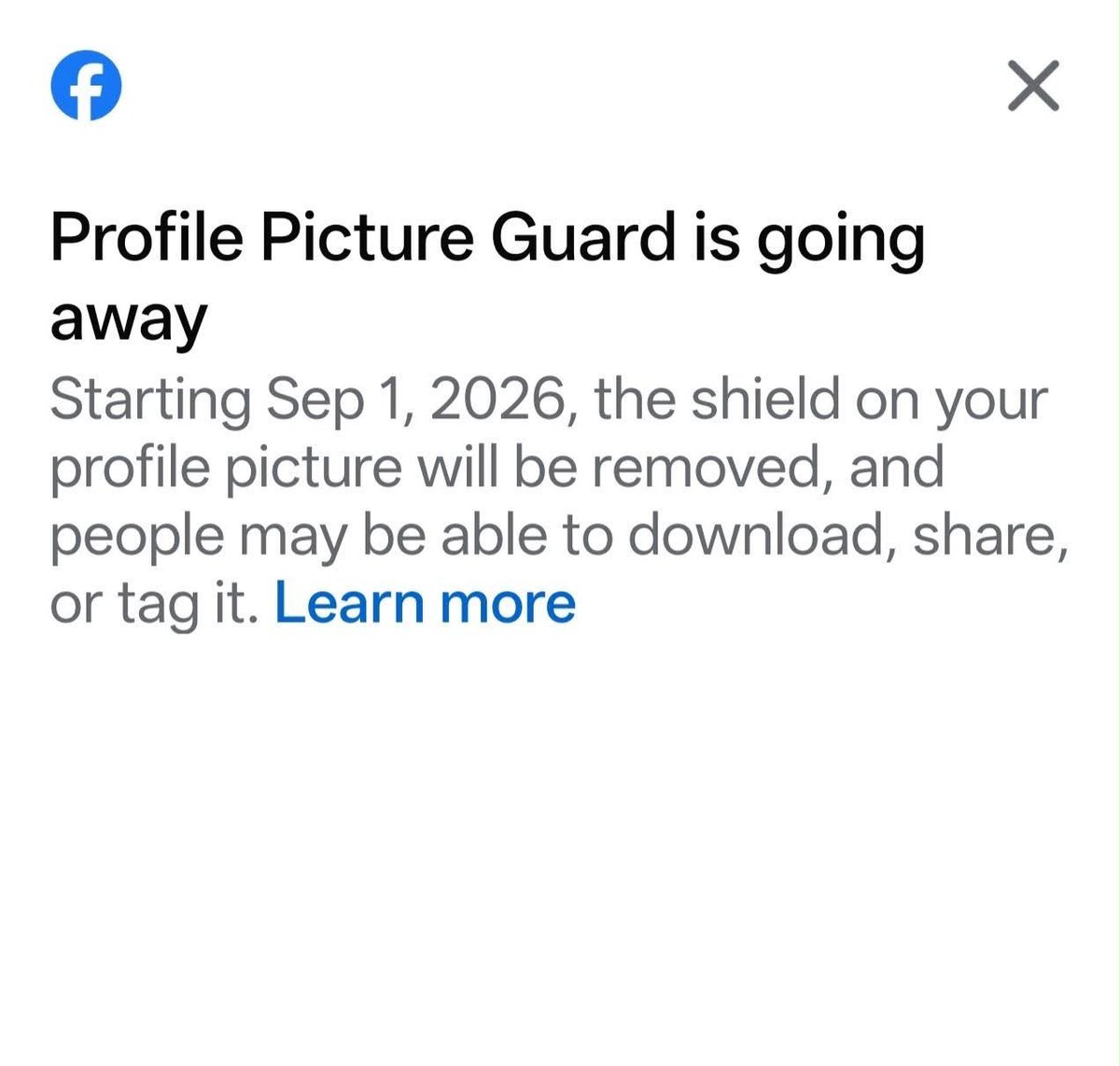
Facebook officially retired its Profile Picture Guard feature earlier this month. The blue shield that appeared over a user's profile photo is gone. Once it disappears, other users can download, share, tag, and screenshot the profile image through normal platform interactions.
Facebook's Profile Picture Guard shield is no longer available after the feature was retired this month.
The feature first launched in 2017, originally tested in India, where profile photo theft and impersonation were particularly prevalent problems. The shield worked by restricting the download, sharing, and tagging of a protected photo, giving users in regions with higher identity-fraud risk a layer of passive protection without requiring them to make their profile fully private.
For individual users, the retirement means re-evaluating profile visibility settings. For publishers and page operators, the practical implications are narrower but still worth noting. Brand pages that used a recognizable personal face as a profile image now have less control over how that image circulates. Anyone managing a personal brand on Facebook alongside a monetized page should audit their profile privacy settings to compensate for the lost protection the shield provided.
The removal also fits a pattern Meta has followed across 2026: quietly sunsetting older privacy controls while consolidating settings inside Meta Accounts Center. Viallo noted that Meta also removed its "Your activity off Meta technologies" opt-out setting in July 2026, replacing it with a control that limits ad targeting use but does not stop data collection. The direction of travel is toward fewer user-facing restrictions on data and image use, not more.
AI Search Is Splitting Your Audience Across Engines
The third major story from the past 24 hours is the one with the longest tail for Facebook page monetization strategy. AI search is not reducing publisher traffic. It is fragmenting publisher audiences across a growing set of engines that share almost no citation overlap with one another.
The scale of the Google referral decline is now well-documented. Fondure's analysis of Reuters Institute and Chartbeat data covering more than 2,500 websites found that organic Google search traffic to news and publishing sites fell 33% globally and 38% in the United States between November 2024 and November 2025. Newsweek reported that more than 60 percent of Google searches ended without a single click to an external website by early 2026. For some publishers the numbers are far worse: Search Engine Journal documented click-through rate drops as large as 89% for specific content categories at DMG Media.
Key publisher traffic metrics in 2026: Google referral declines, zero-click search share, and overlap between AI engine citation sets.
What is less discussed is the fragmentation problem. It is not enough to adapt to one AI engine. Research cited by QuickSEO drawing on SparkToro data found that only 11% of domains are cited by both ChatGPT and Perplexity, and only 20% overlap exists between Claude and ChatGPT search results. That means a publisher who has optimized to appear in Google AI Overviews may still be completely absent from Perplexity or Claude answers. Each engine uses different citation sources, different training data windows, and different authority signals.
Vardot's analysis of the Reuters Institute's 2026 Digital News Report found that news executives expect a further 43% drop in search traffic over three years, and that weekly use of standalone AI chatbots for news reached only 10% globally in 2026, with trust in chatbot-sourced answers standing at 20% compared to 37% trust in news overall. The audience that moves from Google to AI assistants for news discovery is not yet large enough to replace what traditional search delivered, and that gap creates a window where Facebook remains a disproportionately important owned-audience channel for publishers.
The strategic implication for Facebook page monetization operators is direct. A page with a large, engaged following on Facebook represents an audience relationship that is not intermediated by a search algorithm or an AI answer engine. eMarketer noted that Meta is back in discussions with major publishers about licensing content for its AI products, signaling that the platform recognizes the value of publisher-quality content even as search-driven discovery fragments. Publishers who have built durable Facebook audiences are in a stronger negotiating position than those who relied entirely on Google referral traffic.
AdExchanger observed that smaller publishers have already been forced to shut down as search traffic collapses, with more expected to follow in 2026, pushing ad spend further into walled gardens. Facebook pages with established monetization are one of the few publisher-controlled surfaces inside those walled gardens.
What These Three Stories Have in Common
At first glance, a payout email alert, a retired privacy feature, and an AI search traffic report look like three unrelated items. They share a common thread: the infrastructure that publishers depend on to reach audiences and collect revenue is changing faster than most teams notice, and each change tends to go unannounced or under-communicated.
Meta retired Profile Picture Guard without a prominent product announcement. Meta sends payout issue emails that are easily confused with phishing. Google rolled out AI Overviews that cut publisher click-through rates without offering publishers a clear remediation path. In each case, the publishers who fare best are the ones with monitoring systems, clear internal processes, and diversified audience ownership.
For teams building that kind of operational depth, the frameworks behind large-scale Facebook page monetization are covered in our Facebook consulting practice, and end-to-end operational models are outlined under Facebook turnkey management.
Frequently asked questions
Is the Meta "Payout issue with your page" email a scam or phishing attempt? No. This is a real email Meta sends to notify page owners when something is wrong with their payout account setup. You should log in directly to Meta Business Suite (never click email links if you are unsure) and navigate to your Payouts section to verify the issue. Do not ignore the email, as unresolved payout account problems can result in delayed or missed payments.
What did Facebook Profile Picture Guard do, and is there an alternative now that it is gone? Profile Picture Guard added a blue shield to your profile photo that restricted other users from downloading, sharing, or tagging it. Facebook retired the feature in September 2026. The main alternative is to adjust your profile privacy settings so your profile picture is only visible to friends rather than the public, which limits who can interact with it in the first place.
How much has AI search reduced publisher traffic in 2026? Chartbeat data cited in the Reuters Institute's 2026 Digital News Report found organic Google search traffic to news and publishing sites fell approximately 33% globally and 38% in the United States between November 2024 and November 2025. Separately, roughly 60% of Google searches now end without any click to an external website, according to Bain and Company research.
Why does it matter that different AI engines cite different sources? Research drawing on SparkToro data found only 11% of domains are cited by both ChatGPT and Perplexity, and only 20% overlap exists between Claude and ChatGPT results. That means optimizing for one AI engine's citation patterns does not transfer to others. Publishers need to track their brand mentions and citations across each major AI engine independently rather than treating AI search as a single channel.
What should Facebook page monetization operators do as search traffic declines? The core strategy is to build audience channels you control directly: Facebook page followers, email newsletters, push notification subscribers, and direct app installs. A Facebook page audience is not filtered through a search algorithm the way Google referral traffic is, making it a more durable asset as AI search continues to compress click-through rates from traditional organic search.
See more from Publisher in a Box in your Google results
The team behind 300M+ managed followers. We help publishers scale traffic, revenue, and audience across Facebook, Google Discover, and syndication networks.