Search across our learning center -- articles, newsletters, and more. Start typing or click a topic above.
Stay in the Loop
Get exclusive publishing strategies, industry insights, and early access to new features. No spam -- just signal.
Join 2,000+ publishers. Unsubscribe anytime.
Market Analysis & News
Facebook Page Monetization in Focus: Sector Crashes, Policy Traps, and the Math Behind a $1,500 Photo Post
Publisher In a Box11 min read
Table of Contents
This article is part of our daily digest series, in-depth summaries drawn from our X account, @publisherinabox, expanded with industry data.
A Brutal Week for Facebook Reach: The Sector Scorecard
The week ending September 28, 2026 was one of the most punishing stretches for Facebook page monetization that we have tracked this year. Across nearly every content category we monitor, reach and distribution contracted sharply. Only two sectors finished in positive territory.
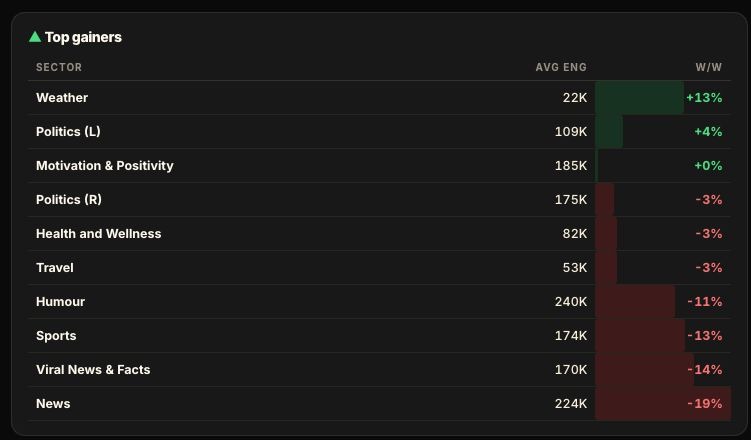
Facebook sector reach performance, week ending September 28, 2026. Weather led all gainers; News fell the most.
Weather content led all sectors with a gain of +13%, and Politics (Left-leaning) came in at +4%. From there the picture turned grim. Motivation and Positivity was flat at 0%, while Politics (Right-leaning), Health and Wellness, and Travel each fell 3%. Humour dropped 11%, Sports fell 13%, Viral News and Facts declined 14%, and News collapsed 19% for the week. That is the steepest single-sector loss we recorded.
Weekly Facebook reach change by content sector. News led all losers at -19%.
These swings are not random noise. The broader platform context matters here. According to Meta's official Q2 2026 earnings release, ad impressions across the Family of Apps rose 14% year-over-year and average price per ad climbed 12%. That means Meta's advertising system is becoming more competitive, which directly affects how organic distribution is weighted and which content categories the algorithm chooses to distribute without paid support.
The collapse in News reach is consistent with a pattern many Facebook consulting professionals have flagged throughout 2026. Meta's algorithm has been deprioritizing link-heavy news content in the feed for years, and the weekly data confirms that pressure has not eased. Pages that built their entire identity around traditional news aggregation faced the steepest cuts this week.
The Overnight Demonetization Trap: What the Partner Monetization Policy Says
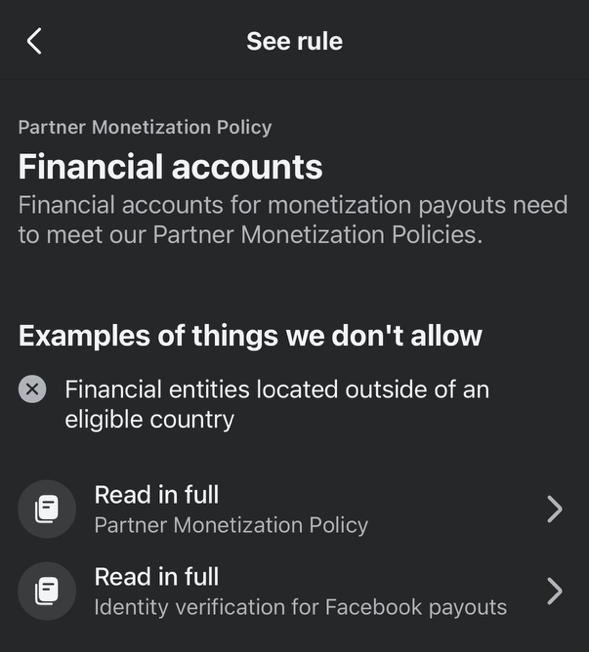
A nostalgia page in our community hit 100,000 views across two videos and was demonetized the next day. The trigger: a financial account compliance flag under Meta's Partner Monetization Policy.
One of the most alarming stories from our community this week involved a nostalgia page that recorded 100,000 views across two videos in a single day, only to have monetization limited the following morning. The rule Meta cited sits inside its Partner Monetization Policies: financial accounts used for monetization payouts must themselves comply with those same policies.
This is a detail that trips up experienced operators, not beginners. The content can be completely clean, the view counts can be strong, and the page can have a spotless community standards record. If the payment or financial account attached to the monetization setup has any compliance gap, payouts stop.
The broader policy environment has become considerably stricter since Meta consolidated its monetization programs. Meta's official March 2026 announcement confirmed that Facebook paid content creators nearly $3 billion in 2025, a 35% increase from the prior year. That scale of payout commitment comes with correspondingly stricter compliance enforcement. The more money flowing through the system, the more aggressively Meta audits every account in it.
Meta's unified Content Monetization Program replaced in-stream ads, Ads on Reels, and the Performance Bonus, all consolidated by August 2025 per Meta's own newsroom. Under this unified system, a single compliance flag on one part of an account can cascade across all revenue streams simultaneously, because everything runs through one dashboard rather than separate disconnected programs. The nostalgia page example illustrates exactly how quickly that cascade can happen: 100,000 views one day, zero monetization the next.
Pages operating under Facebook turnkey management arrangements should treat financial account compliance as a standing audit item, not a one-time setup task. Meta can re-evaluate financial account status at any point, and a flag raised by their systems does not wait for a convenient moment in your content calendar.
The Counterintuitive Post: 10 Million Views, $1,541, and a Net Follower Loss
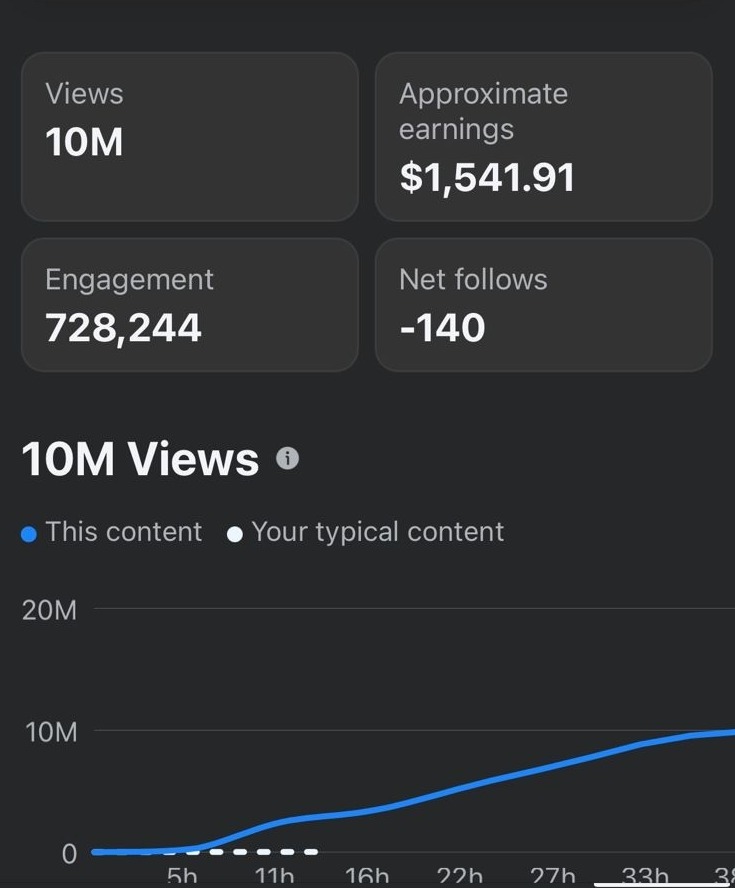
10 million views. 728,244 engagements. $1,541.91 in estimated earnings. And the page lost 140 net followers. A single animal photo with a long educational caption and a simple ask drove all of it.
The numbers from this post deserve a careful read: net follows of negative 140, approximate earnings of $1,541.91, 10 million views, and 728,244 engagements. We analyzed this post in August. The format was a single animal photograph paired with a long educational caption and a direct ask to the reader. No video, no reel, no carousel.
The lesson is not that photo posts always outperform video. The lesson is that qualified views and genuine engagement drive earnings under the current system, and those qualities are independent of format. Meta's March 2026 announcement introduced new dashboard metrics specifically to help creators understand which views qualify for payout, including an earnings rate per 1,000 qualified views and a breakdown of non-qualified views. This post's $1,541.91 came from views that met those qualification criteria, not from the raw 10 million total.
The follower loss is the other half of the story. Viral content that travels outside a page's core audience will always generate a wave of people who engage but do not convert to followers, and sometimes it generates active unfollows from existing followers who feel the post was off-brand or unexpected. A net loss of 140 followers against 728,244 engagements is a remarkably tight ratio, suggesting the content was reasonably well-matched to the existing audience even as it spread far beyond it.
This dynamic also maps to what CNBC reported in March 2026 about Meta's shift away from a revenue-share model toward one based on engagement. When engagement is the primary earnings driver, a post that generates 728,000 genuine interactions on a single photo is not punished for being a photo. It is rewarded for the engagement itself.
$170,378 in 30 Days From Facebook Referral Traffic: What the Data Requires
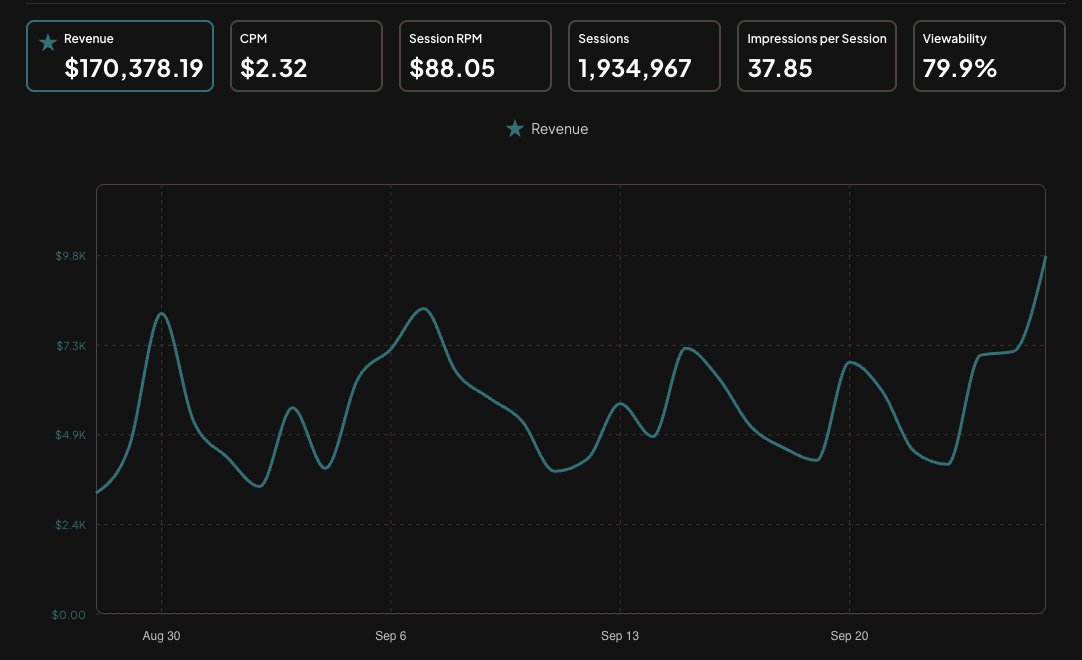
$170,378.19 in 30-day revenue driven by 99% Facebook organic referral traffic, zero paid ads.
The most-viewed post from our account this week showed a 30-day revenue figure of $170,378.19 attributed almost entirely to Facebook referral traffic, with 99% coming organically from the platform and zero paid advertising involved. Numbers like this invite skepticism, so it is worth grounding them in what the platform data shows is possible.
Facebook referral traffic to publishers has been in a meaningful recovery phase. According to reporting cited by SocialPilot drawing on Digiday sourcing, Newsweek's SVP of Audience Development reported that Facebook referral traffic quadrupled in March 2025 compared to March 2024, suggesting Meta's algorithm changes have resumed directing meaningful traffic volumes toward publishers. That trend appears to have continued into 2026 for pages that have stayed aligned with what the algorithm rewards.
The platform backdrop supports the possibility. Meta's Q2 2026 press release reported 3.60 billion daily active people across its Family of Apps as of June 2026. The addressable audience for content that earns algorithmic distribution has never been larger. A page operating in a category with positive or flat reach, producing content that qualifies for monetization, and driving readers to a well-monetized web property has all the structural ingredients for this kind of revenue outcome.
What the $170,000 figure also illustrates is the compounding effect of organic traffic at scale. When acquisition cost is zero and the content keeps circulating, the economics look nothing like a paid traffic operation. The margin profile is fundamentally different. That is why understanding which content categories are gaining algorithmic favor in a given week, and which are losing it, is not an academic exercise. The sector table at the top of this article is directly connected to outcomes like this one.
What Publishers Should Watch Going Into October
Three themes emerge from this week's data that are worth carrying forward into the coming weeks.
First, sector rotation on Facebook is real and it moves fast. A category down 19% in a single week is not a slow bleed. Publishers with diversified content portfolios across multiple sectors will absorb these swings better than single-niche operations. Weather's 13% gain is a useful reminder that the algorithm always has a category it is favoring, and that category changes.
Second, financial account compliance is a silent risk that sits underneath every monetization arrangement. The nostalgia page story is not an outlier. As Meta's Partner Monetization Policies make clear, the payout infrastructure must meet the same standards as the content. A single compliance gap in the payment chain can neutralize strong content performance overnight.
Third, the relationship between views, engagement, and earnings is not straightforward under the current unified program. Meta confirmed in March 2026 that new metrics now show creators exactly which views are qualified views and which are not. Publishers who treat total view counts as their primary performance indicator will consistently misread their actual earnings potential. The qualified view rate is the number that matters for revenue, and it can differ substantially from the raw view count, especially when content spreads to audiences outside a page's core geography or demographic.
For publishers working to understand and manage these dynamics at scale, our team covers the operational frameworks behind Facebook page monetization at facebook-consulting and the execution layer through facebook-turnkey-management.
Frequently asked questions
Why did News content lose 19% reach on Facebook this week? Facebook's algorithm has been systematically deprioritizing link-heavy news content in the main feed for an extended period. Periodic algorithm updates can accelerate that pressure in a given week, producing sharp single-week drops like the 19% decline recorded in the week ending September 28, 2026. News pages that rely on organic feed distribution without supplementing with formats the algorithm currently rewards, such as original video or photo content with strong engagement, are most exposed to these swings.
How can a monetized Facebook page lose access to payouts overnight after strong performance? Meta's Partner Monetization Policies require not only that content meets community and originality standards, but also that the financial account attached to the monetization arrangement is itself compliant. A flag raised against the payment account, rather than the content, can suspend payouts regardless of how well individual posts have performed. Pages should audit their financial account standing regularly, not when they notice a problem.
What makes a Facebook view a qualified view for earnings purposes? Under Meta's unified Content Monetization Program, not every view counts toward earnings. A qualified view is one that meets Meta's eligibility criteria, which include watch time thresholds, geographic eligibility of the viewer, originality of the content, and the absence of policy violations. Meta added a dashboard breakdown in early 2026 showing qualified views, earnings rate per 1,000 qualified views, and a non-qualified views category so creators can identify which views are not generating revenue.
Is it possible to earn substantial revenue from Facebook organic referral traffic without paid advertising? Yes, and the data from this week's posts illustrates the scale that is achievable. A page generating consistent organic distribution in categories the algorithm is currently favoring, driving that traffic to a well-monetized web property, can produce significant revenue without any paid acquisition cost. The key variables are content-category alignment with current algorithmic priorities, the qualified view rate of the content, and the monetization efficiency of the destination.
How much did Meta pay creators across its platforms in 2025? According to Meta's official announcement in March 2026, Facebook paid content creators nearly $3 billion in 2025, which represented a 35% increase from the prior year and the highest annual total in the program's history.
See more from Publisher in a Box in your Google results
The team behind 300M+ managed followers. We help publishers scale traffic, revenue, and audience across Facebook, Google Discover, and syndication networks.