Search across our learning center -- articles, newsletters, and more. Start typing or click a topic above.
Stay in the Loop
Get exclusive publishing strategies, industry insights, and early access to new features. No spam -- just signal.
Join 2,000+ publishers. Unsubscribe anytime.
Industry News
Facebook Content Monetization Reality Check: Format Earnings, Long Approval Waits, and the AI Measurement Trust Gap
Publisher In a Box10 min read
Table of Contents
This article is part of our daily digest series, in-depth summaries drawn from our X account, @publisherinabox, expanded with industry data.
The format split that changes everything for Facebook page operators
One earnings screenshot shared across our network this week stopped a lot of operators mid-scroll, and for good reason. A single publisher reported $8,235.75 earned from Facebook Content Monetization in one payout cycle, on the back of 40 million views that were up 93 percent period over period. The number alone is noteworthy. The breakdown behind it is the part worth studying closely.
Photos generated $5,223.13. Reels generated $943.27. A performance bonus added $2,063. On that specific page, photos out-earned Reels by more than five to one.
One publisher's Content Monetization cycle: $8,235.75 total, with photos accounting for 63% of format earnings.
This matters because the default assumption among most publishers entering Facebook page monetization is that Reels are the dominant earner. That assumption is built on the platform-level aggregate: Meta's official announcement confirmed that in 2025, 60 percent of Facebook's total payout to creators went to Reels, with the remaining 40 percent split across Stories, photos, and text posts. Platform-wide, Reels dominate. Page-by-page, the picture is far more nuanced.
Format-level earnings from a single Facebook Content Monetization payout cycle. Photos outperformed Reels more than 5x on this page.
The structural reason is straightforward. According to Meta, the Facebook Content Monetization program pays creators for every eligible format including short- and long-form videos, Stories, and photo and text posts, with earnings based on engagement and views across all eligible public content. A page that publishes photos at high volume and drives strong engagement will generate photo earnings that compound across many posts per day. A page that posts a smaller number of Reels will see those Reels compete on watch time and completion rate. The content mix that wins on any given page depends on the audience that page has built, not on platform-level payout percentages.
Publishers working with our Facebook consulting team consistently report that the operators who audit their format-level earnings data and double down on the formats driving their page's income outperform those who follow generic advice about which format the platform favors. The aggregate is useful context. Your own earnings dashboard is the document that matters.
Approval timelines: what a year-long wait tells us about the rollout
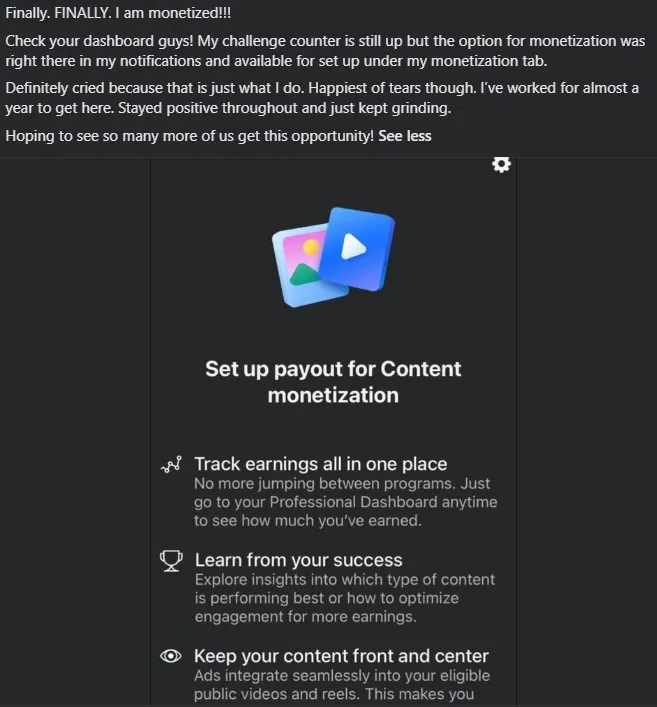
A second post this week documented something many publishers in our audience know from personal experience: the wait for Facebook Content Monetization approval can stretch well beyond what anyone would consider reasonable. One publisher posted proof that after nearly a year of consistent posting, the "Set up payout for Content monetization" option finally appeared live in their dashboard.
The monetization tab finally appearing after a year-long wait, a reality for many publishers in the current rollout phase.
A year is a long time to keep posting without payout confirmation. The publisher kept going, which is the key lesson, but the timeline underscores that the program is still in a staged, invite-based expansion. CNBC reported that Meta paid nearly $3 billion to creators in 2025, up 35 percent from the previous year, confirming the program is fully funded and operational at scale. The issue is not whether the program pays. The issue is the pace at which Meta extends invitations.
Meta's own data shows the number of creators earning more than $10,000 annually on Facebook grew by over 30 percent year over year. That growth confirms the program is expanding, but the expansion is still selective. Publishers waiting for approval need to treat the waiting period as a content-building investment, not a signal to reduce output. The pages that arrive at approval with 12 months of consistent, policy-compliant content behind them are in a materially stronger position than pages that coasted during the wait.
For publishers who want a clearer path through the eligibility and compliance requirements, our Facebook turnkey management service covers the full setup and ongoing compliance work so operators are not navigating the process alone.
The AI visibility measurement problem publishers should understand before spending
The third significant story from this week's feed sits slightly outside the direct Facebook page monetization conversation but is increasingly relevant to any publisher evaluating tools that claim to measure where their content appears in AI-generated answers. Duane Forrester, founder of UnboundAnswers and a recognized authority on AI-era search visibility, published results from a survey he ran over three weeks in July 2026.
Search Engine Journal covered the findings: 163 respondents who work on AI search visibility rated the value of AI visibility data at 4.20 out of 5. They rated the platforms selling that data at only 3.19 out of 5. Practitioners clearly want the information. They are far less convinced that the vendors currently packaging it have earned their trust.
This gap is not a niche concern. Semrush research found that 45 percent of marketing leaders cannot accurately measure their brand visibility within AI-generated answers, while only 9 percent have the tools to track all relevant metrics across platforms. Separately, a Fractl survey of 1,008 U.S. consumers and 150 marketers in Q2 2026 found that consumer trust in AI search fell from 82 percent in 2025 to 54 percent in 2026, a 28-point drop in a single year, even as the share of consumers using AI for search continued to climb.
For Facebook page publishers, this matters in a specific way. As AI discovery layers increasingly mediate how audiences find content, the temptation to buy into AI visibility platforms intensifies. Forrester's survey results are a useful counterweight: the data these platforms generate may be genuinely valuable, but the methodology behind the numbers often lacks transparency. Forrester noted on his Substack that the survey sample itself, at 163 out of a much larger practitioner population, became part of the story, pointing to how few people engaged deeply enough to share an opinion even on a topic they care about.
The operating principle for publishers evaluating any AI visibility tool right now: demand that the vendor explain the prompt methodology, the sampling approach, and the confidence intervals before treating any number as actionable. If those explanations are not available, the score is decorative.
Putting the three signals together
This week's data points converge on a single theme: the gap between what Facebook page monetization looks like in aggregate and what it looks like for an individual publisher who has done the work. Platform-level data says Reels take 60 percent of total creator payouts. One real publisher's dashboard shows photos earning more than five times what Reels earned in the same cycle. Platform rollout suggests broad access to Content Monetization. One real publisher waited a year for the tab to appear. The AI visibility industry says it can tell you exactly where your content shows up. One well-designed practitioner survey says almost nobody buying those numbers fully trusts them yet.
The publishers who build durable revenue from Facebook page monetization are the ones who use aggregate data as directional context and their own performance data as the actual decision input. The platform's numbers tell you what is possible. Your dashboard tells you what is working.
Frequently asked questions
Why did photos out-earn Reels on Facebook Content Monetization on this publisher's page? Facebook Content Monetization pays based on engagement and views across all eligible formats, not a fixed rate that favors one format. A page with a large, photo-engaged audience will generate more photo earnings than a page that relies primarily on Reels, regardless of what the platform-level format split looks like in aggregate. Operators should review their own format-level earnings data to identify which content types are driving the most revenue on their specific page.
How long does Facebook Content Monetization approval typically take? Approval timelines vary widely because the program is still in a staged, invite-based rollout. Some publishers are approved within weeks. Others, as documented this week, wait close to a year while posting consistently. The best documented strategy for reducing the wait is maintaining a high volume of original, policy-compliant content throughout the waiting period. Reducing post frequency during the wait is one of the most common mistakes publishers make.
What does the Facebook Content Monetization program pay for? According to Meta's official program documentation, creators enrolled in Facebook Content Monetization earn from Reels, longer videos, photo posts, text posts, and Stories. Earnings are based on engagement and eligible views across all of those formats, consolidated into a single dashboard and payout, replacing the previous separate programs for in-stream ads, ads on Reels, and performance bonuses.
Should publishers trust AI visibility measurement tools when evaluating their content's reach? Exercise caution. A July 2026 survey by Duane Forrester of 163 practitioners who work on AI visibility found that while respondents rated the value of AI visibility data at 4.20 out of 5, they rated the platforms currently selling that data at only 3.19 out of 5. Separately, Semrush found that 45 percent of marketing leaders cannot accurately measure their brand visibility within AI-generated answers. Before committing budget to any AI visibility platform, ask the vendor to disclose their prompt methodology, sample size, and confidence intervals.
How much did Meta pay creators through Facebook in 2025? Meta paid content creators nearly $3 billion through its creator monetization programs in 2025, a 35 percent increase from 2024 and the highest annual payout in Facebook's history, according to the company's official announcement. Sixty percent of that total went to Reels, with the remaining 40 percent distributed across Stories, photos, and text posts.
See more from Publisher in a Box in your Google results
The team behind 300M+ managed followers. We help publishers scale traffic, revenue, and audience across Facebook, Google Discover, and syndication networks.