Search across our learning center -- articles, newsletters, and more. Start typing or click a topic above.
Stay in the Loop
Get exclusive publishing strategies, industry insights, and early access to new features. No spam -- just signal.
Join 2,000+ publishers. Unsubscribe anytime.
Industry News
Facebook Content Monetization Invites Surge, Publisher Site Revenue Hits $147K, and Meta Bets $145B on AI
Publisher In a Box10 min read
Table of Contents
This article is part of our daily digest series, in-depth summaries drawn from our X account, @publisherinabox, expanded with industry data.
Facebook Content Monetization Invites Are Moving Fast Right Now
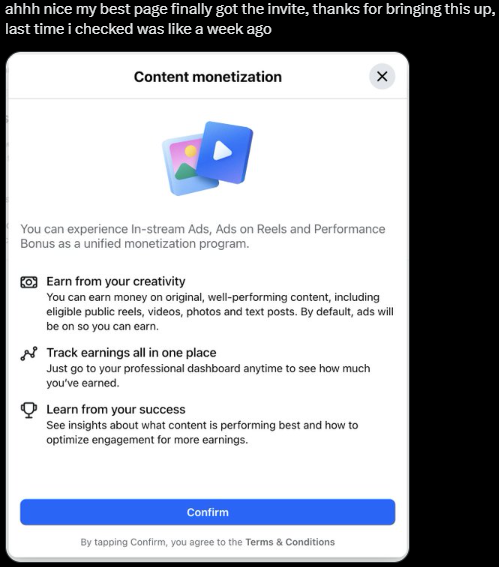
The clearest signal we have watched over the past several weeks is the pace at which Facebook Content Monetization invites are reaching pages. We have seen consistent publishers receive access, in at least one case within two days of activating Subscriptions. That timing matters, because it tells us Meta is watching engagement signals at the page level, not operating a slow, static queue.
Our consulting work confirms what the broader data also shows: posting cadence is one of the most observable correlators with invite timing. Pages that post on a predictable schedule appear to clear Meta's eligibility review faster than pages that publish in bursts. This is consistent with how Meta's own announcement framed the program when it launched the beta, noting that invites would go first to creators already demonstrating monetization momentum.
Facebook for Creators confirmed that Meta is sending invitations to millions of creators this year, with open enrollment planned for the near future. Invites surface inside the Professional Dashboard under the Monetization tab, and that is the place to check first if you have been posting consistently.
A Content Monetization invite appearing in a publisher's Professional Dashboard, a direct result of consistent posting cadence.
What makes the current wave notable is its breadth. Echobox reported that from nearly 700 pages active in the Facebook monetization program, hundreds of publishers have collectively earned over $51 million, a figure that underscores how material these payouts have become at scale. The program now covers Reels, long-form video, photo posts, and text posts under a single payout structure, which is a meaningful expansion from the old siloed tools.
What the $147,292.11 Site Revenue Number Tells Us
Numbers posted publicly tend to invite skepticism, and that skepticism is healthy. So it is worth being precise about what the figure we shared means. One publisher's website, not their Facebook page, not a combined stack, generated $147,292.11 in site revenue in July. August was already tracking at $42,804.05 through the first nine days of the month, representing a monthly run rate that points to a new record.
July site revenue: $147,292.11, up 3.2% over the prior month. Facebook payouts are tracked separately.
The important detail is that this number excludes Facebook payouts entirely. Facebook monetization revenue sits on top of it. Publishers who treat Facebook as a standalone traffic source or payout source are leaving the full picture on the table. The combination of a well-monetized website and an active Facebook page that qualifies for Content Monetization is how the top end of our publisher network generates revenue at this level.
Six-month site revenue trend for one publisher in the PIB network. Facebook monetization payouts are tracked separately and not included.
The trajectory also matters. July closed 3.2% above June, continuing a multi-month upward trend. The accelerating August pace is a function of multiple traffic sources working together: Google Discover, organic search including AI-assisted queries, and Facebook distribution. Publishers who invest in all three simultaneously tend to produce numbers like this. Those who optimize for one channel in isolation tend to plateau.
If you want to understand how the top of the network runs its operations, our turnkey management program covers the full operational model, from content cadence to platform monetization setup.
Zuckerberg's AI Manifesto and What Muse Glimmer Means for Publishers
On the same day that Content Monetization invites continued to flow, Meta made its largest single AI policy statement of the year. Mark Zuckerberg published a 6,500-word essay titled "The Future is for Everyone," and Meta shipped a concrete proof of that thesis the same morning.
Axios reported that Zuckerberg's plan is for "everyone" to have free or affordable access to AI tools, with the paid versions using a dynamic auction mechanism to get compute at the lowest possible price. The manifesto argues that the central long-term risk of advanced AI is excessive concentration of power, and that broad public access is the structural safeguard against that outcome.
The model that landed alongside the essay is Muse Glimmer. Meta AI Research described it as a 30-billion-parameter model optimized for always-on local agent workflows, small enough to run on a Mac or PC with a single consumer GPU. TechCrunch noted it is an open-weight model designed to run AI agents locally on consumer hardware, released under the permissive Apache 2.0 license. Bloomberg described it as a downloadable AI model that can run on a personal computer, adding fuel to the US debate over whether capable AI should be freely available or kept under tighter control.
For publishers, the AI-to-platform connection is not abstract. Meta's AI investment is the engine behind the ad targeting improvements that are driving platform revenue higher. Meta's Q2 2026 earnings release showed ad impressions delivered across the Family of Apps increased 14% year-over-year, while average price per ad rose 12% year-over-year. Total Q2 revenue reached $60.8 billion, up 28% from the prior year. That pricing strength flows downstream into the per-post payout rates publishers see inside the Content Monetization dashboard.
Meta's $145 Billion Capex Commitment and What It Signals to Page Operators
The infrastructure behind all of this is staggering in scale. Fortune reported that Meta raised its full-year 2026 capital expenditure guidance to a range of $125 billion to $145 billion, up from the prior range of $115 billion to $135 billion. The increase was driven by higher component prices and additional data center costs to support future-year capacity. AdGully confirmed the $145 billion figure alongside a $1 billion "Future Is For Everyone Fund" Zuckerberg announced to support local communities near Meta data centers.
CNBC noted that Zuckerberg is using this moment to reassure investors that Meta Superintelligence Labs, formed last year, is making progress and that the capital expenditure will pay off. The open-sourcing of Muse Glimmer is part of that argument: Meta is demonstrating that its AI investment produces tangible, distributable outputs, not internal efficiency gains.
From a publisher's perspective, the capex commitment is a directional signal. A platform spending at this scale on AI infrastructure is a platform that is deepening its monetization tools, not pulling back from them. The Content Monetization rollout, the accelerating invite pace, and the ad pricing strength we cited above are all downstream effects of the same upstream investment in AI-driven targeting and content distribution.
Three Observations From This Week's Activity
Pulling the day's signals together, three things stand out for anyone running a Facebook page or a publisher website right now.
First, consistency is the most accessible lever for Content Monetization access. Pages that publish on a predictable schedule are clearing the invite queue faster than those that do not. This costs nothing to implement and is the single most controllable variable a publisher has.
Second, site revenue and Facebook revenue compound rather than compete. The $147,292.11 figure is site revenue alone. Publishers who have both a well-optimized site and an active monetized page are generating from two independent income streams that reinforce each other through shared audience development.
Third, Meta's AI investment is structurally positive for page monetization rates. Higher ad impression volume and rising average prices per ad, confirmed in Meta's own Q2 results, feed directly into Content Monetization payouts. The manifesto and the Muse Glimmer release are the public face of an AI buildout that is already improving ad economics for publishers on the platform.
Publishers who want to understand the full operational picture, from Content Monetization setup to Discover traffic strategy, can review the work we do through our consulting practice or explore how our management programs handle this end to end.
Frequently asked questions
How do I know if my Facebook page is eligible for Content Monetization? Check the Monetization tab inside your Professional Dashboard or Meta Business Suite. Facebook for Creators confirms that eligible pages receive an in-product invite from an official Facebook or Meta channel. If you are not yet invited, the dashboard will show which eligibility requirements remain unmet, such as follower count, view thresholds, or compliance status.
Does posting more frequently speed up a Content Monetization invite? Based on what we have observed across pages in our network, consistent daily or near-daily publishing correlates with faster invite timing. Meta's system evaluates pages for monetization momentum, and a regular cadence demonstrates that a page is actively maintained and producing content that earns engagement. There is no official metric Meta publishes for this, but the pattern across our observations is consistent.
What is Muse Glimmer and why does it matter to Facebook publishers? Muse Glimmer is a 30-billion-parameter open-weight AI model released by Meta Superintelligence Labs under the Apache 2.0 license. It runs locally on consumer hardware. For publishers, the significance is indirect but real: Meta's AI investment is what powers the improved ad targeting behind rising ad prices on the platform. Higher average prices per ad translate into higher per-post payouts inside Content Monetization.
Can Facebook Content Monetization revenue and website ad revenue run at the same time? Yes. The two revenue streams are independent. Facebook Content Monetization pays based on content performance on the platform. Website ad revenue is generated by traffic that lands on your owned site. Publishers running both simultaneously earn from each independently, and strong Facebook distribution can drive additional traffic to the site, creating a compounding effect across both streams.
What is the current scale of Meta's ad business and why does it matter for payout rates? Meta reported Q2 2026 total revenue of $60.8 billion, up 28% year-over-year, with ad impressions growing 14% and average price per ad growing 12% over the same period, according to Meta's official Q2 earnings release. Stronger ad pricing at the platform level flows into the revenue pool that funds Content Monetization payouts, making the health of Meta's ad business directly relevant to what publishers earn.
See more from Publisher in a Box in your Google results
The team behind 300M+ managed followers. We help publishers scale traffic, revenue, and audience across Facebook, Google Discover, and syndication networks.