Search across our learning center -- articles, newsletters, and more. Start typing or click a topic above.
Stay in the Loop
Get exclusive publishing strategies, industry insights, and early access to new features. No spam -- just signal.
Join 2,000+ publishers. Unsubscribe anytime.
Industry News
Facebook Content Monetization Is Being Restored in Real Time: What Publishers Saw on June 18, 2026
Publisher In a Box8 min read
Table of Contents
This article is part of our daily digest series, in-depth summaries drawn from our X account, @publisherinabox, expanded with industry data.
Facebook content monetization is being restored, and it is happening in real time. Across June 18, 2026, operators reported page after page coming back online, often with no appeal and no action on their part. For any digital publisher caught in this month's enforcement wave, the live feed of restorations is the clearest sign yet of a system error. The day added one more signal for Facebook page monetization: Facebook itself started apologizing.
Operators began reporting content monetization rollbacks on June 17, ahead of the wider restorations.
Restorations landed all day, with no action required
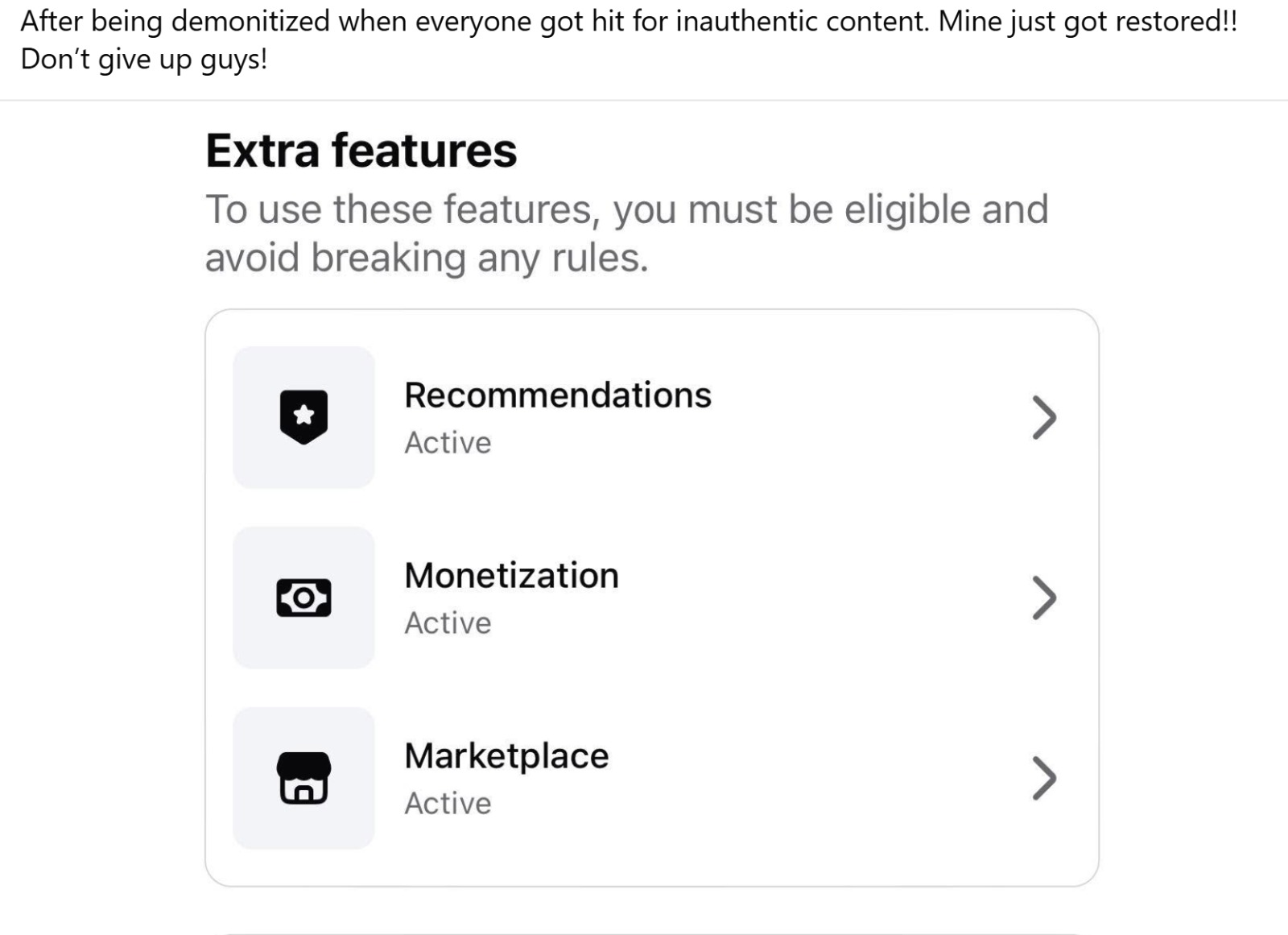
The pattern repeated from morning to afternoon. One operator after another watched monetization return on pages hit in the wave, and most did nothing to trigger it. The flags lifted on their own. The reports came in steadily, from single-page restorations to operators seeing several assets clear at once.
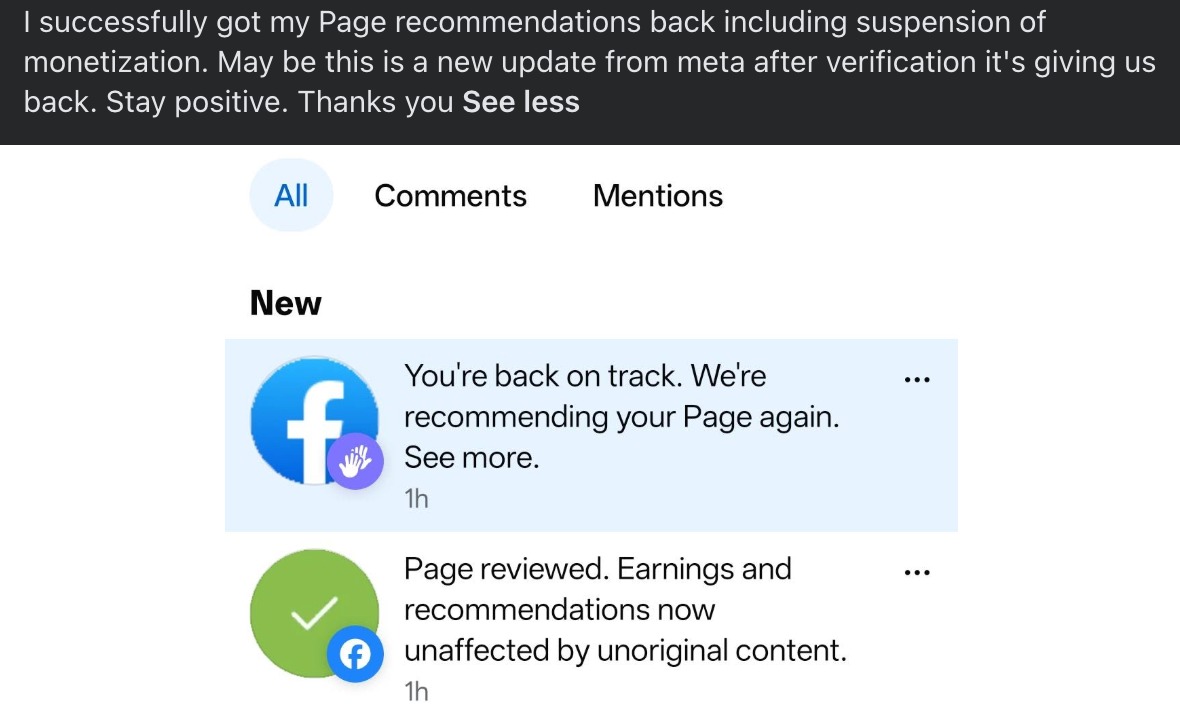
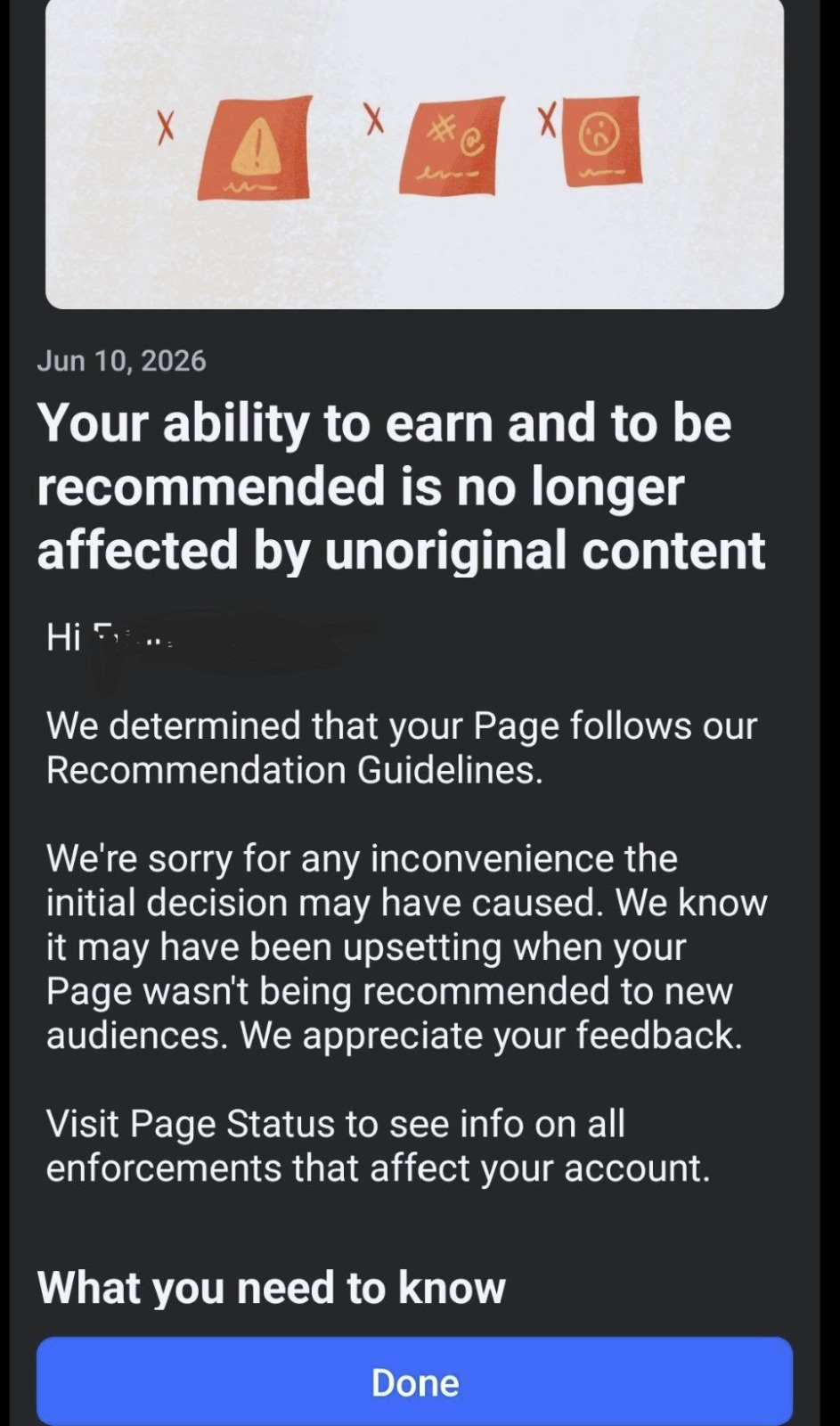
The reversals went past monetization alone. Operators reported recommendations switched back on, and even violations tied to unoriginal content cleared. The earlier wave had bundled several enforcement types together, and the rollback is unwinding them as a group, not one narrow flag. For pages stuck behind multiple strikes, the whole stack is lifting, not a single piece of it.
A page seeing recommendations and unoriginal-content violations reversed alongside monetization.
The volume of reports grew through the day. By afternoon, more operators were confirming restored access, a steady stream rather than a one-off.
More publishers reporting restored content monetization through June 18.
Facebook is now showing a "We're Sorry" popup
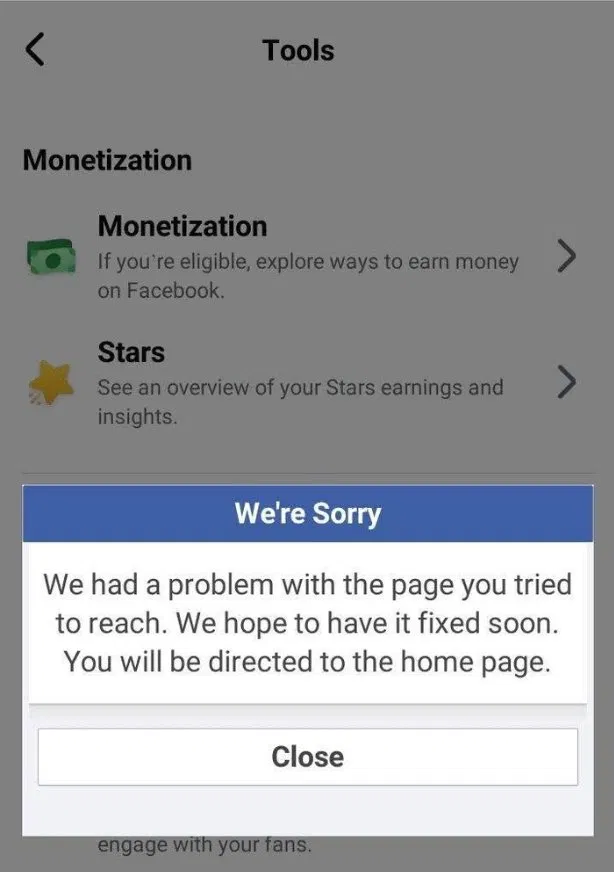
The freshest signal arrived midday. Facebook began serving operators a "We're Sorry" popup across the Monetization menu. After the suspensions and the pulled monetization, the platform is acknowledging something went wrong. A popup is not a press release, but a platform-level apology inside the product is as close to an admission as operators get. Read alongside the restorations, it confirms the strikes were the platform's error, not the publisher's.
Facebook's "We're Sorry" message appearing across the Monetization menu.
What the restorations mean for content monetization
Two takeaways hold for any operator hit in the wave. First, a missing-monetization status from this period is most likely a casualty of the sweep, not a judgment on the page. Second, patience beats panic. Pages are returning without drastic action, and rebuilding a healthy page around a temporary flag would trade a strong long-term asset for a short-term reaction.
The appeals still in the queue are moving slowly because of volume, not merit. A page with clean history and a filed appeal sits in line for a reviewer, and the line is long right now. A wait is the backlog at work, not a verdict on the case.
The ad market is the other half of the story
Facebook enforcement explains only part of what hit publisher earnings this quarter. The advertising market is the other half, and the data points up. eMarketer projects US ad spending to grow about 9.5 percent in 2026, with AI-driven gains in social and retail media helping offset a soft economic outlook, and social leads all channels at 14.6 percent growth (eMarketer).
The shift in who controls that spend matters for every Facebook page monetization strategy. The Meta family of apps is projected to reach 100.86 billion dollars in net US ad revenue in 2026, passing Google on a net basis for the first time (eMarketer). The platform cutting your checks is the one gaining share, and a market growing at that pace does not stay soft for long. As ad budgets and RPMs recover, the reach and rates squeezed out of the spring come back, setting up a stronger Q3 and a profitable Q4.
The Q4 catalyst: US midterms and which niches lead
The spending backs the call. AdImpact projects a record 11.6 billion dollars in US political ad spending for the 2026 midterm cycle, up from 8.9 billion in the 2022 midterms, with 1.68 billion of it going to digital (AdImpact, via CNBC). That money floods the same auctions your pages sell into. Political content goes into heavy demand overnight, so politics pages lead. General news rides the same wave. Finance and economics follow. Consumer goods and anything feeding the Christmas sales run hold up well through all of it.
Publishers positioned in those niches before the season starts capture the demand as it arrives. The operators who wait until the spike is obvious arrive late to their own opportunity.
What the Zuckerberg admission signals for content monetization
Meta gave publishers a useful tell this month. In an internal memo reported by the press, Mark Zuckerberg told staff the company made mistakes in reorganizing itself around AI and will likely make more. Meta laid off roughly 10 percent of its global workforce earlier in the year and moved 7,000 employees into AI initiatives, and when it reported Q1 results in April it raised full-year 2026 capital spending guidance to a range of 125 to 145 billion dollars, up from 115 to 135 billion (Fortune).
Publishers already lived through one of those mistakes. The same AI moderation push Zuckerberg now calls too fast is the system flagging thousands of healthy pages for inauthentic engagement and pulling their monetization on false positives. A chief executive conceding the AI rollout was sloppy is a chief executive confirming those enforcement misfires were a bug, not the operator's fault. Short term, expect more rollbacks and corrections. Long term, that 145 billion dollars a year is pointed at making Feed and Reels recommend better and sell ads at higher rates, feeding the same Content Monetization pool publisher checks are drawn from.
The data behind the recovery
US ad spending is set to grow about 9.5 percent in 2026, with social leading channel growth at 14.6 percent (eMarketer).
The Meta family of apps is projected to reach 100.86 billion dollars in net US ad revenue in 2026, passing Google for the first time (eMarketer).
Meta guided 2026 capital spending to 125 to 145 billion dollars, up from 115 to 135 billion (Meta Q1 2026 results, via Fortune).
US political ad spending for the 2026 midterms is projected at a record 11.6 billion dollars, up from 8.9 billion in 2022 (AdImpact, via CNBC).
Google Discover reaches more than 800 million people a month, a no-search, no-subscription distribution surface (Google figures).
The tactical notes the team flagged today
Alongside the rollback, the day's posts carried the working playbook for publishers building through the recovery.
Reels are the lever for stuck page earnings and for acquiring quality followers cheaply. Partner pages running viral Reels showed steady follower step-ups, from 80,000 to 150,000 on one page and from 250,000 to 350,000 on another.
Consistency beats chasing virality. Pages posting every day outperform pages waiting for a single hit.
Google Discover still reaches more than 800 million people a month, an audience larger than most countries, reached with no search and no subscription and refreshed every time someone opens a phone.
What publishers should do now
The day's signal rewards steadiness. A short checklist keeps operators positioned.
Treat a wave-era monetization loss as a likely false positive, and keep your appeal filed and documented.
Hold your publishing standard. Healthy pages are the ones coming back.
Lean into Reels and daily consistency while reach recovers.
Position in the niches set to lead Q4 before the midterm money arrives, not after.
Operators who want a direct read on their assets and a recovery plan work through our Facebook consulting. Publishers who would rather hand the daily operation to an experienced team use Facebook turnkey management.
The restorations are still landing as this publishes. The direction is set: the strikes are reversing, the platform is apologizing, the ad market is growing, and the publishers who hold steady are the ones who keep the assets they built.
Frequently asked questions
Is Facebook restoring content monetization removed in the June 2026 wave?
Yes. Operators reported restorations throughout June 18, 2026, many with no appeal and no action taken. Recommendations and unoriginal-content violations are reversing alongside the monetization flags.
What is the Facebook "We're Sorry" popup?
Facebook began showing a "We're Sorry" popup across the Monetization menu on June 18, 2026. It is a platform-level acknowledgment of the recent suspensions and pulled monetization going wrong.
Do I need to appeal to get my Facebook monetization back?
Many pages returned with no appeal and no action. Filing a clean appeal still helps, and pending appeals are moving slowly because of volume, not the merits of the case.
Is the Facebook ad market actually recovering in 2026?
The forecasts point up. eMarketer projects US ad spending to grow about 9.5 percent in 2026, with social media leading channel growth, and the Meta family of apps passing Google in net US ad revenue for the first time. The 2026 midterm cycle adds a record projected 11.6 billion dollars in political ad spend.
What should publishers focus on during the recovery?
Hold publishing standards, keep appeals documented, build with Reels and daily consistency, and position in the niches set to lead Q4. Publishers wanting hands-on help use Publisher in a Box Facebook consulting or turnkey management.
See more from Publisher in a Box in your Google results
The team behind 300M+ managed followers. We help publishers scale traffic, revenue, and audience across Facebook, Google Discover, and syndication networks.