Search across our learning center -- articles, newsletters, and more. Start typing or click a topic above.
Stay in the Loop
Get exclusive publishing strategies, industry insights, and early access to new features. No spam -- just signal.
Join 2,000+ publishers. Unsubscribe anytime.
Industry News
Facebook Groups and Facebook Content Monetization: The Dual-Engine Publisher Strategy
Publisher In a Box12 min read
Table of Contents
This article expands on our Publisher Insider newsletter, published by Publisher in a Box, with verified industry data.
Facebook Groups: the retention engine hiding in plain sight
When analysts debate why Facebook continues to hold 2.11 billion daily active users against a rising tide of younger platforms, they tend to reach for algorithmic explanations. The real answer is simpler and harder to replicate: Groups. According to Meta Investor Relations, Facebook carries 3.07 billion monthly active users and 2.11 billion daily active users, a daily-to-monthly ratio of nearly 69 percent. A DAU/MAU ratio that high signals deep habitual use, not casual browsing. Groups are a primary engine of that habit. Meta's own figures, last reported in detail before the company shifted to family-level metrics, counted 1.8 billion monthly Groups users across more than 10 million active communities, with more than 70 million admins and moderators running them. That floor figure carries a 2020 timestamp. The real number today is almost higher.
The pull Groups create is qualitatively different from feed scrolling. A member opens the app because someone posted an answer to a question they asked yesterday. A local neighbor shared a tip. A thread inside a niche community exploded overnight. That notification-driven re-entry loop is stickier than any ranked feed because it feels personal and reciprocal. For a measurable portion of Facebook's user base, Groups are not a feature inside the app. They are the primary interface through which those users interact with the platform at all.
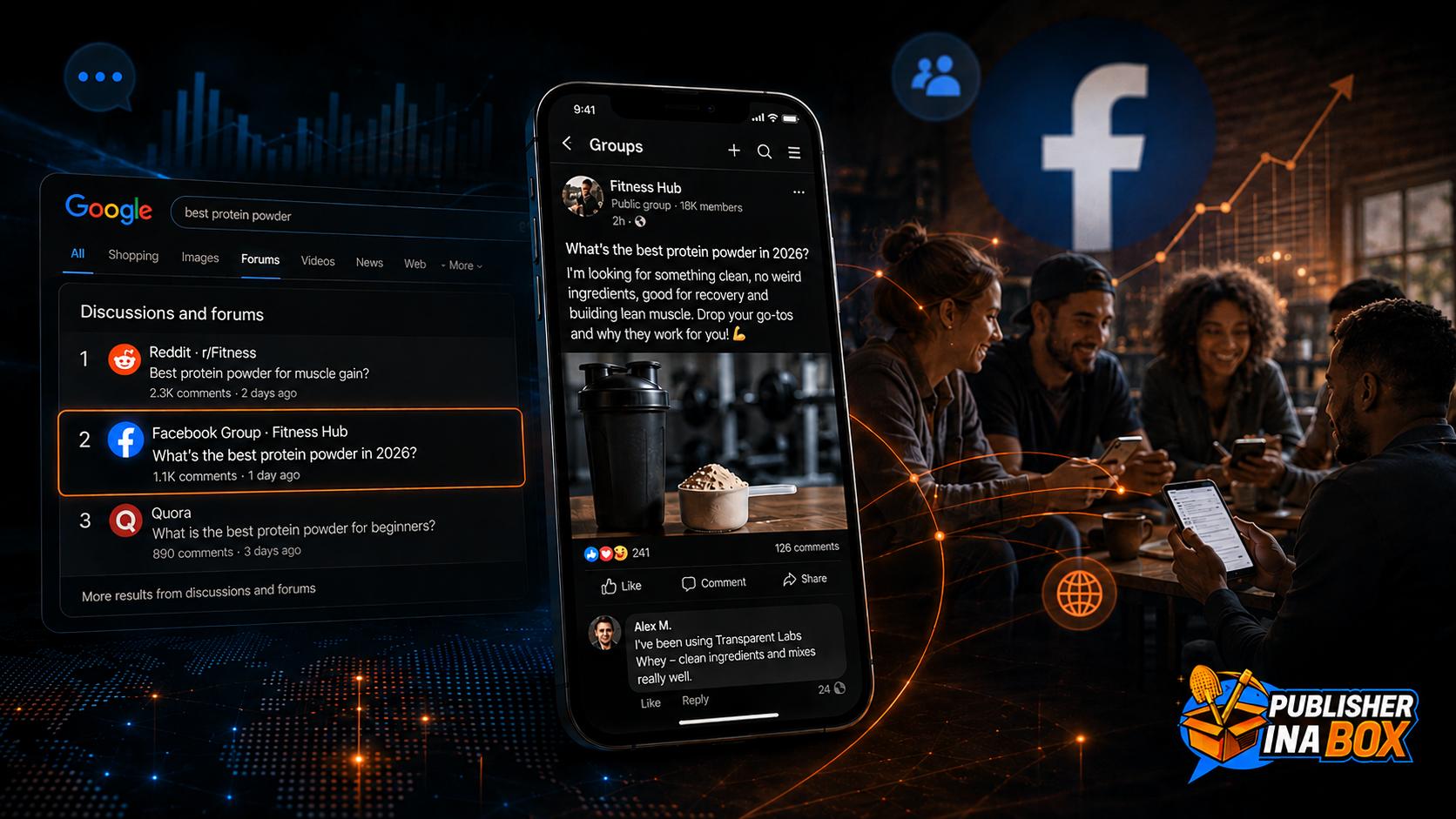
Facebook Groups now appear in 38.3% of Google's Discussions and Forums results in the US, ranking second only to Reddit. Source: Ahrefs / Publisher in a Box analysis.
Why news consumption lives inside Groups
News distribution on Facebook is not primarily a Pages phenomenon. It runs on top of the daily Groups habit. A Pew Research Center survey conducted August 2025 found that 38 percent of U.S. adults regularly get news on Facebook, placing it ahead of every other social platform, including YouTube at 35 percent. Instagram and TikTok each came in at 20 percent, with X at 12 percent. A significant share of that Facebook news consumption travels through Groups, where members share links, add commentary, and amplify stories far beyond what any Page timeline can achieve on its own. Groups turn passive readers into active distributors. A member opens the app to check a Group notification and encounters a news story shared by a trusted community member. That trust layer, applied to content from a publisher's Page, extends reach in a way that a direct Page post cannot replicate.
The same Pew data found that about half of U.S. adults visit Facebook at least once a day, with 37 percent visiting several times daily. That visit frequency is the foundation on which news habit sits. Publishers who treat their Facebook Page and their affiliated Group as separate properties are leaving an amplification loop incomplete. The Group drives the return visit; the Page anchors the content that travels through it.
Facebook leads all social platforms as a regular news source for U.S. adults. Pew Research Center, August 2025 survey of U.S. adults.
Google is now indexing the conversation inside Groups
The most structurally significant development for publishers operating Facebook Groups is that Group content is no longer confined to the Facebook ecosystem. An analysis by Ahrefs, drawing on more than 500 million search results, found that public Facebook Group posts appear in 38.3 percent of Google's Discussions and Forums results in the United States. Reddit remains the dominant source, appearing in 87.8 percent of those results. Facebook sits at number two, ahead of Quora at 32 percent, with every other source below 10 percent.
That ranking shift happened quickly. According to the Ahrefs study, Facebook overtook Quora's position as the second-most common domain in the Discussions and Forums module for the first time in January 2026, and has held that position in every subsequent month of tracking. The analysis further notes that Facebook's presence spans a wide array of communities: the top 10 Groups account for only 2.82 percent of Facebook's links in the module, and the top 100 make up 9.27 percent. Search visibility is distributed across thousands of communities, not concentrated in a handful of mega-Groups. Every Facebook URL appearing in the module came from a public Group, not a Page, not a personal profile.
The Discussions and Forums feature itself appears in 11.7 percent of all U.S. search results where it is triggered, according to the same Ahrefs data. That is a meaningful slice of search real estate, and Group content is capturing a disproportionate share of it relative to most other forum sources. For publishers managing Facebook consulting strategies or running community-driven Pages, this represents a structural search advantage that did not exist at this scale two years ago. Public Group posts are now pulling organic search traffic from audiences who may never have opened Facebook in their session.
There is an additional layer developing in AI-powered search. Ahrefs data from July 2026 shows that Google's AI Overviews cite forums and social platforms heavily, with Reddit at 18.5 percent of AI Overview citations, Facebook at 10.7 percent, Instagram at 5.8 percent, and Quora at 5 percent. Community-generated content is being treated as a credible source by the same AI systems that are reshaping how audiences discover information. A publisher whose Group content earns placement in both the Discussions module and AI Overviews operates with two organic discovery channels beyond the Facebook feed itself.
The monetization trajectory: Pages first, Groups next
Meta's approach to building monetization infrastructure follows a recognizable pattern. It invests in Pages tooling, stabilizes that surface, then extends the model to the next high-engagement surface. That pattern is playing out now with Groups.
On the Pages side, the buildout is well underway. CNBC reported in March 2026 that Meta has been actively recruiting creators from Instagram, TikTok, and YouTube to post on Facebook, offering guaranteed payments, reach boosts, and access to the Facebook Content Monetization program in perpetuity. That program, as Publisher in a Box has covered in detail, consolidates in-stream ads, Reels monetization, Stars, and performance bonuses into a single dashboard with unified eligibility. It is the most coherent creator revenue system Facebook has built. Enrollment began as invite-only and has been expanding through 2025 and into 2026.
The Groups side is earlier in that arc, but the direction is clear. Meta has already enabled select admins to charge subscription fees for access to private Groups. More significantly, Meta introduced interoperable subscriber Groups, a feature that allows creators to receive payments from fans on other platforms and automatically add those paying subscribers to exclusive Facebook Groups. As Meta described it in its official announcement, the feature was framed as the company's first investment in interoperable monetization tools for creators. That framing matters because it signals intent to go further. The first investment in a category rarely stays the last.
In late 2025, Meta also introduced the ability to convert private Groups to public while preserving the privacy of historical content. That change is directly tied to search discoverability. A public Group's posts are indexed by Google and eligible to appear in the Discussions and Forums module. Making it easy for admins to flip the visibility setting without losing their community's archived discussions removes a structural barrier that previously forced admins to choose between privacy and search reach.
Publishers who work with a Facebook turnkey management partner are already thinking about how to connect these surfaces. The playbook emerging from current data suggests treating the Page and the Group as complementary distribution mechanisms: the Page earns from the Content Monetization program, while the Group builds the daily-use habit that keeps audiences returning, amplifies Page content through member-to-member sharing, and establishes the community asset on which future Group-native monetization tools will sit. The two surfaces reinforce each other in ways that neither achieves alone.
What this means for your publishing operation right now
Three things are true simultaneously and independently useful to a publisher building on Facebook today.
First, Facebook Groups are already a search asset. Public Group posts are appearing in Google's Discussions and Forums module at a scale that makes Groups one of the two most visible forum sources on the open web. A well-run public Group in a specific topic niche is generating organic search impressions for an audience that finds the content through Google, not through the Facebook algorithm. That is a discovery channel that most publishers are not treating strategically.
Second, the news consumption data from Pew supports a Group-anchored distribution model. When 38 percent of U.S. adults say they regularly get news on Facebook and the platform's daily engagement ratio runs near 69 percent, the audience is present and habituated. Connecting that audience to Group-level discussion of news content converts passive readers into active participants who share, comment, and return.
Third, the monetization infrastructure for Groups is in an early but active development phase. Meta has precedent for building out Pages tooling over multiple years before the system reached its current depth. The same trajectory, applied to Groups, suggests that admins who build healthy, engaged communities today will be best positioned when Group-native monetization tools expand. Building the community asset before the monetization tools arrive is the correct sequencing. Building it after leaves time and audience on the table.
Frequently asked questions
Why do Facebook Groups appear in Google search results? Google's Discussions and Forums feature surfaces posts from public online communities, including public Facebook Groups. When a Group is set to public visibility, its posts are indexed by Google's crawlers and can appear in search results. According to Ahrefs analysis of more than 500 million search results, Facebook Group posts appear in 38.3 percent of U.S. Discussions and Forums results, making Facebook the second-largest forum source in that module behind Reddit.
Can Facebook Groups be monetized directly through Meta? As of mid-2026, Meta does not pay Group admins directly based on Group activity or ad revenue generated inside a Group. However, Meta has enabled some admins to charge subscription fees for private Group access, and has introduced interoperable subscriber Groups that let creators receive payments from fans on external platforms and automatically grant those paying fans access to a subscriber-only Facebook Group. Group admins who also run a Page can share eligible Page content into their Group and earn through the Page's Content Monetization program. Expansion of Group-native tools is expected as Meta continues developing its creator monetization infrastructure.
How does running a Facebook Group alongside a Facebook Page help a publisher? A Page and a Group serve different functions that complement each other. The Page is the primary surface for content publishing and the anchor for Meta's monetization programs, including in-stream ads and performance bonuses. The Group builds daily return habits, turns passive followers into active community members, and amplifies Page content through member-to-member sharing. Because public Group posts are indexed by Google and can appear in search results, the Group also generates organic discovery for audiences outside the Facebook platform entirely. Together, the two surfaces create distribution and habit loops that neither achieves independently.
What is the Facebook Content Monetization program and how does it relate to Groups? The Facebook Content Monetization program is a unified system Meta has been rolling out since 2025 that consolidates previous separate programs, including in-stream ads, Reels monetization, Stars, and performance bonuses, into a single eligibility and payout framework. It applies to Facebook Pages, not Groups directly. However, admins who run a monetized Page can share eligible content into their Group, extending the reach of monetized content to a community audience. As Meta expands monetization tools to Groups, having an established Content Monetization program on an affiliated Page positions publishers to connect the two surfaces efficiently.
What type of Group content is most likely to appear in Google's Discussions and Forums results? The Ahrefs analysis found no direct correlation between backlinks to individual Group threads and their appearance in Google's Discussions and Forums module. The visibility is spread broadly across thousands of communities rather than concentrated in the largest Groups, suggesting that topical relevance and public accessibility matter more than domain authority signals specific to individual threads. Posts in public Groups on specific, searchable topics, where a real conversational thread exists, are the most likely to be surfaced. Setting a Group to public visibility is the baseline requirement for any Google indexing to occur.
See more from Publisher in a Box in your Google results
The team behind 300M+ managed followers. We help publishers scale traffic, revenue, and audience across Facebook, Google Discover, and syndication networks.