Facebook Organic Growth Strategy for Politicians in 2026: What Works When Political Ads Go Dark
Publisher In a Box12 min read
Table of Contents
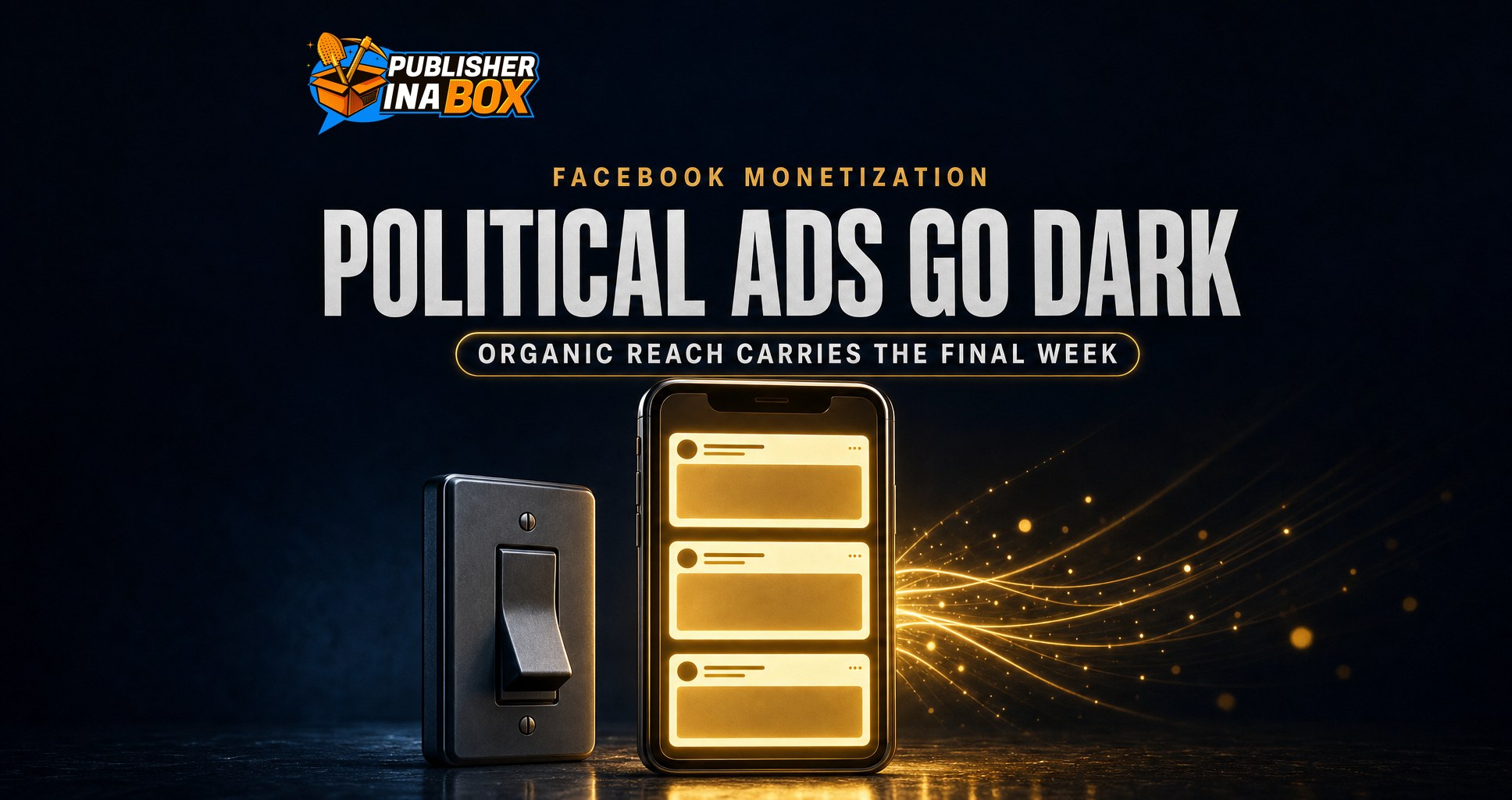
For the last eight days of the 2026 US midterm campaign, a political Page cannot start new ads about social issues, elections or politics on Facebook. Meta will not allow any new ads about social issues, elections or politics in the US from 12:01 AM Pacific Time on Tuesday, October 27, through 11:59 PM Pacific Time on Tuesday, November 3, Election Day. Apart from qualifying ads that were already running before the cutoff, what a candidate, a party or a political Page has built organically carries the final week.
That makes organic growth the strategy that matters most in the week it is hardest to change. This guide covers what Meta's rules actually say about political content in 2026, how political posts reach people in Feed, what a politician's Page can and cannot do, and the organic approach we would use, whether you are running a campaign or a political news Page.
The final-week ad restriction, in plain terms
Meta announced in February that it would again block new political, electoral and social issue ads in the final week of the US campaign, as it has since 2020, and has since published the details on its Government and Nonprofits blog and its Meta for Developers blog. Meta's stated reason is that in the final days of an election there may not be enough time to contest new claims made in ads.
An ad can keep running during the window only if it was created with a valid "Paid for by" disclaimer and served at least one impression before 12:01 AM PT on October 27. Approval alone is not enough. Meta also warns that its systems may take between 6 and 24 hours to record an impression, so an ad that first served late on October 26 may not show as eligible right away.
Ads that qualify can keep running, but the editing options shrink. According to Meta, advertisers can adjust the bid amount, the budget amount and the scheduled end date, and can pause or unpause the ad. Creative, placement, targeting and optimization cannot be edited, and an edit that sends an ad back into review can cost it its eligibility. New ads can be published again at 12:00 AM Pacific Time on Wednesday, November 4.
8 days
Meta's restriction on new US ads about social issues, elections or politics, from 12:01 AM PT October 27 through 11:59 PM PT November 3, 2026
Source: Meta, Government and Nonprofits blog, Restriction period for ads about social issues, elections or politics before the US 2026 Midterm Election
The practical consequence is simple. For a week, every political Page competes for attention with what it publishes for free, and with the ads that rivals had running before the deadline.
How Facebook decides who sees political posts
Organic strategy starts with how political posts reach people, and Meta changed its approach in 2025.
From 2021, Meta reduced how much political content people saw in Feed. In January 2025 it said that approach had been "a pretty blunt approach" and began phasing political content back in. Meta said it would treat civic content from people and Pages you follow more like any other content in Feed, ranking it on explicit signals, such as liking a post, and implicit signals, such as viewing posts. Its Transparency Center page on political content, updated in September 2025, says Meta will treat political content more like other types of content and may recommend it from accounts people do not already follow, in places like In-Feed Recommendations, Video, Groups You Should Join and Pages You May Like.
Each person still has a say on Facebook. Facebook's Help Center describes a political content control in Content Preferences. Under the Default setting, Facebook suggests political content from profiles a person does not follow. If a person switches the control off, Facebook will not suggest political content when it recognizes it. The control covers suggestions. Meta describes political content as content that mentions governments, elections or social topics.
Read together, the rules point to two audiences. Your followers see your posts ranked more like other content they follow. People who do not follow you may be shown your posts as recommendations, and those who have turned political suggestions off will not be. Meta has said the signals it uses include what people like and what they view, among many others, so no single tactic guarantees reach.
Meta now treats political posts more like any other post. Your followers come first, and recommendations are a bonus, not a promise.
What a politician's Page can and cannot do
Candidates and campaigns should know where the line sits between a political Page and a political publisher, because Meta treats them differently.
Meta's Partner Monetization Policies list political and government entities that are ineligible for monetization: current elected and appointed government officials, current political candidates, political parties, registered political committees, and government agencies and departments. Communications that are regulated as political advertising under applicable law are also ineligible for monetization features. Meta's branded content rules list the same entities as ineligible to run branded content. Separately, in the United States, Meta allows the branded content tool on branded content posts where the paying partner has been authorized to run ads about social issues, elections or politics. That rule is about who may sponsor a post, not permission for a candidate or party to publish branded content.
For a candidate, that is rarely a problem, because the goal is votes, not payouts. A political news or commentary Page that is not itself one of those entities may be eligible to monetize, subject to all of Meta's monetization rules. Meta's Content Monetization Policies list "debated social issues" as a restricted category: content may have reduced or disabled monetization if it depicts or discusses subjects such as political affiliation, immigration or the legitimacy of elections in a polarizing or inflammatory manner, and content that exploits controversial political or social issues for commercial purposes is restricted from monetization. We cover how political publishers build revenue inside those rules in our guide to political news monetization on Facebook.
The organic growth strategy we would run
With new political ads frozen and political posts treated more like any other post, here is the approach we would take in the final week and after it. These are our recommendations, not Meta's rules.
Post for the people who already follow you
Followers are the audience that does not depend on anyone's recommendation setting. In the final week, the most valuable posts are the ones that help existing supporters act: pointing them to their official state or local election office for where and when to vote, explaining what is on the ballot, and saying what the candidate will do on a specific local issue. Practical posts give people a reason to come back.
Make every post answer a specific local question
Broad national talking points compete with every other political Page in the country. A post about a specific road, school, tax line or polling place serves a smaller audience that cares more, and gives your followers a reason to read the whole post.
Trade outrage for explanation
Outrage can draw reactions, but for a Page that monetizes it carries a documented cost: Meta may reduce or disable monetization for content that discusses debated social issues in a polarizing or inflammatory manner. That applies to every side equally. Explain the issue, show the number, name the source.
Keep the Page itself in good standing
Policy violations can limit what a Page is able to do, and the final week is the worst time to find that out. Review what gets posted, keep claims accurate and sourced, and make sure anyone with access to the Page knows the rules. We cover how political Pages hold up over time in our analysis of whether Facebook is stable for political publishers.
Build the list you will need on November 4
Every organic post that brings someone to a sign-up page, an email list or a volunteer form builds a direct line to supporters that does not depend on a platform setting. How a campaign may collect, use and transfer that contact data is governed by election and privacy law, so set it up with your compliance team.
title: The whole system, not one tactic
body: Running a political news or commentary Page as a business? The Facebook Monetization Suite pairs the Facebook Automation Machine with the full PIB playbook and a Professional Asset Valuation of your Page. $499, seven deliverables.
link: https://publisherinabox.com/facebook-monetization-suite
Platform rules are not election law
Everything in this guide describes Meta's own platform rules. Campaigns, committees and anyone paying for political communications are also governed by federal and state election law, which this guide does not cover. Meta says the same to its advertisers: some states and countries have specific laws governing ads about social issues, elections or politics, and complying with them is the advertiser's responsibility. Meeting Meta's requirements does not by itself mean a communication complies with the law. Check your obligations with your campaign's counsel or compliance team. We checked every Meta rule in this guide against Meta's live pages on October 26, 2026, and Meta can change them at any time.
What political publishers should take from this
The reach rules apply to political news Pages too, and their business continues after Election Day. Politics is a niche where we have seen publishers build real businesses when they run their Pages as businesses, which is the story of our case study on growing a politics Page from zero to $20,000 a month. That outcome came from consistency and audience trust, not from a single election cycle, and it is not a promise of what any Page will earn.
For a Facebook publisher in the political niche, the final week is a useful stress test. If your reach depends on content that risks your monetization, you are building on a weak base. If it depends on clear, sourced, local reporting, the rules work for you every week of the year.
Where to go from here
If you run a political news or commentary Page and want the whole operation in one place, the Facebook Monetization Suite gives you the Facebook Automation Machine, the full PIB playbook and a Professional Asset Valuation of your Page. If you would rather have your own team trained to grow political Pages within Meta's rules, Facebook Consulting teaches the method Publisher in a Box uses, and you keep 100 percent of the revenue.
Frequently asked questions
When does Meta stop new political ads before the 2026 midterms?
Meta will not allow new US ads about social issues, elections or politics from 12:01 AM PT on Tuesday, October 27, 2026, through 11:59 PM PT on Tuesday, November 3, 2026. New ads can be published again at 12:00 AM PT on Wednesday, November 4.
Can political ads that are already running continue?
Yes, if they were created with a valid disclaimer and served at least one impression before 12:01 AM PT on October 27. During the window, advertisers can change the bid, budget and scheduled end date, and pause or unpause, but cannot edit creative, placement, targeting or optimization.
Does Facebook show political posts to people who do not follow a Page?
It can. Meta says it may recommend political content from accounts people do not already follow. On Facebook, under the Default political content setting, Facebook suggests political content from profiles a person does not follow. People can switch the control off, and then Facebook will not suggest political content it recognizes.
How does Facebook rank political content in 2026?
Since January 2025, Meta has said it treats political content more like other content, ranking posts from accounts you follow on explicit signals such as likes and implicit signals such as viewing, and recommending more political content based on those personalized signals.
Can politicians monetize their Facebook Pages?
Not while they hold office or are running. Meta's Partner Monetization Policies make current elected and appointed government officials, current political candidates, political parties, registered political committees and government agencies and departments ineligible for monetization. Political news Pages that are not themselves political entities may be eligible, subject to Meta's monetization rules.
What is the best organic Facebook strategy for a political candidate?
Our recommendation: post for existing followers, answer specific local questions, explain rather than provoke, keep the Page in good standing, and use organic posts to build an email or volunteer list. Check federal and state election law with your counsel, since Meta's rules are not the only ones that apply.
Key takeaways
Meta blocks new US political and issue ads from 12:01 AM PT October 27 through 11:59 PM PT November 3, 2026, so organic reach carries the final week.
Ads keep running only if they had a valid disclaimer and served an impression before the cutoff, and only bid, budget, end date and pause status can change.
Since 2025, Meta treats political posts more like other content and may recommend them to people who do not follow you, except people who have turned political suggestions off.
Current candidates, officials, parties and committees cannot monetize. Political news Pages may be eligible, within Meta's rules.
Polarizing treatment of debated social issues can reduce or disable monetization.
Meta's rules are platform rules. Election law is separate and is the campaign's responsibility.
Sources
Meta, Government and Nonprofits blog, Restriction period for ads about social issues, elections or politics before the US 2026 Midterm Election, facebook.com
Meta Newsroom, How Meta Is Preparing for the 2026 US Midterm Elections, February 2026, about.fb.com
Meta Newsroom, More Speech and Fewer Mistakes, January 7, 2025, about.fb.com
Meta Transparency Center, Our Approach to Political Content, updated September 18, 2025, transparency.meta.com
Facebook Help Center, About Political Content Control on Facebook, facebook.com
Meta Business Help Center, Partner Monetization Policies, facebook.com
Meta Business Help Center, Content Monetization Policies, facebook.com
Meta Business Help Center, Eligibility requirements for partnership ads and branded content, facebook.com
Meta Government and Nonprofits, Social issue, electoral or political advertising, facebook.com
The team behind 300M+ managed followers. We help publishers scale traffic, revenue, and audience across Facebook, Google Discover, and syndication networks.