Search across our learning center -- articles, newsletters, and more. Start typing or click a topic above.
Stay in the Loop
Get exclusive publishing strategies, industry insights, and early access to new features. No spam -- just signal.
Join 2,000+ publishers. Unsubscribe anytime.
Facebook Monetization
What Is a Facebook Publisher? How the Business Works in 2026
Publisher In a Box12 min read
Table of Contents
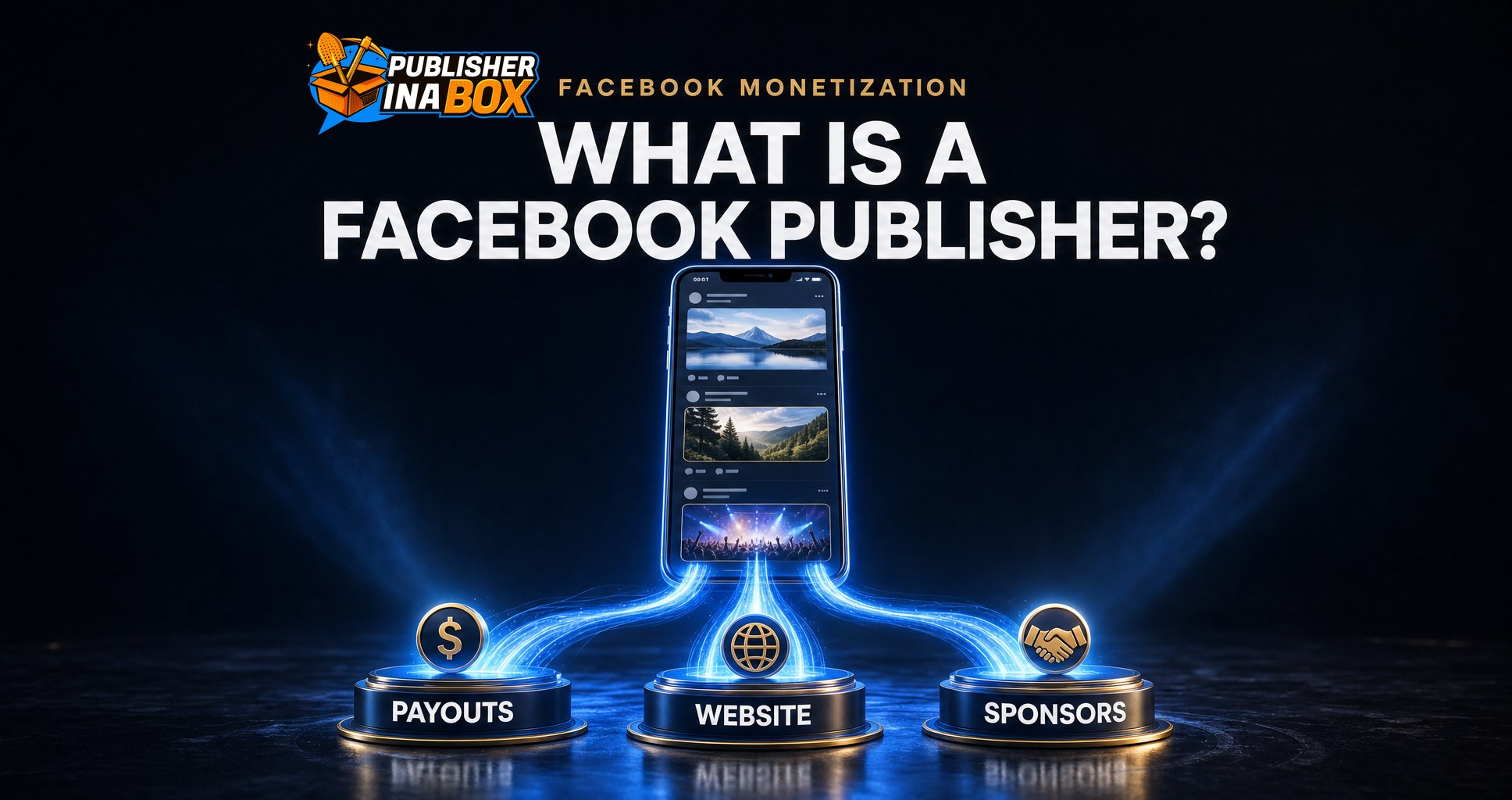
A Facebook publisher is a business that builds audiences on Facebook Pages and turns that attention into revenue, through Meta's own payouts, through readers sent to a website it owns, and through deals with brands. The difference from a hobby Page is intent and structure. A publisher runs its Pages on a content calendar, measures them like a business, and treats each Page as an asset that has a value and can be sold.
That definition matters more this month than it did a year ago, because Meta has started charging some Pages for the thing publishers depend on most. Facebook's Help Center now says that Pages under a new limit can include links in only two organic posts or comments a month unless they pay for a Meta One plan. This guide explains what a Facebook publisher is in 2026, how the money actually comes in, what the link limit changes, and what a Page is worth when it is built properly.
What is a Facebook publisher?
The simplest working definition is a company or operator that publishes on Facebook as a business rather than as a personal account. In practice that usually means one or more Facebook Pages in a defined niche, a steady posting schedule, and at least one way to earn from the audience beyond likes and follows.
Most Facebook publishers fall somewhere on a spectrum. At one end is a single Page that earns from Meta's payouts alone. At the other end is a network of Pages that feeds a website, an email list and sponsor deals, where Facebook is the top of the funnel rather than the whole business. Publishers at that second end are the ones who come through platform changes best, because no single rule change can switch off all of their income at once.
How a Facebook publisher differs from a personality-led Page or a news site
The three overlap, which is why the term causes confusion. A personality-led Page is built around one person on camera, so the audience follows that person. A news site is built around its own domain and treats Facebook as one source of traffic among several. A Facebook publisher sits between the two, because the audience follows the Page and its subject, and the business owns both the Pages and the places it sends readers.
That distinction has a practical consequence. A Page built around a subject rather than a personality can be run by a team, measured against a plan, and transferred to a new owner, which is exactly what makes it a business asset rather than a personal account.
How Facebook publishers make money in 2026
There are three revenue lines, and the strongest publishers run all three at once.
1. Facebook Content Monetization
Meta now pays through one program. Facebook's Business Help Center describes Content Monetization as an invite-only program that lets you earn money from the performance of your eligible public reels, photos, Stories and text posts. Meta introduced it by folding its earlier monetization programs, including In-stream ads and Ads on Reels, into a single program, so a publisher no longer manages separate payouts for each format.
The two words that matter most there are invite-only. You cannot switch Content Monetization on yourself, which means the work before the invitation, posting original content consistently in a defined niche, is the actual application. We cover the eligibility signals in detail in our guide to getting approved for Facebook's Content Monetization program.
Payouts vary widely by niche and audience, which is why most guides quote ranges rather than rates. Our own brand partnerships guide cites reported payouts of about $1 to $10 per 1,000 views from Creators Agency and ShortSync, with United States finance and technology content at the higher end and broad general niches lower. Treat that as a reported range, not a promise, because Meta does not publish a fixed rate.
2. Traffic to a website the publisher owns
The second line is sending Facebook readers to a website, where display ads, affiliate links and email signups earn on every visit. This is where a Facebook publisher becomes a publishing business in the full sense, because the website, the email list and the ad revenue belong to the publisher rather than to Meta.
The traffic case is stronger than many people assume. Chartbeat data published in the Reuters Institute's 2026 trends report showed Facebook referrals to publishers rising 9 percent globally and 23 percent in the United States in the year to November 2025, while Google Search referrals fell 33 percent globally and 38 percent in the US. We walk through what drove that in our guide on how to increase Facebook traffic.
+23%
Growth in Facebook referral traffic to US publishers in the year to November 2025, while Google Search referrals to US publishers fell 38 percent
Source: Chartbeat data, Reuters Institute Journalism, Media and Technology Trends and Predictions 2026
3. Brand partnerships and sponsorships
The third line is direct deals with brands that want to reach a Page's audience. These are paid by the deal rather than by the view, which makes them a useful counterweight to payouts that move with the algorithm. A Page with a clear niche and a measurable audience is far easier to sell to a sponsor than a general Page, which is one reason niche choice comes first. Our breakdown of the most profitable Facebook niches covers how niche shapes all three revenue lines.
title: The whole system, not one tactic
body: Want the automation and the strategy together? The Facebook Monetization Suite pairs the Facebook Automation Machine with the full PIB playbook and a Professional Asset Valuation of your Page, for publishers who want the whole system rather than a single tactic. $499, seven deliverables.
link: https://publisherinabox.com/facebook-monetization-suite
What the new link limit changes for Facebook publishers
This is the change every Facebook publisher should understand this month. Facebook's Help Center article on links in organic Page posts and comments says that if you are seeing a limit on your Page, you can include links in up to two organic posts or comments per month, and that the limit increases only with a Meta One Advanced, Expert or Max plan.
The details decide how much it costs you. The free allowance resets on the first of each month, and unused link posts do not carry over. Links in comments count too, so moving the link into the first comment does not get around the limit. Meta lists four exceptions that do not count: additional links in the comments of a post that already has a link, links to Meta technologies such as Facebook, Instagram, WhatsApp and Threads, links for partners connected through Facebook's affiliate partnerships, and links in ads.
Organic Page posts or comments with links allowed per month, by Meta One plan
posts or comments with links per month
Source: Facebook Help Center, About links in organic Facebook Page posts and comments (USD prices, may vary by region). The Max plan ($499.99) has no limit.
Two caveats keep this in proportion. First, the Help Center says the limit may not apply to all Pages, so many Pages are still posting links normally. Second, Social Media Today reported in September that Meta said publisher Pages are exempt from the test, and Press Gazette reported in October that news publishers are excluded. Press Gazette also noted that Meta has not confirmed how it defines who counts as a publisher, and that it knows of small publishers that were told they had hit the limit. So the honest answer to "does this affect me" is to check your own Page, and to plan as if it might.
Planning for it is mostly a matter of where each link earns its place. A publisher with two link posts a month spends them on the pieces most likely to convert, uses link-free posts to grow reach and earn Content Monetization payouts, and builds an email list so the most engaged readers can be reached without a Facebook link at all. We compare the paid tiers in detail in our guide to Meta One for Facebook publishers.
A Facebook publisher that earns from payouts, a website and sponsors can absorb a rule change on any one of them. A Page that earns from one line is one decision away from earning nothing.
What a Facebook publisher actually runs day to day
The daily work is less glamorous than the payout screenshots suggest, and it is mostly operational. A working Facebook publisher keeps a content calendar for each Page, produces original posts in the formats Meta pays for, watches each Page's standing in Meta's Professional Dashboard, and tracks which posts drive revenue rather than just reach.
The publishers who scale add structure in a predictable order. They automate the repetitive steps, scheduling, formatting and the first pass of drafting, while keeping a human review before anything goes live, which we cover in our guide to Facebook Page automation without slop. They add a second revenue line before they add a second Page, and they record every number, because those records are what a sponsor, a partner or a buyer will ask for later.
What is a Facebook Page worth?
Because a Facebook Page earns, it can be valued and sold like any other publishing asset. Publisher Market, the marketplace run by Publisher in a Box, prices Facebook pages in a band of 15 to 30 times monthly earnings, and content websites and whole publishing businesses at 28 to 40 times monthly earnings. Where a Page lands inside that band depends on its history, its share of United States audience, its account standing and how steady the earnings are.
That is one more reason to run a Page as a business from the first day. Clean records, a clear niche and more than one revenue line raise what the Page earns now and what it is worth later. If you want a number for your own Page, Publisher Market's free valuation estimate takes about three minutes and tells you what it is worth, what to fix and where to sell it. If you are on the buying side, our guide to buying a publishing business covers the checks to run before you pay.
Where to go from here
If you are building or running Facebook Pages and want the whole operation in one place, the Facebook Monetization Suite gives you the Facebook Automation Machine, the full PIB playbook and a Professional Asset Valuation of your Page. If you would rather have your own team trained to run and grow the Pages, Facebook Consulting teaches the method Publisher in a Box uses, and you keep 100 percent of the revenue.
Frequently asked questions
What is a Facebook publisher?
A Facebook publisher is a business that builds audiences on Facebook Pages and earns from them, through Meta's Content Monetization payouts, through traffic to a website it owns, and through brand partnerships. It runs its Pages on a schedule, measures them like a business and treats each Page as an asset.
How do Facebook publishers get paid?
Meta pays through Facebook Content Monetization, an invite-only program that pays for the performance of eligible public reels, photos, Stories and text posts. Many publishers also earn from display ads and affiliate links on their own websites, and from sponsor deals paid by the deal.
Can I apply for Facebook Content Monetization?
Not directly. Facebook's Business Help Center describes it as invite-only, so the invitation comes from Meta. Posting original content consistently in a defined niche is what builds the case for one.
Is Facebook limiting links on Pages?
Some Pages are limited. Facebook's Help Center says affected Pages can include links in up to two organic posts or comments per month without a paid plan, rising to 8 with Meta One Advanced, 20 with Expert and no limit with Max. It also says the limit may not apply to all Pages, and Meta told Social Media Today that publisher Pages are exempt from the test.
Do links in comments count toward the Facebook link limit?
Yes. Links in organic posts and comments both count. The exceptions are additional links in the comments of a post that already has a link, links to Meta technologies, links for Facebook affiliate partners and links in ads.
How much is a Facebook Page worth?
Publisher Market prices Facebook pages at 15 to 30 times monthly earnings, depending on earnings history, United States audience share, account standing and stability. Its free valuation estimate gives a range for a specific Page in about three minutes.
Key takeaways
A Facebook publisher is a business that runs Pages for revenue and treats each Page as an asset, not a personal account.
Meta pays through one invite-only program, Facebook Content Monetization, for the performance of eligible reels, photos, Stories and text posts.
Facebook referrals to US publishers rose 23 percent in the year to November 2025 while Google Search referrals fell 38 percent, according to Chartbeat data.
Some Pages are now limited to two organic posts or comments with links a month unless they pay for Meta One Advanced or higher, and links in comments count.
Meta told Social Media Today that publisher Pages are exempt from the link test, but Meta has not confirmed how it defines a publisher.
Publishers with three revenue lines, payouts, a website and sponsors, are the ones who absorb a rule change on any one of them.
Publisher Market values Facebook pages at 15 to 30 times monthly earnings, and its free valuation estimate takes about three minutes.
Sources
Facebook Help Center, About links in organic Facebook Page posts and comments, facebook.com
Meta Business Help Center, About Facebook Content Monetization for creators, facebook.com
Facebook for Creators, Introducing Facebook Content Monetization, creators.facebook.com
Social Media Today, Facebook Pages get charged for link posts, September 17, 2026, socialmediatoday.com
Reuters Institute, Journalism, Media and Technology Trends and Predictions 2026 (Chartbeat referral data), January 2026, reutersinstitute.politics.ox.ac.uk
The team behind 300M+ managed followers. We help publishers scale traffic, revenue, and audience across Facebook, Google Discover, and syndication networks.