Search across our learning center -- articles, newsletters, and more. Start typing or click a topic above.
Stay in the Loop
Get exclusive publishing strategies, industry insights, and early access to new features. No spam -- just signal.
Join 2,000+ publishers. Unsubscribe anytime.
Foundations
How to Buy a Publishing Business in 2026: What to Check Before You Pay
Publisher In a Box15 min read
Table of Contents
Buying a publishing business can be faster than building one, because you start with an audience, a revenue history and a library of content that already ranks or travels. It can also be the most expensive way to learn what a platform change does to a website, because the price you pay is based on profit that the next algorithm update may not leave in place. The difference between those two outcomes is decided almost entirely before you pay, in the checks you run on where the traffic and the money really come from.
This guide covers what content and publishing businesses sell for in 2026, what the large marketplaces verify before a listing goes live, and the checks a buyer should run on top of that, in the order that protects the most money.
If you want to see real deals while you read, Publisher Market is the marketplace we run for exactly this: buy and sell publishing businesses, made by people who build, manage and own publishing businesses, for people who do the same. You can browse every live listing free, and if you want to know what a business is worth before you buy or sell one, the free valuation estimate takes three minutes.
What publishing businesses sell for in 2026
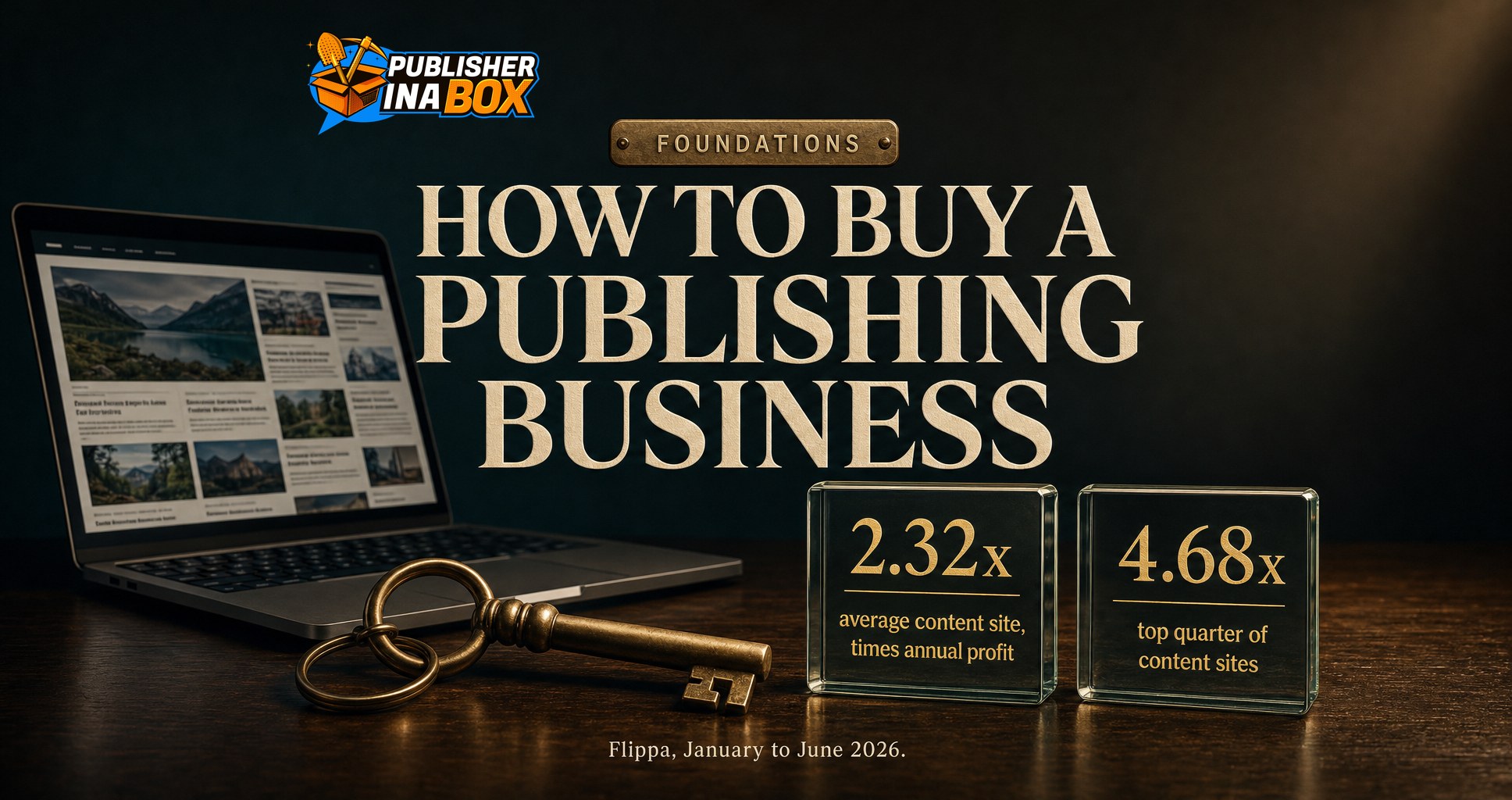
Small online businesses are priced as a multiple of their annual net profit, and content sites sit in the middle of that range. Flippa's Insights Report for the first half of 2026, covering sold deals from January to June, puts the average content site at 2.32 times annual profit, with the top quarter of content sites selling at 4.68 times. Flippa noted that the gap between the average asset and the best one was wider in content than in any other business model it tracks.
2.32x
Average sale multiple of annual net profit for content sites, January to June 2026, with the top quarter at 4.68x
Source: Flippa, Digital M&A Insights Report H1 2026 (sold deals on Flippa, a market average, not a valuation of any one business)
Empire Flippers reports a similar picture on its public scoreboard, measured against trailing twelve months of net profit. Typical businesses sold at 2.2 times, premium businesses at 2.4 times, and premium businesses valued above $1 million at 3.2 times, while distressed businesses, those selling at 1.5 times or less, averaged 1.1 times.
Average sale multiple by business tier, trailing twelve months
times annual net profit
Source: Empire Flippers public scoreboard (sale price divided by trailing twelve month net profit, market averages, not a guarantee)
If you have read older guides, those numbers may look low, and that is a units change rather than a market collapse. On September 8, 2026, Empire Flippers switched every listing from a monthly multiple to an annual one, so a listing that used to show 30 times monthly profit now shows 2.5 times annual profit. Nothing about the price changed. When you compare deals, convert everything to annual profit first, because mixing the two formats is the fastest way to overpay.
Why the same profit can be worth half or double
The spread between the average and the top quarter is where a buyer makes or loses the deal, because two sites with identical profit can be worth very different prices. Flippa's report put it plainly when it summarized the half: buyers are valuing revenue quality, durability and defensibility within each category, not the category itself. It also reported that content sales fell 39 percent in the half, the sharpest decline of any business model, which tells you that buyers have become selective rather than absent.
Here is the arithmetic, as an illustration rather than a valuation. A content site that clears $3,000 a month in net profit earns $36,000 a year. At the first half average of 2.32 times, that is about $83,500. At the top quarter multiple of 4.68 times, it is about $168,500. The difference of roughly $85,000 is not paid for traffic or profit, because both sites have the same. It is paid for confidence that the profit will still be there in a year.
That confidence comes from a short list of things a buyer can verify, and most of them are about concentration.
Where publishing businesses are listed for sale
There are three common places to look, and they differ most in how much of the checking they do for you. Flippa is an open listing platform across every kind of online asset. Empire Flippers is a curated broker that vets businesses before they list. Publisher Market, run by Publisher in a Box, is built only for publishing assets: content websites, newsletters, Facebook pages and page networks, and whole publishing businesses. Its promise is to make publishing asset deals fast, safe and verified.
Publisher Market runs two tracks. Direct Listings, under $50,000, are listed by owners themselves, and every figure is marked as seller-reported, so the buyer runs the diligence and agrees the deal with the owner. Elite Listings, from $50,000, go through Publisher Market's Professional Asset Valuation, and Publisher Market checks the payouts, the audience and the account standing before the listing goes live, then brokers the sale to close. Buyers browse free, open a listing for its private figures, and make an offer. Buyers can also post what they want to acquire on the marketplace's Wanted board, with no fee to post a request, and Publisher Market matches the request against new listings. For sellers, listing is free on both tracks. Elite Listings carry a success fee only when the asset sells: 15 percent from $50,000, 10 percent from $100,000, and a custom fee from $1,000,000.
Two details matter for safety. On every Elite deal, and on every social asset transfer from $5,000, the buyer funds Escrow.com directly, so purchase money never passes through Publisher Market. And the private details of a listing, including the asset's identity and any data room, open only under an NDA signed by the seller, the buyer and Publisher Market.
Get a free valuation before you make an offer
The fastest way to sanity check an asking price is to run the numbers yourself. Publisher Market's free valuation estimate takes three minutes and four questions, and tells you what an asset is worth, what to fix, and where to sell it. It prices a Facebook page, group, Instagram, TikTok or YouTube account, or a newsletter at 15 to 30 times monthly earnings, and a content website or a whole publishing business at 28 to 40 times monthly earnings. In annual terms, that website band is roughly 2.3 to 3.3 times annual profit, the same range the marketplace averages above describe. The estimate is an opinion, not an audit, and the range stays an estimate until Publisher Market verifies the numbers.
The same tool works for owners. When the numbers say wait, the valuation names what to fix before the asset lists, and Publisher in a Box can grow the asset with you through Turnkey Management, or coach you there through Elite Consulting, so it lists once the numbers support the higher price.
What the marketplaces already check
The larger marketplaces do real vetting before a listing goes live, and knowing exactly what they check tells you what is left for you to do.
Empire Flippers lists its minimum requirements publicly. A business must make $24,000 or more a year in net profit, have at least 12 months of revenue history, and have Google Analytics or Clicky tracking traffic for at least three months. Sites earning through AdSense, Amazon Associates, affiliate links or display advertising must have been on the same domain for the previous 12 months. It rejects businesses showing evidence of manipulation, such as penalizations, deleted accounts or short-term gains from 301 redirects, and it denies any site with fake followers on its social accounts.
Its vetting then checks whether the earnings can be verified and belong to that business, whether there are paid or undisclosed traffic sources, whether earnings per pageview match comparable sites, and whether the backlink profile is clean or properly disclosed. Even so, Empire Flippers states on its buyer FAQ that it is still each buyer's responsibility to do their own due diligence. That line is the job description for the rest of this guide.
The five checks to run before you pay
These are the questions we would want answered before money moves, roughly in the order of how much money they protect.
1. Where the traffic comes from, by source and by share
Ask for read access to the analytics and to Google Search Console, and break traffic down by source over at least 12 months. The question is not how much traffic there is. It is how much of it depends on a single platform's decision.
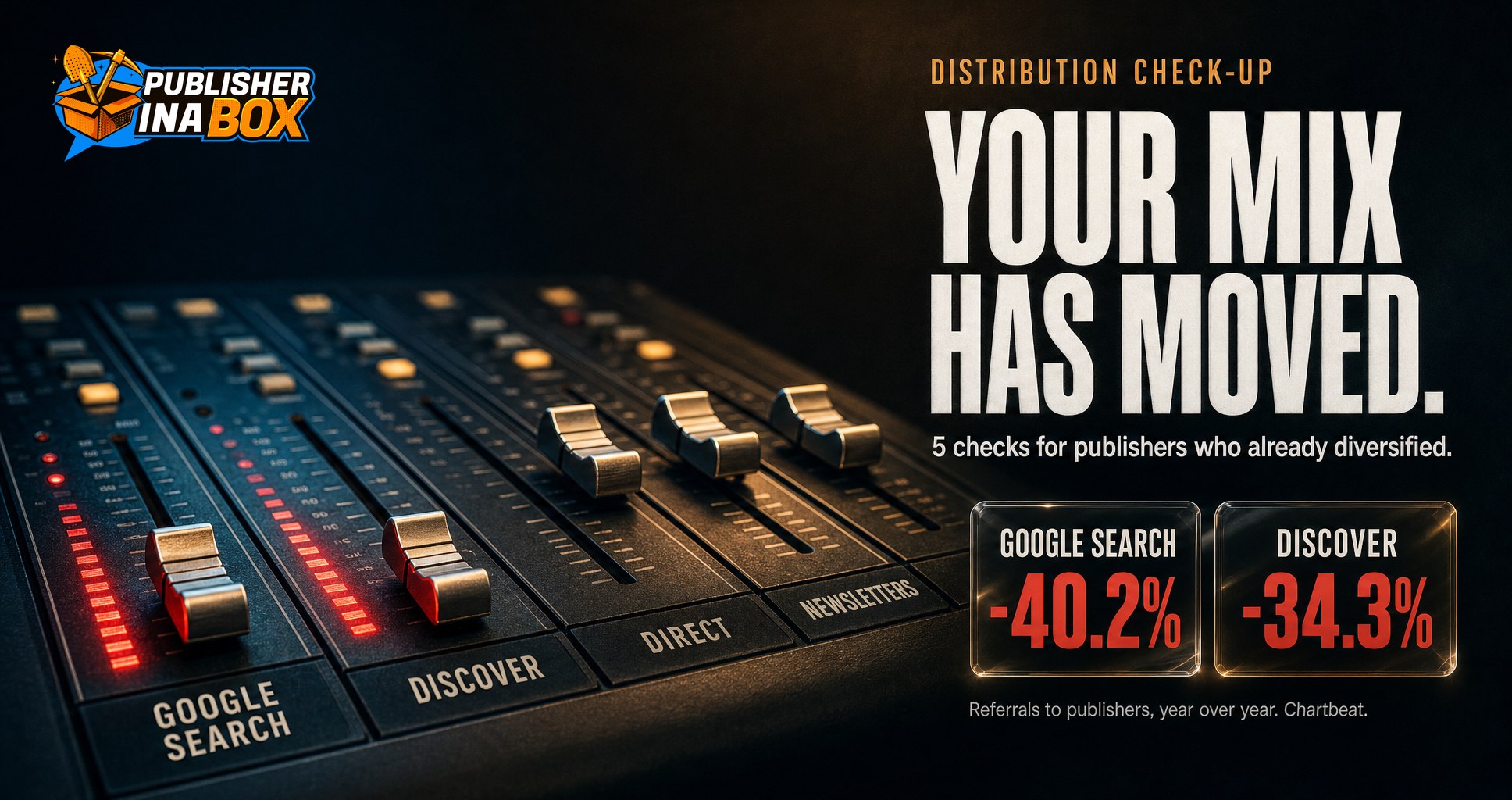
Two 2026 numbers explain why this comes first. Chartbeat's 2026 Publisher Playbook, as reported by Search Engine Journal, found that Google Search referrals to publishers fell 40.2 percent year over year to July 2026, and Google Discover referrals went from a 6.6 percent decline the year before to a 34.3 percent decline. And Press Gazette reported in August that several independent publishers were removed from MSN without notice, including Gadget Review, which had been getting up to 2 million page views a day from MSN at its peak, about 98 percent of its web traffic. A site that looks stable on a twelve month chart can be one partner decision away from a very different business.
You are not buying traffic or profit. You are buying confidence that the profit will still be there in a year, and concentration is what decides it.
2. Where the money comes from, by partner and by page
Ask for the payout statements behind the profit and loss, not screenshots of a dashboard. Then check how much revenue depends on one partner, one affiliate program or a handful of pages. A single ad network or affiliate merchant changing its rates can move the profit figure the whole price is built on, so a business earning across several lines deserves a higher multiple than one earning from one.
3. Whether the trend is up, flat or down
The multiple is applied to trailing profit, which means a declining site is priced on yesterday's numbers. Compare the most recent three months with the same months a year earlier, and line the traffic up against the dates of Google's core and spam updates. A drop that starts the week of an update is a different risk from a slow seasonal dip.
4. How much of the work the seller does, and who does it after
Ask how many hours a week the business takes and who does them: writing, editing, publishing, social distribution and ad operations. A business that needs its founder full time is worth less to a buyer who cannot replace that founder, and the cost of replacing that work comes straight out of the profit you are paying a multiple for.
5. What actually transfers
This is also where the structure of the deal matters. On Publisher Market, publishing businesses change hands as entity-level transfers, meaning the company that owns the assets is transferred, rather than a list of accounts moved one by one. Whatever the structure, list every asset that has to move for the business to keep earning: the domain, the hosting, the content and image rights, the analytics and Search Console properties, the email list and its sending account, the ad and affiliate accounts, and any social pages that drive traffic. Some of those move by changing ownership or administrator access, and some may have to be re-applied for in the buyer's name, depending on each platform's own rules. Confirm which is which with each platform before signing, because an account that cannot move can change the revenue picture on day one.
Buying is the start of the work, not the end of it
The publishers who do well after an acquisition treat the purchase as a starting position. They spread the traffic across more than one source, add revenue lines that do not depend on the same platform, and build a direct relationship with readers, through a newsletter or a community, that no partner can switch off. That is the same discipline we describe in our guide to building a publishing business no single platform can switch off, and syndication is often the fastest second source to add, which our guide to every syndication route covers in full.
Where to go from here
If you are ready to look at what is for sale, browse the live listings on Publisher Market, or post a request for the kind of publishing business you want to buy. Before you make an offer, or if you own a publishing business and want to know what it would sell for, start with the free valuation estimate. If you buy and want it run for you, Facebook Turnkey Management puts the Publisher in a Box team on the operation on a revenue-share basis, with no upfront cost, and you keep the asset. If you would rather have your own team trained to run and grow it, Facebook Consulting teaches the method, and you keep 100 percent of the revenue.
Frequently asked questions
How much does a content website sell for in 2026?
Most sell for a multiple of annual net profit. Flippa's sold deals from January to June 2026 put the average content site at 2.32 times annual profit and the top quarter at 4.68 times, and Empire Flippers' scoreboard shows typical businesses at 2.2 times and premium businesses at 2.4 times.
Why do older guides quote 30 to 40 times profit?
Those are monthly multiples. Empire Flippers switched to annual multiples on September 8, 2026, so 30 times monthly profit is the same price as 2.5 times annual profit. Always convert to annual profit before comparing deals.
What do website marketplaces verify before listing a business?
Empire Flippers, for example, requires at least $24,000 a year in net profit, 12 months of revenue history and three months of analytics, then checks that earnings are real and belong to the business, looks for undisclosed traffic sources, and reviews the backlink profile. It still tells buyers to do their own due diligence.
What is the biggest risk when buying a publishing business?
Concentration. A site that depends on one traffic source or one revenue partner can lose most of its value from a single platform decision, as several independent publishers removed from MSN in August 2026 found.
Can I transfer a site's ad and affiliate accounts when I buy it?
It depends on each platform's rules. Domains, content and analytics properties usually move with the sale, while some ad and affiliate accounts may need to be re-applied for in the buyer's name, so confirm each one with the platform before you sign.
Where can I buy a publishing business?
Flippa lists every kind of online asset, Empire Flippers is a curated broker, and Publisher Market, run by Publisher in a Box, lists only publishing assets. On Publisher Market, listings under $50,000 are listed by owners with seller-reported numbers, and listings from $50,000 are verified, valued and brokered by Publisher Market, with settlement through Escrow.com. You can browse it at publishermarket.ai.
How do I find out what a publishing business is worth?
Start with a free estimate, then verify. Publisher Market's free valuation estimate takes about three minutes and prices Facebook pages and other social accounts at 15 to 30 times monthly earnings, and content websites and whole publishing businesses at 28 to 40 times monthly earnings. From $50,000, Publisher Market's Professional Asset Valuation verifies the numbers against the source data before an Elite Listing goes live.
Key takeaways
Content sites sold for an average of 2.32 times annual profit in the first half of 2026 on Flippa, with the top quarter at 4.68 times.
Convert every listing to annual profit before comparing, because monthly and annual multiples look wildly different for the same price.
Marketplaces verify profit, history and traffic, but buyers still own the due diligence.
Check traffic and revenue concentration first, then the trend, the owner's workload and exactly what transfers.
Publisher Market lists publishing assets only: owner listings under $50,000, and verified, brokered Elite Listings from $50,000 that settle through Escrow.com.
The team behind 300M+ managed followers. We help publishers scale traffic, revenue, and audience across Facebook, Google Discover, and syndication networks.