Search across our learning center -- articles, newsletters, and more. Start typing or click a topic above.
Stay in the Loop
Get exclusive publishing strategies, industry insights, and early access to new features. No spam -- just signal.
Join 2,000+ publishers. Unsubscribe anytime.
Industry News
Facebook Page Monetization: The 300K View Threshold, Paid Growth Strategy, and Real Creator Earnings
Publisher In a Box10 min read
Table of Contents
This article is part of our daily digest series, in-depth summaries drawn from our X account, @publisherinabox, expanded with industry data.
The 300,000-View Hurdle: What the Monetization Invite Measures
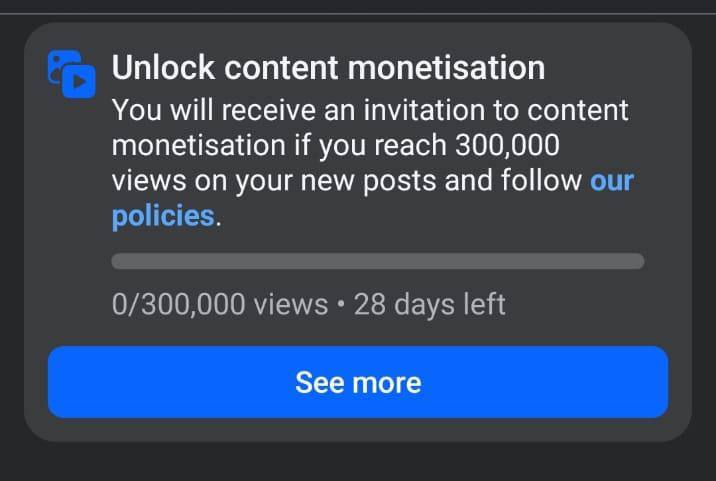
One of our community members received a Facebook content monetization invite on their largest page this week, and the details reveal a frustration that trips up even experienced operators. The requirement gating their access: 300,000 views on new posts within a rolling 28-day window, with a progress bar starting at zero.
The catch is one that many publishers will recognize. The member had already crossed 300,000 views on earlier content, but because the formal invite was not yet active at that time, those views did not count toward the new progress bar. Facebook tracks performance from the moment the invite is issued, not from whenever you last hit the threshold organically.
A community member's monetization progress bar resets to zero on the day the invite lands, regardless of prior view counts.
This is a structural feature of how Facebook evaluates consistency rather than spikes. Meta's official announcement of its Creator Fast Track program in March 2026 introduced a "Qualified View" metric specifically defined as views on your content that may be eligible to earn money, alongside a separate "Non-Qualified Views" breakdown explaining why certain views do not count toward earnings. Not every view that registers in your dashboard is a view that moves the monetization needle.
The broader picture behind that threshold is significant. Meta reported that Facebook paid content creators nearly $3 billion from its creator monetization programs in 2025, a 35% increase from the prior year and the platform's highest annual total ever. The money is real. The path to it, however, requires understanding exactly what Facebook is measuring.
For pages still working toward that first invite, the practical implication is clear: consistent publishing cadence matters more than occasional viral surges. As TechCrunch noted in its coverage of the Creator Fast Track launch, Facebook's new programs are designed to reward creators who build sustained audiences, not those who hit one outsized post and go quiet. Pages seeking guidance on building that kind of consistent infrastructure can explore our resources on Facebook turnkey management.
The Paid-Plus-Organic Playbook: How Page Like Ads Work in Practice
The second thread from this week's posts addresses a false choice that costs many publishers months of unnecessary waiting. Most people assume they must choose between buying followers through ads or growing organically through content. The operators who reach monetization fastest do both simultaneously, treating paid audience acquisition and organic content performance as two distinct but parallel workstreams.
The specific playbook shared this week centers on Page Like ads run at $3 to $5 per day per ad set, targeted to the United States with broad audience parameters. The US-targeting decision is not arbitrary. It reflects the CPM geography reality that Facebook's own data supports: Buffer's analysis of Facebook creator earnings notes that a page with 5 million followers in low-CPM countries can earn less than a page with 200,000 followers in high-CPM markets like the United States. Building your follower base in high-CPM geographies compounds your earnings potential from day one.
Why operators target the US: audience geography is one of the most significant drivers of per-view earnings under Facebook's Content Monetization Program.
At $3 to $5 per day, a single Page Like ad set running for 30 days costs between $90 and $150. Running two or three simultaneously means a total monthly spend in the $270 to $450 range to build a US-weighted follower base while your organic content compounds in the background. This is not a large advertising budget by any standard. WordStream's 2025 Facebook ads benchmark report puts the average cost per click for Facebook lead campaigns across all industries at $1.92, making Page Like campaigns at broad targeting one of the more efficient ways to acquire followers at scale rather than conversion-optimized clicks.
The broader advertising environment context matters here too. Triple Whale's 2025 Meta benchmark analysis, covering nearly 35,000 brands, found that Meta CPM rose 20% year over year in 2025 and that every industry in their dataset saw CPM increases. The cost of paid audience acquisition is not going down. Starting earlier, at lower daily budgets, and letting compound follower growth work over time is the more defensible approach for pages building toward monetization eligibility.
Publishers who want to understand this dual-track growth model in depth can explore our Facebook consulting resources for strategic frameworks.
The Real Earnings Ceiling: What Monetized Pages Produce
The third post from this week grounds the strategy in an outcome that many aspiring Facebook publishers consider aspirational but struggle to believe is within reach: a single page generating $8,000 to $10,000 per month. The case in focus is a woman from the Philippines who invested $8,000 in consulting and recouped the full amount within three months. Her page now produces that income range monthly.
The Philippines case is instructive precisely because of the CPM geography dynamic noted above. Philippines-based audiences carry some of the lowest CPM rates on the platform, which means the page's earnings come not from local audience monetization but from building a content operation that attracts the kind of viewership that Facebook's ad system values. The structural work of targeting US audiences with paid growth, combined with content optimized for qualified views, is what makes a geography like the Philippines an operating base rather than an earnings constraint.
Buffer's review of Facebook creator earnings data found that the number of creators earning more than $10,000 per year on Facebook grew by over 30% year over year in 2025. That figure suggests the $8,000-to-$10,000 monthly outcome sits at the upper end of the distribution, but it is not an outlier in absolute terms within a growing population of high-earning operators. It reflects what the platform pays when content, audience geography, and consistent performance align.
The revenue mechanics behind those numbers are also becoming clearer. According to Buffer's analysis, Reels accounted for approximately 60% of total creator payouts on Facebook in 2025. Facebook's Content Monetization Program, which TechCrunch confirmed now covers videos, Reels, photos, and text posts under a single earnings dashboard, means that operators who post across multiple formats can stack qualified views from more content types than was possible under the older fragmented system.
Three Signals Operators Should Track This Week
Pulling these three threads together surfaces a coherent set of operational priorities for any publisher managing a Facebook page or planning to enter the monetization program.
Signal one: The view clock starts at invite, not at creation. If you are close to receiving a monetization invite, accelerate your publishing cadence now so you are generating qualified views at the moment the invite lands. Views accumulated before that date will not count. This is a timing problem that preparation solves.
Signal two: Paid and organic are not competing strategies. Page Like ads at $3 to $5 per day per ad set with US-only targeting are cheap enough to run alongside any content budget. The US audience weighting is structural, not optional, for pages that want high CPM monetization. Triple Whale's benchmark data confirms that US audiences sit within Meta's most competitive and highest-CPM auction environment.
Signal three: The payout ceiling is higher than most estimates suggest.Meta's own figures show Facebook paid nearly $3 billion to creators in 2025, up 35% from the year before. The platform is actively expanding payouts, not contracting them. Operators who build the infrastructure now, while the growth curve is still steep, are positioning for a larger share of a growing pool. Pages working with professional management can review the structural foundations at our Facebook turnkey management overview.
Frequently asked questions
Why do my previous views not count toward the 300,000 view requirement after receiving a Facebook monetization invite? Facebook's Content Monetization Program measures view performance from the date the invite is issued. The progress bar begins at zero on that day and tracks new qualified views within the following 28-day window. Views generated before the invite was active are not applied retroactively, regardless of how many you had. This makes it critical to maintain a consistent publishing cadence before and immediately after the invite arrives.
What is a qualified view on Facebook, and how does it differ from a regular view? A qualified view is one that Facebook considers eligible to generate earnings under the Content Monetization Program. Meta introduced the Qualified View metric in March 2026 alongside a Non-Qualified Views breakdown that shows creators why certain views do not count. Factors such as view duration, audience geography, and content eligibility standards all influence whether a view qualifies for monetization consideration.
How much do Page Like ads cost and what targeting should publishers use? Page Like ad campaigns can be run at $3 to $5 per day per ad set. Publishers focused on building a high-CPM audience for eventual monetization typically target the United States with broad demographic parameters, since US-based audiences attract significantly higher advertiser CPMs than most other markets. Running two or three ad sets simultaneously keeps total monthly spend modest while accelerating follower growth in parallel with organic content output.
How much does Facebook pay creators per month under the Content Monetization Program? Earnings vary widely based on content format, posting frequency, audience geography, and qualified view totals. Facebook paid nearly $3 billion to creators collectively in 2025, a 35% increase year over year. Individual page operators at scale have reported monthly earnings in the $8,000 to $10,000 range from a single monetized page, while creators earlier in their growth curve earn proportionally less. Reels accounted for roughly 60% of total creator payouts on the platform in 2025.
Is Facebook content monetization available in Southeast Asia and the Philippines? Yes. Facebook content monetization is available across most of Southeast Asia, including the Philippines, as part of Meta's broader eligibility rollout. Creators in these markets can qualify for and receive payouts from the Content Monetization Program. However, advertiser CPM rates in those geographies are significantly lower than in the United States, United Kingdom, and Canada, which means audience geography targeting through paid growth campaigns is an important strategic lever for maximizing per-view earnings.
See more from Publisher in a Box in your Google results
The team behind 300M+ managed followers. We help publishers scale traffic, revenue, and audience across Facebook, Google Discover, and syndication networks.