Search across our learning center -- articles, newsletters, and more. Start typing or click a topic above.
Stay in the Loop
Get exclusive publishing strategies, industry insights, and early access to new features. No spam -- just signal.
Join 2,000+ publishers. Unsubscribe anytime.
Industry News
Facebook Page Monetization Daily Digest: Enforcement Waves, Revenue Streams, and the Google Discover Shift — June 19, 2026
Publisher In a Box12 min read
Table of Contents
This article is part of our daily digest series, in-depth summaries drawn from our X account, @publisherinabox, expanded with industry data.
The Monetization Restriction Wave Hitting Verified Pages Right Now
Today's most-discussed signal across the Facebook publishing community is a wave of monetization restrictions landing on verified pages with no prior warning and no clear path to a human reviewer. Operators are opening support tickets only to be met by AI-driven bots that loop them back to the same dead-end screens. The pattern is consistent enough across accounts that it cannot be dismissed as isolated edge cases.
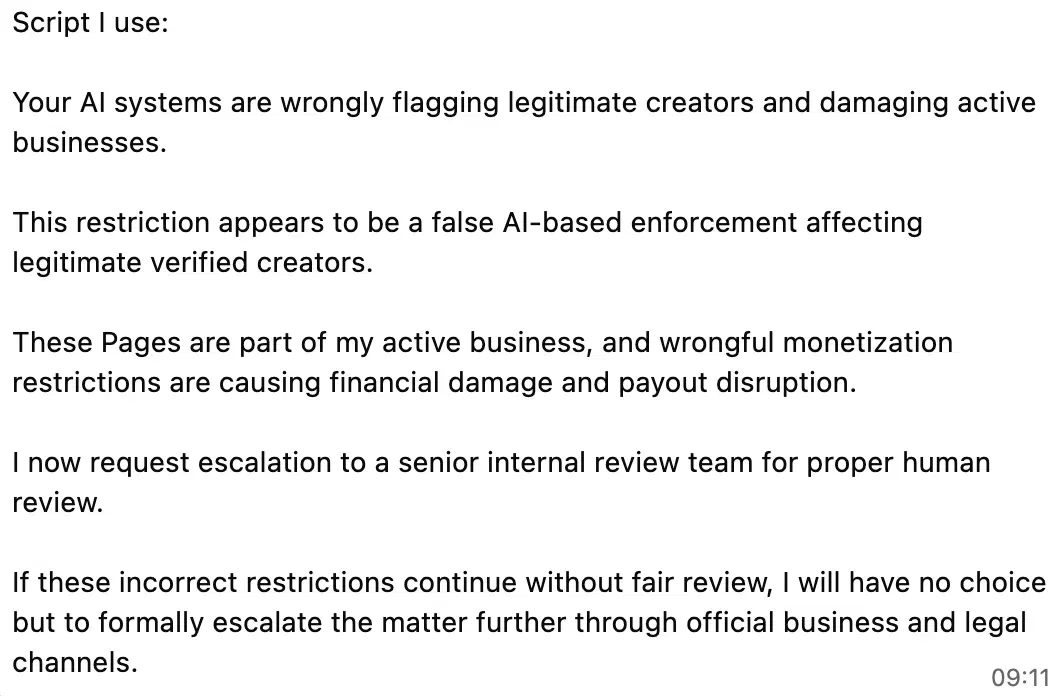
A creator appeal citing wrongful AI-based enforcement against verified, active business pages, one of many similar tickets circulating today.
The core complaint from affected creators is identical to what appears in the ticket above: AI systems are flagging legitimate, verified pages and damaging active businesses with no meaningful recourse. Some operators are reporting that a specific appeal script, framing the restriction explicitly as a false AI-based enforcement action against a verified creator, is helping circumvent automated support routing and reach a human review queue. Results are inconsistent, but the framing appears to change how the support system categorizes the ticket.
This friction is not new at the platform level. Meta's own transparency disclosures acknowledge that false positives are a documented feature of at-scale AI enforcement. Meta's Integrity Report noted that the number of false positives increased over 100% during a brief period in Q4 2025 due to a system bug, an admission that illustrates how consequential these errors can be for creators caught in the window. Meanwhile, Meta has also confirmed it sanctioned 500,000 accounts for spammy behavior in the first half of 2025, a sweep broad enough that clean pages operating in adjacent niches are credibly at risk of collateral flagging. Tubefilter reported the scale of that enforcement action in detail.
Page Recommendations Returning, But the Pattern Is Unpredictable
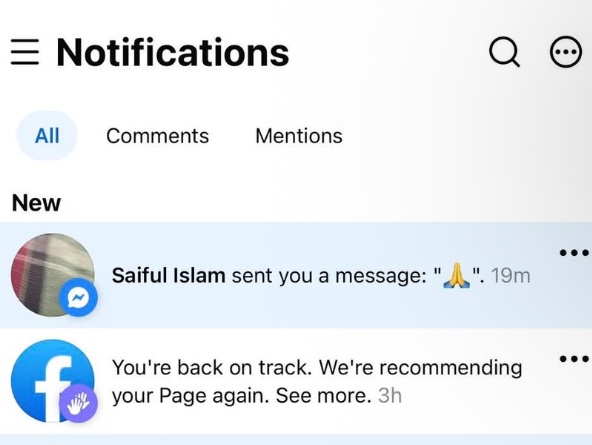
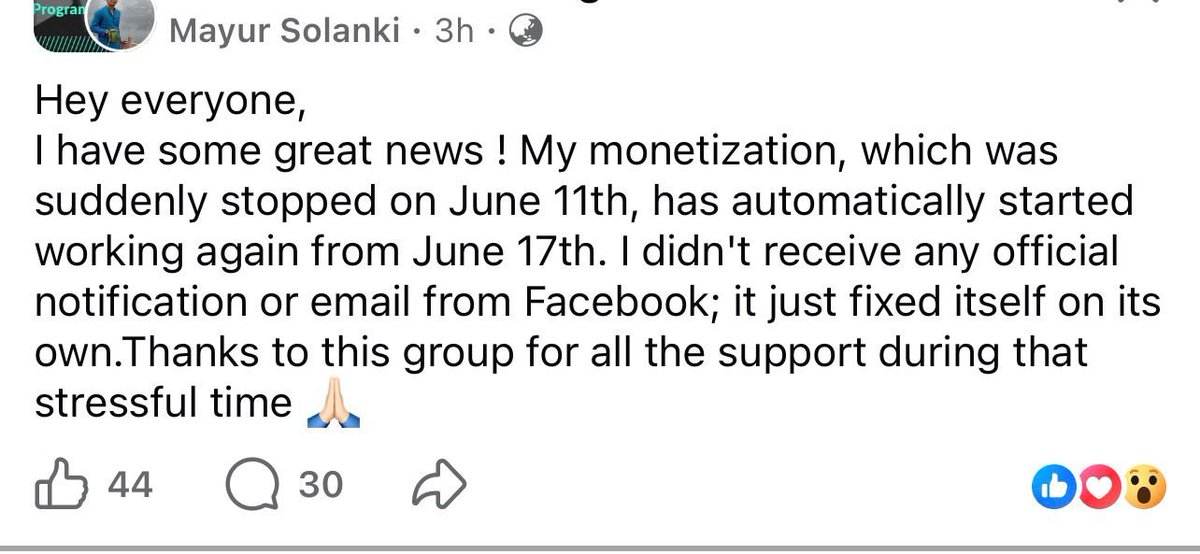
Another page confirmation: recommendations restored after a restriction period, with no email and no formal notice from Meta.A page that went dark June 11th came back June 17th, no email, no warning, no explanation. The switch flipped back on.
The restorations are real, and they are happening. Pages that lost recommendations as recently as June 11th are reporting full restoration by June 17th, with no notification email and no formal communication from Meta. The absence of explanation is its own data point: these decisions are being made algorithmically, which means they can reverse algorithmically as well.
Publishers documenting this pattern on social platforms are noting what researchers have identified independently. The recommendation system behaves in ways that even the platform does not always explain to affected operators. One documented community account of the phenomenon found that pages could be restored, then suppressed again hours later, before stabilizing, consistent with an automated system still resolving a classification conflict. For page operators, this underscores that Page Quality score is not a vanity metric. It is the payout. Treating it as anything less is the operational error that leaves pages exposed.
Our Facebook consulting team tracks these enforcement cycles as part of ongoing publisher support. If your page has been caught in a restriction loop, the framing of your appeal and the escalation path you choose both affect outcomes.
The 14-Step Framework for Building Facebook Pages as a Business Asset
Running parallel to the enforcement discussion, today's thread from @publisherinabox laid out the complete operating framework for building Facebook pages as durable revenue assets rather than single-page experiments. The framework is worth treating as a structured checklist rather than a loose collection of tips.
Start with three pages, not one. Opening three fresh Facebook pages across proven high-RPM niches, politics, news, health, lifestyle, means the niche selection determines the revenue ceiling before a single post goes live. Running three pages means three shots at a breakout, and the one that performs tells you exactly which niche to scale next. With one page, you are hoping. With three, you are running a portfolio.
Install a content automation engine from day one. Running three pages by hand is how operators burn out in week two. Sourcing, formatting, and scheduling need to be systematized so the operator runs pages rather than babysitting them. Ten minutes a day is a realistic operating posture when the workflow is properly built, a human stays on top for compliance and quality assurance, but the repetitive volume work runs automatically.
Start with images and Reels, reach before links. Branded images with curiosity-gap captions open the reach engine. Reels extend it further. The link goes in the first comment once a post is pulling organic reach, that sequencing (reach first, link second) is the difference between a post that gets distributed and one that gets suppressed before it finds an audience. Post volume ranges from 6 to 24 times per day depending on page size and engagement strength.
Reels deserve specific attention as a reach channel. A single well-constructed Reel can compound across multiple viewing cycles, pulling reach long after publication. Buffer's 2026 creator earnings analysis found that Reels accounted for approximately 60% of total creator payouts on Facebook in 2025, making them the single largest format for monetizable reach on the platform. Operators who are not treating Reels as the primary reach engine are leaving the most accessible distribution on the table.
Stop optimizing for pageviews. Optimize for revenue per visitor. The impression does not pay. The revenue is in what happens after the click: where the audience lands, what they read next, and whether they return. That requires pointing the page at an owned site so the traffic lands somewhere the operator controls, not somewhere Meta rents out.
Stack revenue streams off the same audience. Facebook's Content Monetization Program (the platform's direct performance-based payout), referral traffic to the owned site, affiliate revenue, and sponsorships are four separate revenue lines drawing from one audience. Operating all four in parallel is the difference between a page business and a single-channel bet. This matters more now than ever: Meta's official announcement in March 2026 confirmed that Facebook paid content creators nearly $3 billion through its creator monetization programs in 2025, a 35% increase year-over-year and the platform's highest annual total ever. Inc. Magazine further reported that the number of creators earning more than $10,000 per year on Facebook grew more than 30% from 2024 to 2025.
Facebook paid content creators nearly $3 billion in 2025, up 35% year-over-year. Source: Meta, March 2026. Prior-year figures estimated from percentage growth disclosure.
Delegate the engine, check the numbers. Once the system runs, the operator's role shifts. A virtual assistant runs the engine off a documented playbook. The operator reviews performance data, not every individual post. That separation is what makes this a business rather than a content creation job.
The Google Discover Layer Most Operators Walk Past
Beyond the Facebook platform itself, the framework points to Google Discover as an underutilized traffic layer sitting directly under the owned site. No traditional SEO is required to access it, the feed is algorithmic and intent-light, surfacing content to users who have not searched for it. Most page operators building owned sites ignore this entirely.
The data on why that is a costly oversight is striking. MediaPost, reporting on NewzDash's analysis of more than 400 news publishers worldwide, found that Google Discover now accounts for 67.51% of Google traffic to news organizations, up from 37% in 2023. Over the same period, traditional Google Web Search traffic to news publishers fell from 51.10% to 27.42%. That is a structural redistribution of how audiences find content through Google's surfaces, and it happened in two years.
Google Discover's share of publisher traffic nearly doubled in two years while traditional Search lost almost half its share. Source: MediaPost / NewzDash, December 2025.
For publishers building owned sites off their Facebook pages, this creates a clear priority: Discover is not a bonus traffic source. It is now the default Google surface for news and media content consumption. An owned site that is not positioned to receive Discover traffic is operating with its largest potential Google channel closed.
The syndication layer compounds the same logic. Pushing content to MSN, Yahoo, AOL, NewsBreak, and SmartNews extends the same content across networks the operator never had to build independently. Each of those networks is a distribution channel, not a destination that requires separate production. The content is already made. The syndication is the increment.
If you want support mapping your owned site and syndication strategy alongside your Facebook page operation, our team offers structured guidance through Facebook turnkey management that covers the full distribution stack.
Page Quality Is the Business, Not a Compliance Checkbox
The enforcement wave and the payout data point to the same underlying truth: Page Quality score is the asset. Everything else, reach, revenue, syndication, depends on the page remaining in good standing with the platform's monetization policies.
Operators who treat Page Quality as a background concern rather than a front-line operational metric are one strike away from losing the income the page generates. Reading violations carefully rather than guessing at them, staying well inside policy thresholds rather than operating at the edge, and treating the Content Monetization Program eligibility as the floor of the business rather than a bonus, these are the disciplines that separate durable publishing operations from pages that flip on and off at the algorithm's discretion.
Meta's own enforcement architecture now applies both reduced content distribution and monetization program restrictions for content policy violations, with automatic duplicate detection added to the stack in mid-2025. Tubefilter documented the full scope of these measures when Meta announced them in July 2025. The system is designed to be automated and at scale, which means that clean operators who pattern-match to flagged behaviors, even superficially, are at risk of the same false positive problem affecting verified pages today.
The operators who stay protected are the ones who understand exactly what their violations page says, who do not guess, and who build their content operation inside the policy bounds rather than pressing against them.
Frequently Asked Questions
Why are verified Facebook pages getting monetization restrictions in June 2026? Meta's AI enforcement systems are conducting broad sweeps that are catching some legitimate, verified pages as false positives. Meta's own transparency disclosures have acknowledged that false positive rates can spike during system updates or bug events. Operators should file appeals that explicitly describe the restriction as a false AI-based enforcement action and document their verified status and business activity in the ticket.
How do I get my Facebook page recommendations restored after a restriction? The most consistent approach reported by affected operators involves submitting a formal support ticket that frames the issue explicitly as a false AI-based enforcement action rather than a policy question. Providing verification details and business documentation in the ticket changes how automated routing categorizes the request. Persistence matters: some operators report needing multiple submissions before reaching a human reviewer. The platform does restore pages algorithmically in some cases without any action required, but waiting passively is not a strategy.
How much does Facebook pay creators through its Content Monetization Program? Facebook paid content creators nearly $3 billion through its monetization programs in 2025, a 35% increase from the prior year and the platform's highest annual total ever, according to Meta's official announcement in March 2026. The number of creators earning more than $10,000 per year on the platform grew more than 30% year-over-year. Payouts are performance-based and calculated using qualified views across videos, Reels, photos, and text posts.
Why is Google Discover more important than Google Search for news publishers in 2026? According to NewzDash's analysis of more than 400 news publishers worldwide, Google Discover now accounts for approximately 67.5% of Google-driven traffic to news organizations, up from 37% in 2023. Traditional Google Web Search fell from 51% to 27.4% over the same period. For publishers operating owned sites alongside Facebook pages, Discover is now the primary Google traffic surface and should be treated as such in site and content architecture decisions.
How many Facebook pages should a new publisher operate to build a sustainable income? Starting with three pages across high-RPM niches rather than one is the approach that gives operators both redundancy and signal. Three pages mean three shots at a breakout, and the page that performs fastest identifies which niche to scale next. Single-page operations have no buffer if one page is restricted and no comparative data to guide scaling decisions. The niche selection sets the revenue-per-thousand-impressions ceiling before a single post is published, so choosing carefully across all three is the first and most consequential decision.
See more from Publisher in a Box in your Google results
The team behind 300M+ managed followers. We help publishers scale traffic, revenue, and audience across Facebook, Google Discover, and syndication networks.