Search across our learning center -- articles, newsletters, and more. Start typing or click a topic above.
Stay in the Loop
Get exclusive publishing strategies, industry insights, and early access to new features. No spam -- just signal.
Join 2,000+ publishers. Unsubscribe anytime.
Industry News
Facebook Page Monetization at a Crossroads: Meta One Link Tiers, Meta AI Content Tools, and Google's Preferred Sources Button
Publisher In a Box13 min read
Table of Contents
This article is part of our daily digest series, in-depth summaries drawn from our X account, @publisherinabox, expanded with industry data. (weekend recap)
The Meta One Ladder: What Every Facebook Page Publisher Must Know Now
The most-discussed story across our feed this weekend was not a rumor. TechCrunch confirmed back in December 2025 that Meta was already trialing a link-posting limit for professional accounts and Facebook Pages, with a two-link monthly free allowance and a paid Meta Verified subscription required for more. That test has since graduated into a formal, named product: Meta One.
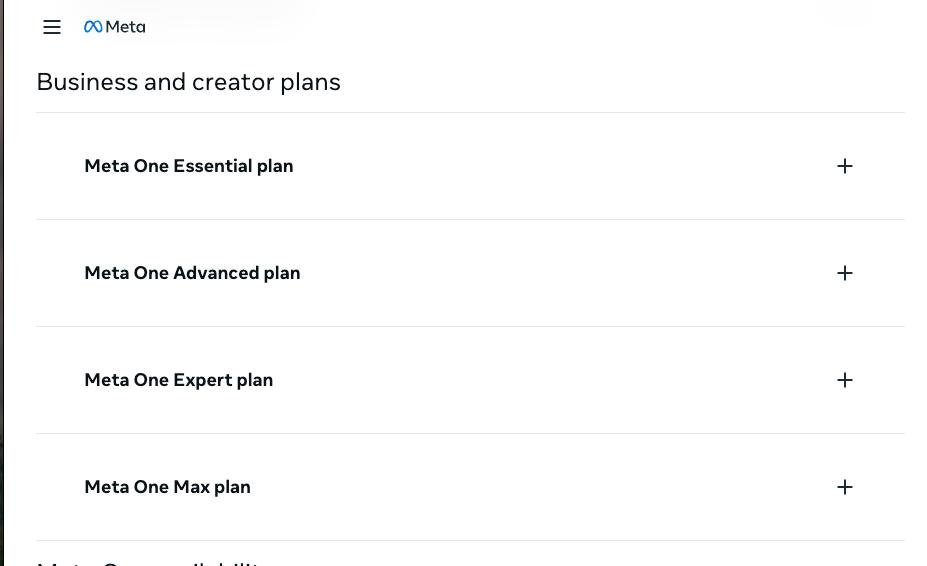
Meta's own Help Center now documents the full tier structure. Every Page already receives two free link posts a month at no cost. From there, paid tiers raise that allowance in steps across four named plans: Essential, Advanced, Expert, and Max. The Advanced plan, priced at $34.99 per month as seen in screenshots shared in our community, gives a publisher a verified badge, impersonation protection, an enhanced linksheet, eight links in Facebook Reels, and placement help through featured-in-feed and optimized search. It reads as a reach product wrapped around a link-access product.
The Meta One Advanced screen as seen by a publisher: verified badge, impersonation protection, enhanced linksheet, and eight Reel links per month.
The Expert tier raises the monthly link allowance further. According to the Meta Help Center, the Advanced plan grants clickable links in up to eight Facebook posts per month, while higher tiers extend that number. Expert, priced around £129 in the UK at the time of writing with US pricing still being finalized, adds 20 Facebook link posts and 20 Facebook link Reels per month, plus content-protection alerts that flag when other pages reuse your content. Accounts are seeing different figures, and Meta has indicated pricing has not been locked.
Meta One Expert: 20 Facebook link posts and 20 Facebook link Reels per month, plus content-protection alerts.
At the top of the stack sits Max. The Meta Help Center confirms that the Max plan grants unlimited Facebook post links and 12 Instagram post links per month. Our community flagged the critical nuance here immediately: unlimited at Max only exists at the top of the paid stack, and everything beneath it is metered. Whether Meta keeps that unlimited designation long term is an open question, given that the first official figures were capped and the product is still being shaped.
Meta One Max: the only tier where the link cap is removed, with unlimited Facebook link posts and link Reels.The full Meta One ladder in one screen: four paid tiers, each with a different monthly link allowance for Facebook Pages.Meta One link-post allowances across the four paid tiers, compared with the two-post free baseline.
The Link Cap Is Real and Already Hitting Pages in the Wild
One screenshot shared in our community captured the moment a publisher mid-post saw a counter reading "1 link left", one more link post remaining for the month before the free allowance runs out. Facebook's own in-product prompt spells out exactly what Meta One adds at that point: more link posts, the ability to choose the preview image, and additional features. The cap is not hypothetical.
A publisher mid-post sees the counter: one link post left for the month. Facebook's prompt names what the paid tier adds.Our co-founder's breakdown of the Meta One announcement, covering what publishers need to do in response.
This is not the first time Meta has explored this model. TechCrunch reported in December 2025 that Meta confirmed the test and explained it as an effort "to understand whether the ability to publish an increased volume of posts with links adds additional value for Meta Verified subscribers." That test is now the foundation of what launched as Meta One in May 2026. The commercial logic is direct: TechCrunch confirmed that Meta One is a subscription covering Instagram, Facebook, and WhatsApp, with creator and business tiers for publishers who need higher link volumes and deeper analytics.
The December 2025 report covering Meta's first link-subscription trial, now the direct precursor to Meta One.
For publishers who depend on Facebook page monetization and the traffic that link posts deliver, understanding the full tier structure is now an operational requirement, not a nice-to-know. If your page drives revenue through Facebook content monetization and you currently post more than two external links a month, you are already inside the scope of these restrictions. Our Facebook consulting team has been fielding questions on exactly where different page sizes land in the tier decision. The answer depends on posting frequency, niche, and how much of your audience relationship runs through link-based traffic versus Reels.
Facebook Content Monetization: What the Real Earnings Numbers Show
Alongside the Meta One story, our feed featured a screenshot that generated significant engagement this weekend: 2.4 million views, $272.54 in earnings, and 14,892 shares from a single post on a small page. The per-post number alone is not the point. The point is what happens when you multiply it across a consistent volume of posts. At eight to 24 posts per day depending on page size and audience, those per-post earnings compound into a different business entirely.
2.4 million views, $272.54 in earnings, 14,892 shares from one post on one small page. Volume is the multiplier.
A separate screenshot showed a Reels RPM of $2.39 per 1,000 qualified views, producing $127.92 from 53,432 qualified views. That is not a viral outlier. Echobox's analysis of publishers enrolled in Meta's Content Monetization program found that image-link posts average $1.93 per share in earnings, making them the top-performing format ahead of video at $1.72 per share. The format most operators underinvest in is the one Meta currently rewards most. For pages serious about Facebook content monetization at scale, working with a team that understands the full operational picture matters, our Facebook turnkey management service is built around exactly that kind of full-funnel execution.
$2.39 per 1,000 qualified Reels views, $127.92 total from 53,432 qualified views. Audience, retention, and runtime aligned.
Meta AI Now Reads Your Page Data and Tells You What to Post
The second major platform story this weekend was Meta's rollout of business features inside its AI assistant. AFAQS reported that Meta AI can now connect to Facebook and Instagram accounts, Meta ad campaigns, and Google Workspace tools including Gmail, Docs, Sheets, and Slides. That connection is available across the Meta AI app, website, and desktop experience.
The practical output for a publisher is meaningful. According to Meta, the features let businesses examine how their content is performing, check their ad campaigns, compare their results against similar accounts, and generate reports and presentations using information pulled from connected business accounts. For a Facebook page publisher, this means the AI assistant can look at your own page's reach, saves, shares, and comments, and surface recommendations for what to post next based on your actual data, not generic best practices.
Meta AI's new business features: connect your page, ad campaigns, and Google Workspace, then ask the assistant what to post next.
The timing is notable. Meta rolled out these tools at the same moment it is metering link posts behind a subscription wall. The message to publishers is consistent: Meta wants you to produce more content, produce it more strategically, and pay for the distribution infrastructure that links your content to your website. The AI tools lower the content-creation burden; the Meta One tiers price the traffic access.
Google's Preferred Sources Button: 600,000 Selections and a Two-Line Embed
The Google story of the weekend arrived with a concrete number attached. PYMNTS reported that Google's General Manager of the Search Ecosystem, Mrinalini Loew, confirmed readers have already selected more than 600,000 unique sources through the Preferred Sources feature. Search Engine Roundtable noted that figure was 200,000 in May 2026, meaning the count has tripled in roughly three months.
PPC Land reported that on August 20, 2026 Google released an embeddable Preferred Sources button for publishers and that the announcement bundled three changes: the interactive button publishers can place on their own pages, a free-text tuning control inside the Discover feed, and topic curation for daily audio briefings in the Google News app on Android. The button itself is the only one of the three available immediately, and it requires two lines of HTML. Once a reader clicks it, they are added back to where they were on the publisher's page rather than being sent away to a Google settings screen.
The Google Preferred Sources embed: two lines of HTML that let a reader mark your site from your own page.
According to PPC Land, once a site is designated as preferred, the effect shows up in three places: Top Stories, where content from that site is more likely to surface with a preferred badge; AI Overviews, where links from that site can carry the same badge for the reader who made the selection; and AI Mode. That last point matters considerably. As Google's AI Overviews continue to reduce organic click-through rates across publishing categories, a reader-level preference signal that follows into AI surfaces represents one of the few mechanisms through which a publisher can maintain individualized visibility without relying purely on algorithmic placement.
The broader traffic context is sobering. A Reuters Institute and Chartbeat 2026 report cited by QuickSEO found that Google search traffic to publishers fell 33% globally in the year to November 2025, with US publishers hit harder at minus 38%. Google Discover referrals to more than 2,500 publisher sites dropped 21% in the same window. Against that backdrop, a reader who has explicitly marked your site as a preferred source represents a materially different kind of relationship than a reader who found you through an undifferentiated search result. 9to5Google reported that readers are twice as likely to click through to a site after marking it as a Preferred Source.
Google AI Overviews and Generative UI: The Next Pressure on Publisher Traffic
Our most-read article link this weekend covered Google's planned Generative UI expansion inside AI Overviews. The threat to publisher referral traffic from AI Overviews is already documented at scale. Search Engine Journal's analysis showed click-through rate reductions ranging from 34% to 46% when AI summaries appear on results pages, citing multiple independent studies covering hundreds of thousands of keywords. Pew Research tracked 68,000 real search queries and found users clicked on results 8% of the time when AI summaries appeared, compared to 15% without them.
Generative UI takes that one step further by replacing static text summaries with interactive, dynamically rendered interfaces inside the search result itself. If a reader can compare products, book a table, or read a full FAQ without leaving Google, the click to a publisher's site becomes even less necessary. The Preferred Sources button described above is the most direct counter-mechanism Google has given publishers to work with inside this environment.
For publishers navigating both the Meta One transition and the Google AI Overviews pressure simultaneously, the operational question is how to build an audience relationship that does not depend entirely on either platform's algorithmic goodwill. That is the strategic context behind the article we published this week on where to move your audience as Google referral traffic continues to decline.
Frequently Asked Questions
What does the Meta One free tier include for Facebook Pages? Every Facebook Page, whether or not it subscribes to Meta One, receives two free link posts per month as the baseline allowance. That is the free tier. Once those two posts are used, the in-product prompt directs the publisher to subscribe to a paid Meta One plan to continue posting external links.
What is the difference between Meta One Advanced and Meta One Expert for publishers? Meta One Advanced includes a verified badge, impersonation protection, an enhanced linksheet, eight Facebook Reel links per month, and placement features including featured-in-feed and optimized search. Meta One Expert raises the monthly link allowance to 20 Facebook link posts and 20 Facebook link Reels, and adds content-protection alerts that notify you when other pages reuse your content. Expert also extends shared account access to more team members. Pricing for Expert is still being finalized and varies by region and account.
What is the Google Preferred Sources button and how does a publisher add it? The Google Preferred Sources button is an embeddable widget, implemented with two lines of HTML, that a publisher places on their own pages. When a reader clicks it, Google marks that site as a preferred source for that reader and returns the reader to the same spot on the publisher's page. The effect shows up in Top Stories, AI Overviews, and AI Mode, where the reader is more likely to see content from that site and may see a preferred badge alongside results from it.
How does Meta AI's new business feature help a Facebook page publisher decide what to post? Meta AI can now connect directly to your Facebook and Instagram accounts, your Meta ad campaigns, and Google Workspace tools. Once connected, the assistant reads your own page's engagement data, including reach, saves, shares, and comments, and surfaces content recommendations based on that performance history. It can also generate reports and compare your results against similar accounts, giving publishers a data-grounded starting point for their posting decisions.
Do Facebook Reels count separately from link posts under Meta One? Yes. The Meta One tier structure gives separate monthly allowances for link posts in standard Facebook posts and link posts inside Facebook Reels. At the Expert tier, for example, a publisher receives 20 Facebook link posts and 20 Facebook link Reels as distinct allocations. Instagram has its own parallel allowances at each tier. Hitting the cap on one format does not reduce the allowance on the other.
See more from Publisher in a Box in your Google results
The team behind 300M+ managed followers. We help publishers scale traffic, revenue, and audience across Facebook, Google Discover, and syndication networks.