Search across our learning center -- articles, newsletters, and more. Start typing or click a topic above.
Stay in the Loop
Get exclusive publishing strategies, industry insights, and early access to new features. No spam -- just signal.
Join 2,000+ publishers. Unsubscribe anytime.
Industry News
Facebook Page Monetization, Meta One UK Pricing, and the Google AI Traffic Shift
Publisher In a Box11 min read
Table of Contents
This article is part of our daily digest series, in-depth summaries drawn from our X account, @publisherinabox, expanded with industry data.
Google AI Overviews Are Cutting Into Organic Traffic at Scale
The clearest data point from the past 24 hours of publishing conversation is this: organic search traffic is contracting measurably, and the inflection point is well documented. Agency Brainlabs tracked Google Analytics data across 54 advertisers spanning 14 months and found that Digiday reported 46 of those 54 clients saw a traffic dip, with the aggregate falling 10.5% from 140.1 million to 125.4 million sessions once Google AI Overviews started appearing on at least 30% of search results pages in September 2025. This is not a projection or a model output. It is measured sessions across a real client roster covering 19 sectors.
The timing matters. Digiday noted that the September 2025 moment, when AI Overviews crossed the 30% result-page threshold in the US, served as the clear inflection point for Brainlabs clients. Before that threshold, organic traffic was running at roughly 20 million sessions per month across the dataset. After it, that figure fell to under 15 million.
Broader publisher-level data from Chartbeat, cited in the Reuters Institute's Journalism and Technology Trends and Predictions 2026 report, found that Google search traffic to publishers declined globally by a third in the year to November 2025. In the US, the drop was sharper at 38% year-over-year. That figure covers more than 2,500 publisher websites and is sourced from Chartbeat's direct measurement panel, not a survey.
The click-through rate picture is equally pointed. Seer Interactive's September 2025 study, which analyzed over 25 million organic impressions across 42 organizations, found that organic CTR dropped 61% on queries where AI Overviews appeared, falling from 1.76% to 0.61%, as reported by Digiday. Among Digital Content Next member sites, the median year-over-year decline in Google Search referral traffic was -10% overall, with non-news brands seeing -14%.
Organic search session decline across 54 Brainlabs clients after Google AI Overviews reached 30% result-page penetration.
There is, however, a counterweight in the Brainlabs data that publishers should register. Sessions from AI platforms, meaning ChatGPT, Gemini, Copilot, and Perplexity, rose 163% over the same 14-month window, as reported by Digiday. AI-driven key events, which measured purchases, newsletter signups, and page completions, rose 335% during the measurement window. Users arriving from AI platforms converted at 1.5 times the rate of traditional organic search visitors. The traffic that is disappearing is mostly casual and top-of-funnel. The traffic staying is higher-intent. That distinction matters for how you plan around Facebook page monetization and owned audience strategy.
Why Publisher Diversification Is a Data-Backed Imperative, Not a Cliche
The Google AI traffic contraction makes the diversification argument concrete rather than theoretical. Publishers who built their entire acquisition model around Google Search organic are now the ones feeling the sharpest pain. The data from the Reuters Institute report found that most publishers now expect to put less effort into traditional Google Search in 2026, with a net score of -25 when asked whether they would invest more or less, according to Press Gazette. Meanwhile, social referrals were flat or slightly up globally, with Facebook up 9% year-on-year in November 2025.
That Facebook uptick aligns with what Digiday reported in a separate study: publishers have witnessed a year-over-year spike in Facebook referral traffic coinciding with revenue from Meta's content monetization program, with several publishers on track to earn between six and seven figures from the program. People Inc., for example, saw non-session-based revenue, which includes social and native campaigns, events, sponsorships, and licensing, grow 24% year-over-year in Q1 2026, according to Digiday's May 2026 Media Briefing. That category's share of total digital revenue rose from 35% in Q1 2025 to 41% in Q1 2026.
For publishers thinking through platform mix, our Facebook consulting resources and Facebook turnkey management coverage outline how operators are building durable distribution structures that do not depend on any single traffic channel. The lesson from the Brainlabs dataset is that concentration is the risk. The publishers emerging most intact are the ones running Facebook alongside search, email, and AI referral as parallel channels rather than as backups.
Facebook Page Recommendations Restored: What Operators Need to Know About the Comeback Path
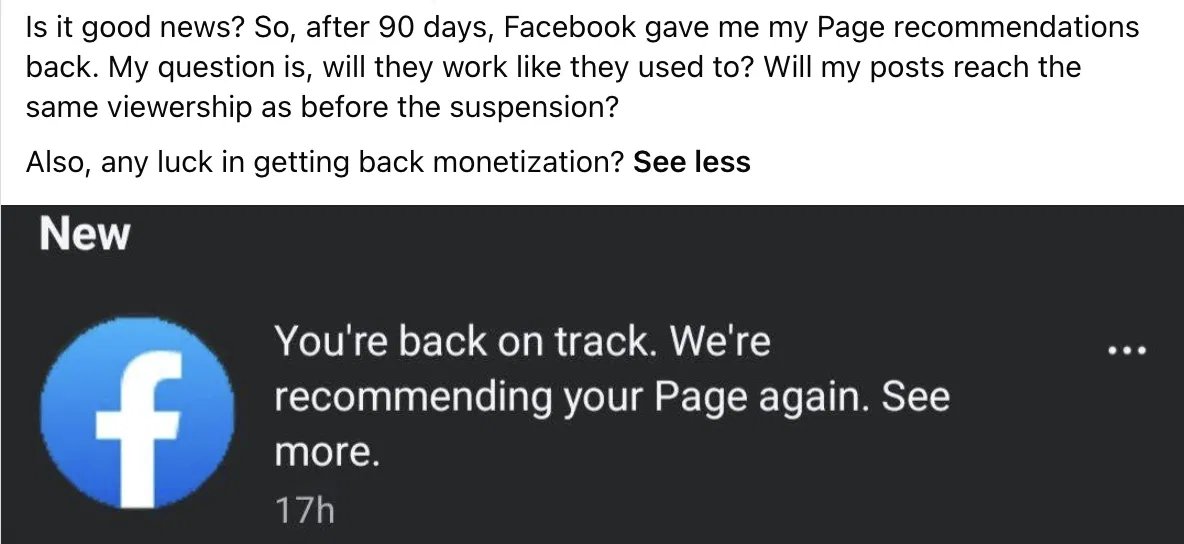
One of the most practical questions we field from page operators is what happens to reach and revenue after a recommendations restriction is lifted. A real-world example surfaced in our feed this week: a page that had been under restrictions for 90 days received the "we're recommending your Page again" notice from Facebook.
A page operator received the Facebook recommendations-restored notice after a 90-day restriction window.
The answer to whether reach and monetization return is yes to both, but the recovery is not instantaneous. Once Facebook restores recommendations, distribution begins rebuilding through the algorithm's normal signals: content quality, engagement rate, and consistency of publishing. Meta's March 2026 update to its original content guidelines made clear that pages posting original content receive greater reach and monetization priority, while unoriginal or spammy content continues to be deprioritized. That means the fastest path back to pre-restriction reach levels is original video and Reels output, not link posts or reposted material.
The algorithm context is important. Meta has stated that it has made Facebook Feed and Reels more relevant over the past year by cracking down on spammy content and making it harder for copycats and impersonators to crowd out authentic creator voices. Facebook's feed now shows over 40% AI-recommended content from accounts users do not follow, up from 15-20% in 2024, according to algorithm tracking published by Hashmeta. That means a page with restored recommendations can reach new audiences it could not touch during the restriction period, accelerating the reach rebuild if the content quality is there.
Monetization follows the same curve. Facebook's content monetization program requires that a page be in good standing with no active policy violations. Pages with recent violations or restricted reach are typically ineligible until those restrictions are resolved. Once recommendations are reinstated and reach begins recovering, monetization eligibility typically returns in parallel, since reach is one of the core performance signals the program evaluates.
Meta One Hits UK Shores: What the GBP Pricing Screen Tells Publishers
A UK publisher this week received the Meta One onboarding prompt with pricing displayed in pounds sterling. This is the first confirmed GBP-denominated pricing screen we have documented for the platform's creator and business subscription tier. The Essential plan is listed at £12.49 per month, marked as "Recommended," and covers the verified badge, impersonation protection, and an enhanced link sheet. The Advanced plan runs at £41.99 and adds Featured in Feed placement.
Meta One UK pricing screen: Essential at £12.49/month and Advanced at £41.99/month, as seen by a UK publisher.
For context, Euronews reported in May 2026 that Meta launched Meta One as its umbrella subscription brand for creators, businesses, and AI users, with CNBC reporting that plans would start at $7.99 per month and reach up to $19.99 per month for Meta One Premium. Hush Digital noted that Meta officially announced pricing in US dollars and had not confirmed UK pricing at launch, with app store subscriptions typically set at rounded local price points that sit slightly above a direct currency conversion. The GBP screen seen by our UK publisher confirms that localised pricing is now rolling out in the UK market.
The features bundled at each tier carry direct relevance to Facebook page monetization. Impersonation protection matters to any page that has built audience equity, since a cloned page can siphon followers and damage monetization standing. The Enhanced Link Sheet affects how your content appears when distributed offplatform. The Featured in Feed placement at the Advanced tier is the most commercially significant differentiator, since feed visibility is the primary lever for content reach and, by extension, performance-based monetization payouts.
Hush Digital also noted that the business and creator plans are still in limited testing and have not yet fully rolled out in the UK, meaning some UK users will not see the option yet even within the same country. The GBP pricing screen our publisher shared represents an active limited rollout, not a universal UK launch.
The Three Forces Reshaping the Publisher Traffic Stack
Taken together, today's four stories point to a structural shift that goes beyond any individual platform update. The Google AI Overviews traffic contraction is a permanent change in search economics, not a temporary fluctuation. The Facebook recommendations recovery story shows that platform algorithms do reward compliant, original content with measurable reach and monetization recovery. And Meta One's arrival in localised GBP pricing signals that Meta is building a recurring revenue model from creators and publishers that will coexist with, and potentially supplement, performance-based content monetization payouts.
For publishers, the implication is that traffic diversification is now a financial resilience strategy rather than a best practice. The Chartbeat data across 2,500 publisher sites, published in the Reuters Institute report via Press Gazette, showed that while US Google search referrals fell 38% year-over-year, Facebook referrals were up 9% globally over the same period. That divergence is the core argument for running Facebook as a primary distribution and monetization channel rather than a secondary one.
Publishers who want to think through the operational mechanics of building that kind of multi-channel structure can explore our Facebook consulting coverage for strategic frameworks and our Facebook turnkey management resources for execution-level guidance on running pages at scale.
Frequently asked questions
Does Facebook reach come back after recommendations are restored? Yes. Once Meta issues the notice that it is recommending your page again, distribution begins rebuilding through normal algorithmic signals including content quality, engagement, and posting consistency. The speed of recovery depends on how consistently original content is published after the restriction is lifted. Reels and original video tend to rebuild reach faster than link posts.
How does a Facebook page recommendations restriction affect monetization? Facebook content monetization requires a page to be in good standing with no active policy violations or restricted reach. Pages under a recommendations restriction are typically ineligible for monetization payouts until the restriction is resolved and reach begins recovering. Monetization eligibility generally returns in parallel with the reach rebuild once the page is compliant again.
What is Meta One and what does the UK Essential tier include? Meta One is Meta's umbrella subscription brand for creators, businesses, and AI users, launched in May 2026. The UK Essential tier, priced at £12.49 per month, includes the verified badge, impersonation protection, and an enhanced link sheet. The Advanced tier at £41.99 adds Featured in Feed placement. UK rollout is in a limited testing phase and is not yet available to all UK accounts.
How much has Google AI Overviews affected organic search traffic for publishers? Brainlabs tracked 54 advertisers across 14 months and found organic sessions fell 10.5% after Google AI Overviews reached 30% search result penetration in September 2025. Chartbeat data across 2,500 publisher websites showed global Google search referral traffic fell 33% from November 2024 to November 2025, with US publishers seeing a 38% year-over-year drop. Organic CTR dropped 61% on queries where AI Overviews appeared, according to Seer Interactive's study of 25 million impressions.
What should publishers do to protect Facebook page monetization during a traffic decline from Google? Publishers should treat Facebook as a primary distribution channel rather than a backup. Meta's content monetization program rewards original content with reach and performance-based payouts. Maintaining page compliance, publishing original Reels and video consistently, and building owned audience assets such as email lists reduces dependence on any single traffic source including Google Search.
See more from Publisher in a Box in your Google results
The team behind 300M+ managed followers. We help publishers scale traffic, revenue, and audience across Facebook, Google Discover, and syndication networks.