Search across our learning center -- articles, newsletters, and more. Start typing or click a topic above.
Stay in the Loop
Get exclusive publishing strategies, industry insights, and early access to new features. No spam -- just signal.
Join 2,000+ publishers. Unsubscribe anytime.
Industry News
Facebook Page Monetization: What Near-1M Views, A 5x Revenue Jump, and Meta's Fake Engagement Policy Mean for Publishers
Publisher In a Box10 min read
Table of Contents
This article is part of our daily digest series, in-depth summaries drawn from our X account, @publisherinabox, expanded with industry data.
Nearly 1 Million Views in One Week, and $0.00 in Earnings. Here Is Why That Is Normal.
One of the most counterintuitive moments in Facebook page monetization is the early stretch when the numbers look impressive but the payout dashboard stays flat. A page we track publicly crossed 993,031 views and 92,353 engagements in its first seven days, added 6,502 net followers, and is running on full content automation. The earnings total sits at $0.00, not because the page is doing anything wrong, but because it is still inside what Meta calls the monetization ramp period.
This matters because new publishers routinely misread early zeros as a sign of failure and abandon strategies that are working. The ramp is structural, not punitive. Meta uses it to verify that a page is generating authentic, sustained audience behavior before revenue tools activate. According to eligibility guidance published by Meta, pages must meet follower, watch-time, and compliance thresholds before monetization features go live, and those thresholds take time to accumulate even when content is performing well.
The page-age requirement reinforces this. Meta requires pages to have a meaningful account history partly to distinguish real creators from bot-driven or spam operations. A one-week-old page generating nearly a million views is genuinely impressive. The system still needs more runway before it opens the revenue tap. Patience during this window is not optional, it is part of the process.
For publishers who want to understand the full eligibility picture or need help structuring a page correctly from day one, our Facebook consulting practice walks through every requirement in detail.
From $10,786 in April to $50,599 in May: What a 5x Revenue Jump Looks Like
Same site. Same niche. Facebook moved from a side channel to the primary traffic driver between April and May, and revenue followed.
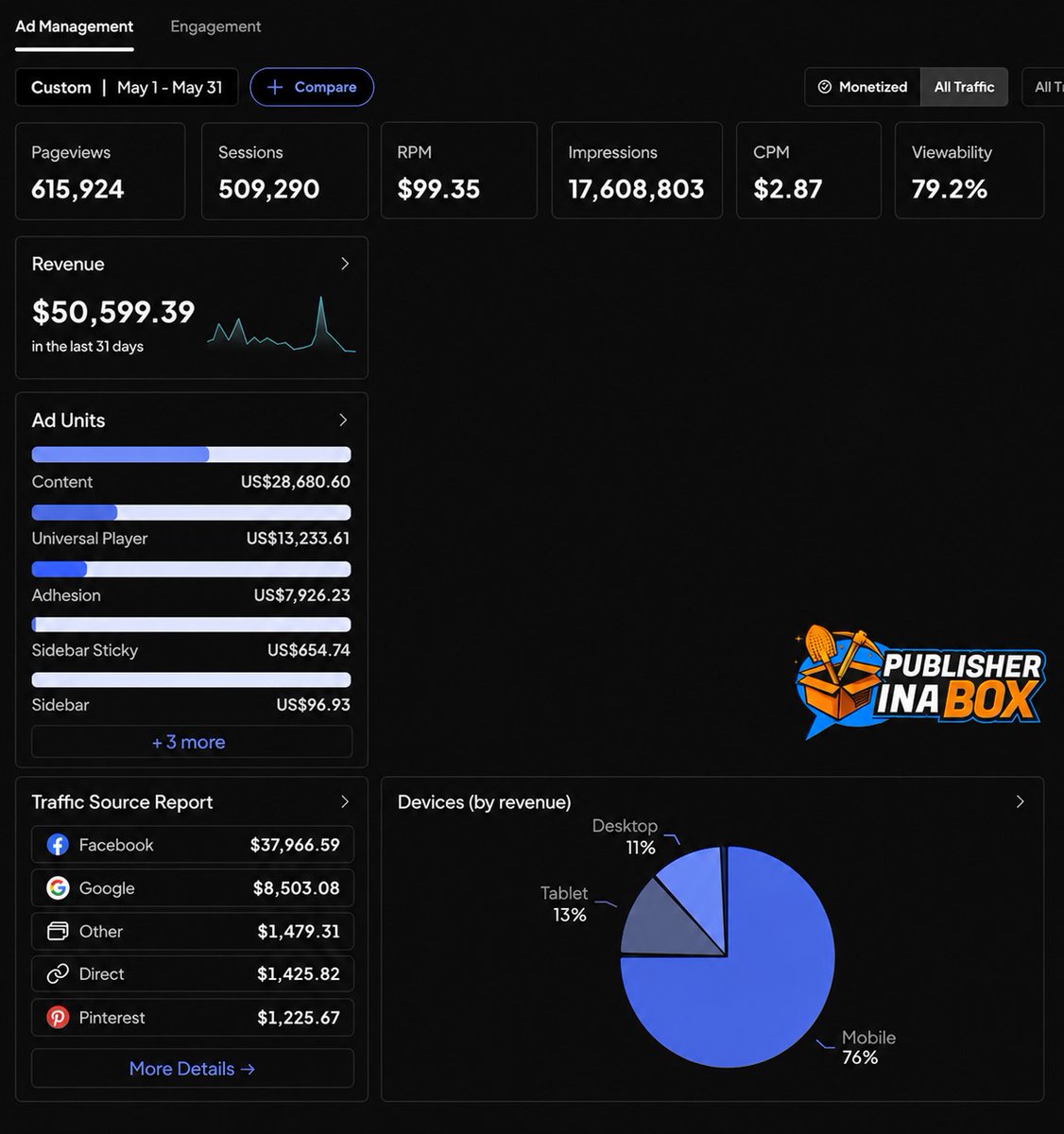
The second major data point from our feed this week is a site revenue screenshot that is generating significant attention. The site earned $10,786.73 in April. One month later, after Facebook was shifted from a supplemental channel to the primary traffic driver, the same site recorded $50,599.39 in May, a nearly 5x increase in a single calendar month with no change in niche, domain, or fundamental content strategy.
What changed was the source and volume of traffic. Facebook, when treated as a primary distribution engine rather than an afterthought, moves a meaningful quantity of engaged readers to publisher websites. Those readers arrive with topic intent already primed by the content that brought them from the feed, which typically translates into stronger on-site engagement metrics and higher ad yields per session compared to cold search traffic.
April vs. May site revenue for a publisher that moved Facebook from side channel to primary traffic driver.
Publishers who want a managed path to this kind of traffic-to-revenue conversion can explore our Facebook turnkey management service, which handles the operational side of running a high-output page.
Meta's Fake Engagement Policy: What It Covers, What It Removes, and Why It Affects Monetization Directly
The third thread from our feed this week is arguably the most important for any publisher who wants to keep earnings intact long-term. Meta has an explicit policy framework covering inauthentic behavior, and it is broader than most page owners realize.
The policy consequences are direct. Facebook's Content Monetization Policies tie eligibility to compliance standing. A page with active policy violations cannot access monetization features, and a page that loses its compliance standing after approval can have those features suspended. The ramp period discussed earlier is partly designed to surface these issues before revenue tools are extended, which is another reason the early patience is worth it.
The Macro Context: Why Facebook Monetization Is Worth Getting Right
Publishers sometimes ask whether Facebook page monetization is worth the effort given platform volatility concerns. The revenue data at the macro level answers that question clearly.
Publishers who are evaluating whether to build, restructure, or scale a Facebook presence can get a structured assessment through our Facebook consulting team, or hand off day-to-day operations entirely through Facebook turnkey management.
Frequently asked questions
Why does a new Facebook page show zero earnings even with strong view counts? New pages go through a monetization ramp period during which Meta verifies that audience behavior is authentic and sustained. Follower counts, watch-time thresholds, page age, and compliance standing all factor into eligibility. Views accumulating before those thresholds are met do not generate payouts, the revenue tools are not active yet. This is normal and expected for pages in their first weeks of operation.
What does Meta flag as fake engagement on Facebook? Meta's policies prohibit artificially inflating likes, comments, shares, follows, or any other engagement metric. This covers buying followers, using engagement pods, offering rewards in exchange for engagement, and requiring users to engage before viewing content. The platform also flags high-frequency posting behavior when other inauthenticity signals are present. Any of these violations can delay or remove access to monetization features.
How much does Facebook pay creators, and is the platform growing its payouts? Meta reported that Facebook paid content creators nearly $3 billion in 2025, a 35% increase from the prior year and the platform's highest annual payout total ever. Sixty percent of those payouts came from Reels, with the remainder distributed across Stories, photos, and text posts. The number of creators earning more than $10,000 annually grew by over 30% year-over-year in the same period.
Can a website's revenue grow 5x in a single month by prioritizing Facebook traffic? The case study we track publicly shows exactly this outcome: a site that earned $10,786.73 in April recorded $50,599.39 in May after Facebook was shifted from a supplemental channel to the primary traffic driver. The site, niche, and content strategy remained the same. The change was operational, Facebook volume and consistency increased significantly. Results vary by niche, audience, and monetization setup, but the directional effect of Facebook-first distribution on publisher revenue is real and documented.
Is Facebook page monetization worth pursuing given the platform's size and ad market trends? The ad market data supports it. eMarketer projects Meta will generate $243.46 billion in worldwide net ad revenue in 2026, surpassing Google for the first time. Meta's Q1 2026 ad impressions grew 19% year-over-year and the average price per ad rose 12% in the same period. A growing ad pool means more revenue available to flow to publishers who meet eligibility requirements and maintain policy compliance.
See more from Publisher in a Box in your Google results
The team behind 300M+ managed followers. We help publishers scale traffic, revenue, and audience across Facebook, Google Discover, and syndication networks.