Search across our learning center -- articles, newsletters, and more. Start typing or click a topic above.
Stay in the Loop
Get exclusive publishing strategies, industry insights, and early access to new features. No spam -- just signal.
Join 2,000+ publishers. Unsubscribe anytime.
Industry News
Facebook Content Monetization, Meta AI Search, and Google's Publisher Controls: A Publisher Digest
Publisher In a Box12 min read
Table of Contents
This article is part of our daily digest series, in-depth summaries drawn from our X account, @publisherinabox, expanded with industry data. (weekend recap)
Facebook Content Monetization: What Consistent Daily Output Looks Like
One of the most shared posts from our account this period showed a verified Facebook content monetization dashboard: $11,874.17 earned in a single calendar month, with multiple days clearing $500 and several approaching $1,000. What made the result notable was not a single viral spike carrying the total. The earnings curve was broad and relatively flat, built by consistent daily publishing that produced consistent daily revenue.
Verified Facebook content monetization dashboard: $11,874.17 in one month, driven by consistent daily output rather than a single viral event.
This data point matters for publishers who are evaluating whether Facebook page monetization is a reliable income channel or a lottery. The answer, at least in this case, is structural: pages that publish daily on proven engagement topics can generate revenue that compounds week over week. If you are working toward building that kind of operation and want strategic guidance on page architecture and content cadence, our Facebook consulting service covers exactly that ground.
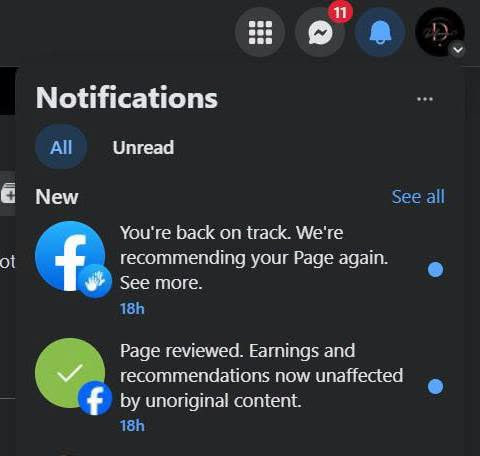
A separate post showed another publisher whose account had been under review. After the review concluded, both earnings and content recommendations were restored. Account reviews remain one of the most stressful events in a publisher's calendar, and the resolution here reinforces that the review process, while slow, does move in the right direction when a page is operating within policy.
Publisher earnings and recommendations restored following a completed Facebook review period.
Meta AI Search Is No Longer a Future Concern for Publishers
Meta has been building AI-powered search capabilities across its entire app family for some time, but the pace of deployment shifted materially in mid-2026. Meta launched "AI Mode," a new way to search Facebook that uses Meta AI to surface answers pulled from public posts across the platform, including Groups and Reels. The practical implication is that a user asking a question inside Facebook now gets a synthesized AI answer drawn from public content rather than a list of ranked page links.
Launched globally on June 15, 2026, the Facebook search tab uses Meta AI to answer from public posts, Groups, and Reels rather than returning ranked links. Users can then ask follow-up questions in the same interface, making the experience closer to a conversational assistant than a traditional search box.
The scale of the audience this reaches is difficult to overstate. Meta has roughly three billion people using its apps every day. When AI Mode synthesizes answers from public Facebook content, publishers whose pages produce high-frequency, high-quality posts become source material for those answers. Pages that do not publish consistently become invisible to the retrieval layer entirely.
Meta has been embedding its Meta AI assistant across Facebook, Instagram, WhatsApp and Messenger for years, but the June launch is the first time the company has positioned AI as a direct replacement for Facebook's own search bar, putting it in more direct competition with Google. Analysts cited by Forbes suggested the move could generate $10 billion in incremental annual revenue for Meta if it captures search-related advertising.
Meta annual capital expenditure on AI infrastructure. The 2026 figure represents the upper end of full-year guidance of $125B, $145B, nearly double the $72.2B spent in 2025.
The infrastructure behind this AI push is staggering. Meta reported first quarter 2026 earnings and raised its full-year 2026 capital expenditure guidance to $125 billion to $145 billion, up from a previous range of $115 billion to $135 billion. Meta told investors the increase was the result of higher prices for components and "additional data center costs to support future-year capacity." Last year, Meta spent $72.2 billion on capex, up roughly $30 billion from the year before. As Fortune reported, the company is now guiding to nearly double what it spent in 2025, and more than it spent in 2025 and 2024 combined.
That spending is not abstract for publishers. For Meta specifically, the AI infrastructure is not about competing with OpenAI or Anthropic in the model race. The more immediate goal is improving the AI systems embedded in Facebook, Instagram, WhatsApp, and the ad products that sit behind all of them. A platform that is spending at this level to make its AI surfaces better will reward publishers who produce public, structured, high-frequency content and penalize those who do not.
This week we also noted a frank internal admission: Mark Zuckerberg reportedly told employees that AI agent development has not accelerated as expected over the past four months. The gap between the capital being deployed and the results being generated is something investors have also noticed, with CNBC reporting that Meta told investors in April that it plans to spend as much as $145 billion on capex this year as it continues developing data centers and securing the graphics processing units needed to train AI models and run large workloads. The tension between investment pace and near-term results creates a period of genuine uncertainty that publishers should watch closely.
Meta's $145B AI capex bet against a backdrop of slower-than-expected agent development progress, as reported this week.
Meta Gives Publishers a Path to Erase a First Community Standards Strike
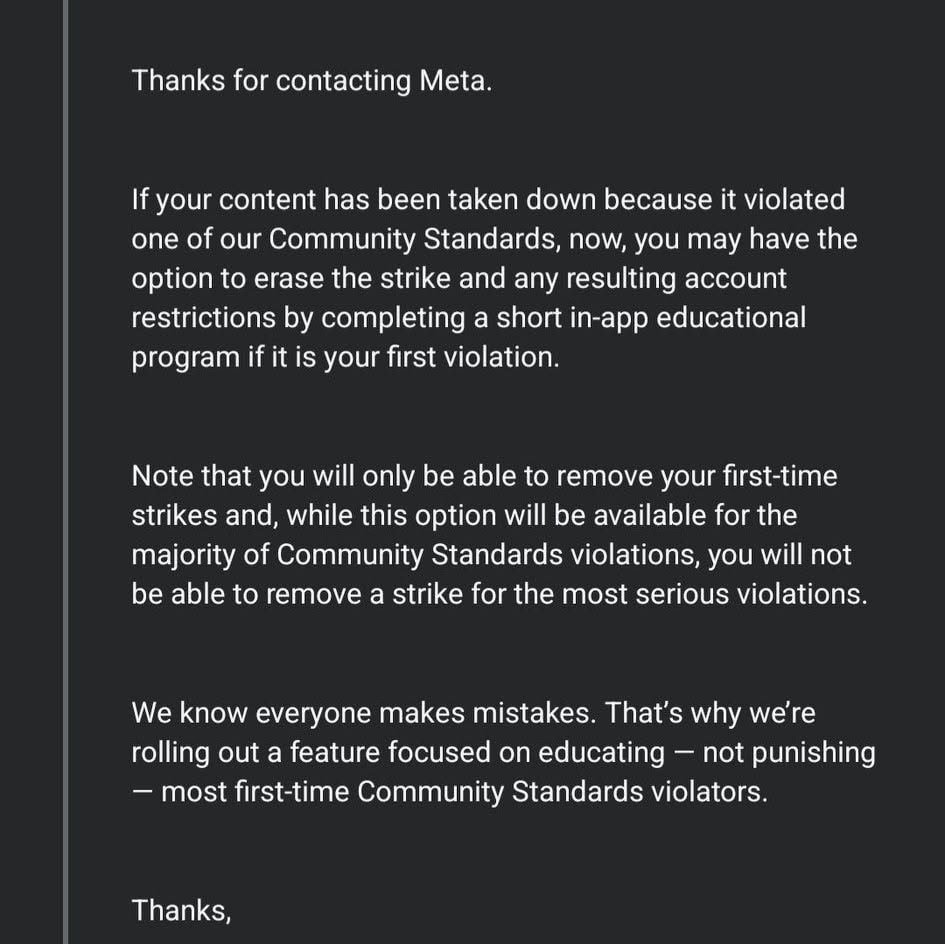
One of the highest-impression posts from this period covered a meaningful change in how Meta handles first-time policy violations. Multiple publishers in our community received a direct notification from Meta confirming they could erase a first-time Community Standards strike by completing a short educational program inside the app.
Meta's in-app notification offering publishers the option to remove a first-time Community Standards strike through a short educational exercise.
People who violate one of the company's rules for the first time will have the option to complete "a short educational program" in Facebook or Instagram's app in order to avoid a "strike" on their account and any restrictions that may come with it. Users will be able to take advantage of the process once in a 12-month period for most first-time offenses.
Meta's own Transparency Center data shows how widely this program has been adopted. Over a three-month period from January 12, 2025 to April 10, 2025, over 7.1 million Facebook users and over 730 thousand Instagram users who had content removed for a first-time, non-severe Community Standard violation opted to view the eligible violation notice. Among the nearly 3 million users across Facebook and Instagram who started the educational exercise, the majority completed it and successfully removed their strike. On Instagram, over 290 thousand users, nearly 85% of those who started the exercise, completed it and had their strike and any resulting account restrictions removed.
The program is only offered once in a 12-month period for first-time violations and excludes the most severe Community Standards violations, such as posting content that involves sexual exploitation, selling high-risk drugs, or glorifying dangerous organizations or individuals.
For publishers managing pages across Facebook page monetization programs, a strike can trigger payout suspensions and recommendation restrictions. The ability to erase that first strike without an appeal process changes the risk profile meaningfully. Publishers who receive a qualifying notice should act on it immediately rather than letting it expire. If your page operation involves multiple contributors or a managed publishing workflow, our Facebook turnkey management service includes compliance monitoring as part of its standard process.
Google Extends Generative AI Controls in Search Console Beyond the UK
The week also brought significant news on the Google side. Google appears to be rolling out new Generative AI controls in Google Search Console to sites outside the United Kingdom. It initially launched a month ago only for.co.uk-based sites but is now appearing for some (not all) sites based in the US and other countries.
This control is consequential. With the new toggle in Search Console, website owners can decide if they want their site to appear in and help ground responses in Google's generative AI Search features, including AI Overviews, AI Mode, and AI Overviews in Discover. Sites that opt out will not receive traffic or impressions from these generative AI features.
The context behind the UK-first rollout matters. This control did not arrive because Google chose to ship it voluntarily. On June 3, 2026, the UK Competition and Markets Authority issued a legally binding conduct requirement, the world's first such mandate, ordering Google to give publishers genuine opt-out controls over AI Overviews, AI Mode, and related AI features.
The scale of the surfaces these controls govern is significant. According to Google's official blog, AI Overviews now has over 2.5 billion monthly active users, while AI Mode has surpassed one billion monthly users. These are vendor-stated figures from Google I/O 2026 with no independent audit, but they give a sense of the distribution reach publishers are either opting into or out of.
For publishers, the default setting is inclusion. The "Include" setting means a site's content can appear in Search generative AI features, including showing up as links and helping to ground AI responses in these features. The site can receive impressions and traffic from these features. This is the default control for all properties. The opt-out option is available, but as Google's official blog notes, this control will not be used as a ranking signal for search results outside of these generative AI Search features.
The practical recommendation: check your Search Console settings now. Not all properties have access yet, but the rollout is ongoing. Confirm your property's setting before the expansion reaches full coverage, so the decision is deliberate rather than accidental.
Content Multiplication and Syndication: The Operational Foundation
Two additional posts from the period covered the operational mechanics that sit beneath all of the platform-level developments above. One post introduced the Content Multiplication System, a framework for turning a single idea into ten or more Facebook posts. The other covered the fundamentals of syndication monetization, explaining how publishers can earn from content distributed across multiple placement types.
Both topics connect directly to the AI search discussion. Meta's AI Mode draws from public posts, Group discussions, and Reels. A publisher who produces one piece of content per week generates a thin retrieval corpus. A publisher who multiplies each idea into ten or more posts, formatted for different surfaces, produces far more signal for AI retrieval to work with. The operational investment in content multiplication is therefore both a direct monetization play and an indirect AI visibility play at the same time.
Syndication monetization extends that logic further. When content is placed across multiple publisher networks and platforms, it increases both direct earnings and the total distribution footprint that feeds AI training and retrieval systems. Publishers who treat these as separate strategies are leaving compounding value on the table.
Frequently Asked Questions
How much can a Facebook page realistically earn from content monetization in a month? Earnings depend heavily on niche, follower count, posting frequency, and content type, but verified dashboards shared in our community show figures ranging from a few hundred dollars to over $11,000 in a single month. The more consistent the daily output, the more stable the revenue curve tends to be, with less reliance on individual viral posts to carry monthly totals.
What is Meta AI Mode and how does it affect Facebook page publishers? Meta AI Mode is a search experience launched globally in June 2026 that replaces traditional link-based Facebook search results with synthesized AI answers drawn from public posts, Groups, and Reels. For publishers, it means that pages producing frequent, well-structured public content become source material for AI answers delivered to billions of users. Pages with thin or infrequent content become less visible in this new retrieval layer.
How does the Meta first-strike educational program work for Facebook page owners? When a Facebook page or profile receives its first qualifying Community Standards violation, the account holder is given the option to complete a short in-app educational course instead of accepting the strike. Completing the course removes the strike and any associated restrictions. The option is available once per 12-month period and does not apply to severe violations such as sexual exploitation or drug sale content.
What is the Google Search Console Generative AI control and should publishers opt out? The control is a toggle under Settings in Search Console that determines whether a site's content can appear in Google's AI Overviews, AI Mode, and AI Overviews in Discover. The default is inclusion. Sites that opt out receive no traffic or impressions from those AI surfaces. The control does not affect traditional organic rankings. Most publishers should remain opted in and use the new Generative AI performance reports to measure the impact before making any changes.
Is Meta's $145 billion AI infrastructure spending a concern for publishers monetizing on Facebook? The spending signals that Meta is committed to making AI a central part of every surface on its platform for years to come. For publishers, that means the operational habits that matter today, including consistent publishing, structured content, and policy compliance, are the same habits that will determine visibility in AI-driven surfaces going forward. The investment level suggests this is not a short-term experiment.
See more from Publisher in a Box in your Google results
The team behind 300M+ managed followers. We help publishers scale traffic, revenue, and audience across Facebook, Google Discover, and syndication networks.