Search across our learning center -- articles, newsletters, and more. Start typing or click a topic above.
Stay in the Loop
Get exclusive publishing strategies, industry insights, and early access to new features. No spam -- just signal.
Join 2,000+ publishers. Unsubscribe anytime.
Industry News
Facebook Content Monetization, Muse Image, and the Case for Not Giving Up on Restrictions
Publisher In a Box9 min read
Table of Contents
This article is part of our daily digest series, in-depth summaries drawn from our X account, @publisherinabox, expanded with industry data.
Meta Ships Muse Image: What Publishers Need to Know
Meta launched Muse Image on July 7, 2026, its first in-house AI image generation model built by Meta Superintelligence Labs under Chief AI Officer Alexandr Wang. The model is already live for consumers in the United States through the Meta AI app, Instagram Stories, and WhatsApp direct messages, with Facebook and Messenger support coming later in 2026.
The practical capabilities extend well beyond a standard text-to-image tool. According to Meta's official announcement, the model powers more than 30 new AI-powered effects for Instagram Stories and allows image generation directly inside WhatsApp chats. Per CNBC, the model was originally code-named Mango and marks the second major release from Meta Superintelligence Labs, following the Muse Spark large language model unveiled in April 2026.
For publishers, the most commercially relevant detail is the advertising integration. CNBC reports that Muse Image will also power advertiser-specific image generation tools as part of Meta's Advantage Plus service, letting brands develop ad creative and automate certain tasks. In the coming weeks, advertisers and agencies will gain access through Advantage+ creative, according to Meta's newsroom. This matters for page owners because better advertiser creative quality tends to translate into healthier CPMs across the content that ad inventory runs against.
According to TechCrunch, Muse Image lets users erase objects from photos, render legible text inside visuals, and build functional QR codes from a single conversational prompt. The model pairs with Muse Spark so it can plan its layout, look up real-time web context, and blend multiple visual references in one generation pass, per Meta's own documentation.
The broader AI advertising story around this launch is substantial. WARC Media projects Meta will generate $240 billion in advertising revenue in 2026, a 22.3 percent year-on-year increase. Separately, Meta reported at Cannes Lions in June 2026 that a study of more than one million ad campaigns found every dollar spent on Meta advertising generates $4.13 in downstream revenue for advertisers, up 25 percent from 2022, per PPC.land's coverage of the event. Muse Image fits squarely inside that AI-driven performance flywheel.
Meta advertising revenue trajectory, 2022, 2026 forecast (WARC Media)
A Single Facebook Page, 19 Days, $17,798
One of the most instructive data points that crossed our feed this week was a real publisher dashboard showing $17,798.30 earned from a single Facebook page across 19 days, driven entirely by content monetization. The period represented an 11.4 percent improvement over the preceding 19 days. The earnings curve included multiple days crossing the $1,000 mark in a single day, with the top individual post pulling $838.34, a second bringing $588.05, and a third contributing meaningfully to the total as well.
Real publisher dashboard: $17,798.30 in 19 days from Facebook content monetization alone
What makes this case useful analytically is the source of the income. There were no brand deals, no digital products, no affiliate links. Content monetization carried the entire dashboard. That aligns with the structural shift Meta completed in August 2025 when it retired its fragmented payout programs and replaced them with a unified Content Monetization Program that bundles in-stream ads, ads on Reels, Stars, and performance bonuses into a single payout mechanism, as detailed by Meta's Creator Fast Track announcement.
The platform-level context behind individual earnings like this is significant. Meta confirmed in March 2026 that Facebook paid content creators nearly $3 billion in 2025, a 35 percent increase from the prior year and the highest annual total in the platform's history. That figure comes from Meta's own newsroom and was separately confirmed by Yahoo Finance's coverage of the Creator Fast Track launch. Publishers who are managing their pages as media businesses, optimizing post formats, and maintaining monetization eligibility are the ones capturing the most meaningful portions of that payout pool. Our Facebook consulting resources go deeper on how to position a page for consistent performance inside this program.
Meta's Q1 2026 earnings results add further context. Content Grip's analysis of Meta's Q1 filing showed advertising revenue of $55.02 billion for the quarter, driven by AI-powered optimization across targeting, creative, and placement. More ad spend flowing through Meta's network means more inventory value, which flows downstream to creator payouts. The two trends are connected.
Turning 500,000 Followers Into Durable Income
A persistent question among large-page operators is how to convert reach into revenue that stays. The mechanics matter here. Under the unified Content Monetization Program, Facebook pays creators for every eligible format: short- and long-form video, Reels, Stories, and photo and text posts, according to Meta's official program documentation. A page with 500,000 followers that posts across multiple eligible formats is drawing from a wider revenue surface than one that posts only video.
The Creator Fast Track program, launched in March 2026, also signals how Meta is thinking about this tier of creator. Yahoo Finance reported that creators with at least 100,000 followers on platforms like Instagram, TikTok, or YouTube can earn $1,000 per month guaranteed through the program, while those with over one million followers can earn $3,000 per month, as an incentive to bring established audiences to Facebook. That floor gives large-page operators a baseline to work from while their organic content monetization scales up.
The revenue split also matters. Creators keep roughly 55 percent of ad revenue under the unified program, with Meta retaining 45 percent, per reporting from Meta's own AI performance overview. For pages serving high-CPM audiences, primarily North American and Western European viewers, those percentages translate into meaningful per-post earnings at scale. Pages serving lower-monetization geographies need higher volume or broader content diversification to reach comparable totals. Our turnkey management resources address both scenarios.
Restrictions Are Not the End: What the Data and Real Results Show
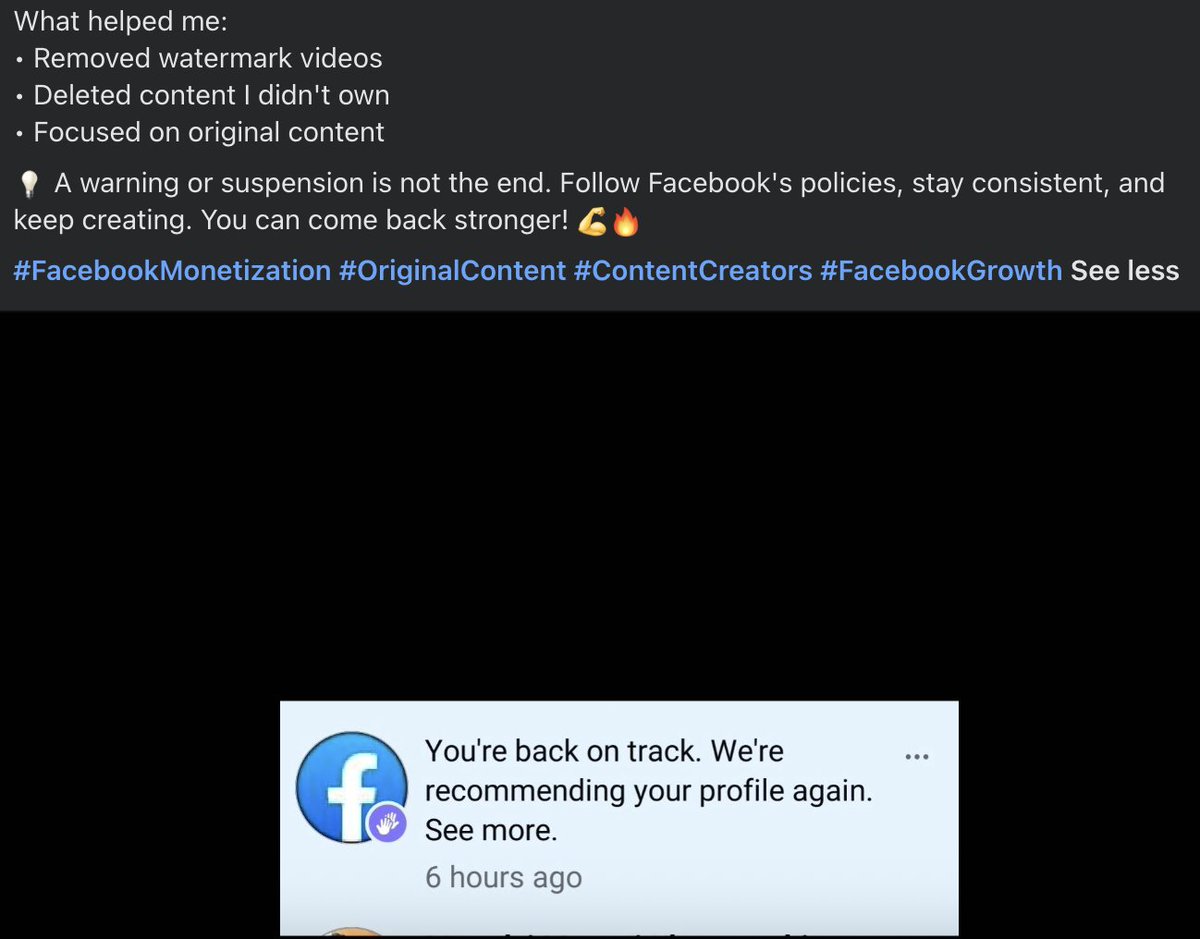
The fourth story from our feed this week showed a publisher recovering both monetization access and content recommendations after a restriction period. That outcome is achievable, and the framing matters: a restriction is a policy event, not a permanent closure.
A publisher gets monetization and recommendation access reinstated after a restriction period
Meta's own help documentation provides a formal appeal path through Monetization Manager for creators who believe a restriction was applied incorrectly. The process requires reading the exact reason cited in the Professional Dashboard, addressing the specific policy concern, and submitting a clear appeal if Meta offers that option for the type of violation involved.
The policy environment around original content is also worth understanding. Meta's March 2026 original content update noted that the platform has been cracking down on spammy content and making it harder for copycats to crowd out authentic creator voices. That same enforcement posture is what drives restrictions when pages carry reused content, but it also means that pages producing genuinely original material are being rewarded with greater reach and monetization access. The enforcement and the reward are two sides of the same policy.
Publishers who experience restrictions and abandon their pages forgo real money. The $3 billion paid to creators in 2025 was distributed across pages that stayed in the program and kept producing. A page that goes dark during a restriction period cannot recover its earnings trajectory after reinstatement. The case study in our feed this week is a concrete illustration of what patience and correct appeal procedure can produce.
Frequently asked questions
What is Facebook Content Monetization and how does it pay creators? Facebook Content Monetization is Meta's unified program that bundles ad revenue from in-stream placements, ads on Reels, performance bonuses, Stars tips, and subscriptions into a single payout. Creators keep approximately 55 percent of the ad revenue generated by their content. Eligible formats include short- and long-form video, Reels, Stories, and photo and text posts.
How much did Facebook pay creators in 2025? According to Meta's official newsroom, Facebook paid content creators nearly $3 billion in 2025, representing a 35 percent increase from the previous year and the highest annual creator payout total in the platform's history.
What is Muse Image and how does it relate to Facebook page monetization? Muse Image is Meta's first in-house AI image generation model, built by Meta Superintelligence Labs and launched on July 7, 2026. It generates and edits images from conversational prompts, produces legible in-image text, erases objects, and builds functional QR codes. For publishers, its most relevant aspect is the planned Advantage+ creative integration, which will allow advertisers to generate on-brand ad variations at scale, improving ad quality and CPMs across creator content.
Can a Facebook page recover monetization after a restriction? Yes. Meta provides a formal appeal process through Monetization Manager. Publishers should review the specific policy reason cited in their Professional Dashboard, address that issue directly, and submit a clear appeal when Meta makes one available. Restrictions are policy events with defined review paths, not permanent account closures. Pages that stay active and produce original content during and after a restriction period are better positioned for reinstatement.
What is the Creator Fast Track program? Creator Fast Track is a Facebook program launched in March 2026 designed to help established creators from other platforms build audiences on Facebook quickly. Creators with at least 100,000 followers on Instagram, TikTok, or YouTube can earn $1,000 per month guaranteed for three months, while those with over one million followers can earn $3,000 per month, along with increased reach on eligible Reels.
See more from Publisher in a Box in your Google results
The team behind 300M+ managed followers. We help publishers scale traffic, revenue, and audience across Facebook, Google Discover, and syndication networks.