Search across our learning center -- articles, newsletters, and more. Start typing or click a topic above.
Stay in the Loop
Get exclusive publishing strategies, industry insights, and early access to new features. No spam -- just signal.
Join 2,000+ publishers. Unsubscribe anytime.
Newsletter Digests
Why Google, YouTube, and Facebook Are the Three Pillars of Facebook Page Monetization Strategy
Publisher In a Box12 min read
Table of Contents
This article expands on our Publisher Insider newsletter, published by Publisher in a Box, with verified industry data.
The Attention Economy Has Three Centers of Gravity
Most publishers understand, in theory, that platform concentration matters. In practice, they spread themselves across a dozen channels, chasing whatever is generating buzz in a given quarter. Threads, Bluesky, LinkedIn newsletters, podcast feeds, none of those are bad investments, but treating them as primary channels before you have the three largest websites on the planet fully working for you is a strategic error that compounds over time.
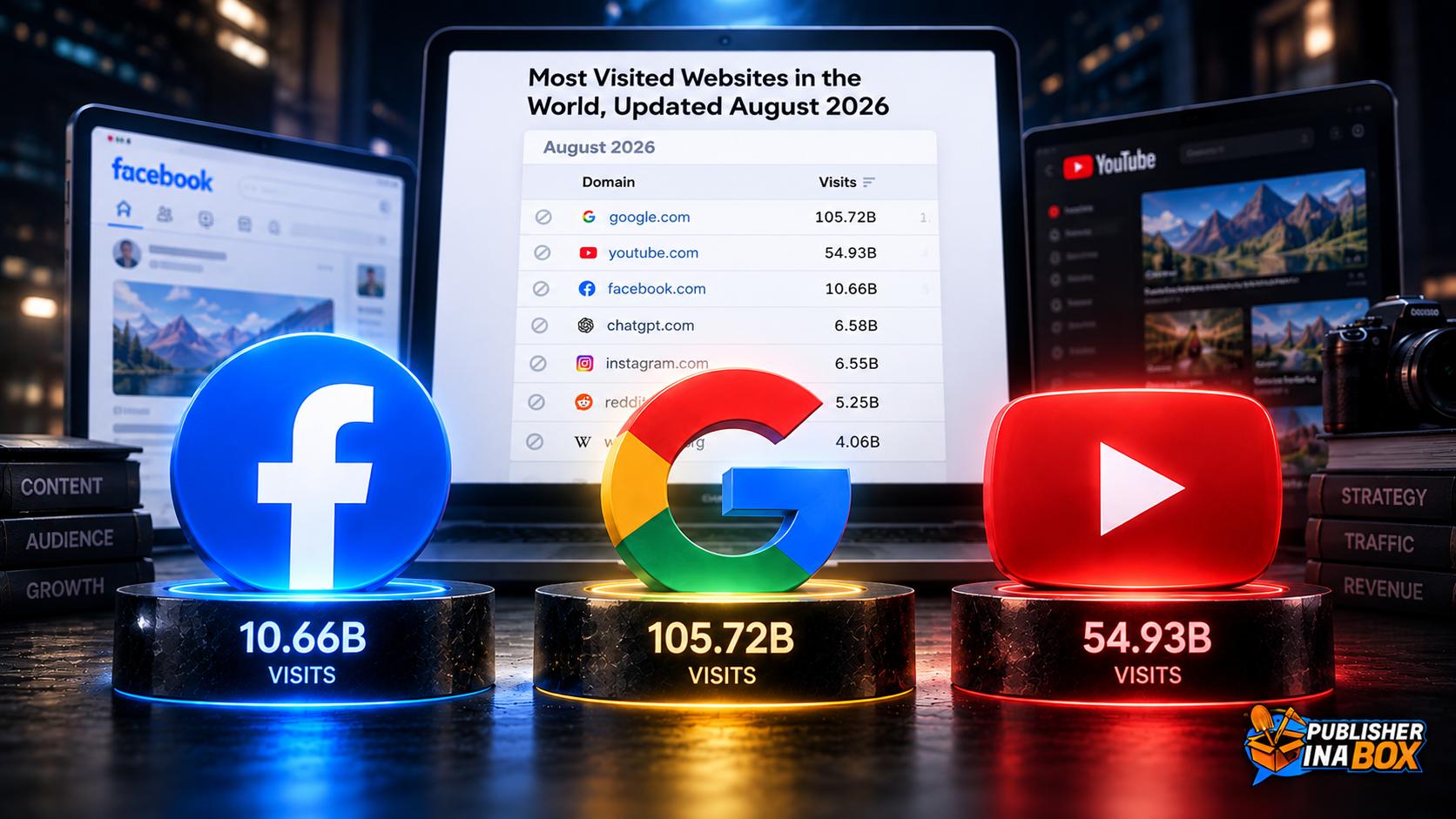
The data on where human attention lives online is not ambiguous. Semrush reports that Google.com receives approximately 111.75 billion monthly visits, YouTube sits at 54.4 billion, and Facebook clocks 10.85 billion, and together the top three account for roughly 30 percent of all measured web traffic on the open internet. Instagram, the next closest social platform, comes in at roughly 6.2 billion monthly visits. Nobody else is operating at remotely the same scale as the big three.
That concentration is not a coincidence. Google has held the number one position uninterrupted since the early 2010s. YouTube is the world's second-largest search engine by volume. Facebook remains the biggest social network by web visits, and its user base of roughly 3 billion monthly active users gives it more social-graph data than any other entity on the internet. These platforms are durable because they are self-reinforcing: more users produce better signals, better signals improve the product, and a better product attracts more users.
Monthly visits across the three largest websites in the world, per Semrush data for 2026.
Why the Sequencing of These Three Platforms Matters
Knowing which platforms matter is only the first part. The second part is understanding that you cannot realistically build all three to full capacity simultaneously, and attempting to do so typically results in mediocre execution on all three rather than dominance on any of them. The correct answer is a sequenced build, with each phase funding and informing the next.
The sequence that works for most publishers is Facebook first, Google second, YouTube third, and the reasoning behind each step is grounded in the economics and mechanics of each platform.
Facebook: The Fastest Feedback Loop and the Proving Ground
Facebook is where publishers should begin because it returns results faster than either of the other two platforms. You post content, you see engagement data within hours, you iterate the same day. The feedback cycle is tight enough that a publisher can genuinely learn what resonates with their audience within weeks rather than months.
The monetization infrastructure is live and paying out. Digiday reported that of the ten publishers it spoke with, several were on track to make between six and seven figures in a single year from Meta's content monetization program, which pays creators based on engagement with photos and videos posted on the platform. That program merges Facebook's in-stream ads and performance bonus programs into one, simplifying the creator monetization process considerably.
Publisher Insider analysis: Google, YouTube, and Facebook as the three structural pillars of a modern publishing operation.
Google: The Compounding Engine That Rewards Patience
Google is the largest single website on earth by a significant margin, and its value to publishers is real, but it operates on a different timeline than Facebook. DemandSage puts Google's monthly visits at 105 billion, and organic search generates 53 percent of total website traffic globally. Those are numbers that no publisher can afford to ignore. The challenge is that Google's returns are compounding rather than immediate.
Google Discover can send enormous traffic spikes to individual pieces of content, but those spikes are largely unpredictable in the early stages of a publishing operation. Search, by contrast, delivers returns that build over months as a content library grows and the algorithm accumulates enough indexed material to establish topical authority. Publishers who start layering Google into their strategy after Facebook has already generated some operating revenue are in a far better position to sustain the slower ramp, they are not relying on Google traffic to keep the lights on during the months it takes to gain traction.
It is also worth noting the context of AI's growing role in search. Digiday reported that many publishers lost a third or more of their traffic since the launch of Google's AI summaries in search, which makes having a diversified platform strategy more important now than at any point in the last decade. A publisher that has Facebook monetization running while building its Google presence is far less exposed to any single algorithmic shift.
YouTube: The Heaviest Build With the Longest Runway
YouTube is the platform with the highest ceiling and the steepest climb to get there. YouTube is the world's second-largest search engine, and its content library compounds in a way that text-based content typically cannot: every video a publisher has ever uploaded keeps surfacing in search and recommendations indefinitely. A video published three years ago can generate as much traffic today as it did on launch day, and in many cases more.
The cost is real, though. Video production is more resource-intensive than any other content format. The first six to twelve months on a new YouTube channel are genuinely difficult, the algorithm needs dozens of uploads before it develops a clear picture of what a channel is about and who its audience is. Growth on YouTube tends to be non-linear: it looks like nothing is happening, and then it is not. Once a channel establishes algorithmic trust, its back catalog keeps working with no additional production cost.
This is why YouTube belongs at the end of the sequence rather than the beginning. A publisher who arrives at YouTube with operating revenue from Facebook and a growing content library from Google is in a position to sustain the slow early months without abandoning the channel. A publisher who tries to build YouTube from scratch on day one, with no other revenue source, usually cannot. For publishers ready to explore what a full three-platform operation looks like in practice, our Facebook turnkey management service is one way to keep the Facebook operation running efficiently while attention shifts to building the other two legs.
Meta's Infrastructure Investments Signal Where the Platform Is Headed
Petal will be the first subsea cable system to deploy multi-core fiber technology at scale, built in partnership with NEC and Sumitomo Electric Industries. The engineering rationale is that two-core fiber places two independent optical transmission paths inside a single fiber strand, effectively doubling capacity without doubling the physical cable infrastructure. For publishers, this matters as a signal: a company that is building petabit-scale transatlantic infrastructure is not winding down its digital ambitions. It is building for a decade of AI-driven content delivery and social engagement at a scale that dwarfs what today's networks can support.
What the Top-Performing Posts Tell Publishers Right Now
Beyond platform strategy, the content format data coming out of Facebook's top performers in any given week consistently reinforces one finding: image posts with strong emotional or informational hooks outperform more resource-intensive formats when the underlying story is compelling enough to carry the post on its own. According to Publisher in a Box performance reporting, the highest-interaction posts in recent tracking periods have been static image posts, not Reels, not videos, built around a single strong frame: a debut goal celebration, a player's real social media reaction to a match result, or a breaking news moment captured in a plain visual. When the fact itself is the hook, a static image post can outperform every Reel on the platform.
The takeaway for publishers is not that video is dead, it is that format should follow the strength of the story rather than default assumptions about what the algorithm rewards. A publisher with a strong breaking news or emotional story should reach for the format that deploys fastest and lets the content lead. A publisher building evergreen or educational content has more room to invest in video production. Matching format to story type is one of the more durable lessons the data keeps surfacing.
The Mistake Most Publishers Are Making Right Now
The common thread in underperforming publishing operations is not a lack of content or effort. It is the misallocation of that effort across too many platforms at once. A publishing team that splits its attention equally across Facebook, YouTube, Google, LinkedIn, TikTok, and a newsletter from day one typically generates mediocre results on all of them rather than a dominant position on any of them. Platform algorithms reward consistency and volume, and it is genuinely difficult to produce either at the level required for algorithmic trust when attention is divided six ways.
The publishers generating meaningful revenue from digital content right now are almost universally the ones who built a dominant Facebook presence first, used that to fund a growing Google content library, and are now either in the early stages of a YouTube build or sustaining a channel that has already passed the algorithmic inflection point. That is the sequence. Everything else is an addition to it, not a replacement for it.
Frequently Asked Questions
Why should publishers focus on Facebook before Google or YouTube? Facebook offers the fastest feedback loop of the three platforms. Engagement data is available within hours of posting, the content monetization program is live and paying out, and referral traffic to publisher sites has been rebounding. It is the platform best suited to generating operating revenue quickly enough to fund the slower ramps required by Google and YouTube.
How long does it typically take for a YouTube channel to gain traction? Most publishers who build YouTube from scratch should plan for a six-to-twelve month period before the algorithm has enough data to consistently recommend their content. Growth on YouTube is non-linear, it appears flat for an extended period before accelerating. This is why starting YouTube before you have stable revenue from Facebook and Google creates unnecessary financial pressure.
Is Google Discover a reliable traffic source for publishers? Google Discover can deliver large traffic spikes to individual pieces of content, but those spikes are largely unpredictable early in a publishing operation's life. Google Search, by contrast, delivers compounding returns over months as a content library grows. Publishers should plan for Search as the primary Google traffic driver and treat Discover as a valuable but unpredictable supplement.
What does Meta's infrastructure investment in Petal mean for Facebook publishers? The Petal subsea cable announcement is a signal of long-term platform commitment. A company investing in petabit-scale transatlantic infrastructure is building for a decade of growth in content delivery, AI-driven recommendations, and social engagement. For publishers, it reinforces that Facebook is not a declining platform but one whose parent company is actively expanding its capacity to serve content at global scale.
What content formats are performing best on Facebook right now? According to Publisher in a Box performance data, static image posts with strong emotional or informational hooks are generating some of the highest interaction counts on the platform, often outperforming Reels when the underlying story is compelling enough to carry the post on its own. Format should follow the strength of the story rather than a fixed production template.
See more from Publisher in a Box in your Google results
The team behind 300M+ managed followers. We help publishers scale traffic, revenue, and audience across Facebook, Google Discover, and syndication networks.