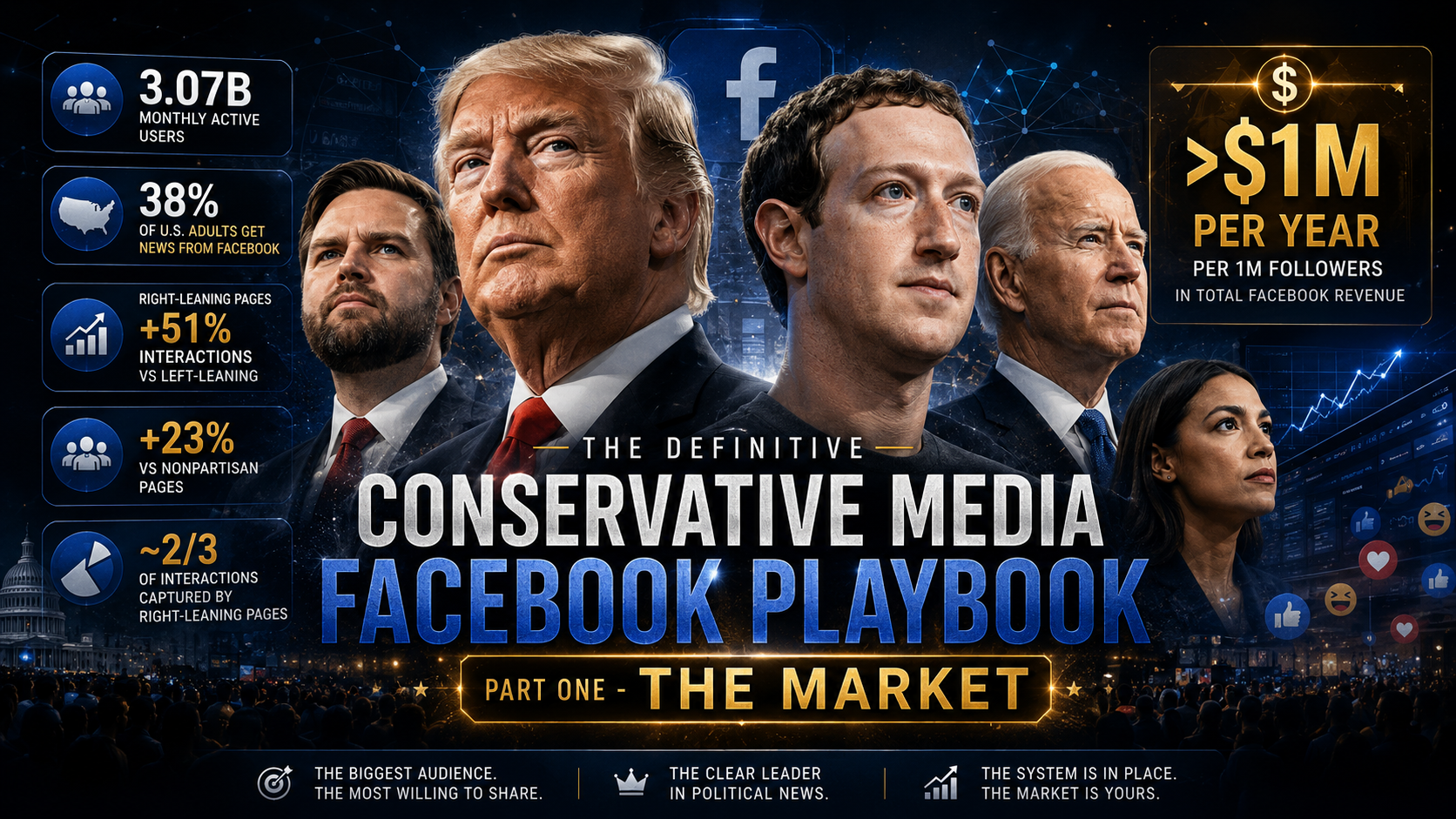
This is Part 1 of a two-part Facebook page monetization playbook built for operators and owners of major conservative media brands. Part 1 maps the state of the Facebook market for political publishers in 2026, with the platform changes, monetization realities, and earnings math behind every follower an operator already owns. Part 2 lays out the exact execution system used to take a conservative media page from zero to $1,000,000 per year per 1,000,000 followers in total Facebook revenue.
The opportunity in the conservative media niche on Facebook is the biggest it has been in five years. Bigger than 2020. Bigger than 2018. Bigger than the cycle that built the category in the first place. And the largest publishers in this niche, the names every operator already knows, are leaving 2 to 10 times their current revenue on the table. Because they are still running playbooks built between 2017 and 2020. The audience moved. The platform moved. The math moved. The playbook did not.
1. The state of Facebook for political publishers in 2026
Facebook is the largest news distribution platform on earth, bigger than any other social platform and bigger than most television networks. Meta reported 3.07 billion monthly active users globally in its Q1 2026 earnings, and Pew Research data from late 2025 shows 38% of American adults regularly get their news from Facebook. It is the single biggest place in the country where political news gets read, shared, and reacted to in real time.
Inside that audience, the conservative media segment dominates by a wide margin. Right-leaning Facebook pages generate 51% more total interactions than left-leaning pages and 23% more than nonpartisan ones. Audits of more than 16,000 posts across 250 popular Facebook pages found right-leaning pages capturing roughly two-thirds of all interactions and producing more than three-quarters of top-performing posts. Researchers describe this as a structural pattern across the platform, not a one-off effect tied to specific news cycles. Conservative content is the structural advantage in Facebook's largest political category.
For an operator already sitting on a conservative media audience, every one of those data points is a tailwind. The audience is bigger, louder, and more willing to share than almost any other vertical on Facebook. The constraint has never been demand; it has always been execution. The market is waiting and the platform is leaning in. The only thing standing between an operator in this niche and the next revenue tier is the system being applied to the audience already in hand.
2. The January 2025 reversal: the golden age is back
For four years, from 2021 through the end of 2024, Facebook quietly went to war with political content. There was no announcement, no vote, and no recourse for any of the publishers who had built real audiences on the platform. Meta reduced political posts in News Feed, ended formal partnerships with news publishers, and dialed back distribution for pages covering public affairs and elections. Pages with strong fundamentals, real engagement, and real history were getting a fraction of their historical distribution. Analysis through 2024 showed political engagement collapsing across the board, with the biggest names in the niche quietly losing 60, 70, even 80% of their views and nothing they could do about it.
That ended on January 7, 2025. In a single announcement, Mark Zuckerberg reversed all of it. Meta terminated the third-party fact-checking program and replaced it with a Community Notes system, the same model X runs. The four-year policy of limiting political content in feeds was lifted publicly and without hedging. Distribution opened back up within weeks.
And the downstream effects were not gradual. They were not subtle. They were immediate, they were measurable, and they were enormous:
- Political page operators watched follower counts triple within months of the reversal. No new strategy. No new content. The suppression lifted, and the audience came back at scale.
- Engagement with politically charged content surged roughly 20% across the entire platform, with the largest gains concentrated in pages already producing high-share content.
- Pages that had been left for dead during the suppression period started rebuilding distribution inside their first 30 days of active management again. From a standing start.
This matters operationally. Every conservative media page running on Facebook in 2026 is operating with the wind at its back. Publishers who built playbooks for the 2021 through 2024 environment are still running defense in a market that does not require defense anymore, and publishers who recognize the shift and adapt fast are pulling ahead at a rate the others cannot match.
The golden age of conservative media on Facebook is back, and it is bigger than the run that built the category the first time. The audience is larger, the platform is leaning in, and the monetization infrastructure is wide open. What this looks like in three years is unknown, because platform policy shifts on its own clock. What is true today is that every operator already inside this niche is sitting in the highest-engagement audience inside the most distribution-friendly political content environment Facebook has produced in over five years, and the publishers who move first take the largest share of it.
3. The earnings math: what a single conservative media page is worth in 2026
Here is what the math looks like. Not theoretical. Not modeled. Drawn directly from running dozens of conservative media Facebook pages at full operational capacity inside Publisher In a Box. For a properly managed conservative media page, the monthly revenue profile on the first 1,000,000 followers is the chart above. Read it carefully. This is the per-page baseline. This is the number every operator should be multiplying across every page in their network.
Four calibrations on this range.
The range is per page, then multiplied across the network. Every operator with multiple pages applies this baseline to each page individually. A network with five well-managed conservative media pages, each at one million followers or above, models the math five times over rather than treating the audience as a single pooled number. Network-level economics in the next section apply this principle.
Variance inside the range is wide, but the baseline is reachable. The range runs from $20,000 a month at the low end to $100,000 a month at the high end, with a typical well-run page landing near $45,000 a month. Variance within the range reflects differences in content niche specificity, audience composition, referral infrastructure on the destination site, and Reels execution. Some pages sit at the low end of the range. Some pages sit at the high end. The high end is not a starting point. It is earned over months of full execution, with documented examples of single conservative media pages above one million followers generating $35,000 to $50,000 a month from Facebook Content Monetization alone, before referral revenue is counted.
The high end requires full execution. Pages hitting the top of these ranges run the full content system. Multiple Reels per day, breaking news velocity, a dedicated production team, optimized referral traffic flows with strong publisher relationships, and an active conversion loop on the destination site. Pages running partial systems earn partial outcomes.
Earnings per follower degrade past the first million. This is a structural pattern across the platform. The first 1,000,000 followers on a page produce a higher revenue-per-follower rate than every additional follower beyond that point. Several factors drive this: saturation of the high-engagement audience segment, distribution algorithms that surface posts less aggressively as page size grows, and increased competition for attention within the existing follower base. The drop-off past the first million is sharp, but absolute revenue keeps climbing. A 10 million follower page still generates substantially more revenue than a one million follower page. The earnings simply do not scale linearly.
For planning purposes, a reasonable working model is:
- First 1,000,000 followers on a page: full per-follower rate
- 1,000,000 to 5,000,000 followers: approximately 35% of the baseline per-follower rate
- 5,000,000 followers and beyond: approximately 25% of the baseline per-follower rate
This is the framework Publisher In a Box uses internally to model network value. It is conservative on purpose. Pages with elite execution blow past it. Some by a little. Some by a lot.
4. Network-level math: what your full audience is worth in 2026
Now the per-page baseline gets multiplied. This is where the real number lives. Apply the per-page math with realistic degradation past the first million followers, page by page, and the chart above is what a conservative media Facebook network is worth at scale. The math compounds. A network with one flagship page and several mid-sized pages applies the full baseline to each page individually, with degradation calculated per page, not pooled across the network as a whole. That distinction matters. It is the difference between a 20 million follower network worth $500K a month and the same 20 million followers spread across pages worth two or three times that figure.
The ranges above assume properly managed pages with full execution. Half-managed networks earn a fraction. Unmanaged networks earn close to zero. The system is what produces the number, not the audience size on its own.
A few notes on how to read these numbers.
These are total revenue ranges across Facebook Content Monetization and referral traffic combined. The split varies by operator. Some networks run heavier on Facebook Content Monetization with limited referral infrastructure. Others run heavier on referral with light Content Monetization participation. The strongest networks build both streams in parallel.
The ranges widen at larger network sizes for a reason. At 100 million followers, the difference between a network running tight execution across every page and a network running mixed execution is enormous. The 100 million range assumes the network is being run as a coordinated operation rather than a collection of independent pages with no shared strategy.
The ranges do not include licensing revenue, syndication revenue, sponsorship or partnership revenue, or any product or service revenue layered on top of the audience. Those streams are common in conservative news operations and the math above intentionally excludes them to isolate Facebook-attributable revenue from Content Monetization and referral traffic.
And the ceiling is higher than the chart shows. The ranges above are strong execution. Best-in-class execution beats them. Some operators in this niche are quietly running networks that pay out at the top of these ranges every single month. Most are not. The gap between the top of the range and the median is where every operator in this article should be looking.
5. Why most of the biggest players are leaving 2 to 10 times their revenue on the table
This is the section that matters most for operators of major conservative media brands. The opportunity is not theoretical or somewhere out in the future. It is sitting inside operations that are already running today, already generating real revenue, on systems that were built for a platform environment that no longer exists. 2x, 5x, in some cases 10x of current revenue, sitting on the table, already paid for in audience and infrastructure, uncollected.
Here is the pattern observed consistently across the largest conservative media operators on Facebook.
The strategy is from 2018 to 2020. The page is publishing primarily link posts to drive traffic to the owned website. The content cadence is consistent but moderate. Image posts and Reels are either absent or treated as a secondary format. Breaking news is handled, but on a slower production cycle than what the platform currently rewards. The referral traffic to the owned website is strong because the website infrastructure is mature, the ad stack is well-developed, and the audience is loyal. But Facebook itself is being run as a distribution channel for the website rather than as a profit center in its own right.
This worked beautifully from 2017 through 2020. It still works in 2026. The pages are profitable. The brands are real. The revenue is real. But the available revenue, the number on the other side of the table, is bigger. A lot bigger. And it is being left there, untouched, by almost every major publisher in this niche.
Here is a real example. One major conservative media publisher analyzed by Publisher In a Box is generating an estimated $300,000 a month from referral traffic out of its Facebook pages. The page strategy in use was built between 2018 and 2020. It is still effective. The referral revenue is real. But the Facebook Content Monetization revenue, which would be substantial at the size of this operator's audience, is a fraction of what it should be. The Reels strategy is underbuilt. The image post cadence is too low for the size of the audience. The breaking news production speed is competitive but not best-in-class. The structural setup of the pages favors outbound link clicks over native engagement, which is precisely the inverse of what Facebook's current distribution algorithm rewards.
A 3x lift on this operator's baseline is achievable within 12 months by:
- Doubling or tripling the daily Reels output across the largest pages
- Shifting the post mix from link-heavy to image-heavy and text-heavy with intentional click-out moments rather than constant outbound links
- Tightening the breaking news production loop to capture early engagement windows on more stories
- Activating Facebook Content Monetization across every eligible page in the network at a level matched to the existing referral revenue
- Reinforcing the page like ad strategy on the smaller pages in the network to break them out of stagnation
That lift takes the operator from roughly $300,000 a month in Facebook-attributable revenue to roughly $900,000 a month, with no acquisition cost, no new content categories, and no new audience built from scratch. The audience is already there. The system being applied to it is what is wrong, and fixing the system triples the number within 12 months.
And this pattern is not one operator. It is the whole segment. The biggest publishers in this niche are competing against each other on a baseline of strong but outdated execution. They are all sitting on the same kind of upside. The first one to upgrade pulls ahead at a rate the others cannot easily match. The second one catches up. The third one starts falling behind. By the time everyone runs the new playbook, the early movers are sitting at the new ceiling and the late movers are competing for what is left.
For an operator with 20 million followers running a 2018 era playbook today, a realistic short-term opportunity looks like this:
- Current baseline estimated revenue: roughly $150,000 to $300,000 per month across Content Monetization and referral, often weighted heavily toward referral with light Content Monetization
- After full system upgrade over 6 to 12 months: roughly $450,000 to $615,000 per month, the mid-to-high end of what a 20,000,000 follower network supports
- The system upgrade has no equity cost, no new audience acquisition, no platform diversification work required. It is operational. It is execution.
The rest of this document is the system that produces the upgrade.
6. How conservative media brands make money on Facebook in 2026 and beyond
Two streams. That is the whole picture. Facebook Content Monetization on one side. Referral traffic to an owned site on the other. Both are bigger than they have ever been for conservative media pages in 2026. Both are paying better than they did in 2024. Both compound if the page is built for it. Understanding how each stream pays is the foundation for every operational decision in Part 2.
6.1 Stream 1: Facebook Content Monetization
Facebook Content Monetization is Meta's revenue-share program for Pages and Profiles. Facebook serves ads against eligible content (Reels, video, and certain photo and text posts) and the publisher takes a share of the ad revenue. For a conservative media page in 2026, this is the highest-margin, fastest-growing monetization stream on the platform. Nothing else on Facebook is paying conservative media pages the way Content Monetization is paying them right now.
Current RPM ranges in conservative media on Facebook Content Monetization:
- Low end: approximately $1,000 per 10,000,000 views
- High end: approximately $2,000 per 10,000,000 views
- Translation: $100 to $200 per 1,000,000 views, varying by content quality, audience composition, and format mix
And RPMs are climbing, not flat or seasonal. Pages that built strong content libraries during the 2025 ramp are pushing past the high end of this range in strong months. Pages with weak content composition, low dwell time, and inconsistent Reels output sit at the low end or below.
Eligibility for Facebook Content Monetization in 2026:
- Page or profile at least 30 days old
- At least 10,000 followers
- At least 150,000 unique views in the last 28 days
- At least 3 Reels posted in the last 90 days
- Operating in an eligible country with a clean policy record
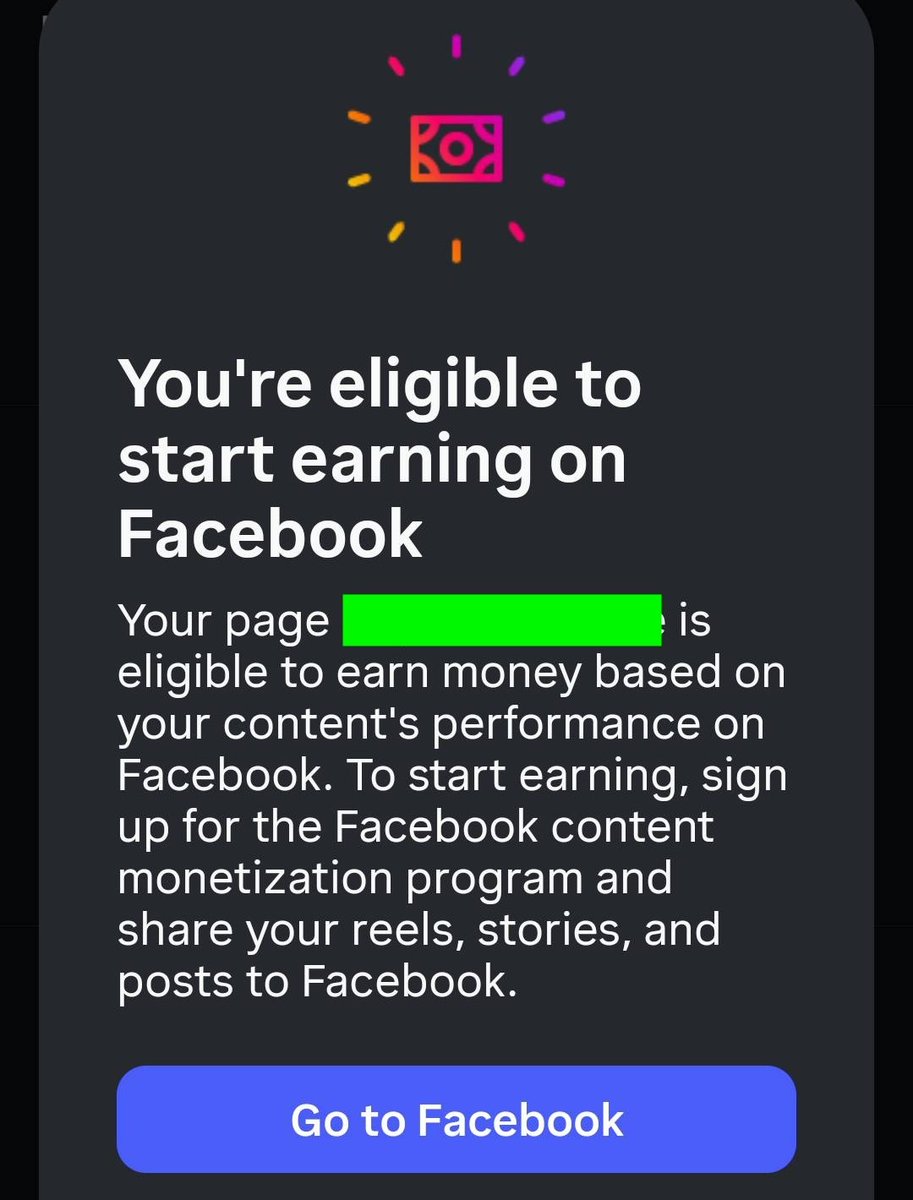
For a fresh page built with deliberate execution, invites to the Facebook Content Monetization program are arriving in as little as 3 weeks. For an older page being re-energized after a dormant period, the invite window is often shorter because the page already meets follower and history requirements and only needs to demonstrate consistent recent posting and Reels activity.
6.2 Stream 2: Referral traffic (display ads and affiliates)
The second monetization stream is referral traffic. The Facebook page drives users to an owned and operated website. That website is monetized through display ad networks (Mediavine, Raptive, Journey, AdSense, or a comparable platform) and through affiliate revenue streams.
The economics of referral revenue:
- Display ad RPMs on conservative media websites range from $10 to $40 per 1,000 sessions, depending on tier-1 traffic mix, ad stack quality, and seasonality
- Affiliate revenue varies dramatically by niche and offer. For conservative media, common categories include news subscriptions, financial newsletter trials, and gold and precious metals offers, with payouts ranging from $5 to $100+ per converted lead
- Referral traffic compounds with Facebook Content Monetization rather than competing against it. A click-out from a Facebook post is revenue from referral. A view on a Facebook native post is revenue from Content Monetization. The same audience generates both if the post mix is designed for it.
The structural shift in 2026:
Publishers built between 2017 and 2020 optimized almost exclusively for referral traffic. Every Facebook post was a link post pushing users off-platform. That made sense when Facebook Content Monetization either did not exist or paid poorly compared to display ad RPMs.
In 2026, the math has flipped completely. Native engagement on Facebook (image posts with long captions, breaking news text posts, Reels) generates Facebook Content Monetization revenue while also driving the engagement signals that Facebook's algorithm rewards with expanded distribution and view counts. Pages that publish only link posts are sacrificing the algorithmic distribution that produces both streams in the first place, losing revenue on the post they published and on every post that comes after it.
The strongest conservative media operators in 2026 run a hybrid post mix: 70 to 80% native engagement content (image, text, Reels) and 20 to 30% strategic outbound links to capture affiliate revenue and feed the destination site. Pages running 100% link-heavy strategies generate substantially less of both streams than hybrid pages. The native-heavy hybrid has emerged as the dominant structure across every page Publisher In a Box has scaled past $30K a month.
6.3 The streams the math excludes
The per-page and network-level revenue ranges in Sections 3 and 4 isolate Facebook Content Monetization and referral traffic. They intentionally exclude:
- Licensing revenue from syndication partners (MSN, Yahoo, AOL, Newsbreak, SmartNews and similar platforms)
- Sponsorship and partnership revenue from advertisers paying for placement or content collaboration
- Newsletter monetization from email lists built off the back of the Facebook audience
- Product and service revenue from courses, communities, or owned commerce layered on top of the audience
These streams are common in mature conservative media operations and frequently add another 30 to 100% on top of the Facebook-attributable baseline. The math in this article is the floor, not the ceiling, and the operators running the full stack are the ones who get to the higher number.
The audience is the largest it has been in five years, the platform is leaning in, and the monetization streams are wide open and climbing. The biggest publishers in this niche are leaving 2 to 10x on the table because they are running 2018 playbooks in a 2026 environment. Part 2 is the playbook that fixes it.
The Execution System
The full operational playbook. Page setup, content strategy, format hierarchy, the Reels engine, breaking news velocity, team structure, ceiling-breakers, common mistakes, and revenue progression at every follower stage. Read it as a sequence, not a menu.