Search across our learning center -- articles, newsletters, and more. Start typing or click a topic above.
Stay in the Loop
Get exclusive publishing strategies, industry insights, and early access to new features. No spam -- just signal.
Join 2,000+ publishers. Unsubscribe anytime.
Industry News
Facebook Content Monetization: $12K in 24 Days, the Case for Weekly KPIs, and a New Restriction Prompt
Publisher In a Box10 min read
Table of Contents
This article is part of our daily digest series, in-depth summaries drawn from our X account, @publisherinabox, expanded with industry data.
The $12K payout that rewrites assumptions about Facebook content monetization
One of the most striking data points we have shared recently came from a publisher running a single Facebook page. In 24 days, that page generated $11,947.88 from content monetization alone, up 134% from the prior month. The overall payout figure, including a small contribution from other sources, landed at a 132% month-over-month gain. What makes the number genuinely instructive is what was not driving it: the breakdown showed zero revenue from in-stream ads and zero from Ads on Reels. Nearly the entire payout came from photo and text posts running through Facebook's unified Content Monetization Program (CMP).
$11,947.88 from content monetization in 24 days, entirely from photo and text posts, with no in-stream ad or Reels revenue contributing to the total.
This result aligns with what Meta itself has confirmed at the platform level. In 2025, Facebook paid content creators nearly $3 billion from its creator monetization programs, a 35% increase from the previous year and its highest annual total ever. According to the official Meta announcement, the Facebook Content Monetization program pays creators for every eligible format, including short- and long-form videos, Stories, and photo and text posts, and in 2025, 60% of Facebook's total payout to creators went to Reels while the rest went to Stories, photos, and text posts. The single-page result we shared demonstrates that the non-Reels 40% can, under the right conditions, produce five-figure monthly payouts.
The number of creators earning more than $10,000 annually on Facebook has grown by over 30% year-over-year, according to Meta's own data released alongside the Creator Fast Track program in March 2026. The structural reason for that growth is the consolidation of what were previously separate earning pathways. Meta stated that In-stream Ads, Ads on Reels, and Performance Bonus ended on August 31, 2025. The shift to a unified system means you apply once and can access multiple revenue streams from the same page, rather than applying separately for each. For publishers running photo and text-heavy pages, that structural change is the reason the payout curve has shifted so sharply.
Facebook total creator payouts have risen sharply, reaching nearly $3 billion in 2025, a 35% year-over-year increase and the platform's highest annual total on record. Source: Meta.
For publishers who manage pages at scale or are exploring the program for the first time, our Facebook consulting practice covers how to structure a page portfolio for maximum CMP eligibility and payout stability.
Why experienced operators track week-over-week, not day-over-day
The second signal from our feed came from a practitioner running dozens of Facebook pages simultaneously. The question posed was simple: which KPIs do you track daily? The answer was more useful than any metric list: stop tracking daily. Compare week-to-week instead. Day-to-day swings in reach, RPM, and engagement on Facebook pages carry a high noise-to-signal ratio. Algorithmic distribution fluctuates with inventory levels, competing content, and audience behavior patterns that reset across the week. A single low-traffic Tuesday followed by a high-Saturday will mislead any operator who draws conclusions from the raw daily line.
This matches established best practice in performance reporting. A recommended reporting template includes trend analysis covering week-over-week or month-over-month comparisons rather than raw daily figures. The same framework applies specifically to Facebook page monetization: earnings per post, qualified view counts, and RPM all benefit from a seven-day rolling view because weekly content cadence, weekend audience spikes, and the platform's own payout calculation cycles align more closely with the calendar week than with any single day.
A practical framing from practitioners is to track metrics that connect back to the actual goal of the content: if the goal is awareness, look at views and follower growth; if the goal is community, look at comments, shares, reactions, saves, and direct messages; if the goal is action, look at clicks, conversions, and what people do after they leave Facebook. At scale, this goal-aligned weekly review is far more actionable than a daily dashboard refresh that surfaces normal variance as apparent crisis or opportunity.
For operators managing multiple pages, Meta's Family of Apps averaged 3.43 billion daily active people in March 2025, according to Sociality.io's analytics guide citing Meta data, meaning the volume of competing content is enormous. Week-over-week comparisons normalize that competitive noise. Practical operators we follow set a fixed review window, the same day each week, comparing the same seven-day block, and annotate any content or policy changes that occurred during the period. That annotation habit is what separates a useful trend line from a line that raises more questions than it answers.
Publishers managing page networks can find a deeper walkthrough of KPI structures in our Facebook turnkey management resources, which cover how to set up consistent weekly reporting across a multi-page operation.
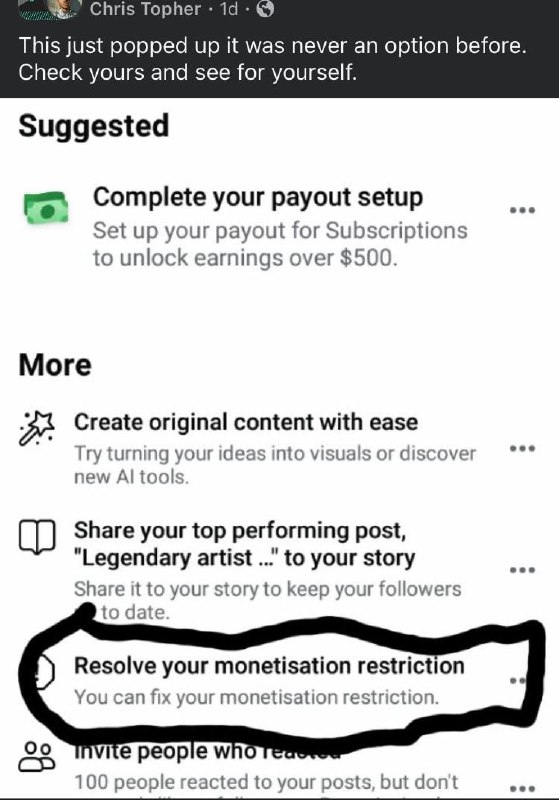
Meta surfaces a "Resolve your monetisation restriction" prompt inside page suggestions
The third signal is a product change with meaningful operational consequences. Facebook is now surfacing a "Resolve your monetisation restriction" prompt directly inside the page suggestions panel. Previously, a publisher whose page hit a monetization restriction had to diagnose the problem through Page Quality, the Support Inbox, or trial and error across multiple dashboard views. The new prompt changes the discovery experience: the restriction is now surfaced at a point where the publisher is actively engaging with page management, rather than buried inside a settings hierarchy.
Facebook's new prompt surfaces monetization restriction alerts directly inside the page suggestions panel, reducing the time between a restriction occurring and a publisher taking action.
This matters in the current enforcement environment. Since mid-2025, creators across Facebook have reported sudden, unexplained monetization restrictions, the majority attributed to flags for "unoriginal content," with the pattern of abrupt enforcement and opaque reasoning formally documented on June 4, 2026, when Meta's independent Oversight Board published findings that described Meta's account governance as lacking "transparency and consistency." Against that backdrop, any improvement to restriction visibility is a meaningful change for publishers.
The enforcement context that produced widespread restriction complaints has been building through a series of deliberate policy moves. In 2025, Meta removed more than 20 million accounts impersonating large content creators and impersonation reports related to large content creators dropped by 33%. These efforts drove measurable impact: both views and time spent watching original Reels on Facebook approximately doubled in the second half of 2025, compared with the same period in 2024. The stricter enforcement of originality standards has produced legitimate false positives for compliant publishers, making faster restriction discovery directly valuable.
When a restriction does appear, the appeal pathway runs through the Professional Dashboard. Creators can access the appeals process through their Professional Dashboard, Meta has published guidance on this process and confirmed that enforcement decisions can be reversed, and the company has explicitly acknowledged that automated systems are not perfect and that creators who believe a decision was incorrect have recourse. Appeals are reviewed by Meta's policy team and can take one to five business days. The new prompt effectively shortens the gap between a restriction being issued and a publisher initiating that process.
Page compliance requires that your page must be in good standing with no active policy violations, and pages with recent violations, unpublished content, or restricted reach are typically ineligible until the violations are resolved. Given that a single active restriction blocks all CMP payouts for the affected page, the speed at which a publisher identifies and resolves a restriction directly affects monthly revenue. The new panel prompt accelerates that identification step.
What these three signals mean together
Taken together, the three posts from the past 24 hours tell a coherent story about where Facebook page monetization stands in mid-2026. The payout potential from photo and text posts running through the CMP is real and, in the case of the page we featured, substantial. The measurement discipline that experienced operators apply, weekly comparison windows, goal-aligned KPI selection, annotated trend lines, is what converts that potential into a sustainable and readable revenue curve. And Meta's continued investment in surface-level tooling, such as the new restriction prompt, reflects an acknowledgment that the enforcement environment it has created requires better discovery mechanisms for publishers who are operating in good faith.
For publishers who want to build and maintain a page operation that captures CMP revenue consistently, the fundamentals remain the same: original content, clean compliance posture, and a reporting cadence that measures what matters on the timeframe that signals change.
Frequently asked questions
What is Facebook's Content Monetization Program and how does it differ from in-stream ads? The Facebook Content Monetization Program is a unified system that replaced separate tools including in-stream ads, Ads on Reels, and the Performance Bonus, all of which ended on August 31, 2025. Under the CMP, eligible pages earn from a single enrollment across all qualifying formats, Reels, longer videos, Stories, photo posts, and text posts, based on content performance rather than format-specific thresholds.
Why do experienced Facebook page operators track KPIs week-over-week rather than daily? Day-to-day figures on Facebook pages carry high noise from algorithmic distribution fluctuations, weekend audience spikes, and normal inventory variance. Weekly comparisons smooth that noise and align with the platform's own content performance and payout calculation cycles, making trends genuinely actionable rather than reactive to single-day outliers.
What should a publisher do when they see a monetization restriction on their Facebook page? Check the Professional Dashboard or, now, the new restriction prompt in the page suggestions panel for a specific reason. If the restriction appears to be a false positive or you believe it was issued in error, submit an appeal through the Appeals section in Creator Studio. Appeals are reviewed by Meta's policy team and typically take one to five business days. Document the state of your content and any recent policy changes when submitting.
Can photo and text posts generate meaningful revenue through Facebook content monetization? Yes. Meta's own data shows that 40% of the nearly $3 billion paid to creators in 2025 went to formats other than Reels, including Stories, photos, and text posts. The publisher result we featured, nearly $12,000 in 24 days from a single page, came entirely from photo and text posts, with zero contribution from in-stream ads or Ads on Reels.
How does Meta's enforcement of originality rules affect monetization eligibility? Meta has updated its content guidelines to classify minor edits to another creator's post, re-uploading content the page had no role in creating, adding borders, inserting captions, or changing playback speed, as unoriginal. Pages flagged for unoriginal content face demonetization, reduced reach, and classification as non-recommendable. In 2025, Meta took enforcement action against more than 500,000 accounts for spammy or inauthentic behavior, so maintaining a clean originality record is a prerequisite for stable CMP payouts.
See more from Publisher in a Box in your Google results
The team behind 300M+ managed followers. We help publishers scale traffic, revenue, and audience across Facebook, Google Discover, and syndication networks.