Search across our learning center -- articles, newsletters, and more. Start typing or click a topic above.
Stay in the Loop
Get exclusive publishing strategies, industry insights, and early access to new features. No spam -- just signal.
Join 2,000+ publishers. Unsubscribe anytime.
Market Analysis & News
Facebook Page Monetization Signals, Trial Reels, Google Discover Traffic, and AI News Consumption: A Publisher Digest
Publisher In a Box12 min read
Table of Contents
This article is part of our daily digest series, in-depth summaries drawn from our X account, @publisherinabox, expanded with industry data.
AI is now a mainstream news channel, and publishers are not in control of it
Ofcom's 2026 News Report dropped data that should reset how every publisher thinks about audience reach. Ofcom's annual study of news habits shows 21% of UK adults used AI apps or services to follow the news during the past month, with ChatGPT alone reaching 13%. Among younger adults the numbers are far more dramatic. According to the @publisherinabox post that shared the report via Press Gazette, that figure rises to 37% for the 25-to-34 age group, based on a survey of 5,397 adults.
The reach of these AI surfaces is not matched by trust. 56% of UK adults say they place less trust in AI-produced stories or summaries than in human journalism. That gap between reach and trust is the central problem for publishers: audiences are arriving through a channel they are wary of, and one the publisher does not control.
The global picture mirrors the UK finding. 10% of people globally now use AI chatbots for news each week, up from 7% a year earlier, but only 1% say AI is their main source of news, according to the Reuters Institute Digital News Report 2026. Age remains the sharpest dividing line. Young people lead AI news consumption: 17% of the youngest age group use chatbots for news weekly, three times the rate of the oldest group at 5%, according to the Reuters Institute Digital News Report 2026.
The click-through behavior that publishers rely on is also deteriorating in this environment. Across 27 markets, 4% of all respondents say they always or often click through to the original news source from AI chatbots, compared with 19% from search engines, per the Reuters Institute Digital News Report 2026. That 15-percentage-point gap between AI referrals and search referrals is a concrete measure of the traffic loss built into AI-intermediated news discovery.
What does this mean for Facebook page monetization strategy? It means social distribution is not competing with search. It is now competing with AI summarization layers that sit in front of content and keep readers from ever reaching the original page. Publishers who build direct audience relationships on owned platforms, including Facebook pages with strong recommendation reach, are better positioned than those who rely on passive algorithmic discovery alone. Our Facebook consulting team works through exactly this kind of distribution audit with operators every week.
UK and global adults using AI for news, with AI news distrust rate. Sources: Ofcom 2026 News Report; Reuters Institute DNR 2026.
Trial Reels: the Facebook and Instagram content testing tool most operators ignore
One of our highest-impression posts from this window covered Trial Reels, a feature built directly into Reel Settings on Facebook and Instagram. The mechanic is straightforward. When you publish a reel with Trial Reels turned on, the platform routes it to non-followers first. You observe the performance data, and if the numbers hold up you can then push the content to your full existing audience. Your established followers never see an underperforming post.
The Trial Reels toggle inside Reel Settings routes content to non-followers before your main audience sees it.
Meta introduced trial reels as a way to try out content and see what performs best by sharing reels with people who do not follow you. When creating the trial reel, you can choose to have Instagram automatically share your trial reel with followers if the platform determines it is performing well based on the views it receives within the first 72 hours.
Meta launched the feature in December 2024 for public accounts with at least 1,000 followers. In February 2026, Instagram added the ability to schedule Trial Reels in advance, so operators can batch a week of tests in one sitting, per Social Media Today.
For Facebook page monetization operators this is one of the most underused distribution tools available. The conventional posting workflow exposes every piece of content to your existing audience immediately. If the content underperforms, your followers see a low-engagement post and the algorithm registers a weak signal on your page. Trial Reels inverts that risk. You get signal from cold audiences, the most honest signal available, before your followers are exposed to the content at all. Operators who test systematically using this feature build a content library where only proven material reaches their monetized audience. If you want a structured approach to this kind of workflow, our Facebook turnkey management service covers content testing protocols as a core component.
Google Discover is still sending real traffic to early-stage sites
We shared analytics from a site still in early Discover traction. The numbers in the screenshot told a clear story: 826 active users in the last 30 minutes, 146 in the last 5 minutes, all arriving without a search query.
Real-time analytics showing Discover-driven traffic on a site still early in its Discover presence. 826 active users, 146 in the last five minutes.
The scale of the Discover audience makes this kind of burst possible. Google Discover has more than 800 million monthly active users. Of publishers' overall traffic, Google now makes up 25%, according to Chartbeat, divided into 17% from Discover and 8% from search. That 17-to-8 ratio is the key figure. Discover now sends more than twice the Google traffic that organic search does for the average publisher in Chartbeat's network of nearly 2,000 global news and media sites.
The broader context is a contracting environment. Referrals to more than 2,500 publisher websites from Google Discover were down 21% year on year, according to Press Gazette's analysis of Reuters Institute and Chartbeat data. In the US only, referrals from organic Google search were down 38% year on year and Google Discover was down 29%. That contraction makes the traffic in the screenshot above more notable, not less. A site early in its Discover presence is still attracting meaningful real-time volume at the same moment larger publishers are reporting declines.
The February 2026 Discover core update changed the algorithmic signals that determine which content gets surfaced. Google released its first-ever standalone Discover core update on February 5, 2026, targeting the algorithmic systems that surface content in the Google Discover feed. The update favors country-specific and expert content, emphasizing a reduction in clickbait and a consolidation of domains with proven authority. For publishers who have been producing original, topically focused content consistently, this update is an opportunity rather than a setback.
Facebook content in Google Search: a real distribution layer that most operators miss
We also shared a guide to how Facebook content now surfaces in Google Search results, a distribution channel that many Facebook page operators do not actively manage. Google has indexed Facebook's public Pages for years, but the practical implications for Facebook content monetization have grown as search behavior shifts and as Google incorporates more social content into its results.
The opportunity is structural. As search is shrinking as a share of traffic while direct, internal, and messaging channels are growing, Facebook pages that generate consistent search impressions are accumulating a second traffic layer on top of native Facebook distribution. Posts with strong engagement metrics, clear entity signals, and consistent topical authority are more likely to surface in Google's results for relevant queries.
Recommendation restrictions: the data keeps showing that clean content is the recovery path
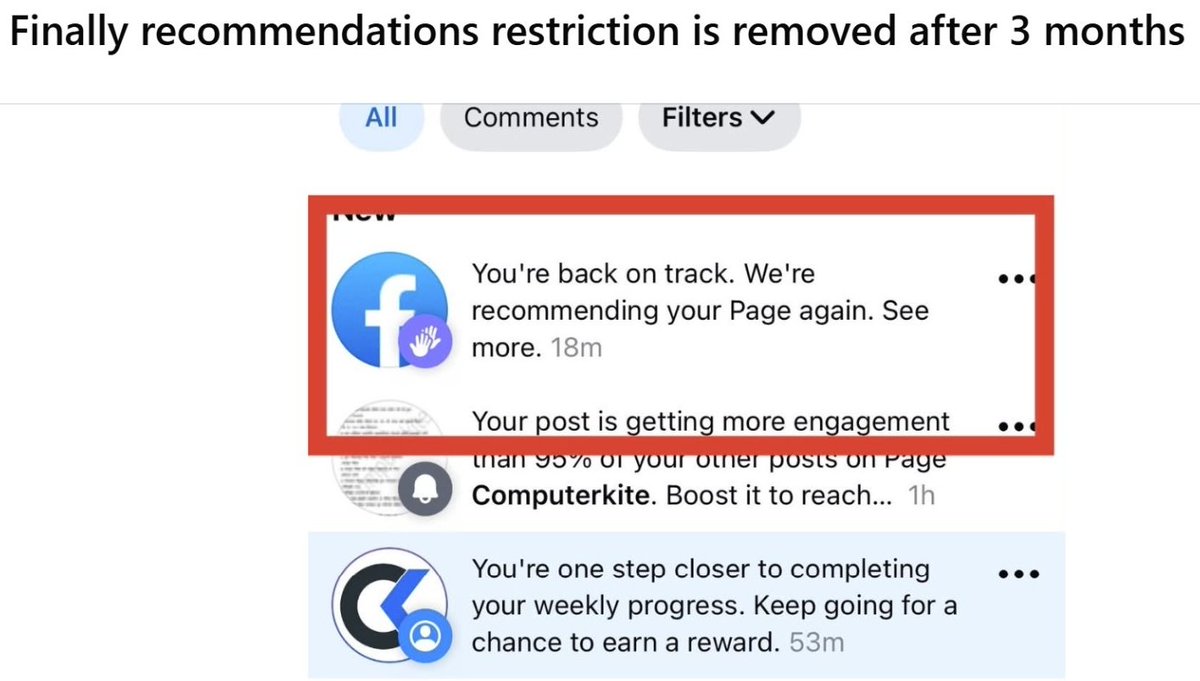
We shared another case in our ongoing restriction-recovery series. A publisher who kept posting clean, original content had every recommendation restriction lifted after three months. The screenshot showed the restriction status cleared.
Facebook Professional Dashboard showing a full recommendation restriction lift after three months of clean, original content.
The pattern we see across this series is consistent. Operators who catch a restriction but stay disciplined and keep content clean tend to recover their reach. Those who abandon the page, try to work around the restriction, or continue posting borderline material do not.
The platform context for this is well documented. By July 2025, Meta had introduced formal penalties for unoriginal content on Facebook, warning that accounts repeatedly reusing others' material would face demonetization and reduced reach. Meta first announced a crackdown on unoriginal and repurposed Facebook content back in July 2025, and the March 2026 announcement formalized and extended that same standard with clearer definitions, a public policy page, and an appeals process.
The implication for any operator currently sitting under a recommendation restriction is that the recovery path is the same one Meta has been signaling for nearly two years: original content, consistent posting cadence, no shortcuts. Three months is a credible timeline based on what we are seeing across multiple operators in this series. The cases that take longer typically involve pages that continued posting non-compliant content intermittently after the restriction appeared.
For operators who want a structured framework for managing recommendation status alongside their broader Facebook page monetization workflow, the Facebook consulting track covers restriction diagnostics, content audits, and recovery cadences based on current platform signals.
The thread connecting all four signals
Each of the four areas covered today points toward the same underlying shift: algorithmic intermediaries, whether AI news apps, Facebook's recommendation engine, Google Discover, or Google Search, are making more of the decisions about what audiences see. Publishers and page operators who rely entirely on passive algorithmic distribution are the most exposed when those algorithms change. The operators who build direct audience relationships, maintain clean content that qualifies for recommendation reach, and test systematically with tools like Trial Reels are building a more durable traffic and revenue base.
The AI news data from Ofcom is not a curiosity. It is a leading indicator of where passive content discovery is heading. When 37% of 25-to-34-year-olds in the UK are getting news through AI apps, and only 4% of those users click through to the original source per the Reuters Institute, the traditional page-view economics of algorithm-driven discovery are under structural pressure. The response is not to abandon algorithmic channels. It is to layer direct distribution, engagement, and monetization on top of them so that any single channel's decline does not determine the operation's outcome.
Frequently asked questions
What is the Trial Reels feature on Facebook and Instagram? Trial Reels is a setting in Reel Settings that sends your reel to non-followers first, before your existing audience sees it. You review the performance data after roughly 24 hours and choose whether to push the reel to your full audience or let it expire without your followers ever seeing it. Meta launched it in December 2024 for public accounts with at least 1,000 followers and added scheduling functionality in February 2026.
How long does it take to recover from a Facebook recommendation restriction? Based on the cases we track in our restriction-recovery series, operators who post clean, original content consistently and avoid borderline material tend to see restrictions lifted within approximately three months. Timelines vary depending on the severity of the original violation and whether the operator continues to post non-compliant material after the restriction appears. Abandoning the page or trying to circumvent the restriction extends the timeline or prevents recovery entirely.
Why is Google Discover important for Facebook page monetization publishers? Google Discover now accounts for 17% of overall publisher traffic and delivers more than twice the Google referrals that organic search does, according to Chartbeat data analyzed by Press Gazette. Because Discover traffic arrives on mobile without a search query, it represents a passive discovery channel that complements Facebook's native distribution. Publishers who build topical authority on their sites and maintain original content standards qualify for both Discover and Facebook recommendation reach simultaneously.
What does the Ofcom AI news data mean for publishers? Ofcom's 2026 News Report found that 21% of UK adults used AI apps for news in the past month, rising to 37% among 25-to-34-year-olds. The Reuters Institute Digital News Report 2026 found that only 4% of users click through to the original source from an AI chatbot, compared with 19% from a search engine. For publishers, this means AI intermediaries are capturing audience attention without generating referral traffic at the same rate as earlier discovery channels. Building direct audience relationships through owned channels, including Facebook pages with strong recommendation reach, reduces dependence on this click-through gap.
How does Facebook content appear in Google Search results? Google indexes public Facebook Pages and their posts, meaning content with strong engagement signals and clear topical authority can surface as a result for relevant search queries. This creates a secondary distribution layer for Facebook page operators that runs independently of Facebook's native recommendation algorithm. Maintaining a consistent publishing cadence, using clear descriptive text, and building entity signals around specific topics improves the likelihood of Facebook content appearing in Google results.
See more from Publisher in a Box in your Google results
The team behind 300M+ managed followers. We help publishers scale traffic, revenue, and audience across Facebook, Google Discover, and syndication networks.