Facebook Now Finds New Posts Before They Earn Engagement. What Meta's Q3 2026 Call Means for Your Reach and Payouts
Publisher In a Box11 min read
Table of Contents
A common piece of advice for Facebook publishers has been to win the first hour, on the theory that a post which collects reactions early gets shown to more people while a slow starter stays small. Meta's third quarter 2026 earnings call, held on October 21, described a change that weakens that rule, because Facebook now has a system built to find relevant new posts before they have much engagement at all.
This guide covers what Meta said, what it means for a monetized Page, and what we would change this month. Every figure comes from Meta's transcript, earnings release or help pages, and we mark where Meta's words stop and our reading begins. If your reach has already slipped, our guide to why Facebook reach drops and how to get paid anyway covers the older causes first.
What Meta said on the October 21 call
Susan Li, Meta's chief financial officer, gave the detail in her prepared remarks. She said that on Facebook Feed and Reels, Meta "completed the global launch of a new generative retrieval architecture." She described it as a system which, inspired by large language models, "labels pieces of content with semantic representations and generates potential recommendations."
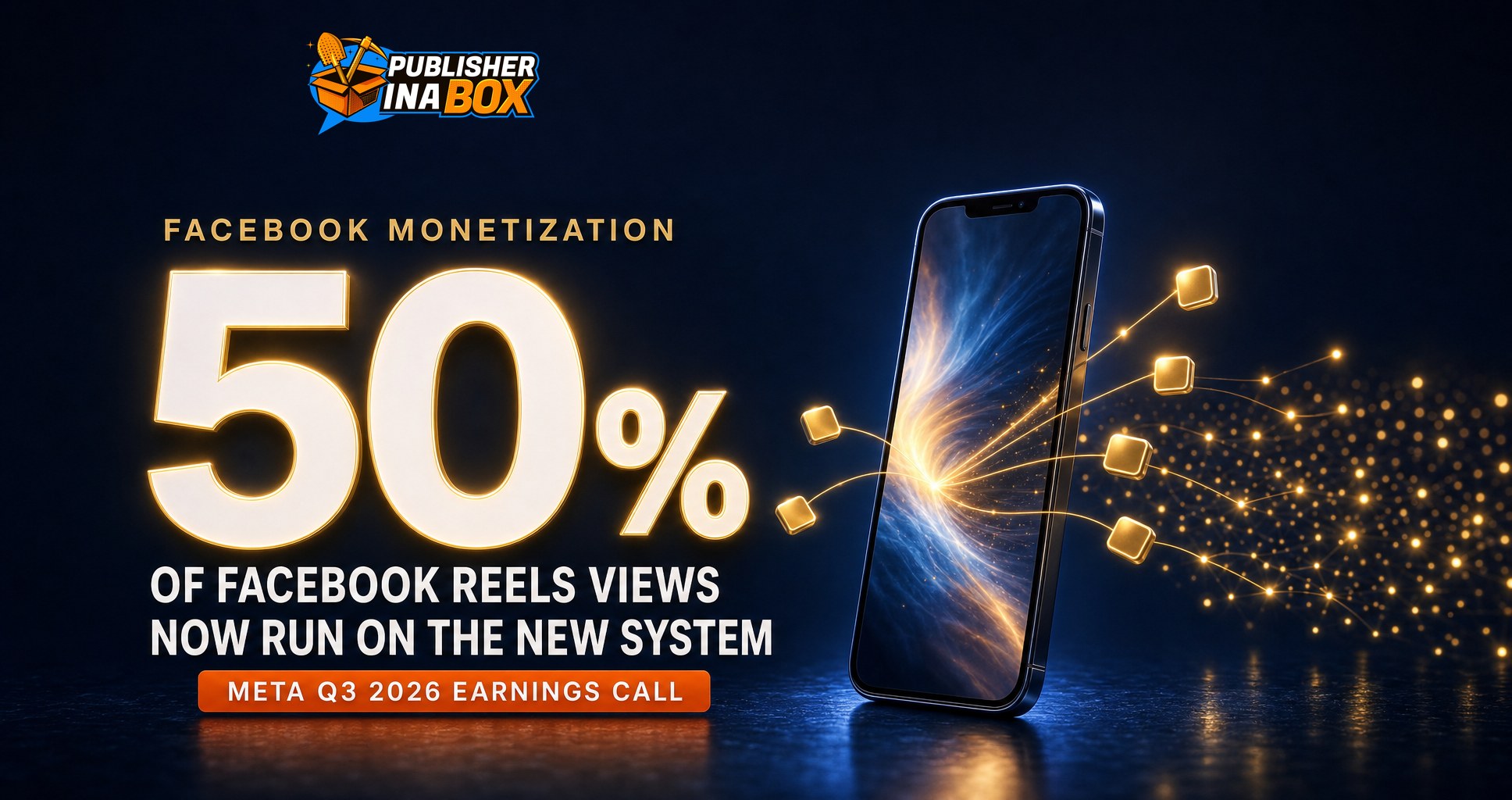
The sentence that matters most for publishers came next. Li said the system is "helping our systems surface relevant new posts before they've accumulated significant engagement." She added that it is now rolled out to roughly one quarter of unconnected Feed views and half of Reels views, and that it increased Reels watch time by 1%.
Unconnected views come from people who do not follow your Page, which is where new audience comes from, so the system already handles a meaningful share of the moments when a stranger could meet your content.
50%
Share of Facebook Reels views now served by Meta's new generative retrieval system, which also covers roughly one quarter of unconnected Feed views
Source: Meta Q3 2026 earnings call transcript, October 21, 2026
Retrieval and ranking, in plain terms
Recommendation systems on Facebook work in two broad steps. Retrieval is the step that pulls a short list of candidate posts out of everything that could be shown to a person. Ranking is the step that orders that short list. A post that never makes the candidate list cannot be ranked, however good it is, which is why a change to retrieval matters so much.
Meta's description says the new retrieval step labels content by what it is about, then generates candidates from those labels. So it can match a new post to people likely to care about its subject before engagement signals exist, because it reads the post itself instead of waiting for the crowd to vote.
Meta also improved ranking on Facebook Reels. Li said Meta "doubled the amount of history our ranking model can consider," which drove a 1% increase in US Reels watch time, so each Reel is judged against a fuller picture of what a viewer actually watches.
What this changes for a monetized Page
Here is our reading, an inference from Meta's words rather than a promise Meta made. If the system can surface a relevant new post before it earns engagement, a slow first hour matters less than it used to, and a clear post on a defined subject has a better chance of reaching new people on its own merits.
The flip side follows from the same logic. If the system labels posts by subject, then a Page that posts about everything sends a blurrier signal than a Page with a clear lane. Engagement bait also loses some of its old purpose, since early reactions are no longer the only way a post gets considered, and Meta's own best practices page already warns against prompts like "watch until the end" unless the payoff is meaningful to the viewer.
When the system can read a post before the crowd reacts to it, the post itself has to carry the signal.
Meta did not say this system changes how much any Page is paid. Payouts in Facebook Content Monetization are, in Meta's words, "based numerous factors, including qualified views and watch time of your eligible public content on Facebook, as solely determined by Meta." What the call describes is the route to those views. More relevant reach to people who will actually watch is the input that payouts are built on, which is why a retrieval change is a monetization story even though no rate changed. For more on how views turn into earnings, see how much Facebook pays in 2026.
The freshness figure that is easy to misread
A widely syndicated transcript of the call, published by Mitrade on October 22, quotes Li as saying nearly 45% of recommended Reels are now less than one day old, with no platform named, and the next sentence in that transcript is about Facebook Reels. Read that way, the number looks like a Facebook figure. Meta's published transcript is more specific. Li said, "Nearly 45% of recommended Instagram Reels are now less than one day old, up more than 11 percentage points from Q2." The figure is about Instagram, not Facebook.
What Meta did say about freshness is general. Li said the recommendations work "is also helping us deliver fresher and more personalized content," and the Facebook specific claim is the one above, that relevant new posts can surface before they collect engagement. Treat fresh content as favored by direction, and do not quote a Facebook freshness percentage, because Meta has not published one.
The engagement backdrop: video is where the time is
Mark Zuckerberg opened the call by saying Meta is "seeing all-time highs in engagement on both Facebook and Instagram driven by strong growth in video." Li added that on Facebook, Reels time spent reached all time highs both globally and in the US, with both growing at double digits year over year.
Meta's earnings release says daily active people across its apps averaged 3.64 billion in September 2026, up 3% year over year, which is the scale this system now routes.
For a publisher, the practical point is that Reels carry the larger share of the new system today, at half of Reels views against roughly a quarter of unconnected Feed views. If you have been posting photos and links only, our guide to Facebook Reels revenue explains why so many Reels pay little and what changes that.
Originality is the rule the new system runs under
Faster discovery of new posts only helps Pages whose posts are allowed to travel. Meta's July 14, 2025 post on unoriginal content said accounts that repeatedly reuse other people's content "will not only lose access to Facebook monetization programs for a period of time" but "will also receive reduced distribution on everything they share." It also said that "if our systems detect duplicate videos on Facebook, we will reduce the distribution of the copies."
The same post explained what counts as making reused material your own, "through creative editing, voiceover or commentary," and what does not, since "simply stitching together clips or adding your watermark does not qualify as meaningful enhancement." Meta's best practices page says the greatest distribution goes to accounts that "primarily post content that is filmed or created by them."
Original posts with a clear subject are what Meta says it wants to distribute, and they are what a system that reads meaning can most easily match to an interested viewer. If some of your posts reach people but still earn nothing, our guide to why some Facebook posts earn nothing walks through the eligibility rules that sit underneath reach.
title: The whole system, not one tactic
body: The Facebook Monetization Suite pairs the Facebook Automation Machine with the full PIB playbook and a Professional Asset Valuation of your Page, so your Reels, posts and earnings run as one operation. $499, seven deliverables.
link: https://publisherinabox.com/facebook-monetization-suite
What we would change this month
These are our recommendations, drawn from what Meta said on the call and on its help pages. They are not Meta's instructions.
1. Define each Page's lane in one sentence. Write down the subject your Page covers, then check your last 30 posts against it. A system that labels posts by meaning rewards a Page whose posts point the same way. 2. Make the first frame and first line say what the post is about. Assume the system reads the post before anyone reacts to it. A caption and opening that state the subject plainly give it something clear to work with. 3. Shift the mix toward Reels you made yourself. Reels carry half their views through the new system, and Meta's eligibility rules require Reels of at least 10 seconds to earn. Keep them vertical, clear and free of third party watermarks, as Meta's best practices page advises. 4. Stop judging a post by its first hour. Give posts more time before you delete or repost them, and remember Meta's help page says deleted content may not get credit for the engagement it received before deletion. 5. Cut engagement bait. Meta lists content that collects or incentivizes inauthentic engagement as possibly ineligible for payouts. 6. Watch qualified views and watch time, not raw reach. Those are the measures Meta names for payouts, so they tell you whether the new reach is the kind that pays.
If you want your posting, Reels and payouts run as one system built for how Facebook now distributes content, the Facebook Monetization Suite gives you the Facebook Automation Machine, the full PIB playbook and a Professional Asset Valuation of your Page. If you would rather have your own team trained to build monetized Pages, Facebook Consulting teaches the method Publisher in a Box uses, and you keep 100 percent of the revenue.
Frequently asked questions
What is generative retrieval on Facebook?
It is the system Meta says it launched globally on Facebook Feed and Reels in the third quarter of 2026. Meta describes it as an architecture inspired by large language models that labels content with semantic representations and generates potential recommendations, which helps surface relevant new posts before they have accumulated significant engagement.
How much of Facebook does the new system cover?
On its October 21, 2026 earnings call, Meta said the system is rolled out to roughly one quarter of unconnected Feed views and half of Reels views. Unconnected views are views from people who do not follow the Page.
Does this change how much Facebook pays per view?
Meta did not announce any change to payout rates. Content Monetization pays based on factors including qualified views and watch time, as solely determined by Meta. The new system changes how posts find viewers, which affects the views that payouts are built on.
Is it true that 45% of recommended Facebook Reels are less than a day old?
No. Meta's published transcript says nearly 45% of recommended Instagram Reels are less than one day old. Meta has not published that figure for Facebook.
Do I still need early engagement for a post to reach people?
Engagement still matters, and Meta says reactions, comments and shares help content perform. The call adds that relevant new posts can now surface before they collect significant engagement, so a slow start is less decisive.
Does reposting other people's videos still work?
Meta says accounts that repeatedly repost others' content without meaningful enhancement lose monetization for a period and get reduced distribution on everything they share.
Key takeaways
Meta told investors on October 21, 2026 that a new generative retrieval system is live globally on Facebook Feed and Reels.
The system surfaces relevant new posts before they have significant engagement, and covers roughly one quarter of unconnected Feed views and half of Reels views.
Meta also doubled the viewing history its Facebook Reels ranking model can consider, which lifted US Reels watch time by 1%.
The widely repeated 45% freshness figure is about Instagram Reels, not Facebook.
No payout rate changed, but more relevant reach feeds the qualified views and watch time that Content Monetization pays on.
Original posts with a clear subject are what both Meta's originality rules and a meaning based retrieval system favor.
Sources
Meta, Third Quarter 2026 Results Conference Call transcript, October 21, 2026, investor.atmeta.com
Meta, Meta Reports Third Quarter 2026 Results, October 21, 2026, investor.atmeta.com
Meta Business Help Center, About Facebook Content Monetization for creators, facebook.com
Meta Business Help Center, Best practices for Facebook Content Monetization, facebook.com
Facebook for Creators, Combating Unoriginal Content to Protect and Elevate Creators, July 14, 2025, creators.facebook.com
Mitrade, Meta (META) Q3 2026 Earnings Call Transcript, October 22, 2026, a syndicated transcript in which the 45% sentence names no platform, mitrade.com
See more from Publisher in a Box in your Google results
The team behind 300M+ managed followers. We help publishers scale traffic, revenue, and audience across Facebook, Google Discover, and syndication networks.