Instagram Is Testing 90 Minute Videos With No Revenue Share. Where a Facebook Publisher's Long Video Earns in 2026
Publisher in a Box editorial teamUpdated
Key takeaways
Instagram began testing Features on October 26, 2026, with horizontal videos of up to 90 minutes for selected accounts in the U.S. and Brazil.
Instagram has not announced a revenue share for Features, and Mosseri said Instagram's payouts come primarily from brands.
On Facebook, every new video is a reel with no length restriction, and Content Monetization pays on qualified views and watch time, with ads that can run inside a reel.
Views under five seconds, content with ads turned off and content under an ownership claim do not earn, so rights and strong openings matter more for long video.
On Monday, October 26, Instagram began testing a format called Features that lets selected accounts post horizontal videos of up to 90 minutes, with short Reels that link viewers into the full episode. It is the biggest change to video on Meta's apps this year, and for a publisher who runs both a Facebook Page and an Instagram account, it raises a practical question about where a long video should live if the goal is to get paid for it.
The short answer, based on what Meta has said and published so far, is that the money for long video sits on Facebook today, while Instagram is offering reach and brand deals without a share of ad revenue. This guide covers what Instagram announced, how each app pays for video right now, the rules that decide which Facebook views earn, and what we would do with a long video this month. Every figure comes from Meta's own help pages and newsroom or from the outlets that interviewed Instagram's leaders on the record, and we mark where their words stop and our reading begins. If you are new to how Facebook pays, our explainer on how much Facebook pays in 2026 is the place to start.
What Instagram announced on October 26
Instagram head Adam Mosseri and Tessa Lyons, Instagram's vice president of product, announced the test in a video posted to Instagram. According to The Hollywood Reporter, Instagram is "launching a test of horizontal videos of up to 90 minutes with select creators in the U.S." The same report says Instagram "has already been testing the feature with creators in Brazil and has a plan to expand to tens of thousands of creators in the U.S.," and that the videos "will also be recommended to users on Instagram's Explore page and in other areas."
The format is built around clips. The Hollywood Reporter describes short Reels as "typically around three minutes or less," and Lyons explained how the two connect. "You see a clip of a podcast that you love, you can just click and continue watching or watch the full video," she said, "because creators are going to be able to link these Reels to their overall feature." TechCrunch reports that Instagram calls the clip format "Clips as Reels."
Mosseri was candid that this is a reversal. "For a long time, I have been against doing long-form video on Instagram," he said in the announcement video, as quoted by TechCrunch. Lyons framed the change as an addition rather than a replacement, saying "Reels is still going to be a core part of Instagram."
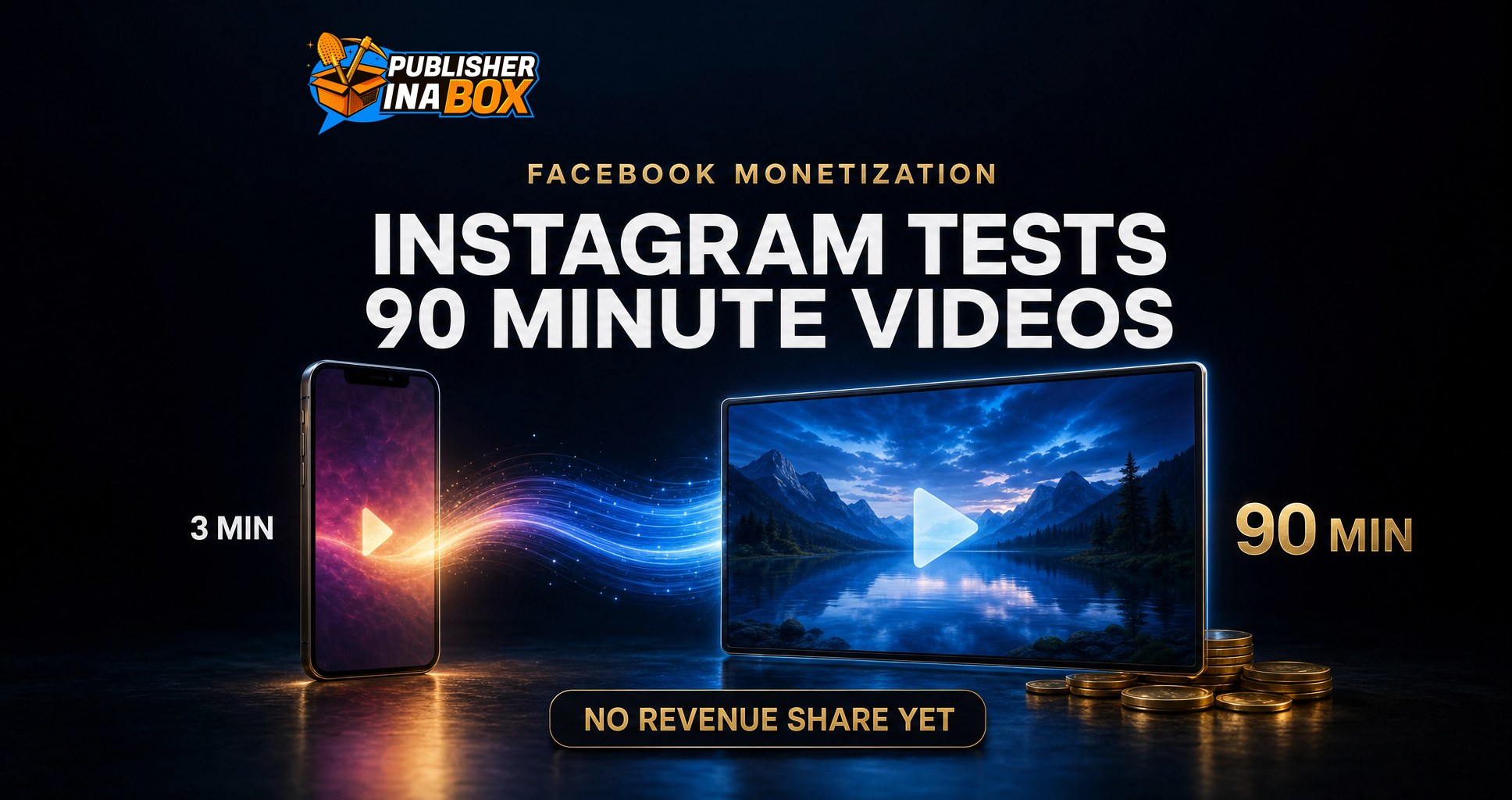
90 min
The longest video in Instagram's new Features test, against Reels that typically run about three minutes or less
Source: The Hollywood Reporter, October 26, 2026
How Instagram pays for video right now
The part of the announcement that matters most to a publisher is the part Instagram has not finished. A Meta spokesperson told TechCrunch, "It's too early to share a long-term monetization model, but we're exploring ways for creators to earn from brands, fans, and Instagram, including performance-based incentives." The Hollywood Reporter adds that existing ad deals "will carry over into the videos" and that Lyons said Instagram is working on "a few different deals" with the first accounts in the test.
Mosseri explained the reasoning on the Colin and Samir Show, in remarks TechCrunch reported. "Right now, the way that it works on Instagram primarily is you primarily get paid by brands. Some people get paid by fans," he said. "We have still a small performance-based program, but … we spend more money than we make back by a long shot, and so it doesn't really make sense to scale up because we're just burning capital."
That is a clear statement of where Instagram stands, because it tells you that a long video on Instagram today earns through sponsorships you bring or negotiate, not through a platform payout tied to views. For comparison, The Hollywood Reporter puts YouTube's share for qualified channels at "55 percent of ad revenue," which is the benchmark Instagram is being measured against. Instagram may change its model as the test grows, and Meta has left that door open, so treat the current position as a snapshot rather than a final answer.
Where long video already earns on Facebook
Facebook settled its own long video question more than a year ago, and it went in the opposite direction. In a June 17, 2025 newsroom post, Meta said that "all videos on Facebook will be shared as reels" and that "Reels on Facebook will also not have any length or format restrictions." The same post said "Facebook remains a home for all types of video," naming short, long and Live video. So on Facebook, a long video is simply a reel without a time cap, and it moves through the same recommendation system as everything else you post.
The payout side changed in 2025 as well. Meta's help page for Facebook Content Monetization says "In-stream Ads, Ads on Reels, and the Performance Bonus Program ended on August 31, 2025," and that the program that replaced them "lets you earn money from your eligible public Facebook videos, reels, photos and text posts." The page is specific about what drives the amount, which it says "is based numerous factors, including qualified views and watch time of your eligible public content on Facebook, as solely determined by Meta."
Watch time is the detail a long video producer should notice, because a longer piece gives a viewer more time to watch. Meta's help page on ad formats for reels adds the mechanism behind it. It says ads "can play before, during or after your reels." Mid-roll ads "play during your reel" and "work best in qualifying reel that has natural breaks," while image ads "help you earn money from reels that don't have a natural break for mid-roll ads." Meta adds that the number of ads a viewer sees depends partly on "the length of the reel."
The catch is access. Meta's help page says "Facebook Content Monetization is currently invite-only," and it offers an interest form with the note that it "is not an application and it does not guarantee that you will be invited." Our guide to how Content Monetization invites are being earned covers what we see Pages doing before the invite arrives.
The view rules that decide what a long video pays
A long video only pays on Facebook if its views qualify, and Meta's help page on approximate earnings lists the main reasons a view does not. They include views on content where an ownership claim is "settled in favor of the copyright holder," content in a language "that isn't supported for Facebook Content Monetization," views on content by another person or Page that you have crossposted, content you have paid to promote on Facebook, deleted posts, "content where ads are disabled by the creator," and views that "are fraudulent or result from inauthentic engagement."
Two of those rules matter more for long video than for short clips. The first is rights. Long pieces such as interviews, shows and compilations are more likely to include footage or music you do not own, and Meta says that while a claim is reviewed "a portion or all of your payout will be withheld," sometimes "for several weeks or months." Our guide to the 90 second rule for licensed music walks through how that plays out with audio.
The second is the five second floor. Meta's content monetization page says "if watch time is less than 5 seconds for any piece of content, it does not qualify for monetization," and that reels "must be a minimum of 10 seconds." A long video that loses its viewer in the opening seconds earns nothing from that view, however good the rest of it is, which is why the first moments of a long piece carry as much weight as they do in a short one.
There is also good news in the crossposting rule for anyone running both apps. Meta's help page says content crossposted by another Page you do not own or manage is ineligible, and then adds, "This does not apply to content you've crossposted from Instagram." So a video you publish on Instagram and crosspost to your own Facebook Page can still earn on the Facebook side.
Instagram is offering a stage for long video. Facebook is the side of Meta that currently pays for the audience in the seats.
What this means for a publisher who runs both apps
Here is our reading, and it is ours rather than Meta's. Meta now has two apps pulling long video in two directions, and neither has been framed as a choice you must make. The practical split is to let each app do the job it currently rewards.
Facebook is where a long video can earn directly today, because Content Monetization counts qualified views and watch time and can place ads inside a reel. Instagram Features, for the accounts in the test, is a discovery and sponsorship play, since the platform says it is exploring payouts but has not announced one. If you already sell sponsorships, the ad deals Lyons described as carrying over into Features make Instagram a second place to deliver that sponsor's message, and our guide to Facebook brand partnerships covers how those deals work on Meta's side.
The clip structure Instagram is building also mirrors a habit that already works on Facebook, which is cutting short pieces from a longer one so each clip can find its own audience. Meta's own best practices page advises that you "experiment with different durations lengths to find your content's ideal combination of watch time engagement and qualified views to maximize earnings," so testing a long cut against short cuts of the same material is exactly the kind of experiment Meta describes. Our Facebook Reels revenue strategy explains how we would read the results.
The larger lesson is that platform rules move, as Instagram's reversal shows, so a Page earning from one format on one app carries more risk than one with several income lines. Our guide to publisher revenue diversification makes that case in full.
A five step plan for this month
1. Check whether you are in the Instagram test. Instagram has not published eligibility rules, so the only way to know is to look for the option in your account. If you do not see it, nothing is wrong, you are simply outside the test. 2. Keep your long video publishing on Facebook. If your Page is in Content Monetization, a long video posted there can earn on qualified views and watch time today, and that is not true of Instagram Features yet. 3. Clear the rights before you post anything long. Ownership claims can hold a payout for weeks or months, so confirm you own or have permission for every piece of footage and audio in a long cut. 4. Build the first ten seconds like a short clip. Views under five seconds do not qualify, so open with the strongest moment rather than an introduction. 5. Cut clips from every long piece and compare. Post the full video and two or three short cuts, then compare qualified views and earnings rate in Meta Business Suite under Insights and Earnings, where Meta says those numbers appear.
Where to go from here
If you want your long video, Reels and payouts run as one system rather than as separate experiments on two apps, the Facebook Monetization Suite gives you the Facebook Automation Machine, the full PIB playbook and a Professional Asset Valuation of your Page. If you would rather have your own team trained to build monetized Pages, Facebook Consulting teaches the method Publisher in a Box uses, and you keep 100 percent of the revenue.
Frequently asked questions
What is Instagram Features?
Features is a test format that lets selected accounts post horizontal videos of up to 90 minutes on Instagram, according to The Hollywood Reporter. Creators can link short Reels to the full video, and the report says the longer videos will be recommended on the Explore page, with Instagram aiming to bring the viewing experience to its TV app.
Does Instagram pay for Features videos?
Not through a revenue share at this point. A Meta spokesperson told TechCrunch it is "too early to share a long-term monetization model," and The Hollywood Reporter says existing ad deals will carry over into the videos. Meta has said it is exploring performance-based incentives, so this could change.
Can I earn from long videos on Facebook?
Yes, if your Page or professional profile is in Facebook Content Monetization. Meta says the program pays on eligible public videos, reels, photos and text posts, based on factors that include qualified views and watch time. Since 2025, every new Facebook video is a reel, and Meta says reels on Facebook have no length restrictions.
If I crosspost a video from Instagram to Facebook, can it still earn on Facebook?
Yes. Meta's help page says content crossposted by another Page you do not own or manage is not eligible, and adds that this "does not apply to content you've crossposted from Instagram." Your own Instagram video crossposted to your own Facebook Page can still qualify, as long as the views meet the other rules.
Should I move my long videos from Facebook to Instagram?
Based on what Meta has said so far, we would not move a library that earns on Facebook to chase a test that does not yet pay. Keep earning where the payout exists, use Instagram Features for reach or sponsor delivery if you are in the test, and revisit the decision if Instagram announces a payout model.
Sources
The Hollywood Reporter, Instagram Tests 90-Minute Horizontal Videos in Major Play for Podcasters and Creators, October 26, 2026, hollywoodreporter.com
TechCrunch, Watch out, YouTube: Instagram goes from short-form to 90-minute videos, October 26, 2026, techcrunch.com
Meta Newsroom, Making it Easier to Create Videos on Facebook, June 17, 2025, about.fb.com
Meta Business Help Center, About Facebook Content Monetization for creators, facebook.com
Meta Business Help Center, Facebook Content Monetization ads formats for reels, facebook.com
Meta Business Help Center, About approximate earnings for Facebook Content Monetization, facebook.com
Meta Business Help Center, Best practices for Facebook Content Monetization, facebook.com
See more from Publisher in a Box in your Google results
The team behind 300M+ managed followers. We help publishers scale traffic, revenue, and audience across Facebook, Google Discover, and syndication networks.