Meta Put Its New Business Terms on Hold. What a Monetized Facebook Page Should Do During the Pause
Publisher in a Box editorial teamUpdated
Key takeaways
Meta's existing Commercial Terms remain in place, and the draft has no firm start date, although Meta's page still shows November 20, 2026.
Both versions count managing a Page as business use, and Meta's Content Monetization Terms build on the Commercial Terms and make payouts subject to compliance.
We found nothing saying the payout calculation changes, and we found no explanation of what happens to a monetized Page that declines.
The draft also changes what you promise about licensed content, and it adds responsibility for AI features and third-party tools.
Use the pause to save both versions, set your robots.txt, list your domains and tools, check your licenses, measure your exposure and assign someone to watch the page.
Court and regulator actions are interim or early, and they should not be read as protection for your business.
Table of Contents
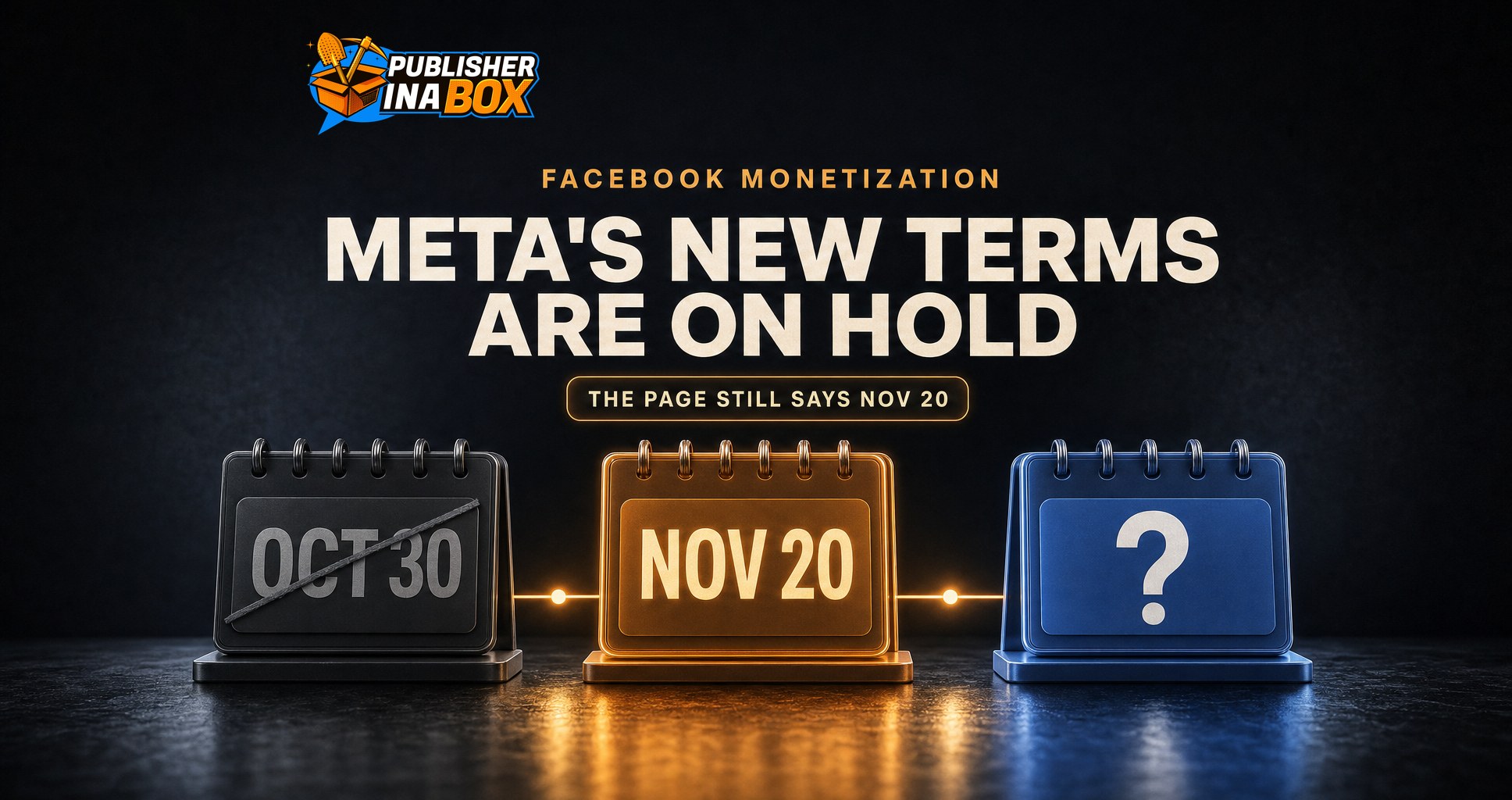
Meta's updated Commercial Terms did not start on October 30, and Meta now says they may not start on November 20 either. Its own terms page, read on November 5, 2026, still says "These updates will go into effect on November 20, 2026," so a publisher who checks the page and a publisher who reads the news can come away with different dates.
Most coverage of this fight has been about news publishers and AI crawling, which we covered in October. A Facebook publisher has a different exposure, because the Page is where the income is earned and Meta's terms count managing a Page as business use. This guide covers where the terms stand, how they connect to your payouts, what the draft changes beyond crawling, and how we would use the pause. We mark where our own reading begins.
Where do Meta's Commercial Terms stand today?
The current terms remain in force, and Meta has given the draft no firm start date beyond the one it says may move. The version in effect is dated March 6, 2024. The draft first carried an October 30 date, which Meta moved to November 20 following, in the words of the UK's Competition and Markets Authority, "active engagement with the CMA."
On October 28, Meta said it does "not plan to make policy changes without a full consultation with industry groups and leaders." Its statement added that the consultation "could extend beyond November 20," in which case it would delay implementation, and that "our existing terms remain in place" until then.
Reuters described that as an indefinite delay and the CMA described it as a pause. The statement itself is conditional and the page still shows the date, so we would treat the terms as paused and unscheduled rather than withdrawn. WAN-IFRA, the World Association of News Publishers, warned that "putting the terms on hold is not withdrawing them."
November 20
The date still shown on Meta's Commercial Terms page, even though Meta said on October 28 that the consultation could run past it and that it would then delay the change.
Source: Meta Commercial Terms and Reuters, page read November 5, 2026
The consultation also looks early. Digiday reported on November 3 that the News Media Alliance, Digital Content Next and the Professional Publishers Association said they had not yet been in contact with Meta about it, and we found no published timetable.
Do the paused terms change your Facebook payouts?
We found nothing saying the way Meta calculates payouts would change, because Meta's October 28 statement does not mention payouts and the draft does not mention monetization. The two sets of rules are still connected, though, and this is the part most coverage skips. Meta's Content Monetization Terms say they "supplement and amend" its Terms of Service "including the Commercial Terms," and they say "Your payout, if any, is subject at all times to your compliance with these Terms." Meta also reserves the right to withhold payment if you violate "any other terms or policies that apply to the Content and your use of the Meta Products."
Those Terms describe revenue from Meta's Ads Tool, and we could not confirm from the page whether they cover every current Content Monetization payout. Either way, both versions of the Commercial Terms say business purposes include "managing a Page," so a monetized Page falls under them in our reading. The draft then says "If you do not agree to the updated terms, you may stop all access or use of our Products for business or commercial purposes." We found no explanation in Meta's pages of what that means for a Page in a monetization program, and stopping business use of a Page is hard to square with earning from it.
That is why the debate reads differently for this kind of business. Digiday cited Chartbeat data showing Meta's platforms at an average of 3.47% of global publisher traffic in July 2026, and heads of audience at three publishers still were not ready to cut ties, because of reach, engagement and awareness. A Page earning from Facebook directly has more at stake in that decision, because those payouts do not depend on referral clicks at all.
What else does the draft change besides crawling?
The crawling clause drew the attention, but when we read the current terms against the draft we found other changes that touch daily Page operations. Any of them could change in the consultation, and the summaries are our reading rather than legal advice.
What you promise about your content. The current terms have you secure permission "to display, distribute and deliver your content." The draft says "display, distribute, create derivative works, and deliver your Content," which matters most for licensed material, because your promise covers rights you may have bought from someone else. The terms do not say why the phrase was added, and it may have a narrow purpose such as adapting content for display, so we would ask rather than assume.
Responsibility for AI features. A new section says "You are solely responsible for and assume any and all risks associated with such AI features and any resulting Content." The same section says "You must not alter or remove any watermark or content-authenticating metadata generated by AI in connection with Content," which is a concrete rule for anyone editing images made with Meta's tools.
Responsibility for outside tools. The draft adds "You are solely responsible for the acts or omissions of any third-party software or service that you use or authorize." Schedulers and automation tools fit that description.
Meta's discretion over business products. The draft adds that Meta may "modify, limit, suspend, or discontinue any commercial products, services, and features at any time without prior notice or liability."
A wider list of business uses. The draft adds "using any business product, such as Ads Manager or Meta Business Suite," and Meta's help pages send you to Meta Business Suite to check monetization eligibility.
The crawling clause got the headlines, while the sentences about licensed content, AI features and third-party tools are the ones a Page operator meets every working day.
How should a monetized Page use the pause?
We would do this work now, while nothing is forced. Both versions say that "By continuing any access or use" for business purposes after notice of an update, "you agree to be bound," so the decision should come before a new date appears. Nothing here requires closing, deleting or pausing anything on your Page.
1. Save both versions with today's date. Keep a PDF of the current terms and the draft, so that you can see exactly what moved if the consultation produces new wording. 2. Set your robots.txt on purpose. Meta documents Meta-ExternalAgent as crawling for uses "such as training foundation AI models," and FacebookExternalHit as the crawler behind link previews. Our crawler guide walks through each one, although its November 20 deadline now depends on the consultation. Meta told Reuters that "these updates don't give us new rights to supersede such preferences," according to Music Business Worldwide, while the draft terms themselves do not mention robots.txt. 3. List the domains tied to your Page. The clause reaches domains "associated with your products or services," and the draft does not define that further. Write down your sites, landing pages and paid content. 4. Name the tools and people acting on your Page. Record every scheduler, automation tool, agency and admin with access, because the draft puts their acts on you. 5. Check your licenses against the new wording. Stock photos and licensed assets remain a normal part of publishing, and we are not suggesting you stop using them. If the draft wording survives, ask whether your license lets you make the derivative works promise. 6. Put a number on your exposure. Add up the last 90 days of income by source and mark each line that depends on a Meta product. Our guide to publisher revenue diversification covers what to build next, including Google Discover, syndication, email and generative engine optimization (GEO), often referred to as AI search optimization. 7. Give one person the watch. Have someone check the banner and effective date on Meta's terms page every week, along with your Page notifications, and write down what your business will do if a new date appears.
What have courts and regulators done so far?
Three actions matter here, and none is a final ruling on the terms. In Norway, the trade body MBL reports that Oslo District Court ruled on October 28 that Meta may not implement the changes until their lawfulness is finally decided, and AFP, as cited by Music Business Worldwide, reported that the order came on an emergency basis without hearing from Meta. In Brazil, the newspaper association ANJ, one of the plaintiffs, reports that a São Paulo court granted a preliminary injunction on November 3, suspending part of the terms and requiring Meta to keep member outlets' accounts, pages and tools working, with a daily fine of R$1 million capped at R$100 million.
In the UK, the CMA opened a competition investigation on October 30, and it says "no decision has yet been made on whether Meta has broken the law." Its case page shows information gathering from October 2026 to January 2027, with dates it calls indicative. Meta told Reuters there were "no grounds" for the investigation.
Do not assume any of this protects you. The Brazilian order as ANJ describes it covers the outlets of the associations that sued, and we have read the announcements from the groups that brought these cases rather than the court orders themselves.
A platform's terms are not the law
Meta's Commercial Terms are a private contract, and whether parts of them hold up is what these cases will test. Nothing here is legal advice, and it does not address election law or political advertising rules, which are separate from a platform's commercial terms. If your income depends on your Pages, a conversation with a lawyer in your own country is a sensible cost before any new date arrives.
Where to go from here
If you want your team trained to run monetized Pages with these risks built into the process, Facebook Consulting teaches the method Publisher in a Box uses, and you keep 100 percent of the revenue.
Frequently asked questions
Are Meta's new Commercial Terms in effect?
No. Meta said on October 28, 2026 that its existing terms remain in place during the consultation. Its terms page still showed November 20, 2026 when we read it on November 5, and Meta has said it would delay the change if the consultation runs past that date.
Do Meta's new terms apply to my Facebook Page?
In our reading, yes, if the Page is used for business. Both the current terms and the draft say business or commercial purposes include "managing a Page."
Will the new terms change my Facebook Content Monetization payouts?
We found nothing from Meta saying the calculation changes. Meta's Content Monetization Terms do build on the Commercial Terms and make payouts subject to compliance, and we found no explanation from Meta of what happens to a monetized Page that declines the update.
Should I leave Facebook over these terms?
We would not make that decision against a date that is not firm, and we would not ignore it either. Measure how much of your income depends on Meta, build other lines, and decide what your business will do if a new date appears.
Do the court orders in Norway and Brazil protect me?
Do not assume so. The groups that brought the cases describe orders tied to their own markets and, in Brazil, to the member outlets of the associations that sued. Neither is a final ruling on whether the terms are lawful.
Sources
Meta, Commercial Terms, effective March 6, 2024, read November 5, 2026, facebook.com
Meta, Commercial Terms preview, effective November 20, 2026, read November 5, 2026, facebook.com
Meta, Content Monetization Terms, read November 5, 2026, facebook.com
Meta Business Help Center, How to check your monetization eligibility, facebook.com
The team behind 300M+ managed followers. We help publishers scale traffic, revenue, and audience across Facebook, Google Discover, and syndication networks.