What Is Non-Session Revenue? How Publishers Measure the Income That Does Not Need a Site Visit in 2026
Publisher in a Box editorial teamUpdated
Key takeaways
Non-session revenue is income that does not depend on a visit to your site, a category People Inc. reports each quarter.
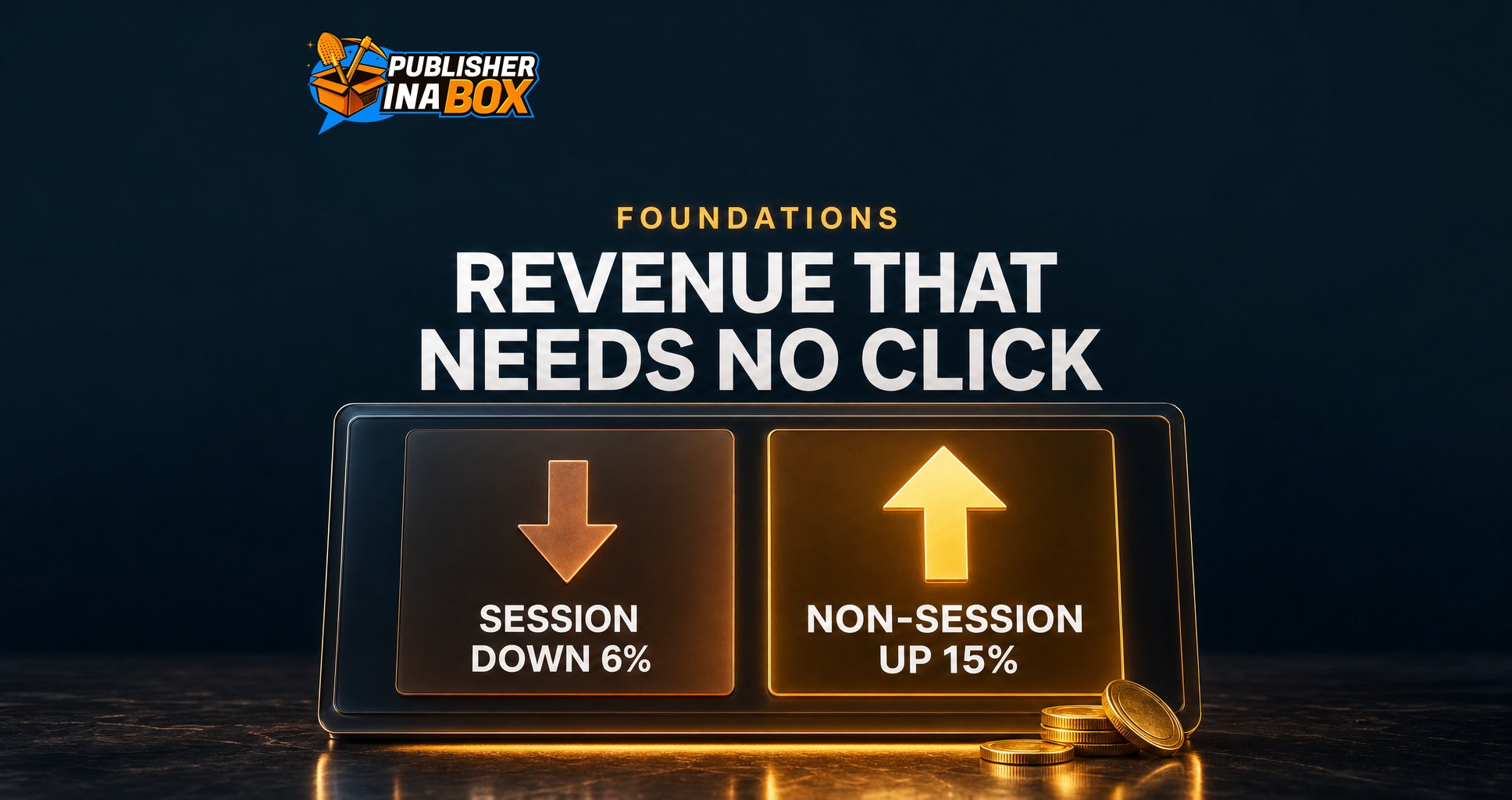
In the third quarter, People Inc. gained $16.0 million of non-session revenue and lost $10.6 million of session-based revenue, which is why digital revenue still grew.
A high non-session share does not mean safety, because a Facebook payout counts as non-session and Meta can still stop it.
Give every income line two labels, then track your non-session share and your largest controller share each quarter.
Add email first, then syndication, then sponsorships. Syndication Turnkey Management can run the syndication step for sites that qualify.
Table of Contents
People Inc. told investors this week that it has lost nearly 70 percent of its Google search traffic over two years, while its digital revenue still grew 2 percent last quarter. The explanation sits in a split the company reports every quarter, between money that depends on a visit to its websites and money that does not. Its name for the second kind, non-session revenue, is worth borrowing at any size, because it turns a general worry about traffic into a figure you can calculate in an afternoon.
There is a catch for smaller operators, and it matters more than the headline. A Facebook publisher can score close to 100 percent on this measure and still be one policy notice away from earning nothing, so the number only helps once you add a second question about who controls each income line. This guide defines the term from People Inc.'s own filing, works through its math, and then sets out the two-label audit we would run on any publisher's revenue.
What is non-session revenue?
Non-session revenue is publisher income that does not depend on someone visiting your website. People Inc.'s earnings release defines a session as "a unique visit to a site," and describes session-based revenue as money from "advertisements served or performance marketing referrals initiated during a session." Everything else falls on the other side, which the release describes as "revenue not dependent upon a session."
The company's list of what counts includes "social platforms, email and affinity marketing, and all Licensing and other revenue." Its presentation and earnings call add events, social video, Apple News, content syndication, AI partnerships and subscriptions to the picture.
The term is a company's reporting category and not an accounting standard, so we treat it as a working tool. The simplest test we know is this one: if your site received no visitors for a month, would this line still pay you? Because the test follows the transaction and not the product, the same affiliate program can sit on both sides, with a link clicked on your site counting as session-based and the same link clicked in your newsletter counting as non-session.
What do People Inc.'s numbers actually show?
The third quarter is a clean worked example, because the two lines moved in opposite directions by amounts you can add up. Session-based revenue fell from $174.2 million to $163.6 million, a loss of $10.6 million, while non-session revenue rose from $109.0 million to $125.0 million, a gain of $16.0 million. The difference, about $5 million, is why total digital revenue finished at $288.5 million against $283.2 million a year earlier.
People Inc. digital revenue by type, third quarter
$ millions
Source: People Inc. earnings release, 8-K filed November 2, 2026
Non-session revenue is now about 43 percent of People Inc.'s digital total, up from about 38.5 percent a year earlier by the filing's own figures. Management told investors the plan is to grow it "about 15% to 20% over time," and that it "will represent about half of our digital revenue by this time next year."
43%
Share of People Inc.'s digital revenue that did not depend on a site visit in the third quarter of 2026. It grew 15 percent while session-based revenue fell 6 percent.
Source: People Inc. earnings release and Q3 2026 earnings call, November 2 and 3, 2026
The fastest piece was licensing and other revenue, up 49 percent, which the filing attributes mainly to "improved performance from Apple News+ and other content syndication partners" and to the Meta content partnership signed in late 2025. A single large deal sits inside that growth rate, and AdExchanger reported that licensing growth should slow in the fourth quarter as the company laps the Meta agreement.
These results describe a hard quarter, so they should not be read as a rescue story. Core sessions fell 26 percent, from 2,168 million to 1,613 million, advertising revenue fell 8 percent, digital growth slowed from 6 percent to 2 percent, and AdExchanger reported about 195 job cuts, roughly 6 percent of staff. Session revenue fell far less than sessions did, which the company partly credits to higher rates, and a smaller site should not assume the same cushion because People Inc. sells premium inventory directly to advertisers (our reading).
Why does a high number not make you safe?
By this definition, nearly all of a Facebook payout is non-session money, because the view happens on Facebook and your website never enters the transaction (our reading). Your score may look better than People Inc.'s, yet the measure says nothing about who can turn the income off.
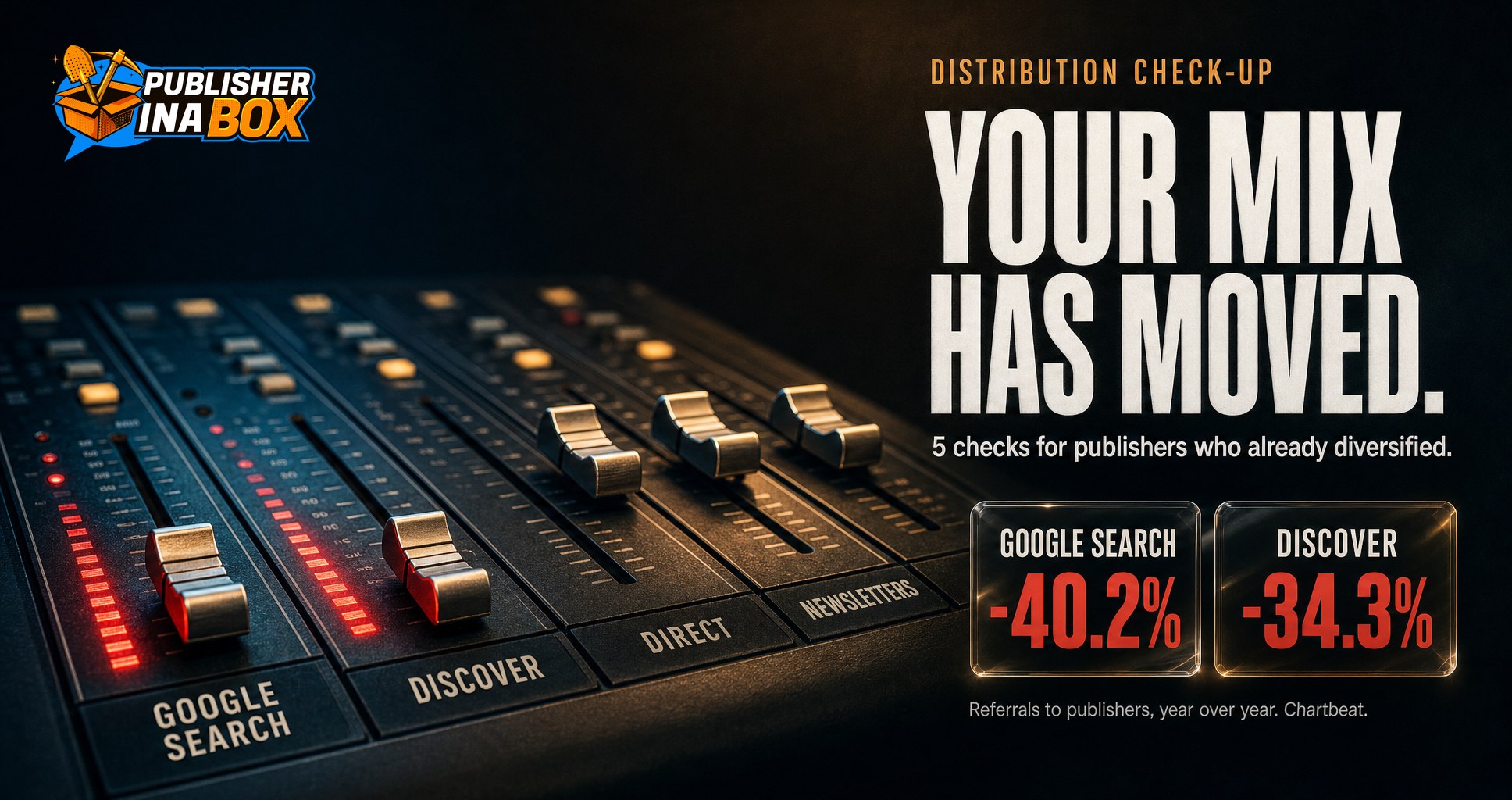
Meta's help pages show how quickly that can happen. In most cases, a limited originality flag "carries a 90-day demonetization penalty," and Meta adds that it "may withhold accrued but unpaid earnings." Aggregators carry a version of the same risk, since Press Gazette reported in August that MSN removed several independent publishers without notice, as we covered in our distribution mix check-up. People Inc. lists the risk in its own filing, naming "the potential expiration or modification of key commercial agreements."
Non-session tells you the income does not need your website. It does not tell you the income is yours.
So moving away from sessions can simply move your dependence from Google to someone else, a risk we cover in our guide to platform dependency and revenue concentration. The audit below puts a number on it.
How do you run the two-label audit?
Take the last 12 months of revenue and give every line two labels. The first says whether it needs a site visit. The second names who can switch it off, which is usually you, a partner under contract, or a platform under its own rules.
Income line
Needs a site visit?
Who can switch it off
Display ads on your site
Yes
You and your ad partner, with traffic set largely by search and social platforms
Then calculate two numbers. The first is your non-session share, meaning non-session revenue divided by total revenue. The second is your largest controller share, meaning everything one company can switch off divided by total revenue. Nobody publishes a safe level for either one, and People Inc.'s target of about half reflects its own scale, so we would track the direction every quarter and avoid chasing a fixed percentage.
Now run both stress tests, using a made-up publisher earning $10,000 a month: $6,000 from Facebook, $2,500 from site ads, $500 from on-site affiliate links, $600 from newsletter sponsors and $400 from syndication. Its non-session share is 70 percent, which looks strong, while its largest controller share is 60 percent, all of it Meta.
If its sessions fell 26 percent and site income fell with them, it would lose $780 a month, or $2,340 over three months. If a Facebook flag stopped payouts for 90 days, it would lose about $18,000 over the same stretch, and any accrued balance would be a further risk. The second loss is nearly eight times the first, which is why this publisher's next hour of work belongs in reducing Meta's share.
Which non-session line should you add first?
We would start with what you control and what you already produce.
1. Email first. You own the list, and our guide to newsletter ad networks covers earning before you can sell sponsors yourself. A report on Yahoo Finance on October 29 said the beehiiv Ad Network pays publishers more than $1 million a month in total, which shows the channel exists and is no guide to what one publication will earn. 2. Syndication next, if you already write articles. The same work earns again elsewhere, although access is uneven because MSN and Yahoo are invitation-only. 3. Sponsorship packages after that. AdExchanger reported that People Inc. lets brands sponsor a full season of a seven-episode short video series. The scale differs, but a sponsor buying a series pays for the audience and the idea, and neither requires a site visit (our reading). 4. AI licensing last. Our guide to how publishers earn from AI explains why direct deals flow to large archives, and PPC Land, citing The Information, reported that Google pays about 100 publishers for AI answers, with several smaller sites receiving less than $1,000 over several months. We would not plan a budget around it.
None of this means abandoning your site. People Inc. management said "there's still a fairly large audience on the web that we can market to," and your site remains the home for your archive and your email signup. Generative engine optimization (GEO), often referred to as AI search optimization, can keep your name in front of readers who never click, as we explain in whether AI search is replacing Google, although that visibility only becomes income once it leads to a line above.
The audit stays useful only if you repeat it. Pull each platform's earnings into one sheet on a schedule, whether you wire that in n8n with an HTTP node per source, run a Make scenario, or schedule a small script against each export. The tool matters far less than the labels, and our distribution mix check-up gives you a one-page cadence.
Where to go from here
If the audit shows you need income beyond one platform and you already publish articles, Syndication Turnkey Management is the next place to look. Through direct relationships with Yahoo, MSN, NewsBreak, AOL and more, Publisher in a Box reviews your site, handles verification and feed setup, and runs the pipeline while you keep your site and your content. It is 100 percent performance-based with no upfront cost, spots are limited, and not every site qualifies for every platform.
If you are also thinking about what your revenue mix is worth, the free Publisher Market valuation takes three minutes and tells you what your asset is worth, what to fix and where to sell it. Buyers look hard at concentration, as we explain in how to buy a publishing business, so your largest controller share also matters on the day you sell. You can browse listings at Publisher Market.
Frequently asked questions
What is the difference between session-based and non-session revenue?
Session-based revenue depends on a person visiting your site, such as display ads and affiliate clicks that happen there. Non-session revenue does not, and it includes social platform income, email, licensing, syndication and events. The terms come from People Inc.'s reporting, not from an accounting standard.
Is Facebook content monetization non-session revenue?
Yes, by People Inc.'s definition, because social platform revenue falls outside a site session. It remains under Meta's control, and Meta says a limited originality flag usually carries a 90-day demonetization penalty, so it still needs to be counted in your largest controller share.
What percentage of revenue should be non-session?
Nobody publishes a safe figure. People Inc. was at about 43 percent in the third quarter and expects about half by this time next year, but that reflects its size and sales operation. We would watch your own direction each quarter, alongside how much of your revenue one company controls.
Does non-session revenue mean I can stop caring about traffic?
No. People Inc. still earned 57 percent of its digital revenue from sessions, and management said a fairly large web audience remains. Your site also holds your archive and your email signup.
Does my revenue mix affect what my publishing business is worth?
It can, because buyers check how much traffic and revenue depends on a single platform's decision. The free Publisher Market valuation gives you an estimate and what to fix.
Sources
People Inc. Q3 2026 earnings release and definitions, Form 8-K filed November 2, 2026, read November 4, 2026, stocktitan.net
People Inc. Q3 2026 earnings call transcript, November 3, 2026, benzinga.com
People Incorporated Q3 presentation summary, TradingKey, November 3, 2026, tradingkey.com
AdExchanger, With Search Traffic Down 70%, People Inc. Bets On Revenue Beyond Site Visits, November 3, 2026, adexchanger.com
Meta Business Help Center, Understanding limited originality of content violations, read November 4, 2026, facebook.com
PPC Land, Check My Ads says Google profits twice from publisher content, October 31, 2026, ppc.land
Yahoo Finance, Beehiiv And Substack Launch New Podcasting Tools, October 29, 2026, finance.yahoo.com
Publisher in a Box, Syndication Turnkey Management, read November 4, 2026, publisherinabox.com
Publisher Market, Free Valuation Estimate, read November 4, 2026, publisherinabox.com
See more from Publisher in a Box in your Google results
The team behind 300M+ managed followers. We help publishers scale traffic, revenue, and audience across Facebook, Google Discover, and syndication networks.